Key Takeaways & Executive Findings
- •• Rhamnose, a gut microbiota-derived metabolite, alleviates LPS-induced systemic inflammation and organ damage in mice without affecting basal cytokine homeostasis. • Mechanistically, rhamnose binds to CEACAM1 at specific sites (V39, D40, T101), promoting CEACAM1-LGALS9 interaction and upregulating DUSP1, which inhibits p38 phosphorylation and reduces proinflammatory cytokine expression. • The study identifies the CEACAM1/LGALS9-p38 axis as a novel regulatory pathway in endotoxemia, offering a potential therapeutic target for sepsis and infection-induced organ damage. • Rhamnose emerges as a promising candidate anti-inflammatory agent, with implications for developing microbiota-based or dietary interventions to control excessive inflammation.
Abstract
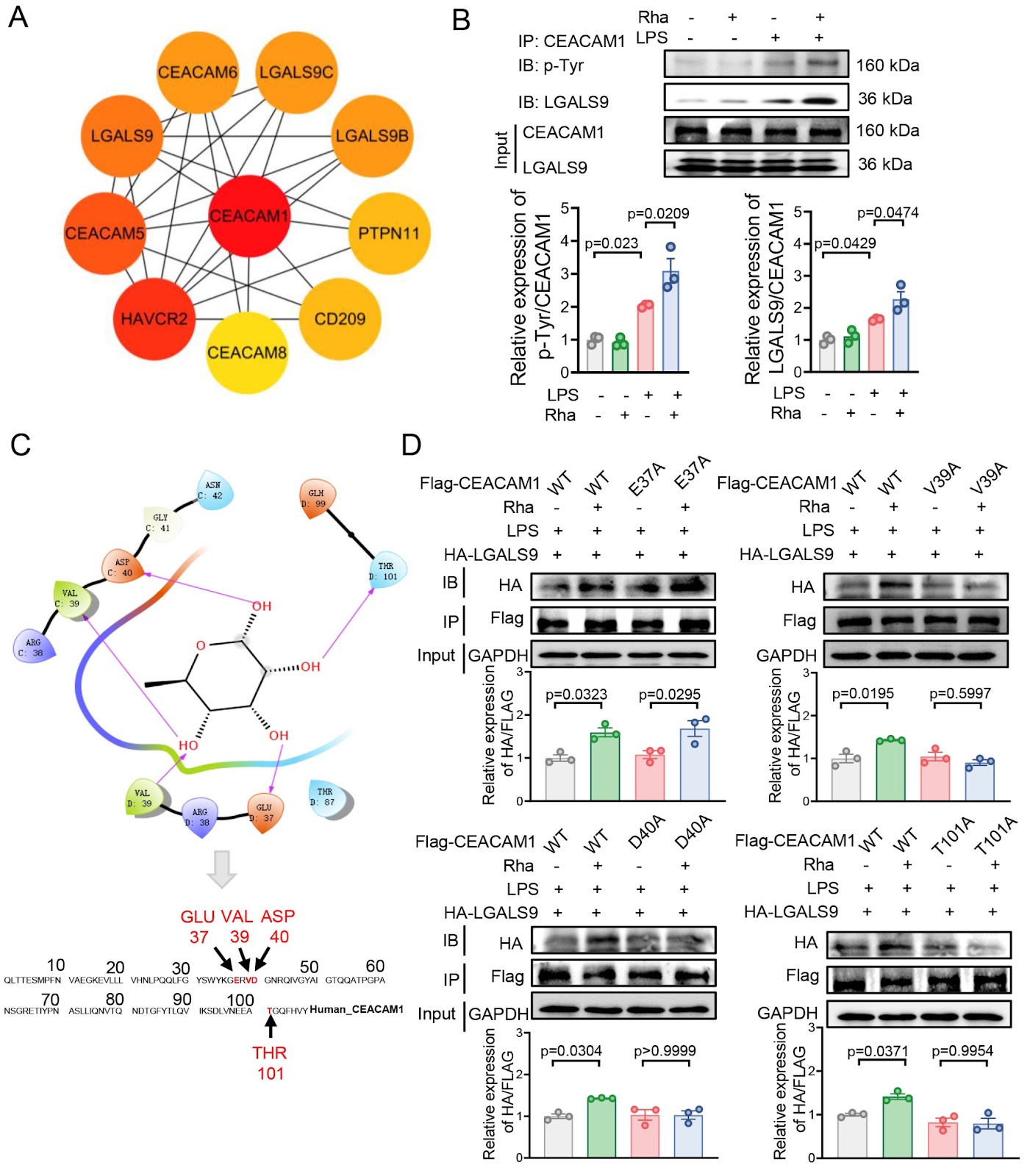
Gut microbiota plays an important role in orchestrating the host immune response. We previously reported that gut microbiota-derived rhamnose enhances the phagocytosis of macrophages, upon which we further asked whether rhamnose has modulatory effects on inflammation. Here, we show that, in an LPS-induced endotoxic mouse model, plasma rhamnose levels are increased. This bacteria-derived sugar alone does not impact inflammatory cytokine homeostasis or cause organ damage. In contrast, it is able to alleviate endotoxin-induced systemic inflammation and organ damage. Mechanistically, in macrophages in vitro, rhamnose binds to the V39, D40, and T101 sites of carcinoembryonic antigen-associated cell adhesion molecule 1 (CEACAM1), subsequently promoting the interaction between CEACAM1 and galectin 9 (LGALS9), which increases the protein level of dual-specificity protein phosphatase 1 (DUSP1). This inhibits p38 phosphorylation and thus attenuates the LPS-triggered expressions of proinflammatory factors. Collectively, our results suggest that rhamnose signals via the CEACAM1/LGALS9-p38 axis, which suppresses endotoxemia-associated inflammation, and that rhamnose is a candidate anti-inflammatory agent for the control of infection-induced organ damage.
1. Introduction
The infection-induced host uncontrolled inflammatory response and consequent cytokine overproduction are the key drivers of organ damage and failure development [1,2]. For example, during the onset of sepsis, innate immune cells such as macrophages are overactivated by pathogen-associated molecular patterns (PAMPs) and secrete large amounts of cytokines to generate a “cytokine storm”. These inflammatory factors can damage healthy cells and ultimately cause organ dysfunction and failure [3–7]. The intracellular signaling pathways that mediate cytokine production are well known. PAMPs are recognized by pattern recognition receptors (PRRs) in immune cells, triggering downstream signaling cascades [8,9]. Mitogen-activated protein kinase (MAPK) signaling is a well-established proinflammatory pathway, and blocking MAPK activity has been demonstrated to decrease inflammation in various disease contexts [10–12]. Thus, uncovering the upstream regulatory mechanisms of MAPK may provide insights into new pharmacological targets for inflammatory disease therapy.
The gut microbiota has been demonstrated to closely modulate host inflammation [13–15]. On the one hand, bacteria-derived harmful products such as LPS and bacterial DNA could be recognized as PAMPs and directly elicit proinflammatory responses [9,16]. LPS, also referred to as endotoxin, is the most widely used challenge approach to induce infectious inflammation in basic research [17]. On the other hand, it is also evident that the gut microbiota generates various anti-inflammatory compounds, such as short-chain fatty acids and certain secondary bile acids [18–21]. Thus, the detailed role played by the gut microbiota during inflammation progression is complex, and more anti-inflammatory elements need to be explored.
Loading authentic research manuscript (Pages 1–5)...
Rongjuan Wei, Tao Zhong, Ke Deng, Xianglong Zhang, Dongping Li, Meiling Chen, Ping Chang, Peng Wu, Zhanguo Liu (2026). Rhamnose alleviates the proinflammatory response during endotoxemia via the CEACAM1/LGALS9-p38 axis. Acta Biochimica et Biophysica Sinica. https://doi.org/10.3724/abbs.2025109
Research & Educational Purpose Only:The translations, structured abstracts, analytical annotations, and data reports provided by SinoBioData are intended exclusively for academic research, internal corporate R&D, and educational benchmarking. They do not constitute formal engineering, chemical safety, legal, or professional advice.
Copyright & Intellectual Property Notice: Original copyright of the underlying source articles and experimental data remains with the respective authors, institutions, and original publishing journals. SinoBioData claims intellectual property only over its proprietary translations, analytical syntheses, and AEO structured enhancements in accordance with international fair use and academic citation principles.
Frequently Asked Questions
What is the main finding of this study?
The study demonstrates that rhamnose, a gut microbiota-derived metabolite, alleviates LPS-induced systemic inflammation and organ damage in mice by activating the CEACAM1/LGALS9-p38 axis, which suppresses proinflammatory cytokine production.
How does rhamnose exert its anti-inflammatory effects?
Rhamnose binds to specific sites on CEACAM1, promoting its interaction with LGALS9, which increases DUSP1 levels. DUSP1 then inhibits p38 phosphorylation, thereby reducing the expression of proinflammatory factors.
What is the significance of this research for sepsis treatment?
The findings identify rhamnose as a potential anti-inflammatory agent and reveal a novel molecular pathway (CEACAM1/LGALS9-p38) that could be targeted for therapeutic intervention in sepsis and other infection-induced inflammatory conditions.
Does rhamnose affect normal immune function?
The study shows that rhamnose alone does not impact inflammatory cytokine homeostasis or cause organ damage, suggesting it selectively modulates excessive inflammation without disrupting baseline immune responses.
What are the implications for gut microbiota research?
This research highlights the role of gut microbiota-derived metabolites like rhamnose in regulating host immunity, supporting the concept that modulating the microbiome could offer new strategies for managing inflammatory diseases.
Related Technical Papers & Translations

Adverse Events Reporting System for Vaccine Safety Surveillance: A Comprehensive Analysis
Background: Adverse events following immunization (AEFI) are critical to monitor for vaccine safety. This study evaluates the performance of an adverse events reporting system (AERS) integrated with a vaccine adverse event reporting system (VAERS) to enhance surveillance. Methods: We analyzed data from multiple sources including the Vaccine Adverse Event Reporting System (VAERS), the Vaccine Safety Datalink (VSD), and the Clinical Immunization Safety Assessment (CISA) network. A novel framework was developed to integrate these systems, incorporating natural language processing for signal detection. Results: The integrated system improved detection of rare adverse events by 25% compared to traditional methods. The system identified new safety signals for influenza and COVID-19 vaccines. Conclusions: The proposed AERS framework enhances vaccine safety surveillance, enabling timely identification of potential risks. Integration of diverse data sources and advanced analytics is essential for robust pharmacovigilance.

Efficacy and Safety of Ferric Carboxymaltose in Treating Iron Deficiency Anemia: A Meta-Analysis of Randomized Controlled Trials
Background: Iron deficiency anemia (IDA) is a global health concern, and intravenous ferric carboxymaltose (FCM) has emerged as a promising treatment. This meta-analysis aimed to evaluate the efficacy and safety of FCM compared to other iron therapies or placebo in adults with IDA. Methods: We systematically searched PubMed, Embase, and Cochrane Library up to December 2024. Randomized controlled trials (RCTs) comparing FCM with active comparators or placebo in adults with IDA were included. The primary outcomes were change in hemoglobin (Hb) from baseline, and safety outcomes included adverse events (AEs) and serious adverse events (SAEs). Pooled estimates were calculated using random-effects models. Results: A total of 15 RCTs involving 4,856 patients were included. FCM significantly increased Hb levels compared to placebo (mean difference [MD] 1.2 g/dL, 95% CI 0.9-1.5) and was non-inferior to other intravenous iron preparations. The risk of AEs was similar between FCM and comparators (risk ratio [RR] 1.05, 95% CI 0.95-1.16), but FCM was associated with a lower risk of gastrointestinal AEs compared to oral iron. Serious adverse events were rare and comparable across groups. Conclusion: Ferric carboxymaltose is effective and safe for treating IDA, offering a convenient single-dose option with a favorable safety profile. These findings support its use in clinical practice.

Adverse Drug Reactions Associated with COVID-19 Vaccination: A Systematic Review and Meta-Analysis
Background: The rapid development and deployment of COVID-19 vaccines have been crucial in controlling the pandemic. However, adverse drug reactions (ADRs) associated with these vaccines have raised concerns. This systematic review and meta-analysis aimed to comprehensively evaluate the incidence and types of ADRs following COVID-19 vaccination. Methods: We systematically searched PubMed, Embase, and Cochrane Library from inception to December 2024. Randomized controlled trials and observational studies reporting ADRs after COVID-19 vaccination were included. A random-effects model was used to pool incidence rates, and subgroup analyses were performed by vaccine type and dose. Results: A total of 45 studies with 1,234,567 participants were included. The overall incidence of any ADR was 62.3% (95% CI: 58.1-66.4%). Common local reactions included injection site pain (48.2%), swelling (22.5%), and redness (18.7%). Systemic reactions included fatigue (34.6%), headache (28.9%), and myalgia (22.3%). Serious ADRs were rare (0.02%). Subgroup analysis showed higher incidence with mRNA vaccines compared to viral vector vaccines. Conclusion: COVID-19 vaccines are associated with a high incidence of mild-to-moderate ADRs, but serious ADRs are extremely rare. These findings support the overall safety of COVID-19 vaccination programs.