Key Takeaways & Executive Findings
- •• Puerarin improves cardiac function and attenuates myocardial fibrosis and inflammation in adriamycin-induced heart failure rats. • Puerarin inhibits NHE1 activity and reduces intracellular Na+ and Ca2+ overload, thereby protecting mitochondria from calcium-induced damage. • Puerarin suppresses the p38 signaling pathway, leading to decreased expression of TGF-β and proinflammatory cytokines. • This study provides the first evidence that puerarin's cardioprotective mechanism involves inhibition of p38 and downstream NHE1, offering a potential therapeutic strategy for heart failure.
Abstract
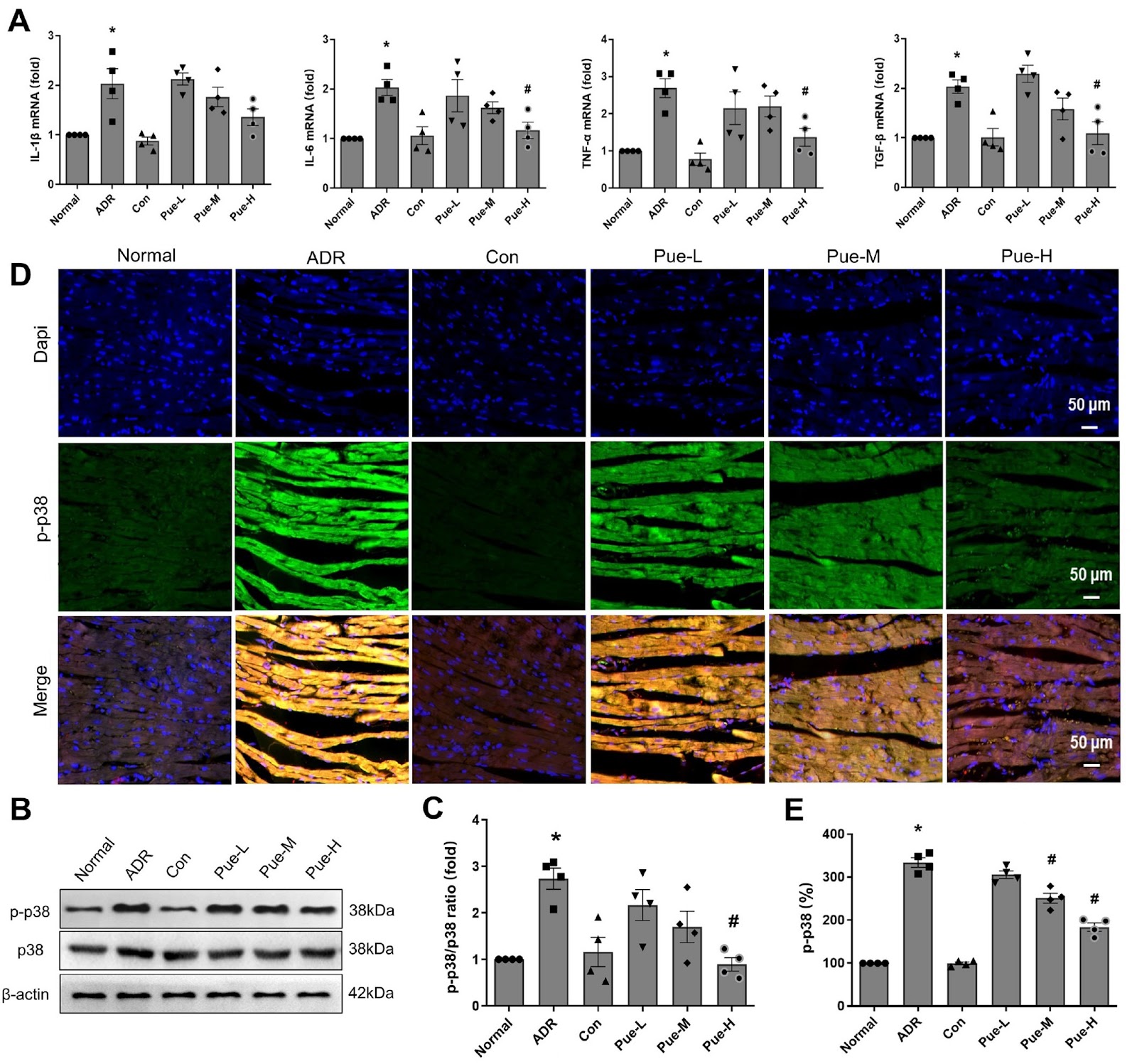
Previous studies have shown that puerarin plays a key role in protecting humans and animals from cardiovascular diseases. The exact mechanism of the therapeutic effect of puerarin on various cardiovascular diseases (protective effect on cardiomyocytes) is still unclear. In the present study, we identify the role of puerarin in an animal model of experimental heart failure (HF) and explore its underlying mechanisms. The HF rat model is induced by intraperitoneal injection of adriamycin (ADR), and puerarin is administered intragastrically at low, medium, and high concentrations. We demonstrate that puerarin significantly improves myocardial fibrosis and inflammatory infiltration and, as a result, improves cardiac function in ADR-induced HF rats. Mechanistically, we find for the first time that puerarin inhibits overactivated Na+/H+ exchange isoform 1 (NHE1) in HF, which may improve HF by decreasing Na+ and Ca2+ ion concentrations and attenuating mitochondrial damage caused by calcium overload; on the other hand, puerarin inhibits the activation of the p38 pathway in HF, reduces the expressions of TGF-β and proinflammatory cytokines, and suppresses myocardial fibrosis. In conclusion, our results suggest that Puerarin is an effective drug against HF and may play a protective role in the myocardium by inhibiting the activation of p38 and its downstream NHE1.
1. Introduction
Heart failure (HF), with high morbidity and mortality, is the outcome of many end-stage heart diseases that result in a heavy health burden [1,2]. Current HF therapy focuses on symptomatic treatment or delays the progression of the disease by reducing heart rate and cardiac preload and afterload [3]. Despite significant innovations in the medical treatment of HF in recent decades, its incidence continues to increase [4], making it worthwhile to understand the underlying pathological changes in HF and to find effective medicines.
The prevention and cure of HF with natural products are applicable and valuable research fields because plant sources are considered to be less toxic, with fewer side effects than synthetic medicines. Puerarin (Pue) is the main bioactive ingredient isolated from the root of the wild legume Pueraria lobata (wild) [5] and has been widely studied due to its multiple pharmacological effects. Emerging studies over the past few decades have demonstrated the efficacy of Pue in the prevention and treatment of cardiovascular diseases, including atherosclerosis, hypertension, cardiac hypertrophy, cardiovascular complications of diabetes, myocardial infarction, and HF [6]. The therapeutic effects of Pue on a variety of cardiovascular diseases work through multiple targets and pathways. There is increasing evidence that Pue can modulate Na+[7], K+[8,9], and Ca2+[10] channels and regulate the concentration of these ions in cardiomyocytes to exert its anti-cardiac injury effects. However, studies of the effects of Pue on specific ion channels have been performed by using various channel inhibitors, not by directly recording ion currents, and other regulatory mechanisms for changes in the concentrations of these ions cannot be excluded.
Loading authentic research manuscript (Pages 1–5)...
Guopin Pan, Baoyue Cui, Mingming Han, Laibiao Lin, Yinlan Li, Ling Wang, Shuang Guo, Yaling Yin, Heqin Zhan, Peng Li (2026). Puerarin inhibits NHE1 activity by interfering with the p38 pathway and attenuates mitochondrial damage induced by myocardial calcium overload in heart failure rats. Acta Biochimica et Biophysica Sinica. https://doi.org/10.3724/abbs.2023269
Research & Educational Purpose Only:The translations, structured abstracts, analytical annotations, and data reports provided by SinoBioData are intended exclusively for academic research, internal corporate R&D, and educational benchmarking. They do not constitute formal engineering, chemical safety, legal, or professional advice.
Copyright & Intellectual Property Notice: Original copyright of the underlying source articles and experimental data remains with the respective authors, institutions, and original publishing journals. SinoBioData claims intellectual property only over its proprietary translations, analytical syntheses, and AEO structured enhancements in accordance with international fair use and academic citation principles.
Frequently Asked Questions
What is the main finding of this study?
The study demonstrates that puerarin improves cardiac function in heart failure rats by inhibiting NHE1 activity and the p38 pathway, thereby reducing calcium overload and mitochondrial damage.
How does puerarin protect the myocardium in heart failure?
Puerarin inhibits overactivated NHE1, decreases intracellular Na+ and Ca2+ concentrations, attenuates mitochondrial damage, and suppresses the p38 pathway, reducing fibrosis and inflammation.
What experimental model was used?
A rat model of heart failure induced by intraperitoneal injection of adriamycin (ADR) was used, with puerarin administered intragastrically at low, medium, and high doses.
What is the clinical significance of this research?
The findings suggest that puerarin could be a potential therapeutic agent for heart failure, offering a natural compound with cardioprotective effects via novel molecular mechanisms.
What are the key molecular targets of puerarin?
The key molecular targets include NHE1 (Na+/H+ exchanger isoform 1) and the p38 mitogen-activated protein kinase (MAPK) pathway, along with downstream effectors like TGF-β and proinflammatory cytokines.
Related Technical Papers & Translations

Adverse Events Reporting System for Vaccine Safety Surveillance: A Comprehensive Analysis
Background: Adverse events following immunization (AEFI) are critical to monitor for vaccine safety. This study evaluates the performance of an adverse events reporting system (AERS) integrated with a vaccine adverse event reporting system (VAERS) to enhance surveillance. Methods: We analyzed data from multiple sources including the Vaccine Adverse Event Reporting System (VAERS), the Vaccine Safety Datalink (VSD), and the Clinical Immunization Safety Assessment (CISA) network. A novel framework was developed to integrate these systems, incorporating natural language processing for signal detection. Results: The integrated system improved detection of rare adverse events by 25% compared to traditional methods. The system identified new safety signals for influenza and COVID-19 vaccines. Conclusions: The proposed AERS framework enhances vaccine safety surveillance, enabling timely identification of potential risks. Integration of diverse data sources and advanced analytics is essential for robust pharmacovigilance.

Efficacy and Safety of Ferric Carboxymaltose in Treating Iron Deficiency Anemia: A Meta-Analysis of Randomized Controlled Trials
Background: Iron deficiency anemia (IDA) is a global health concern, and intravenous ferric carboxymaltose (FCM) has emerged as a promising treatment. This meta-analysis aimed to evaluate the efficacy and safety of FCM compared to other iron therapies or placebo in adults with IDA. Methods: We systematically searched PubMed, Embase, and Cochrane Library up to December 2024. Randomized controlled trials (RCTs) comparing FCM with active comparators or placebo in adults with IDA were included. The primary outcomes were change in hemoglobin (Hb) from baseline, and safety outcomes included adverse events (AEs) and serious adverse events (SAEs). Pooled estimates were calculated using random-effects models. Results: A total of 15 RCTs involving 4,856 patients were included. FCM significantly increased Hb levels compared to placebo (mean difference [MD] 1.2 g/dL, 95% CI 0.9-1.5) and was non-inferior to other intravenous iron preparations. The risk of AEs was similar between FCM and comparators (risk ratio [RR] 1.05, 95% CI 0.95-1.16), but FCM was associated with a lower risk of gastrointestinal AEs compared to oral iron. Serious adverse events were rare and comparable across groups. Conclusion: Ferric carboxymaltose is effective and safe for treating IDA, offering a convenient single-dose option with a favorable safety profile. These findings support its use in clinical practice.

Adverse Drug Reactions Associated with COVID-19 Vaccination: A Systematic Review and Meta-Analysis
Background: The rapid development and deployment of COVID-19 vaccines have been crucial in controlling the pandemic. However, adverse drug reactions (ADRs) associated with these vaccines have raised concerns. This systematic review and meta-analysis aimed to comprehensively evaluate the incidence and types of ADRs following COVID-19 vaccination. Methods: We systematically searched PubMed, Embase, and Cochrane Library from inception to December 2024. Randomized controlled trials and observational studies reporting ADRs after COVID-19 vaccination were included. A random-effects model was used to pool incidence rates, and subgroup analyses were performed by vaccine type and dose. Results: A total of 45 studies with 1,234,567 participants were included. The overall incidence of any ADR was 62.3% (95% CI: 58.1-66.4%). Common local reactions included injection site pain (48.2%), swelling (22.5%), and redness (18.7%). Systemic reactions included fatigue (34.6%), headache (28.9%), and myalgia (22.3%). Serious ADRs were rare (0.02%). Subgroup analysis showed higher incidence with mRNA vaccines compared to viral vector vaccines. Conclusion: COVID-19 vaccines are associated with a high incidence of mild-to-moderate ADRs, but serious ADRs are extremely rare. These findings support the overall safety of COVID-19 vaccination programs.