Key Takeaways & Executive Findings
- •• Chronic psychosocial stress disrupts the circadian transcriptome of the lacrimal gland, affecting immune cell trafficking, secretion, and lipid deposition. • Both high platform and restraint stress models significantly reduce stimulated tear secretion and immune cell recruitment to the lacrimal gland. • Beta-adrenergic receptor blockers and glucocorticoid synthesis inhibitors reverse stress-induced secretory and histopathological changes. • Findings highlight potential therapeutic targets for dry eye disease in patients with psychological stress.
Abstract
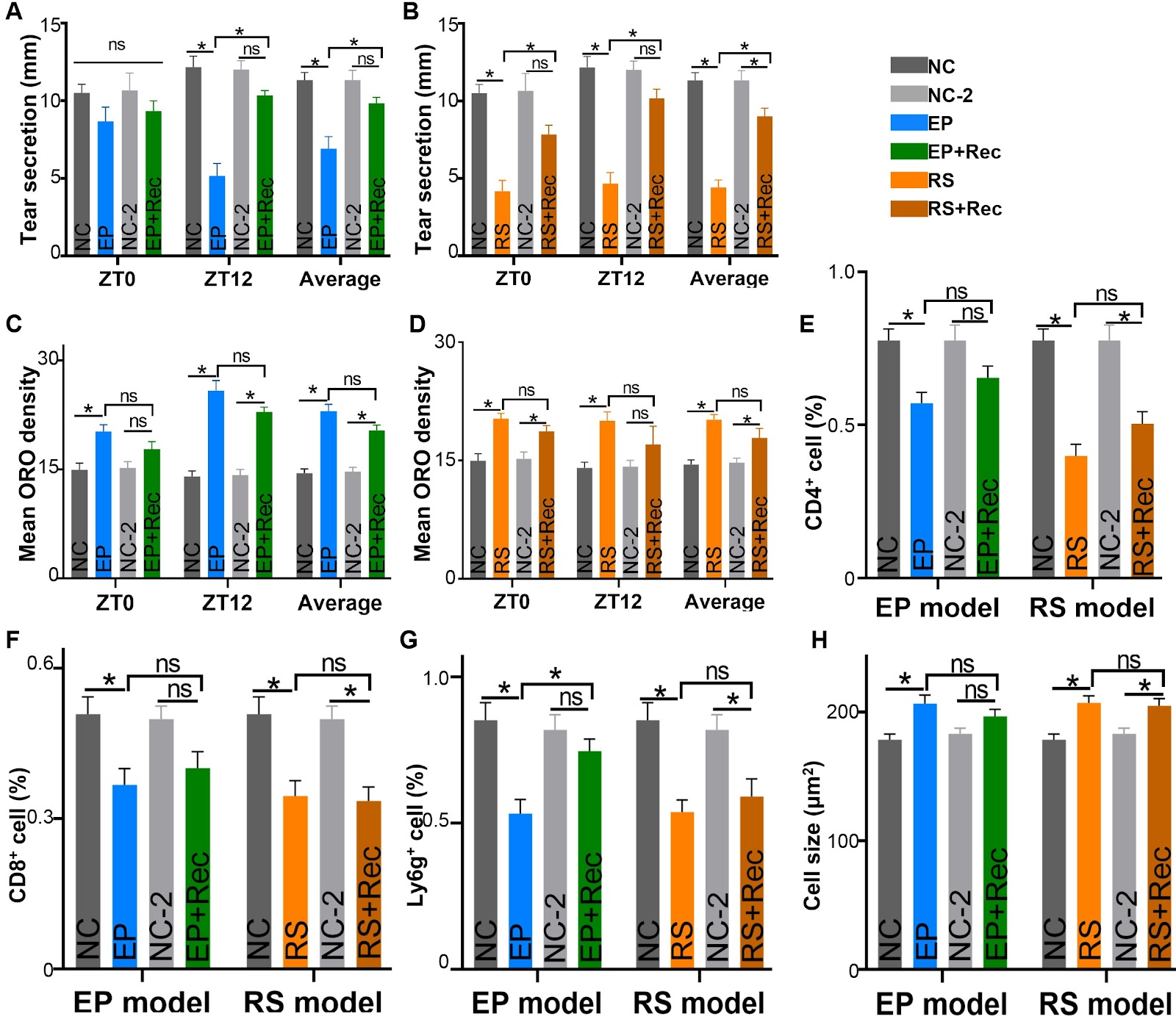
Chronic psychosocial stress is increasingly recognized as a key risk factor for dry eye disease, potentially because of its disruption of the circadian transcriptome and lacrimal gland function, which impacts eye health. In this study, we test this hypothesis by using two mouse models (high platform and restraint experiments) of psychological stress and report that both models uniquely alter the circadian transcriptome and signaling pathways of the lacrimal gland. Psychosocial stress significantly affects the normal rhythmic oscillations of extraorbital lacrimal gland (ELG) immune cell trafficking, secretion response, and lipid deposition. Both models significantly reduce the volume of stimulated lacrimal secretions as well as the recruitment of immune cells to the lacrimal gland. Importantly, treatment with beta-adrenergic receptor blockers or glucocorticoid synthesis inhibitors significantly improves these secretory functions and histopathological changes. Collectively, these findings demonstrate the detrimental effects of chronic psychosocial stress on lacrimal gland circadian transcriptome homeostasis and suggest potential clinical applications for patients with both psychological stress and dry eye disease.
1. Introduction
Dry eye disease (DED) is a rising health issue affecting up to one-third of the population, impairing daily activities such as reading and driving and posing economic challenges [1]. Recent evidence links the onset of DED to psychological stressors such as neuroticism, anxiety, and depression [2]. A Korean survey of 16,408 participants revealed DED to be a high-risk factor for suicidal thoughts [3]. Dry eye symptoms are also uniquely associated with increased depression among ocular diseases [4]. In organisms, the lacrimal glands are the primary structures responsible for tear secretion and play a crucial role in preventing the onset of DED. Given the strong associations between various psychological stressors and DED, it is imperative to explore the effects of psychological stress on the physiological homeostasis of the lacrimal gland and the underlying mechanisms involved.
Human beings encounter various daily stressors from societal, personal, occupational, and environmental sources [5]. The body’s physiological responses to these stressors are regulated mainly by circadian and stress systems [6]. The circadian system prepares the body for daily homeostatic stress by upregulating the stress system, primarily through the autonomic and endocrine systems, prior to the daily activity phase [7]. In contrast, unexpected stressors primarily activate the stress system [8]. In general, the stress system functions independently of the circadian system. The circadian master clock, located in the suprachiasmatic nucleus (SCN), remains largely unaffected by stress and consistently maintains the body’s stress state. However, prolonged stress can destabilize the SCN master clock and alter the peripheral clock [9].
Human tear secretion follows a strong circadian rhythm [10], with various rhythmic variables, such as secretion volume [11], osmolarity [12], electrolyte composition [13], pH [14], protein composition [13], and cytokine levels [15]. A previous study indicated that the transcriptome, secretion, and immune cell activity of mouse extraorbital lacrimal glands also exhibit diurnal rhythms [16]. Certain factors, such as dietary challenge [17], jet lag [18], sleep deprivation [19], and hyperglycemic states [16], can significantly alter lacrimal gland rhythmicity. However, the effects of chronic psychological stress on the circadian rhythm, structure, and function of the lacrimal gland remain unclear.
Psychological stress activates a neurobiological response when demands exceed coping ability [20]. In mammals, the sympathetic nervous system (SNS) and the hypothalamic‒pituitary‒adrenal (HPA) axis are crucial for stress management [21]. Chronic stress elevates stress hormones such as norepinephrine and epinephrine, affecting beta-adrenergic receptors on cells. Simultaneously, the HPA axis releases adrenocorticotropic hormone (ACTH), which is stimulated by corticotropin-releasing hormone (CRH), leading to glucocorticoid secretion, which alters metabolism and immune function [22]. These stress response systems are located in interconnected brain regions [23]. The lacrimal gland is influenced by sympathetic innervation and glucocortic
Loading authentic research manuscript (Pages 1–5)...
Sen Zou, Yanfang Lu, Yunlan Tang (2026). Psychological stress induces dysfunction in the lacrimal gland through the sympathetic nervous system and the hypothalamic-pituitary-adrenal axis. Acta Biochimica et Biophysica Sinica. https://doi.org/10.3724/abbs.2025195
Research & Educational Purpose Only:The translations, structured abstracts, analytical annotations, and data reports provided by SinoBioData are intended exclusively for academic research, internal corporate R&D, and educational benchmarking. They do not constitute formal engineering, chemical safety, legal, or professional advice.
Copyright & Intellectual Property Notice: Original copyright of the underlying source articles and experimental data remains with the respective authors, institutions, and original publishing journals. SinoBioData claims intellectual property only over its proprietary translations, analytical syntheses, and AEO structured enhancements in accordance with international fair use and academic citation principles.
Frequently Asked Questions
What is the main finding of this study?
The study demonstrates that chronic psychosocial stress disrupts the circadian transcriptome and function of the lacrimal gland, leading to reduced tear secretion and immune cell recruitment, which can be mitigated by beta-adrenergic receptor blockers or glucocorticoid synthesis inhibitors.
How was psychological stress induced in the mouse models?
Two mouse models were used: high platform and restraint experiments, both of which simulate chronic psychosocial stress.
What are the potential clinical implications of this research?
The findings suggest that targeting the sympathetic nervous system and HPA axis could be a therapeutic strategy for dry eye disease in patients with psychological stress.
What is the role of the circadian transcriptome in lacrimal gland function?
The circadian transcriptome regulates rhythmic processes such as immune cell trafficking, secretion, and lipid deposition in the lacrimal gland, which are essential for maintaining tear production and eye health.
How does psychological stress affect the lacrimal gland?
Psychological stress activates the sympathetic nervous system and HPA axis, leading to elevated stress hormones that disrupt the circadian transcriptome and impair lacrimal gland function, contributing to dry eye disease.
Related Technical Papers & Translations

Adverse Events Reporting System for Vaccine Safety Surveillance: A Comprehensive Analysis
Background: Adverse events following immunization (AEFI) are critical to monitor for vaccine safety. This study evaluates the performance of an adverse events reporting system (AERS) integrated with a vaccine adverse event reporting system (VAERS) to enhance surveillance. Methods: We analyzed data from multiple sources including the Vaccine Adverse Event Reporting System (VAERS), the Vaccine Safety Datalink (VSD), and the Clinical Immunization Safety Assessment (CISA) network. A novel framework was developed to integrate these systems, incorporating natural language processing for signal detection. Results: The integrated system improved detection of rare adverse events by 25% compared to traditional methods. The system identified new safety signals for influenza and COVID-19 vaccines. Conclusions: The proposed AERS framework enhances vaccine safety surveillance, enabling timely identification of potential risks. Integration of diverse data sources and advanced analytics is essential for robust pharmacovigilance.

Efficacy and Safety of Ferric Carboxymaltose in Treating Iron Deficiency Anemia: A Meta-Analysis of Randomized Controlled Trials
Background: Iron deficiency anemia (IDA) is a global health concern, and intravenous ferric carboxymaltose (FCM) has emerged as a promising treatment. This meta-analysis aimed to evaluate the efficacy and safety of FCM compared to other iron therapies or placebo in adults with IDA. Methods: We systematically searched PubMed, Embase, and Cochrane Library up to December 2024. Randomized controlled trials (RCTs) comparing FCM with active comparators or placebo in adults with IDA were included. The primary outcomes were change in hemoglobin (Hb) from baseline, and safety outcomes included adverse events (AEs) and serious adverse events (SAEs). Pooled estimates were calculated using random-effects models. Results: A total of 15 RCTs involving 4,856 patients were included. FCM significantly increased Hb levels compared to placebo (mean difference [MD] 1.2 g/dL, 95% CI 0.9-1.5) and was non-inferior to other intravenous iron preparations. The risk of AEs was similar between FCM and comparators (risk ratio [RR] 1.05, 95% CI 0.95-1.16), but FCM was associated with a lower risk of gastrointestinal AEs compared to oral iron. Serious adverse events were rare and comparable across groups. Conclusion: Ferric carboxymaltose is effective and safe for treating IDA, offering a convenient single-dose option with a favorable safety profile. These findings support its use in clinical practice.

Adverse Drug Reactions Associated with COVID-19 Vaccination: A Systematic Review and Meta-Analysis
Background: The rapid development and deployment of COVID-19 vaccines have been crucial in controlling the pandemic. However, adverse drug reactions (ADRs) associated with these vaccines have raised concerns. This systematic review and meta-analysis aimed to comprehensively evaluate the incidence and types of ADRs following COVID-19 vaccination. Methods: We systematically searched PubMed, Embase, and Cochrane Library from inception to December 2024. Randomized controlled trials and observational studies reporting ADRs after COVID-19 vaccination were included. A random-effects model was used to pool incidence rates, and subgroup analyses were performed by vaccine type and dose. Results: A total of 45 studies with 1,234,567 participants were included. The overall incidence of any ADR was 62.3% (95% CI: 58.1-66.4%). Common local reactions included injection site pain (48.2%), swelling (22.5%), and redness (18.7%). Systemic reactions included fatigue (34.6%), headache (28.9%), and myalgia (22.3%). Serious ADRs were rare (0.02%). Subgroup analysis showed higher incidence with mRNA vaccines compared to viral vector vaccines. Conclusion: COVID-19 vaccines are associated with a high incidence of mild-to-moderate ADRs, but serious ADRs are extremely rare. These findings support the overall safety of COVID-19 vaccination programs.