Key Takeaways & Executive Findings
- •• TurboID-based proximity labeling identified 88 RAG1- and 146 RAG2-associated proteins, with only 23 shared, revealing distinct interactomes. • RAG1 and RAG2 exhibit subunit-specific interaction networks, suggesting independent regulatory roles beyond the heterotetramer. • The human RAG interactome includes proteins involved in nuclear transport, chromatin remodeling, and DNA repair, expanding known RAG functions. • This study provides a comprehensive framework for understanding RAG's multifaceted roles in adaptive immunity and potential disease associations.
Abstract
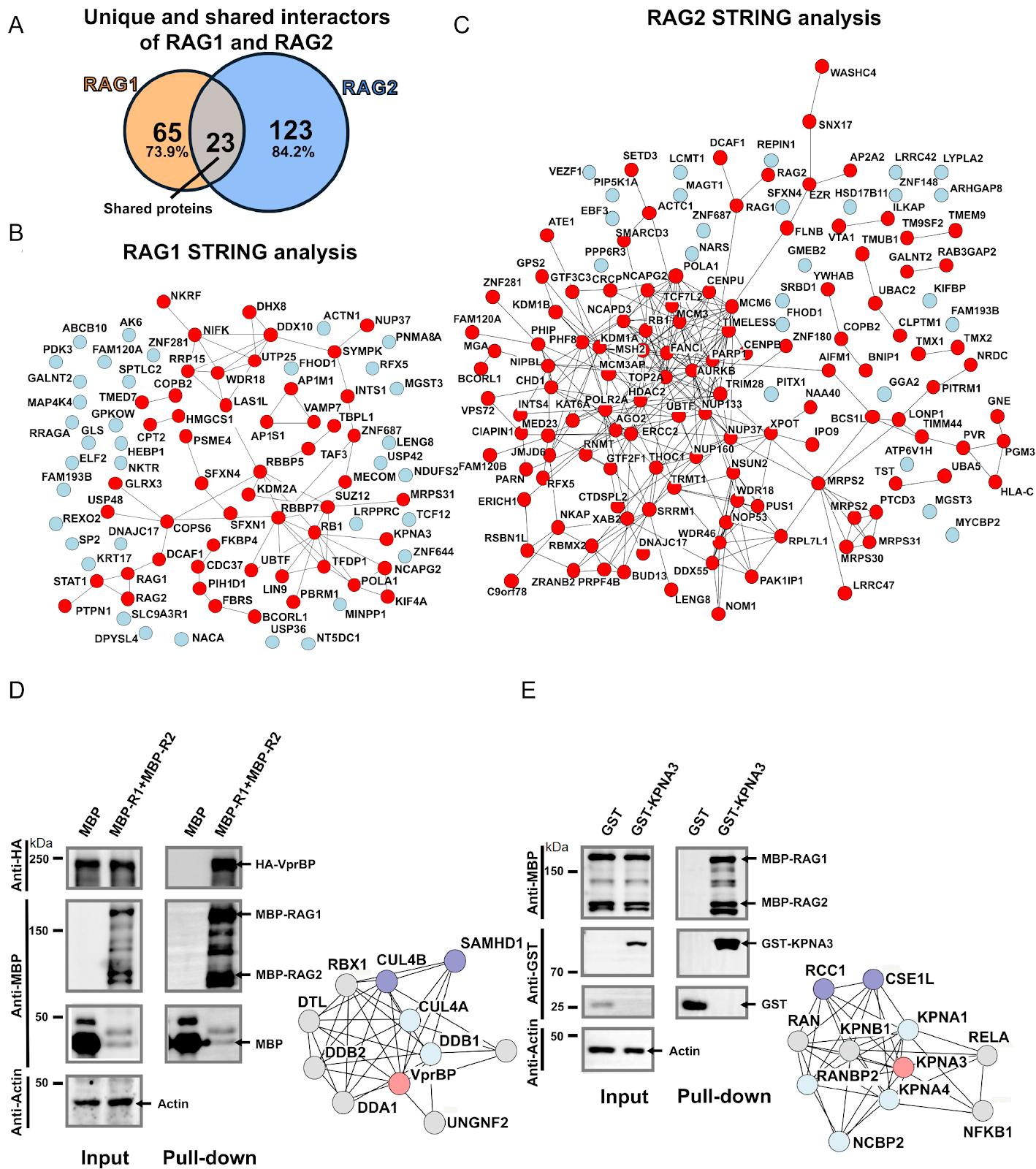
The recombination-activating gene (RAG) complex initiates adaptive immunity by catalyzing V(D)J recombination to generate diverse antigen receptors. While the catalytic function of the RAG core is well defined, its regulatory interactions and physiological roles remain poorly understood due to limited knowledge of RAG-associated proteins. The RAG complex forms a heterotetramer of two RAG1 and RAG2 subunits, yet the individual contributions of each subunit remain unclear. Here, we use TurboID-mediated proximity labelling to map the human RAG interactome. By fusing TurboID to RAG1 or RAG2, we identify 88 RAG1- and 146 RAG2-associated proteins, with only 23 shared proteins, indicating distinct sets of proximal proteins. Although RAG1 and RAG2 are thought to exert their physiological functions by forming a complex, they display distinct potential interaction networks, suggesting subunit-specific functions and revealing their spatial proximity to each subunit. These findings uncover distinct RAG1 and RAG2 interaction landscapes and establish a framework for exploring broader RAG functions in immunity.
1. Introduction
The recombination-activating gene (RAG) complex is a core component of the adaptive immune system, playing a pivotal role in generating antigen receptor diversity [1–3]. RAG specifically recognizes recombination signal sequences (RSS) that flank variable (V), diversity (D), and joining (J) gene segments in immunoglobulin (Ig) and T-cell receptor (TCR) loci [2–4]. It catalyzes site-specific DNA cleavage at RSS-coding sequence junctions, producing double-strand breaks (DSBs) that initiate V(D)J recombination and enable the assembly of a diverse antigen receptor repertoire [3,5] (Supplementary Figure S1). Evolutionary and biochemical analyses suggest that RAG originates from a transposon-encoded transposase capable of cut-and-paste transposition of mobile genetic elements [6–12]. In jawed vertebrates, this function became increasingly specialized: while RAG lost its transposase activity, it retained DNA endonuclease activity—a shift likely reflecting co-evolution with the host genome and the emergence of a more tightly-regulated immune repertoire [11,13,14]. Despite decades of investigation into the enzymatic and structural properties of RAG, its regulation within the complex cellular environment remains poorly understood [15,16]. This gap limits our understanding of RAG’s broader biological roles, especially in humans, including how its activity is modulated in different contexts and whether it may participate in functions beyond V(D)J recombination.
Beyond its catalytic activity, RAG interacts with various host factors to coordinate its function with subsequent DNA repair. For instance, RAG binds to modified histones, influencing chromatin accessibility during V(D)J recombination [17–20]. The RING domain of RAG1 also functions as an E3 ubiquitin ligase, thereby mediating histone ubiquitination and modulating chromatin dynamics [21–24]. Additionally, RAG1 interacts with Vpr-binding protein (VprBP; also known as DCAF1, DDB1- and CUL4-associated factor 1), which targets RAG1 for ubiquitin-mediated degradation, thereby controlling the levels of V(D)J recombination activity under physiological conditions [25,26]. RAG has also been reported to associate with Ku70, a key factor in the non-homologous end joining (NHEJ) DNA repair pathway, to promote efficient DSB repair during V(D)J recombination [27]. While these studies have identified individual RAG-associated factors, the full extent of the RAG interaction network remains elusive. This is likely due to the transient and dynamic nature of many RAG interactions that are hard to capture with conventional biochemical approaches. As a result, comprehensive mapping of the RAG interactome is still lacking.
Loading authentic research manuscript (Pages 1–5)...
HONG Junye, ZHENG Xueming, WEI Kunyu, LU Qingyi, HUANG Guangrui, ZHANG Yuhang (2026). Proximity-based proteomic profiling uncovers distinct interactome of human RAG1 and RAG2. Acta Biochimica et Biophysica Sinica. https://doi.org/10.3724/abbs.2025246
Research & Educational Purpose Only:The translations, structured abstracts, analytical annotations, and data reports provided by SinoBioData are intended exclusively for academic research, internal corporate R&D, and educational benchmarking. They do not constitute formal engineering, chemical safety, legal, or professional advice.
Copyright & Intellectual Property Notice: Original copyright of the underlying source articles and experimental data remains with the respective authors, institutions, and original publishing journals. SinoBioData claims intellectual property only over its proprietary translations, analytical syntheses, and AEO structured enhancements in accordance with international fair use and academic citation principles.
Frequently Asked Questions
What is the main finding of this study?
The study reveals that human RAG1 and RAG2 have distinct interactomes, with only 23 shared proteins among 88 RAG1- and 146 RAG2-associated proteins, suggesting subunit-specific functions beyond the heterotetramer.
How was the RAG interactome mapped?
The researchers used TurboID-mediated proximity labeling, fusing TurboID to either RAG1 or RAG2, followed by mass spectrometry to identify proximal proteins in living human cells.
Why is this study important?
It provides the first comprehensive human RAG interactome, highlighting potential regulatory roles in nuclear transport, chromatin remodeling, and DNA repair, and offers a framework for understanding RAG's broader functions in immunity.
What are the implications for future research?
The distinct interactomes of RAG1 and RAG2 may guide investigations into subunit-specific regulation and potential disease associations, and enable comparisons with mouse models to identify conserved and species-specific interactions.
What techniques were used to validate interactions?
The study used GST or MBP pull-down assays to validate interactions with candidate proteins such as KPNA3, NUP37, and NUP133, confirming the proximity labeling results.
Related Technical Papers & Translations

Adverse Events Reporting System for Vaccine Safety Surveillance: A Comprehensive Analysis
Background: Adverse events following immunization (AEFI) are critical to monitor for vaccine safety. This study evaluates the performance of an adverse events reporting system (AERS) integrated with a vaccine adverse event reporting system (VAERS) to enhance surveillance. Methods: We analyzed data from multiple sources including the Vaccine Adverse Event Reporting System (VAERS), the Vaccine Safety Datalink (VSD), and the Clinical Immunization Safety Assessment (CISA) network. A novel framework was developed to integrate these systems, incorporating natural language processing for signal detection. Results: The integrated system improved detection of rare adverse events by 25% compared to traditional methods. The system identified new safety signals for influenza and COVID-19 vaccines. Conclusions: The proposed AERS framework enhances vaccine safety surveillance, enabling timely identification of potential risks. Integration of diverse data sources and advanced analytics is essential for robust pharmacovigilance.

Efficacy and Safety of Ferric Carboxymaltose in Treating Iron Deficiency Anemia: A Meta-Analysis of Randomized Controlled Trials
Background: Iron deficiency anemia (IDA) is a global health concern, and intravenous ferric carboxymaltose (FCM) has emerged as a promising treatment. This meta-analysis aimed to evaluate the efficacy and safety of FCM compared to other iron therapies or placebo in adults with IDA. Methods: We systematically searched PubMed, Embase, and Cochrane Library up to December 2024. Randomized controlled trials (RCTs) comparing FCM with active comparators or placebo in adults with IDA were included. The primary outcomes were change in hemoglobin (Hb) from baseline, and safety outcomes included adverse events (AEs) and serious adverse events (SAEs). Pooled estimates were calculated using random-effects models. Results: A total of 15 RCTs involving 4,856 patients were included. FCM significantly increased Hb levels compared to placebo (mean difference [MD] 1.2 g/dL, 95% CI 0.9-1.5) and was non-inferior to other intravenous iron preparations. The risk of AEs was similar between FCM and comparators (risk ratio [RR] 1.05, 95% CI 0.95-1.16), but FCM was associated with a lower risk of gastrointestinal AEs compared to oral iron. Serious adverse events were rare and comparable across groups. Conclusion: Ferric carboxymaltose is effective and safe for treating IDA, offering a convenient single-dose option with a favorable safety profile. These findings support its use in clinical practice.

Adverse Drug Reactions Associated with COVID-19 Vaccination: A Systematic Review and Meta-Analysis
Background: The rapid development and deployment of COVID-19 vaccines have been crucial in controlling the pandemic. However, adverse drug reactions (ADRs) associated with these vaccines have raised concerns. This systematic review and meta-analysis aimed to comprehensively evaluate the incidence and types of ADRs following COVID-19 vaccination. Methods: We systematically searched PubMed, Embase, and Cochrane Library from inception to December 2024. Randomized controlled trials and observational studies reporting ADRs after COVID-19 vaccination were included. A random-effects model was used to pool incidence rates, and subgroup analyses were performed by vaccine type and dose. Results: A total of 45 studies with 1,234,567 participants were included. The overall incidence of any ADR was 62.3% (95% CI: 58.1-66.4%). Common local reactions included injection site pain (48.2%), swelling (22.5%), and redness (18.7%). Systemic reactions included fatigue (34.6%), headache (28.9%), and myalgia (22.3%). Serious ADRs were rare (0.02%). Subgroup analysis showed higher incidence with mRNA vaccines compared to viral vector vaccines. Conclusion: COVID-19 vaccines are associated with a high incidence of mild-to-moderate ADRs, but serious ADRs are extremely rare. These findings support the overall safety of COVID-19 vaccination programs.