Key Takeaways & Executive Findings
- •• PROS1 administration protects mice from lethal influenza infection by activating AXL signaling. • PROS1/AXL signaling induces M2 macrophage polarization via Gab1 and PI3K/AKT/mTOR pathway. • Gab1 knockdown or PI3K inhibition abolishes the protective effect of PROS1, confirming the pathway's necessity. • The PROS1/AXL axis represents a novel therapeutic target for influenza infection and associated lung injury.
Abstract
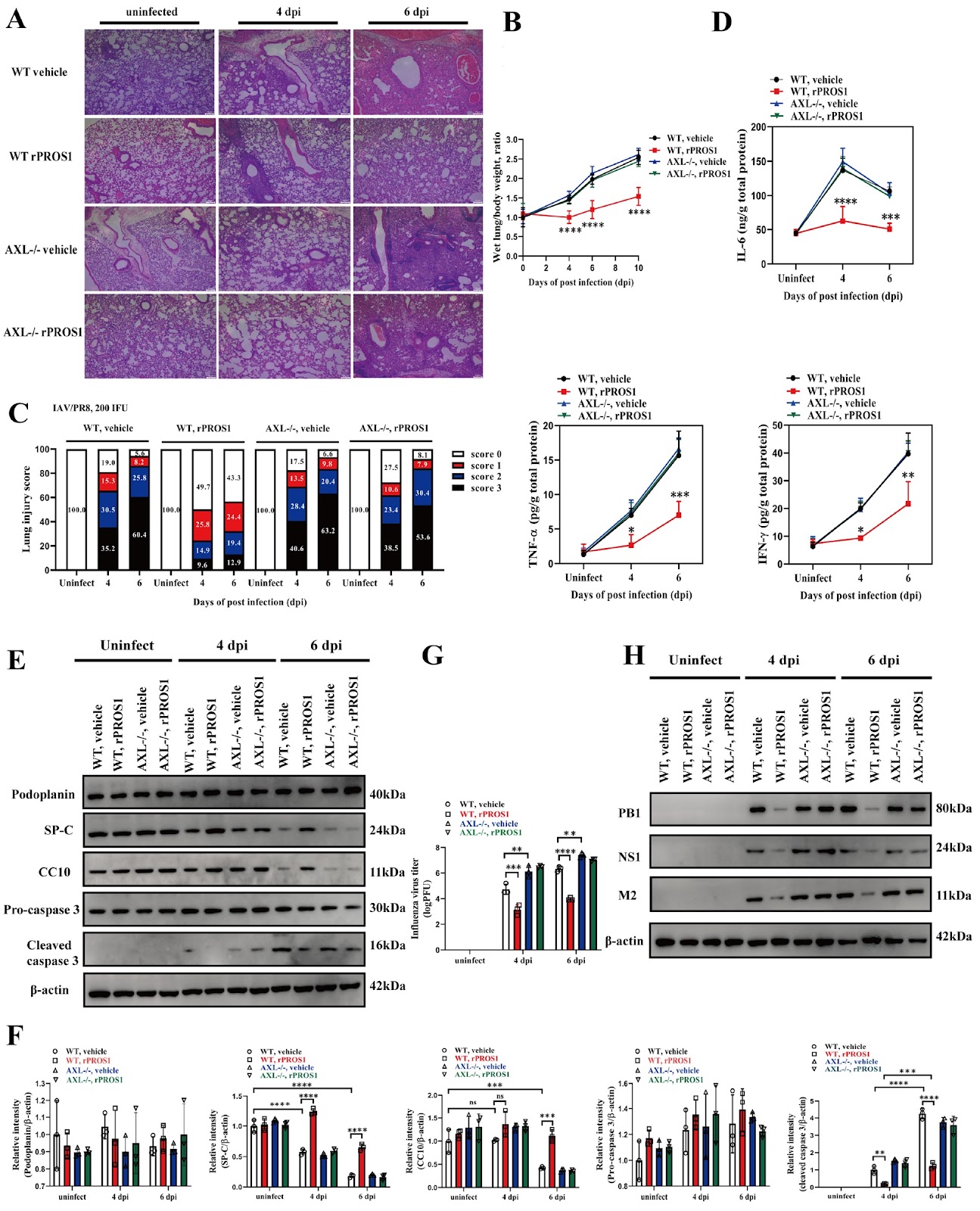
AXL, a member of the TAM (Tyro3, AXL, and Mertk) subfamily of RTKs, is abundantly expressed in lung tissue and has been implicated in viral infections and lung injury. PROS1, one of the ligands known to activate AXL, functions as an immunomodulator in many diseases. However, the role of PROS1/AXL signaling in influenza A virus (IAV) infection and infection-induced lung injury is largely unknown. In this study, we find that the exogenous administration of PROS1 mitigates lung injury and protects mice from lethal infection by IAVs through the activation of AXL. PROS1 induces the phosphorylation of AXL, which in turn recruits Gab1 and p85, a regulatory subunit of PI3K, to form a complex that activates Gab1 and its downstream PI3K/AKT/mTOR in alveolar macrophages. Gab1 knockdown in vivo, or LY294002 (a PI3K inhibitor), abolishes the PROS1/AXL-induced protective activity against lethal influenza infection in mice. We also show that PROS1/AXL signaling induces M2 polarization of alveolar macrophages through Gab1 activation both in vitro and in vivo. Gab1 knockdown inhibits M2 macrophage accumulation in IAV-infected lungs and attenuates the protective effect of PROS1. These results indicate that PROS1/AXL signaling can activate Gab1 in macrophages and induce macrophage polarization to an anti-inflammatory M2 phenotype, thereby eliciting protective activity against lethal infection with IAVs. These data also highlight the PROS1/AXL signal as a novel therapeutic target for IAV infection.
1. Introduction
Influenza A viruses (IAVs) are zoonotic, negative-sense, single-stranded RNA viruses that are closely associated with worldwide pandemics [1]. Annual outbreaks of IAV cause considerable morbidity and mortality in communities [2]. The deadliest of these outbreaks, the 1918 pandemic “Spanish Flu”, caused by an unusually virulent H1N1 subtype of IAV, resulted in 500 million infections and 50 million deaths [3]. In recent years, avian influenza variants, including H5N1 and H7N9, have been able to cross-infect humans and have high rates of infection and lethality compared with other IAV strains, with pandemic potential risk [4]. Severe influenza infections are often lethal, manifesting as cytokine storms, inflammation, flooding of alveolar spaces, and even acute respiratory distress syndrome and respiratory failure. However, the factors that control IAV replication and limit lethal lung inflammation remain largely unknown. Vaccines and anti-influenza medications, such as neuraminidase inhibitors, are available but may be much less effective in immunocompromised populations or those infected with drug-resistant IAVs [5,6]. Therefore, the identification of novel antiinfluenza targets and agents is urgently needed.
Tyro3, AXL, and Mertk (TAM) receptors are a subfamily of receptor tyrosine kinases (RTKs) that are expressed in various cells and tissues. In the lung, TAM receptors are expressed in alveolar type II epithelial cells (ATII cells), alveolar macrophages and neutrophils [7–10]. Vitamin K-dependent protein growth arrest specific protein 6 (Gas6) and protein S (PROS1) are two ligands that bind to and activate the TAM receptor [11]. TAM receptors and their ligands have potent immunomodulatory functions. Currently, the most studied TAM receptors (Tyro3/AXL/Mertk) recognize phosphatidylserine on apoptotic cells via the bridging molecules Gas6 and PROS1, thus mediating the clearance of apoptotic cells [12,13]. TAM receptor activation-mediated efferocytosis and inhibition of inflammatory pathways protect the brain from ischemic stroke and viral infections [14,15]. However, the role of the immunomodulatory functions of TAM receptors and their ligands in combating IAV infection and infection-induced lung pathology is unclear. Exogenous administration of PROS1 or Gas6 alleviated acute lung injury in mice by inhibiting inflammatory cytokine secretion through the activation of AXL [16,17]. AXL plays a crucial role in inducing protective antiviral adaptive immunity by limiting the immunosuppressive effects of type I IFNs [18]. Alveolar macrophages (AMs) are critical for immunity to influenza A virus (IAV) infection [19], and PROS1 has been reported to promote an immunosuppressive microenvironment in gliomas by polarizing tumor-associated macrophages toward the M2 phenotype [20], suggesting that PROS1 may also affect alveolar macrophage polarization and function. All of the above studies suggest an important and beneficial role for the TAM receptor and its ligands in modulating immune responses during IAV infection.
Loading authentic research manuscript (Pages 1–5)...
Wenbo Zhu, Shao Wang, Shuangquan Liu, Qiang Fu, Hongbo Zhang (2026). PROS1/AXL signaling protects mice from lethal influenza infection by inducing M2 macrophage polarization. Acta Biochimica et Biophysica Sinica. https://doi.org/10.3724/abbs.2025169
Research & Educational Purpose Only:The translations, structured abstracts, analytical annotations, and data reports provided by SinoBioData are intended exclusively for academic research, internal corporate R&D, and educational benchmarking. They do not constitute formal engineering, chemical safety, legal, or professional advice.
Copyright & Intellectual Property Notice: Original copyright of the underlying source articles and experimental data remains with the respective authors, institutions, and original publishing journals. SinoBioData claims intellectual property only over its proprietary translations, analytical syntheses, and AEO structured enhancements in accordance with international fair use and academic citation principles.
Frequently Asked Questions
What is the role of PROS1/AXL signaling in influenza infection?
PROS1/AXL signaling protects mice from lethal influenza infection by inducing M2 macrophage polarization, which reduces lung inflammation and injury.
How does PROS1/AXL signaling induce M2 macrophage polarization?
PROS1 activates AXL, leading to recruitment of Gab1 and p85, which activates the PI3K/AKT/mTOR pathway, promoting M2 polarization of alveolar macrophages.
What is the significance of Gab1 in this pathway?
Gab1 is a key adaptor protein that mediates the downstream signaling of AXL, and its knockdown abolishes the protective effect of PROS1, confirming its essential role.
Could PROS1/AXL be a therapeutic target for influenza?
Yes, the study highlights PROS1/AXL as a novel therapeutic target for IAV infection, as exogenous PROS1 administration protects mice from lethal infection.
What are the implications for treating severe influenza?
Targeting the PROS1/AXL pathway could provide a new approach to mitigate lung injury and improve outcomes in severe influenza, especially in cases where vaccines and antiviral drugs are less effective.
Related Technical Papers & Translations

Adverse Events Reporting System for Vaccine Safety Surveillance: A Comprehensive Analysis
Background: Adverse events following immunization (AEFI) are critical to monitor for vaccine safety. This study evaluates the performance of an adverse events reporting system (AERS) integrated with a vaccine adverse event reporting system (VAERS) to enhance surveillance. Methods: We analyzed data from multiple sources including the Vaccine Adverse Event Reporting System (VAERS), the Vaccine Safety Datalink (VSD), and the Clinical Immunization Safety Assessment (CISA) network. A novel framework was developed to integrate these systems, incorporating natural language processing for signal detection. Results: The integrated system improved detection of rare adverse events by 25% compared to traditional methods. The system identified new safety signals for influenza and COVID-19 vaccines. Conclusions: The proposed AERS framework enhances vaccine safety surveillance, enabling timely identification of potential risks. Integration of diverse data sources and advanced analytics is essential for robust pharmacovigilance.

Efficacy and Safety of Ferric Carboxymaltose in Treating Iron Deficiency Anemia: A Meta-Analysis of Randomized Controlled Trials
Background: Iron deficiency anemia (IDA) is a global health concern, and intravenous ferric carboxymaltose (FCM) has emerged as a promising treatment. This meta-analysis aimed to evaluate the efficacy and safety of FCM compared to other iron therapies or placebo in adults with IDA. Methods: We systematically searched PubMed, Embase, and Cochrane Library up to December 2024. Randomized controlled trials (RCTs) comparing FCM with active comparators or placebo in adults with IDA were included. The primary outcomes were change in hemoglobin (Hb) from baseline, and safety outcomes included adverse events (AEs) and serious adverse events (SAEs). Pooled estimates were calculated using random-effects models. Results: A total of 15 RCTs involving 4,856 patients were included. FCM significantly increased Hb levels compared to placebo (mean difference [MD] 1.2 g/dL, 95% CI 0.9-1.5) and was non-inferior to other intravenous iron preparations. The risk of AEs was similar between FCM and comparators (risk ratio [RR] 1.05, 95% CI 0.95-1.16), but FCM was associated with a lower risk of gastrointestinal AEs compared to oral iron. Serious adverse events were rare and comparable across groups. Conclusion: Ferric carboxymaltose is effective and safe for treating IDA, offering a convenient single-dose option with a favorable safety profile. These findings support its use in clinical practice.

Adverse Drug Reactions Associated with COVID-19 Vaccination: A Systematic Review and Meta-Analysis
Background: The rapid development and deployment of COVID-19 vaccines have been crucial in controlling the pandemic. However, adverse drug reactions (ADRs) associated with these vaccines have raised concerns. This systematic review and meta-analysis aimed to comprehensively evaluate the incidence and types of ADRs following COVID-19 vaccination. Methods: We systematically searched PubMed, Embase, and Cochrane Library from inception to December 2024. Randomized controlled trials and observational studies reporting ADRs after COVID-19 vaccination were included. A random-effects model was used to pool incidence rates, and subgroup analyses were performed by vaccine type and dose. Results: A total of 45 studies with 1,234,567 participants were included. The overall incidence of any ADR was 62.3% (95% CI: 58.1-66.4%). Common local reactions included injection site pain (48.2%), swelling (22.5%), and redness (18.7%). Systemic reactions included fatigue (34.6%), headache (28.9%), and myalgia (22.3%). Serious ADRs were rare (0.02%). Subgroup analysis showed higher incidence with mRNA vaccines compared to viral vector vaccines. Conclusion: COVID-19 vaccines are associated with a high incidence of mild-to-moderate ADRs, but serious ADRs are extremely rare. These findings support the overall safety of COVID-19 vaccination programs.