Key Takeaways & Executive Findings
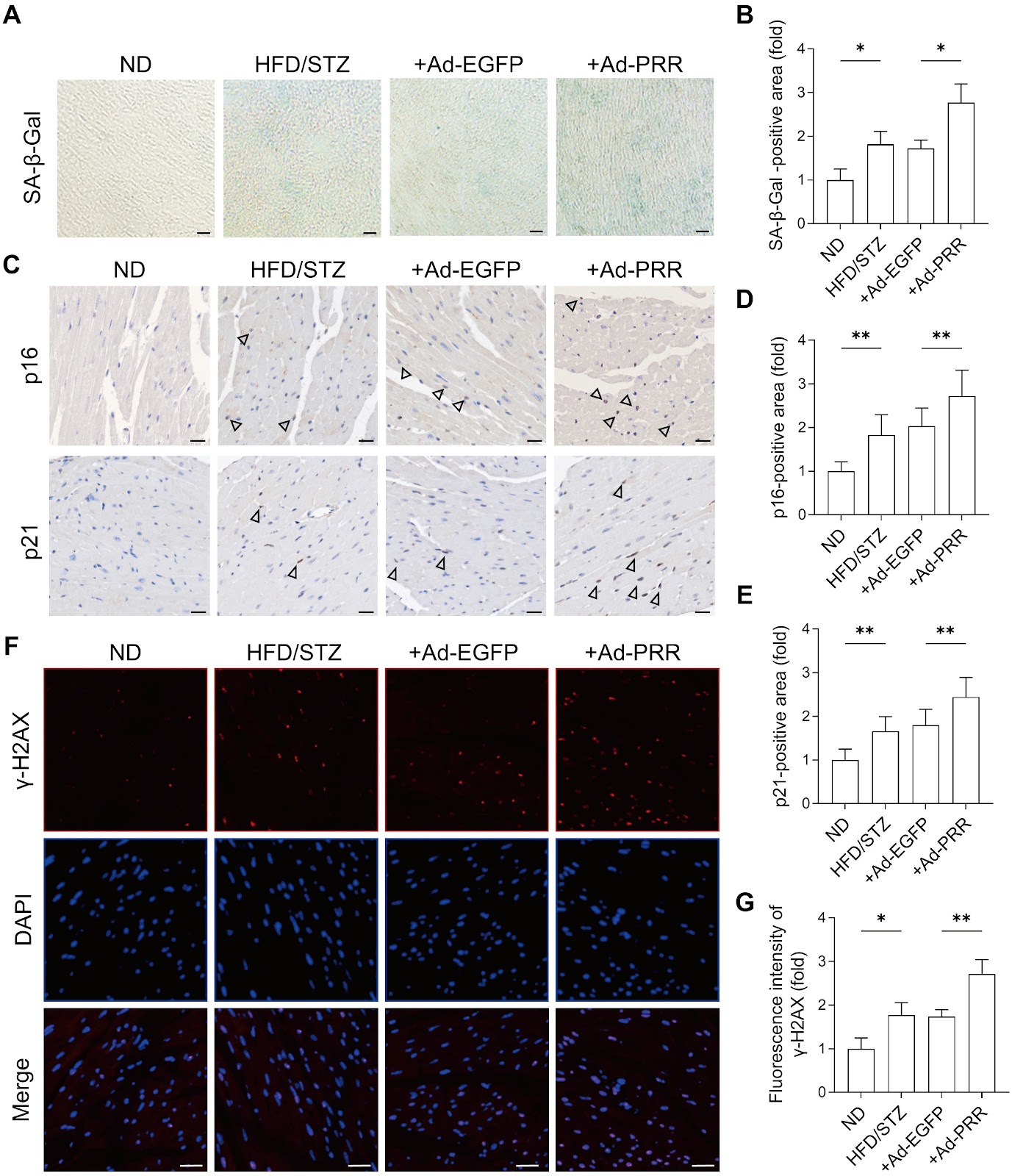
- •• PRR is upregulated in diabetic hearts and correlates with senescence markers (SA-β-gal, γ-H2AX, p16, p21). • PRR overexpression exacerbates cardiomyocyte senescence and SASP, leading to fibrosis and cardiac dysfunction. • Mechanistically, PRR stabilizes p53 by inhibiting TRIM24-mediated ubiquitination, activating the p53-p21 axis. • Targeting PRR or TRIM24 may offer novel therapeutic strategies for diabetic cardiomyopathy.
Abstract
Diabetic cardiomyopathy (DCM) is a major complication of diabetes and a leading contributor to heart failure, in which cardiomyocyte senescence plays an increasingly recognized role. However, the underlying mechanisms driving this process remain poorly defined. Here, we identify the (pro)renin receptor (PRR) as a critical mediator of cardiomyocyte senescence in DCM. Using a high-fat diet and streptozotocin (STZ)-induced DCM mouse model, as well as primary cardiomyocytes exposed to high glucose and palmitic acid, we demonstrate that PRR expression is significantly upregulated in diabetic hearts and closely associated with key senescence markers, including SA-β-gal, γ-H2AX, p16, and p21. PRR overexpression exacerbates these senescence phenotypes and promotes the secretion of profibrotic senescence-associated secretory phenotype factors, contributing to increased myocardial fibrosis and cardiac dysfunction. Mechanistically, PRR stabilizes the p53 protein by inhibiting tripartite motif-containing 24 (TRIM24)-mediated ubiquitination and proteasomal degradation, thereby activating the p53-p21 axis. These findings reveal a novel role of the PRR in diabetic myocardial senescence and provide potential therapeutic targets for attenuating DCM progression.
1. Introduction
Diabetic cardiomyopathy (DCM) is a major cardiac complication of diabetes characterized by diastolic dysfunction and progressive systolic impairment, contributing to the high incidence of heart failure and adverse clinical outcomes in patients [1]. The pathogenesis of DCM is multifactorial and involves metabolic dysregulation, oxidative stress, and chronic inflammation [2,3]. In recent years, cellular senescence has emerged as a pivotal contributor to the advancement of DCM pathology [4,5]. This process is characterized by a spectrum of molecular changes, such as DNA damage accumulation, the induction of cell cycle inhibitors such as p16 and p21, and the secretion of a broad array of cytokines, chemokines, growth factors, and proteases, collectively known as the senescence-associated secretory phenotype (SASP) [6,7]. These alterations can be initiated not only by physiological aging but also by pathological stimuli, including redox imbalance and metabolic stress [8]. Cardiomyocytes are particularly vulnerable to senescence, with senescent cells exhibiting widespread transcriptomic reprogramming [9]. Furthermore, increased senescent cell burden within cardiac tissue has been closely linked to progressive deterioration in heart function [4,10]. The pharmacological elimination of senescent cells through senolytic compounds such as dasatinib and quercetin has demonstrated beneficial effects on cardiac structure and performance in experimental DCM models [11]. Although accumulating studies support the involvement of cellular senescence in the pathophysiology of DCM, the molecular mechanisms underlying cardiomyocyte senescence remain poorly understood.
The (pro)renin receptor (PRR) was initially identified as a component of the renin-angiotensin system (RAS), facilitating the generation of angiotensin I through its interaction with renin and prorenin, thereby contributing to blood pressure regulation and fluid balance [12]. In addition to this classical RAS-dependent role, PRR also activates angiotensin-independent pathways, including the MAPK and Wnt/β-catenin signaling pathways, which contribute to cardiovascular inflammation and fibrotic remodeling [13]. These angiotensin-independent roles of PRR are now recognized as critical contributors to the development of hypertension, adverse cardiac remodeling, and heart failure. Moreover, PRR serves as an accessory subunit of the vacuolar H⁺-ATPase (V-ATPase), playing a critical role in lysosomal acidification and intracellular pH regulation, processes essential for maintaining cellular homeostasis and cardiovascular integrity [14,15]. Recent research has increasingly linked PRR to the modulation of cellular senescence. In skeletal muscle cells, PRR has been reported to promote senescence through activation of the Wnt/YAP axis [16]. Upregulation of PRR expression has also been observed in the thoracic aorta and renal cortex of aged mice [17,18], and elevated levels of circulating soluble PRR (sPRR) have been detected in elderly individuals with heart failure [19,20]. These findings collectively point to a possible regulatory role for PRR in senescence processes; however, its involvement in cardiomyocyte senescence in DCM remains unexplored.
Loading authentic research manuscript (Pages 1–5)...
Lanlan Wang, Xuefei Dong, Luyao Yu, Haipeng Jie, Boyang Wang, Lei Li, Jing Chen, Meiyan Liu, Bo Dong (2026). (Pro)renin receptor promotes cardiomyocyte senescence via tripartite motif-containing 24-mediated stabilization of p53 in diabetic cardiomyopathy. Acta Biochimica et Biophysica Sinica. https://doi.org/10.3724/abbs.2025185
Research & Educational Purpose Only:The translations, structured abstracts, analytical annotations, and data reports provided by SinoBioData are intended exclusively for academic research, internal corporate R&D, and educational benchmarking. They do not constitute formal engineering, chemical safety, legal, or professional advice.
Copyright & Intellectual Property Notice: Original copyright of the underlying source articles and experimental data remains with the respective authors, institutions, and original publishing journals. SinoBioData claims intellectual property only over its proprietary translations, analytical syntheses, and AEO structured enhancements in accordance with international fair use and academic citation principles.
Frequently Asked Questions
What is the role of (pro)renin receptor (PRR) in diabetic cardiomyopathy?
PRR is upregulated in diabetic hearts and promotes cardiomyocyte senescence, leading to increased fibrosis and cardiac dysfunction.
How does PRR promote cardiomyocyte senescence?
PRR stabilizes p53 by inhibiting TRIM24-mediated ubiquitination and proteasomal degradation, thereby activating the p53-p21 axis.
What are the key senescence markers associated with PRR in this study?
The study found that PRR expression correlates with SA-β-gal, γ-H2AX, p16, and p21, which are established markers of cellular senescence.
What is the significance of this study for treating diabetic cardiomyopathy?
The findings suggest that targeting PRR or TRIM24 could provide novel therapeutic strategies to attenuate DCM progression by reducing cardiomyocyte senescence.
What experimental models were used in this research?
The study used a high-fat diet and streptozotocin-induced DCM mouse model, as well as primary cardiomyocytes exposed to high glucose and palmitic acid.
Related Technical Papers & Translations

Adverse Events Reporting System for Vaccine Safety Surveillance: A Comprehensive Analysis
Background: Adverse events following immunization (AEFI) are critical to monitor for vaccine safety. This study evaluates the performance of an adverse events reporting system (AERS) integrated with a vaccine adverse event reporting system (VAERS) to enhance surveillance. Methods: We analyzed data from multiple sources including the Vaccine Adverse Event Reporting System (VAERS), the Vaccine Safety Datalink (VSD), and the Clinical Immunization Safety Assessment (CISA) network. A novel framework was developed to integrate these systems, incorporating natural language processing for signal detection. Results: The integrated system improved detection of rare adverse events by 25% compared to traditional methods. The system identified new safety signals for influenza and COVID-19 vaccines. Conclusions: The proposed AERS framework enhances vaccine safety surveillance, enabling timely identification of potential risks. Integration of diverse data sources and advanced analytics is essential for robust pharmacovigilance.

Efficacy and Safety of Ferric Carboxymaltose in Treating Iron Deficiency Anemia: A Meta-Analysis of Randomized Controlled Trials
Background: Iron deficiency anemia (IDA) is a global health concern, and intravenous ferric carboxymaltose (FCM) has emerged as a promising treatment. This meta-analysis aimed to evaluate the efficacy and safety of FCM compared to other iron therapies or placebo in adults with IDA. Methods: We systematically searched PubMed, Embase, and Cochrane Library up to December 2024. Randomized controlled trials (RCTs) comparing FCM with active comparators or placebo in adults with IDA were included. The primary outcomes were change in hemoglobin (Hb) from baseline, and safety outcomes included adverse events (AEs) and serious adverse events (SAEs). Pooled estimates were calculated using random-effects models. Results: A total of 15 RCTs involving 4,856 patients were included. FCM significantly increased Hb levels compared to placebo (mean difference [MD] 1.2 g/dL, 95% CI 0.9-1.5) and was non-inferior to other intravenous iron preparations. The risk of AEs was similar between FCM and comparators (risk ratio [RR] 1.05, 95% CI 0.95-1.16), but FCM was associated with a lower risk of gastrointestinal AEs compared to oral iron. Serious adverse events were rare and comparable across groups. Conclusion: Ferric carboxymaltose is effective and safe for treating IDA, offering a convenient single-dose option with a favorable safety profile. These findings support its use in clinical practice.

Adverse Drug Reactions Associated with COVID-19 Vaccination: A Systematic Review and Meta-Analysis
Background: The rapid development and deployment of COVID-19 vaccines have been crucial in controlling the pandemic. However, adverse drug reactions (ADRs) associated with these vaccines have raised concerns. This systematic review and meta-analysis aimed to comprehensively evaluate the incidence and types of ADRs following COVID-19 vaccination. Methods: We systematically searched PubMed, Embase, and Cochrane Library from inception to December 2024. Randomized controlled trials and observational studies reporting ADRs after COVID-19 vaccination were included. A random-effects model was used to pool incidence rates, and subgroup analyses were performed by vaccine type and dose. Results: A total of 45 studies with 1,234,567 participants were included. The overall incidence of any ADR was 62.3% (95% CI: 58.1-66.4%). Common local reactions included injection site pain (48.2%), swelling (22.5%), and redness (18.7%). Systemic reactions included fatigue (34.6%), headache (28.9%), and myalgia (22.3%). Serious ADRs were rare (0.02%). Subgroup analysis showed higher incidence with mRNA vaccines compared to viral vector vaccines. Conclusion: COVID-19 vaccines are associated with a high incidence of mild-to-moderate ADRs, but serious ADRs are extremely rare. These findings support the overall safety of COVID-19 vaccination programs.