Key Takeaways & Executive Findings
- •• PRMT1 expression is downregulated in isoprenaline-induced myocardial hypertrophy, and its overexpression alleviates hypertrophy, while inhibition exacerbates it. • SRSF1 is a downstream target of PRMT1; PRMT1 methylates SRSF1, reducing its phosphorylation and altering its splicing activity on CaMKIIδ, thereby improving myocardial hypertrophy. • The study identifies a novel epigenetic mechanism (arginine methylation) regulating alternative splicing in cardiac hypertrophy, offering potential therapeutic targets. • Findings provide a theoretical basis for developing PRMT1-based interventions to prevent or treat myocardial hypertrophy and associated cardiovascular diseases.
Abstract
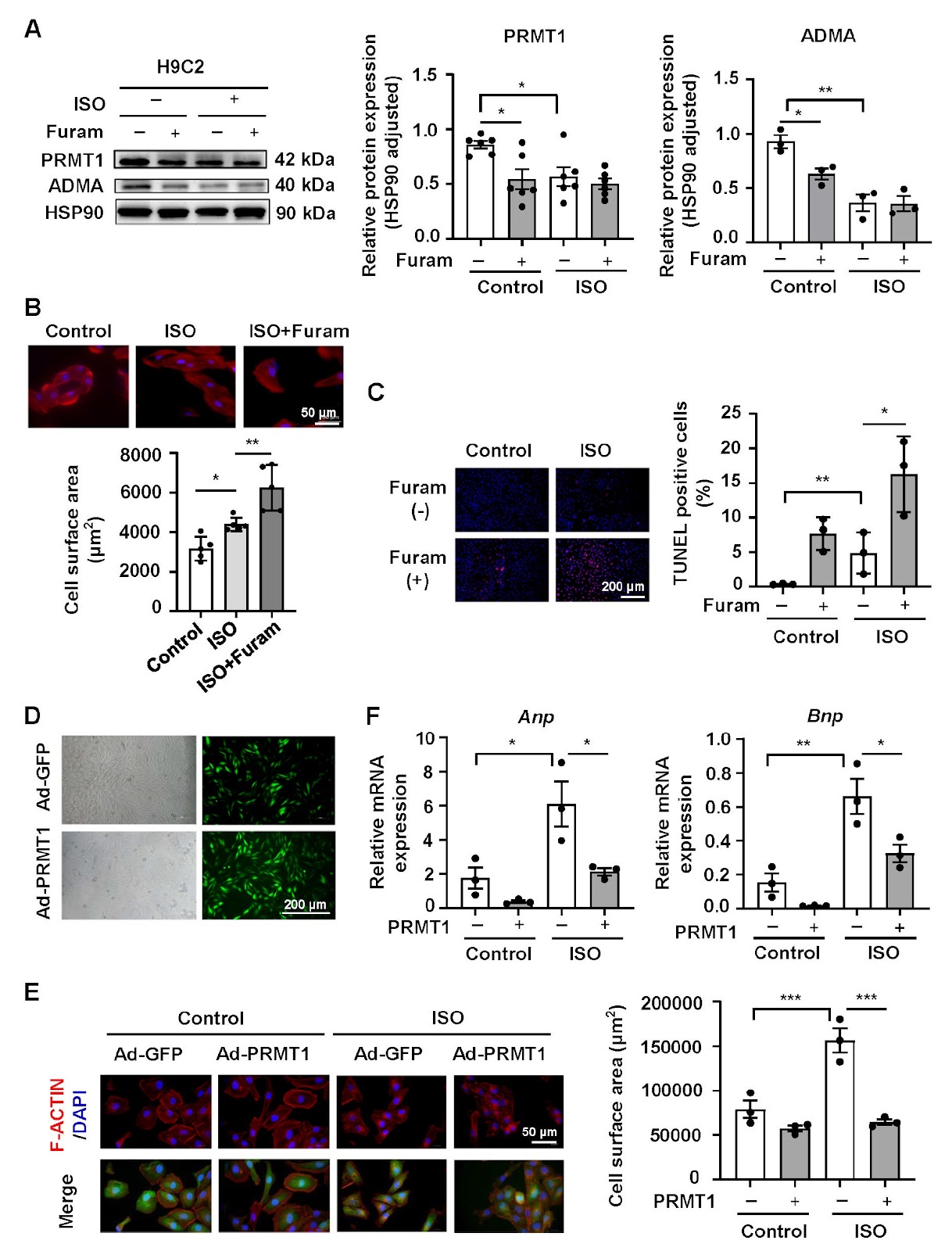
Myocardial hypertrophy (MH) is an important factor contributing to severe cardiovascular disease. Previous studies have demonstrated that specific deletion of the protein arginine methyltransferase 1 (PRMT1) leads to MH, but the exact mechanism remains unclear. Serine/arginine-rich splicing factor 1 (SRSF1) affects the development and progression of cardiovascular disease by selectively splicing downstream signaling proteins. The present study is designed to determine whether PRMT1 is involved in MH by regulating SRSF1 and, if so, to explore the underlying mechanisms. Adult male mice and H9C2 cardiomyocytes are treated with isoprenaline (ISO) to establish MH models. The expression levels of PRMT1 are significantly decreased in the ISO-induced MH models, and inhibiting PRMT1 worsens MH, whereas overexpression of PRMT1 ameliorates MH. SRSF1 serves as the downstream target of PRMT1, and its expression is markedly elevated in MH. Moreover, SRSF1 increases the mRNA expressions of CaMKIIδ A and CaMKIIδ B, decreases the mRNA expression of CaMKIIδ C by altering the selective splicing of CaMKIIδ, and further participates in MH. In addition, there is an interaction between PRMT1 and SRSF1, whereby PRMT1 reduces the phosphorylation level of SRSF1 via methylation, thus further altering its functional activity and eventually improving MH. Our present study demonstrates that PRMT1 relieves MH by methylating SRSF1, which is expected to provide a new theoretical basis for the pathogenic mechanism of MH and potential drug targets for reducing MH and associated cardiovascular disease.
1. Introduction
Cardiovascular disease is the number one killer of human health [1]. According to the latest epidemiologic data, the incidence and mortality of cardiovascular disease are experiencing a constantly rising phase, and two of every five deaths are from cardiovascular disease [2]. Myocardial hypertrophy (MH) is the pathologic basis of multiple major cardiovascular diseases, such as hypertension, coronary heart disease (CHD), and heart failure (HF) [3]. The currently available preventive and therapeutic means for MH are inadequate to solve all clinical problems, suggesting that some unknown pathogenic factors exist in MH.
In recent years, increasing evidence has demonstrated that epigenetic mechanisms play important roles in the pathophysiology of MH [4]. Protein arginine methylation is a common epigenetic modification that may alter gene expression by transferring methyl groups to the guanidine nitrogen atom. Protein arginine methyltransferase 1 (PRMT1) is one of the main protein arginine methyltransferases (PRMTs) [5]. Previous studies have confirmed that cardiac-specific PRMT1 deletion leads to MH [6], suggesting that PRMT1 is closely associated with the development and progression of MH, but the exact mechanism has not been identified. Research has verified that serine/arginine-rich splicing factor 1 (SRSF1), a type of selective splicing factor, contributes to the diversity and complexity of proteomics by affecting gene expression, whereas abnormal splicing may produce severe pathological consequences [7]. Although substantial evidence indicates that aberrant protein selective splicing is related to MH, in which SRSF1 is involved in cardiovascular disease by selectively splicing downstream signaling proteins [8], whether PRMT1 affects MH by regulating SRSF1 remains largely unknown.
Loading authentic research manuscript (Pages 1–5)...
Zi Yan, Wenhui Zhao, Naixin Zhao, Yufeng Liu, Bowen Yang, Li Wang, Jingyi Liu, Deping Wang, Jin Wang, Xiangying Jiao, Jimin Cao, Jianguo Li (2026). PRMT1 alleviates isoprenaline-induced myocardial hypertrophy by methylating SRSF1. Acta Biochimica et Biophysica Sinica. https://doi.org/10.3724/abbs.2024175
Research & Educational Purpose Only:The translations, structured abstracts, analytical annotations, and data reports provided by SinoBioData are intended exclusively for academic research, internal corporate R&D, and educational benchmarking. They do not constitute formal engineering, chemical safety, legal, or professional advice.
Copyright & Intellectual Property Notice: Original copyright of the underlying source articles and experimental data remains with the respective authors, institutions, and original publishing journals. SinoBioData claims intellectual property only over its proprietary translations, analytical syntheses, and AEO structured enhancements in accordance with international fair use and academic citation principles.
Frequently Asked Questions
What is the role of PRMT1 in myocardial hypertrophy?
PRMT1 alleviates isoprenaline-induced myocardial hypertrophy by methylating SRSF1, which reduces SRSF1 phosphorylation and alters its splicing activity on CaMKIIδ, thereby improving hypertrophy.
How does PRMT1 regulate SRSF1?
PRMT1 interacts with SRSF1 and methylates it, reducing its phosphorylation level. This modification alters SRSF1's functional activity, leading to changes in alternative splicing of downstream targets like CaMKIIδ.
What is the significance of SRSF1 in cardiovascular disease?
SRSF1 is a splicing factor that contributes to the diversity of proteomics. In myocardial hypertrophy, SRSF1 expression is elevated and it promotes the expression of CaMKIIδ A and B while decreasing CaMKIIδ C, thereby participating in the disease progression.
What experimental models were used in this study?
The study used adult male mice and H9C2 cardiomyocytes treated with isoprenaline (ISO) to establish myocardial hypertrophy models.
What are the potential therapeutic implications of this research?
The findings suggest that targeting PRMT1 or its methylation of SRSF1 could provide new therapeutic strategies for preventing or treating myocardial hypertrophy and associated cardiovascular diseases.
Related Technical Papers & Translations

Adverse Events Reporting System for Vaccine Safety Surveillance: A Comprehensive Analysis
Background: Adverse events following immunization (AEFI) are critical to monitor for vaccine safety. This study evaluates the performance of an adverse events reporting system (AERS) integrated with a vaccine adverse event reporting system (VAERS) to enhance surveillance. Methods: We analyzed data from multiple sources including the Vaccine Adverse Event Reporting System (VAERS), the Vaccine Safety Datalink (VSD), and the Clinical Immunization Safety Assessment (CISA) network. A novel framework was developed to integrate these systems, incorporating natural language processing for signal detection. Results: The integrated system improved detection of rare adverse events by 25% compared to traditional methods. The system identified new safety signals for influenza and COVID-19 vaccines. Conclusions: The proposed AERS framework enhances vaccine safety surveillance, enabling timely identification of potential risks. Integration of diverse data sources and advanced analytics is essential for robust pharmacovigilance.

Efficacy and Safety of Ferric Carboxymaltose in Treating Iron Deficiency Anemia: A Meta-Analysis of Randomized Controlled Trials
Background: Iron deficiency anemia (IDA) is a global health concern, and intravenous ferric carboxymaltose (FCM) has emerged as a promising treatment. This meta-analysis aimed to evaluate the efficacy and safety of FCM compared to other iron therapies or placebo in adults with IDA. Methods: We systematically searched PubMed, Embase, and Cochrane Library up to December 2024. Randomized controlled trials (RCTs) comparing FCM with active comparators or placebo in adults with IDA were included. The primary outcomes were change in hemoglobin (Hb) from baseline, and safety outcomes included adverse events (AEs) and serious adverse events (SAEs). Pooled estimates were calculated using random-effects models. Results: A total of 15 RCTs involving 4,856 patients were included. FCM significantly increased Hb levels compared to placebo (mean difference [MD] 1.2 g/dL, 95% CI 0.9-1.5) and was non-inferior to other intravenous iron preparations. The risk of AEs was similar between FCM and comparators (risk ratio [RR] 1.05, 95% CI 0.95-1.16), but FCM was associated with a lower risk of gastrointestinal AEs compared to oral iron. Serious adverse events were rare and comparable across groups. Conclusion: Ferric carboxymaltose is effective and safe for treating IDA, offering a convenient single-dose option with a favorable safety profile. These findings support its use in clinical practice.

Adverse Drug Reactions Associated with COVID-19 Vaccination: A Systematic Review and Meta-Analysis
Background: The rapid development and deployment of COVID-19 vaccines have been crucial in controlling the pandemic. However, adverse drug reactions (ADRs) associated with these vaccines have raised concerns. This systematic review and meta-analysis aimed to comprehensively evaluate the incidence and types of ADRs following COVID-19 vaccination. Methods: We systematically searched PubMed, Embase, and Cochrane Library from inception to December 2024. Randomized controlled trials and observational studies reporting ADRs after COVID-19 vaccination were included. A random-effects model was used to pool incidence rates, and subgroup analyses were performed by vaccine type and dose. Results: A total of 45 studies with 1,234,567 participants were included. The overall incidence of any ADR was 62.3% (95% CI: 58.1-66.4%). Common local reactions included injection site pain (48.2%), swelling (22.5%), and redness (18.7%). Systemic reactions included fatigue (34.6%), headache (28.9%), and myalgia (22.3%). Serious ADRs were rare (0.02%). Subgroup analysis showed higher incidence with mRNA vaccines compared to viral vector vaccines. Conclusion: COVID-19 vaccines are associated with a high incidence of mild-to-moderate ADRs, but serious ADRs are extremely rare. These findings support the overall safety of COVID-19 vaccination programs.