Key Takeaways & Executive Findings
- •• PD-1/PD-L1 immune checkpoint is a key mediator of tumor immune escape, and posttranslational modifications (PTMs) critically regulate PD-L1 stability and function. • Small-molecule compounds that modulate PD-L1 PTMs offer a promising alternative to monoclonal antibody immunotherapies, overcoming limitations such as poor oral bioavailability and high cost. • The review highlights specific PTMs (e.g., ubiquitination, glycosylation, phosphorylation) and small-molecule examples that promote PD-L1 degradation, thereby enhancing antitumor immunity. • Targeting PD-L1 PTMs with small molecules represents a novel therapeutic strategy with potential to improve clinical outcomes in cancer patients.
Abstract
Despite the tremendous progress in cancer research over the past few decades, effective therapeutic strategies are still urgently needed. Accumulating evidence suggests that immune checkpoints are the cause of tumor immune escape. PD-1/PD-L1 are among them. Posttranslational modification is the most critical step for protein function, and the regulation of PD-L1 by small molecules through posttranslational modification is highly valuable. In this review, we discuss the mechanisms of tumor cell immune escape and several posttranslational modifications associated with PD-L1 and describe examples in which small molecules can regulate PD-L1 through posttranslational modifications. Herein, we propose that the use of small molecule compounds that act by inhibiting PD-L1 through posttranslational modifications is a promising therapeutic approach with the potential to improve clinical outcomes for cancer patients.
1. Introduction
Immunotherapy, which refers to the state of hypo- or hyperimmunity in the body, artificially enhances or suppresses the body's immune function to achieve therapeutic disease treatment and is gradually becoming an important method for the treatment of cancer. Among numerous immunotherapeutic strategies, immune checkpoint blockade has shown clear advantages in the treatment of a range of cancers. Immune checkpoints increase antitumor immunity by blocking immune-related intrinsic downregulators, such as cytotoxic T lymphocyte antigen 4 (CTLA-4) and programmed cell death 1 (PD-1) or its ligand programmed cell death ligand 1 (PD-L1). Among them, PD-1 is an immune checkpoint receptor that restricts T-cell effector functions in tissues. It has also been the research focus of tumor immunotherapy in recent years, and it is widely used in the clinic. PD-L1, a known PD-1 receptor, can be expressed in normal cells when combined with PD-1 in immune cells to circumvent the killing of immune cells, thus effectively preventing autoimmune diseases, and is expressed in cancer cells to induce immunosuppression and thereby promote immune escape.
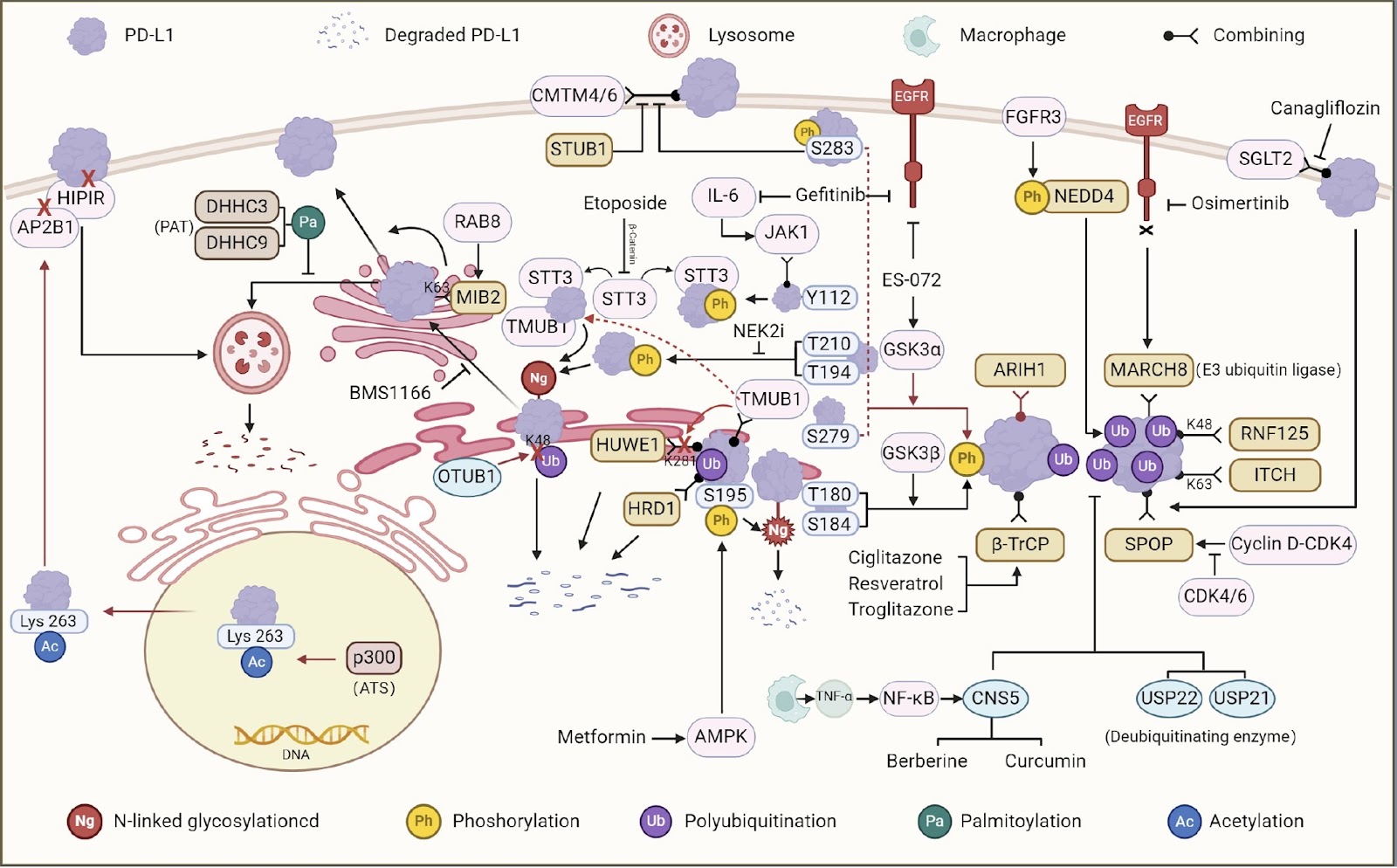
Cancer immunotherapy is a therapeutic approach to reinitiate and maintain the tumor immune cycle and restore the body's antitumor immune response so that immune cells can recognize and kill tumor cells normally, thereby achieving control and clearance of tumor cells in the body. Common tumor immunotherapies include immune checkpoint inhibitors and adoptive cell therapies. In 2014, the first PD-1 monoclonal antibody, nivolumab, was approved for the treatment of melanoma [1,2]. To date, α-PD-1/PD-L1 therapy has shown potent antitumor activity in various cancers, such as melanoma, non-small cell lung cancer (NSCLC), gastric cancer, liver cancer, urothelial cancer, lymphoma, and all microsatellite instability (MSI)-high cancers. Immune checkpoint inhibitors (ICIs) have emerged as highly effective therapies for many cancers. All approved ICIs to date are mAbs, but mAbs, as a type of macromolecular therapeutic, suffer from many inherent drawbacks, including poor oral bioavailability, prolonged tissue retention and half-life, and poor membrane permeability, transport and storage. In addition, the higher cost of antibody drugs is also a nonnegligible issue. Therefore, downregulating the expression of PD-L1 in tumor cells using small molecule compounds is a very promising treatment option (Figure 1).
Loading authentic research manuscript (Pages 1–5)...
Minchen Cai, Mengting Xu, Dianping Yu, Qun Wang, Sanhong Liu (2026). Posttranslational regulatory mechanism of PD-L1 in cancers and associated opportunities for novel small-molecule therapeutics. Acta Biochimica et Biophysica Sinica. https://doi.org/10.3724/abbs.2024085
Research & Educational Purpose Only:The translations, structured abstracts, analytical annotations, and data reports provided by SinoBioData are intended exclusively for academic research, internal corporate R&D, and educational benchmarking. They do not constitute formal engineering, chemical safety, legal, or professional advice.
Copyright & Intellectual Property Notice: Original copyright of the underlying source articles and experimental data remains with the respective authors, institutions, and original publishing journals. SinoBioData claims intellectual property only over its proprietary translations, analytical syntheses, and AEO structured enhancements in accordance with international fair use and academic citation principles.
Frequently Asked Questions
What is the role of PD-L1 posttranslational modifications in cancer?
Posttranslational modifications (PTMs) of PD-L1, such as ubiquitination, glycosylation, and phosphorylation, critically regulate its stability, localization, and function. These modifications can either stabilize PD-L1 to promote immune escape or lead to its degradation, thereby modulating antitumor immunity. Understanding these PTMs offers opportunities for therapeutic intervention.
Why are small-molecule compounds promising for targeting PD-L1?
Small-molecule compounds offer advantages over monoclonal antibodies, including oral bioavailability, better tissue penetration, lower cost, and easier manufacturing. By modulating PD-L1 posttranslational modifications, they can promote PD-L1 degradation and enhance antitumor immunity, potentially improving clinical outcomes.
What are the limitations of current PD-1/PD-L1 monoclonal antibody therapies?
Monoclonal antibodies have drawbacks such as poor oral bioavailability, prolonged tissue retention and half-life, poor membrane permeability, and high cost. These limitations highlight the need for alternative small-molecule approaches that can be more convenient and cost-effective.
How do small molecules regulate PD-L1 through posttranslational modifications?
Small molecules can either inhibit enzymes that add stabilizing modifications (e.g., glycosylation) or activate pathways that promote degradative modifications (e.g., ubiquitination). This leads to reduced PD-L1 expression on tumor cells, thereby restoring T-cell activity and enhancing immune-mediated tumor killing.
What is the clinical significance of targeting PD-L1 posttranslational modifications?
Targeting PD-L1 PTMs with small molecules provides a novel therapeutic strategy that may overcome resistance to existing immunotherapies, improve response rates, and expand the patient population that benefits from immunotherapy. It also offers the potential for combination therapies with other treatments.
Related Technical Papers & Translations

Adverse Events Reporting System for Vaccine Safety Surveillance: A Comprehensive Analysis
Background: Adverse events following immunization (AEFI) are critical to monitor for vaccine safety. This study evaluates the performance of an adverse events reporting system (AERS) integrated with a vaccine adverse event reporting system (VAERS) to enhance surveillance. Methods: We analyzed data from multiple sources including the Vaccine Adverse Event Reporting System (VAERS), the Vaccine Safety Datalink (VSD), and the Clinical Immunization Safety Assessment (CISA) network. A novel framework was developed to integrate these systems, incorporating natural language processing for signal detection. Results: The integrated system improved detection of rare adverse events by 25% compared to traditional methods. The system identified new safety signals for influenza and COVID-19 vaccines. Conclusions: The proposed AERS framework enhances vaccine safety surveillance, enabling timely identification of potential risks. Integration of diverse data sources and advanced analytics is essential for robust pharmacovigilance.

Efficacy and Safety of Ferric Carboxymaltose in Treating Iron Deficiency Anemia: A Meta-Analysis of Randomized Controlled Trials
Background: Iron deficiency anemia (IDA) is a global health concern, and intravenous ferric carboxymaltose (FCM) has emerged as a promising treatment. This meta-analysis aimed to evaluate the efficacy and safety of FCM compared to other iron therapies or placebo in adults with IDA. Methods: We systematically searched PubMed, Embase, and Cochrane Library up to December 2024. Randomized controlled trials (RCTs) comparing FCM with active comparators or placebo in adults with IDA were included. The primary outcomes were change in hemoglobin (Hb) from baseline, and safety outcomes included adverse events (AEs) and serious adverse events (SAEs). Pooled estimates were calculated using random-effects models. Results: A total of 15 RCTs involving 4,856 patients were included. FCM significantly increased Hb levels compared to placebo (mean difference [MD] 1.2 g/dL, 95% CI 0.9-1.5) and was non-inferior to other intravenous iron preparations. The risk of AEs was similar between FCM and comparators (risk ratio [RR] 1.05, 95% CI 0.95-1.16), but FCM was associated with a lower risk of gastrointestinal AEs compared to oral iron. Serious adverse events were rare and comparable across groups. Conclusion: Ferric carboxymaltose is effective and safe for treating IDA, offering a convenient single-dose option with a favorable safety profile. These findings support its use in clinical practice.

Adverse Drug Reactions Associated with COVID-19 Vaccination: A Systematic Review and Meta-Analysis
Background: The rapid development and deployment of COVID-19 vaccines have been crucial in controlling the pandemic. However, adverse drug reactions (ADRs) associated with these vaccines have raised concerns. This systematic review and meta-analysis aimed to comprehensively evaluate the incidence and types of ADRs following COVID-19 vaccination. Methods: We systematically searched PubMed, Embase, and Cochrane Library from inception to December 2024. Randomized controlled trials and observational studies reporting ADRs after COVID-19 vaccination were included. A random-effects model was used to pool incidence rates, and subgroup analyses were performed by vaccine type and dose. Results: A total of 45 studies with 1,234,567 participants were included. The overall incidence of any ADR was 62.3% (95% CI: 58.1-66.4%). Common local reactions included injection site pain (48.2%), swelling (22.5%), and redness (18.7%). Systemic reactions included fatigue (34.6%), headache (28.9%), and myalgia (22.3%). Serious ADRs were rare (0.02%). Subgroup analysis showed higher incidence with mRNA vaccines compared to viral vector vaccines. Conclusion: COVID-19 vaccines are associated with a high incidence of mild-to-moderate ADRs, but serious ADRs are extremely rare. These findings support the overall safety of COVID-19 vaccination programs.