Key Takeaways & Executive Findings
- •• Phillyrin (PHI) preadministration significantly reduces sepsis-induced pulmonary edema, inflammation, and histological damage in mice, indicating its preventive potential against acute lung injury (ALI). • PHI suppresses the activation of the NLRP3/caspase-1/GSDMD pyroptosis pathway in alveolar epithelial cells, both in vivo and in vitro, highlighting its mechanism of action. • Molecular docking and surface plasmon resonance demonstrate that PHI directly binds to GSDMD protein, identifying GSDMD as a potential pharmacological target for PHI. • These findings support PHI as a promising therapeutic candidate for sepsis-induced ALI, offering a novel approach targeting pyroptosis.
Abstract
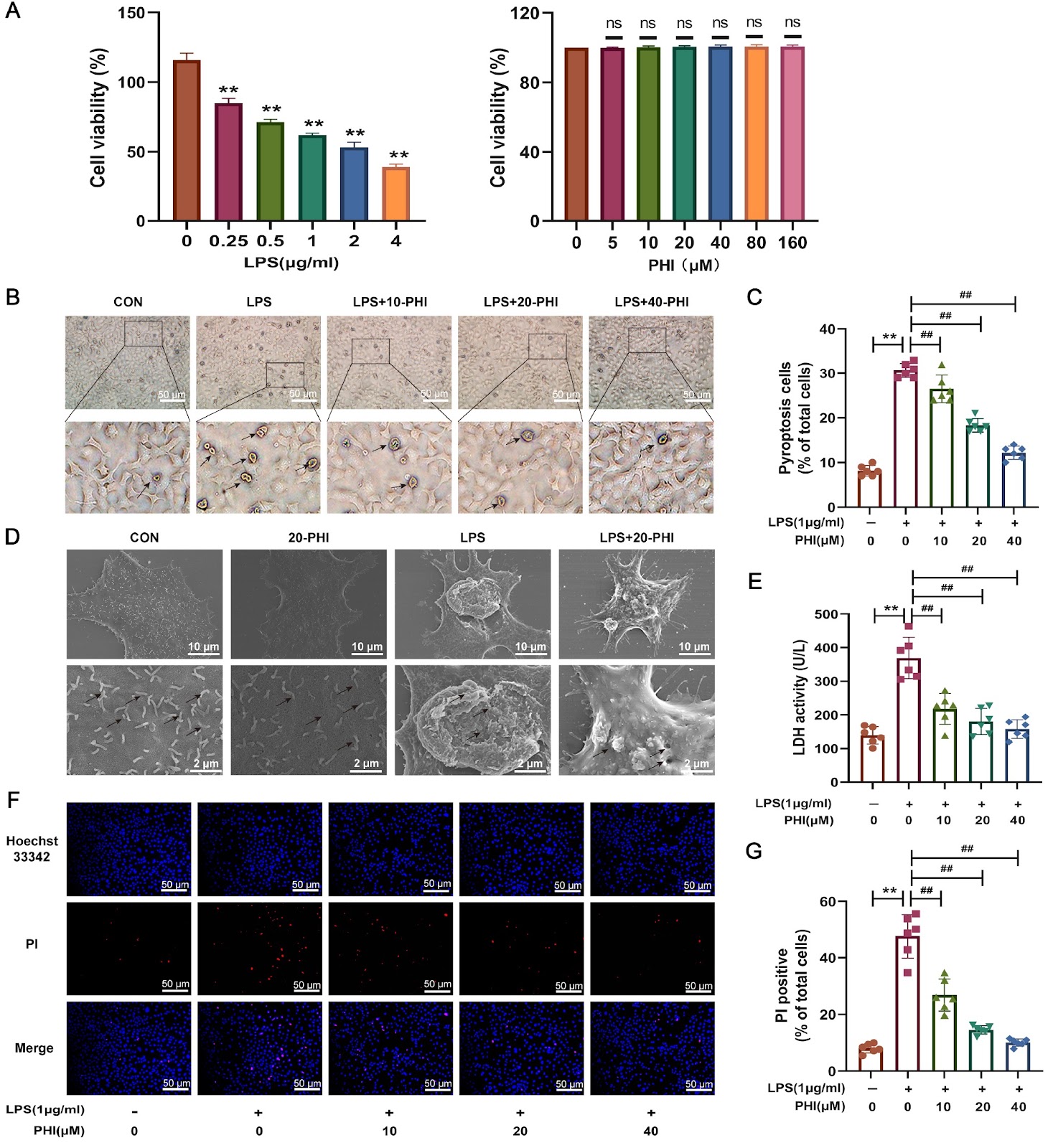
Acute lung injury (ALI) is a severe pulmonary disorder of sepsis with high clinical incidence and mortality. Nucleotide-binding oligomerization domain-like receptor family pyrin domain containing 3 (NLRP3)-cysteinyl aspartate specific proteinase 1-gasdermin D (GSDMD)-dependent pyroptosis of alveolar epithelial cells (AECs) has emerged as a crucial contributor to ALI during sepsis. Phillyrin (PHI), a natural lignan isolated from the traditional Chinese herbal medicine Forsythia suspensa, has been shown to have anti-inflammatory, antioxidant and antiviral properties. However, little is known about the protective role and potential mechanism of PHI in sepsis-induced ALI, and it is uncertain whether the protective effect of PHI in sepsis-induced ALI is connected to pyroptosis. This study aims to examine the preventive effects of PHI on sepsis-induced ALI via the inhibition of NLRP3/caspase-1/GSDMD-mediated pyroptosis in AECs. Our findings demonstrate that preadministration of PHI successfully reduces sepsis-induced pulmonary edema, systemic/pulmonary inflammation, and pulmonary histological damage in lung tissues, bronchoalveolar lavage fluid, and the serum of septic mice. Intriguingly, PHI preadministration suppresses sepsis-induced protein expressions of pyroptosis-specific markers, especially their active forms. In vitro assays show that PHI pretreatment also protects type II AECs (MLE-12) from lipopolysaccharide-induced pyroptosis by preventing the activation of the pyroptosis signaling pathway. The results from molecular docking and surface plasmon resonance reveal that PHI has a significant affinity for direct binding to the GSDMD protein, suggesting that GSDMD is a potential pharmacological target for PHI. In conclusion, PHI can prevent sepsis-triggered ALI by effectively suppressing the activation of the canonical pyroptosis signaling pathway and pyroptosis of AECs.
1. Introduction
In the intensive care unit, acute lung injury (ALI) results in severe pulmonary inflammation, pulmonary edema, pulmonary vascular engorgement, diffuse alveolar damage, and refractory hypoxemia [1–3]. Sepsis is the most common risk factor for ALI [4–7]. The fatality rate of sepsis-induced ALI is still as high as 40% [2,8]. Although western medicine that treats sepsis-induced ALI such as broad-spectrum antibiotics, vasoactive medications, and glucocorticoids [3,4,9‒11] may be used to treat clinical symptoms, the complicated and diverse pathophysiology of sepsis-induced ALI makes it difficult to find precise treatments. Furthermore, the toxicity and side effects of existing therapeutic agents do not considerably improve patient prognosis [4,10,12]. Thus, investigating the molecular mechanism of ALI, as well as discovering safe and viable targeted medications for combating ALI, is critical.
The pathological features of sepsis-mediated ALI are lung inflammation, cytokine storms, and damage/dysfunction of the alveolar epithelium-capillary selective barrier [13,14]. Alveolar epithelial cells (AECs) are important defense barriers in lung tissue that can resist the invasion of pathogenic microorganisms while maintaining the integrity of lung tissue in terms of functional and structural dimensions [13]. However, the death of AECs is inexorably connected to the collapse of the alveolar epithelial barrier and the occurrence of ALI [12,14]. Several investigations have revealed that the pathogenesis of ALI in sepsis is accompanied by unique proinflammatory programmed cell death-pyroptosis of AECs [12,13,15,16]. Pyroptosis in human AECs was shown to play a crucial role in lipopolysaccharide (LPS)-induced ALI. Xiang et al. [13], Wang et al. [15], Kang et al. [17] and Zhang et al. [5] studied sepsis, LPS, and H9N2 influenza virus-induced pyroptosis and cytokine storms as prominent mechanisms of ALI.
Loading authentic research manuscript (Pages 1–5)...
Chen Ji, Xiaoyan Hao, Zhiyi Li, Jiaxing Liu, Hanyu Yan, Ketao Ma, Ling Li, Liang Zhang (2026). Phillyrin prevents sepsis-induced acute lung injury through inhibiting the NLRP3/caspase-1/GSDMD-dependent pyroptosis signaling pathway. Acta Biochimica et Biophysica Sinica. https://doi.org/10.3724/abbs.2024161
Research & Educational Purpose Only:The translations, structured abstracts, analytical annotations, and data reports provided by SinoBioData are intended exclusively for academic research, internal corporate R&D, and educational benchmarking. They do not constitute formal engineering, chemical safety, legal, or professional advice.
Copyright & Intellectual Property Notice: Original copyright of the underlying source articles and experimental data remains with the respective authors, institutions, and original publishing journals. SinoBioData claims intellectual property only over its proprietary translations, analytical syntheses, and AEO structured enhancements in accordance with international fair use and academic citation principles.
Frequently Asked Questions
What is the main finding of this study?
The study demonstrates that phillyrin (PHI) prevents sepsis-induced acute lung injury by inhibiting the NLRP3/caspase-1/GSDMD-dependent pyroptosis signaling pathway in alveolar epithelial cells.
How does phillyrin exert its protective effect?
Phillyrin directly binds to GSDMD protein, suppressing the activation of the pyroptosis pathway, reducing inflammation and pulmonary damage in septic mice.
What is the significance of targeting GSDMD?
GSDMD is a key executor of pyroptosis; targeting it with phillyrin offers a novel therapeutic strategy for sepsis-induced acute lung injury.
What experimental models were used?
The study used a mouse model of sepsis and in vitro assays with MLE-12 alveolar epithelial cells, along with molecular docking and surface plasmon resonance.
What are the potential clinical implications?
Phillyrin could be developed as a preventive or therapeutic agent for sepsis-induced acute lung injury, addressing a critical need for effective treatments.
Related Technical Papers & Translations

Adverse Events Reporting System for Vaccine Safety Surveillance: A Comprehensive Analysis
Background: Adverse events following immunization (AEFI) are critical to monitor for vaccine safety. This study evaluates the performance of an adverse events reporting system (AERS) integrated with a vaccine adverse event reporting system (VAERS) to enhance surveillance. Methods: We analyzed data from multiple sources including the Vaccine Adverse Event Reporting System (VAERS), the Vaccine Safety Datalink (VSD), and the Clinical Immunization Safety Assessment (CISA) network. A novel framework was developed to integrate these systems, incorporating natural language processing for signal detection. Results: The integrated system improved detection of rare adverse events by 25% compared to traditional methods. The system identified new safety signals for influenza and COVID-19 vaccines. Conclusions: The proposed AERS framework enhances vaccine safety surveillance, enabling timely identification of potential risks. Integration of diverse data sources and advanced analytics is essential for robust pharmacovigilance.

Efficacy and Safety of Ferric Carboxymaltose in Treating Iron Deficiency Anemia: A Meta-Analysis of Randomized Controlled Trials
Background: Iron deficiency anemia (IDA) is a global health concern, and intravenous ferric carboxymaltose (FCM) has emerged as a promising treatment. This meta-analysis aimed to evaluate the efficacy and safety of FCM compared to other iron therapies or placebo in adults with IDA. Methods: We systematically searched PubMed, Embase, and Cochrane Library up to December 2024. Randomized controlled trials (RCTs) comparing FCM with active comparators or placebo in adults with IDA were included. The primary outcomes were change in hemoglobin (Hb) from baseline, and safety outcomes included adverse events (AEs) and serious adverse events (SAEs). Pooled estimates were calculated using random-effects models. Results: A total of 15 RCTs involving 4,856 patients were included. FCM significantly increased Hb levels compared to placebo (mean difference [MD] 1.2 g/dL, 95% CI 0.9-1.5) and was non-inferior to other intravenous iron preparations. The risk of AEs was similar between FCM and comparators (risk ratio [RR] 1.05, 95% CI 0.95-1.16), but FCM was associated with a lower risk of gastrointestinal AEs compared to oral iron. Serious adverse events were rare and comparable across groups. Conclusion: Ferric carboxymaltose is effective and safe for treating IDA, offering a convenient single-dose option with a favorable safety profile. These findings support its use in clinical practice.

Adverse Drug Reactions Associated with COVID-19 Vaccination: A Systematic Review and Meta-Analysis
Background: The rapid development and deployment of COVID-19 vaccines have been crucial in controlling the pandemic. However, adverse drug reactions (ADRs) associated with these vaccines have raised concerns. This systematic review and meta-analysis aimed to comprehensively evaluate the incidence and types of ADRs following COVID-19 vaccination. Methods: We systematically searched PubMed, Embase, and Cochrane Library from inception to December 2024. Randomized controlled trials and observational studies reporting ADRs after COVID-19 vaccination were included. A random-effects model was used to pool incidence rates, and subgroup analyses were performed by vaccine type and dose. Results: A total of 45 studies with 1,234,567 participants were included. The overall incidence of any ADR was 62.3% (95% CI: 58.1-66.4%). Common local reactions included injection site pain (48.2%), swelling (22.5%), and redness (18.7%). Systemic reactions included fatigue (34.6%), headache (28.9%), and myalgia (22.3%). Serious ADRs were rare (0.02%). Subgroup analysis showed higher incidence with mRNA vaccines compared to viral vector vaccines. Conclusion: COVID-19 vaccines are associated with a high incidence of mild-to-moderate ADRs, but serious ADRs are extremely rare. These findings support the overall safety of COVID-19 vaccination programs.