Key Takeaways & Executive Findings
- •• PDK4 is identified as a key gene in mesothelial cells during colorectal cancer peritoneal metastasis, with elevated expression in cells undergoing mesothelial-to-mesenchymal transition (MMT). • PDK4 promotes mesothelial cell invasion by enhancing fatty acid oxidation (FAO), which is essential for the invasive phenotype. • PDK4-driven FAO leads to increased acetylation of β-catenin, a modification critical for mesothelial cell invasion. • Targeting PDK4 or FAO may offer a novel therapeutic strategy to inhibit peritoneal metastasis in colorectal cancer.
Abstract
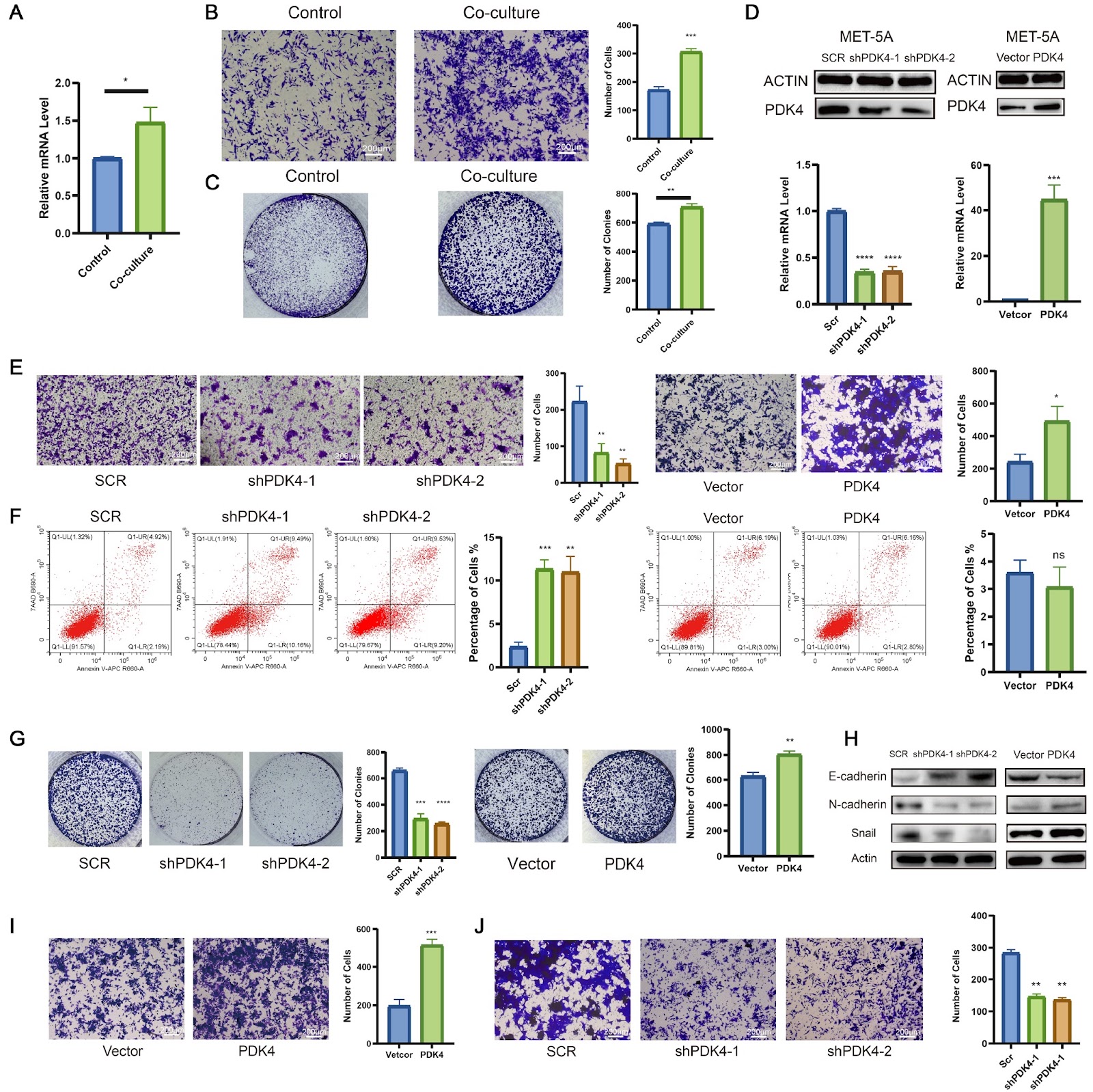
Mesothelial cells play an important role in colorectal cancer peritoneal metastasis (CRC-PM), where they support tumor growth and invasion. In this study, we investigate the molecular mechanisms by which mesothelial cells contribute to CRC metastasis. Using single-cell RNA sequencing (scRNA-seq) on tissue samples from 12 CRC patients with peritoneal metastasis, we identify PDK4 as a key gene in mesothelial cells during metastasis. The expression of PDK4 is significantly greater in mesothelial cells undergoing mesothelial-to-mesenchymal transition (MMT) compared to normal peritoneal cells, suggesting its involvement in mesothelial cell reprogramming during peritoneal metastasis. In vitro experiments show that coculturing mesothelial cells with CRC cells leads to increased PDK4 expression, which in turn enhances mesothelial cell migration and invasion. Knockdown of PDK4 reduces mesothelial cell invasion, while overexpression of PDK4 increases invasive ability, highlighting its critical role in mesothelial cell invasion. Additionally, PDK4 promotes metabolic changes, specifically increasing fatty acid oxidation (FAO), which is necessary for mesothelial cell invasion. Blocking FAO reduces the invasive ability of PDK4-overexpressing mesothelial cells, while restoring FAO in PDK4-knockdown cells rescues their invasion potential. Further analysis shows that PDK4 enhances the acetylation of β-catenin, a protein involved in cell movement, and that this modification is crucial for mesothelial cell invasion. Our results suggest that PDK4 regulates mesothelial cell invasion through β-catenin acetylation following metabolic reprogramming, offering a potential target for therapies aimed at inhibiting CRC-PM.
1. Introduction
Colorectal cancer (CRC) is one of the most common malignancies in China [1]. Among the various metastatic routes, peritoneal metastasis (PM) is particularly prevalent. However, its prognosis is significantly worse than that of patients with lung and liver metastases [2]. To date, the mechanisms underlying peritoneal metastasis are not fully understood, largely because of the heterogeneity of the process [3–5]. Peritoneal metastasis begins with the adhesion of tumor cells to the peritoneum, which is covered by a layer of mesothelial cells. Once metastasis is established, tumor cell invasion is facilitated not only by the tumor cells themselves but also by interactions with the extracellular matrix (ECM) and stromal cells [5–7]. These interactions help create a favorable microenvironment for metastatic growth.
Mesothelial cells, which constitute a signature cell type of the peritoneum, are influenced by various signaling molecules, such as transforming growth factor-beta (TGF-β), platelet-derived growth factor (PDGF), and fibroblast growth factor (FGF). These signals trigger mesothelial-to-mesenchymal transition (MMT), where mesothelial cells lose their epithelial characteristics and acquire mesenchymal traits [8,9]. This transition promotes ECM degradation and enhances the invasive potential of interacting tumor cells. Additionally, MMT contributes to an immunosuppressive tumor microenvironment and provides a source of cancer-associated fibroblasts (CAFs) [10].
Metabolic reprogramming is increasingly recognized as a hallmark of cancer. Both tumor cells and stromal cells, including mesothelial cells, undergo metabolic shifts that support tumor growth and metastasis [11]. While previous studies have shown that mesothelial cells undergo MMT in ovarian cancer [12], it is unclear whether metabolic changes, such as alterations in fatty acid oxidation (FAO), play a role in this process.
Loading authentic research manuscript (Pages 1–5)...
Lingyu Han, Qinyuan Zhang, Yuchen Wu, Wenqin Luo, Shaobo Mo, Hongsheng Fang, Qingguo Li, Renjie Wang, Guoxiang Cai, Weixing Dai (2026). PDK4-driven metabolic reprogramming enhances mesothelial cell invasion in colorectal cancer peritoneal metastasis. Acta Biochimica et Biophysica Sinica. https://doi.org/10.3724/abbs.2025148
Research & Educational Purpose Only:The translations, structured abstracts, analytical annotations, and data reports provided by SinoBioData are intended exclusively for academic research, internal corporate R&D, and educational benchmarking. They do not constitute formal engineering, chemical safety, legal, or professional advice.
Copyright & Intellectual Property Notice: Original copyright of the underlying source articles and experimental data remains with the respective authors, institutions, and original publishing journals. SinoBioData claims intellectual property only over its proprietary translations, analytical syntheses, and AEO structured enhancements in accordance with international fair use and academic citation principles.
Frequently Asked Questions
What is the role of PDK4 in colorectal cancer peritoneal metastasis?
PDK4 is identified as a key gene in mesothelial cells during colorectal cancer peritoneal metastasis. It promotes mesothelial cell invasion by enhancing fatty acid oxidation and β-catenin acetylation, thereby facilitating mesothelial-to-mesenchymal transition and metastatic progression.
How does PDK4 influence mesothelial cell invasion?
PDK4 enhances mesothelial cell invasion by increasing fatty acid oxidation (FAO), which is necessary for invasion. It also promotes the acetylation of β-catenin, a modification crucial for cell movement and invasion.
What is the significance of fatty acid oxidation in this context?
Fatty acid oxidation is a metabolic pathway that provides energy and produces acetyl-CoA, which can modify proteins through acetylation. In this study, FAO is essential for PDK4-driven mesothelial cell invasion, as blocking FAO reduces invasion and restoring it rescues invasion potential.
Could PDK4 be a therapeutic target for inhibiting peritoneal metastasis?
Yes, the study suggests that targeting PDK4 or FAO could offer a potential therapeutic strategy to inhibit peritoneal metastasis in colorectal cancer, as PDK4 regulates mesothelial cell invasion through metabolic reprogramming and β-catenin acetylation.
What methods were used to identify PDK4's role?
The researchers used single-cell RNA sequencing (scRNA-seq) on tissue samples from 12 colorectal cancer patients with peritoneal metastasis to identify PDK4 as a key gene. They then performed in vitro experiments with cocultures, knockdown, overexpression, and metabolic assays to validate its role.
Related Technical Papers & Translations

Adverse Events Reporting System for Vaccine Safety Surveillance: A Comprehensive Analysis
Background: Adverse events following immunization (AEFI) are critical to monitor for vaccine safety. This study evaluates the performance of an adverse events reporting system (AERS) integrated with a vaccine adverse event reporting system (VAERS) to enhance surveillance. Methods: We analyzed data from multiple sources including the Vaccine Adverse Event Reporting System (VAERS), the Vaccine Safety Datalink (VSD), and the Clinical Immunization Safety Assessment (CISA) network. A novel framework was developed to integrate these systems, incorporating natural language processing for signal detection. Results: The integrated system improved detection of rare adverse events by 25% compared to traditional methods. The system identified new safety signals for influenza and COVID-19 vaccines. Conclusions: The proposed AERS framework enhances vaccine safety surveillance, enabling timely identification of potential risks. Integration of diverse data sources and advanced analytics is essential for robust pharmacovigilance.

Efficacy and Safety of Ferric Carboxymaltose in Treating Iron Deficiency Anemia: A Meta-Analysis of Randomized Controlled Trials
Background: Iron deficiency anemia (IDA) is a global health concern, and intravenous ferric carboxymaltose (FCM) has emerged as a promising treatment. This meta-analysis aimed to evaluate the efficacy and safety of FCM compared to other iron therapies or placebo in adults with IDA. Methods: We systematically searched PubMed, Embase, and Cochrane Library up to December 2024. Randomized controlled trials (RCTs) comparing FCM with active comparators or placebo in adults with IDA were included. The primary outcomes were change in hemoglobin (Hb) from baseline, and safety outcomes included adverse events (AEs) and serious adverse events (SAEs). Pooled estimates were calculated using random-effects models. Results: A total of 15 RCTs involving 4,856 patients were included. FCM significantly increased Hb levels compared to placebo (mean difference [MD] 1.2 g/dL, 95% CI 0.9-1.5) and was non-inferior to other intravenous iron preparations. The risk of AEs was similar between FCM and comparators (risk ratio [RR] 1.05, 95% CI 0.95-1.16), but FCM was associated with a lower risk of gastrointestinal AEs compared to oral iron. Serious adverse events were rare and comparable across groups. Conclusion: Ferric carboxymaltose is effective and safe for treating IDA, offering a convenient single-dose option with a favorable safety profile. These findings support its use in clinical practice.

Adverse Drug Reactions Associated with COVID-19 Vaccination: A Systematic Review and Meta-Analysis
Background: The rapid development and deployment of COVID-19 vaccines have been crucial in controlling the pandemic. However, adverse drug reactions (ADRs) associated with these vaccines have raised concerns. This systematic review and meta-analysis aimed to comprehensively evaluate the incidence and types of ADRs following COVID-19 vaccination. Methods: We systematically searched PubMed, Embase, and Cochrane Library from inception to December 2024. Randomized controlled trials and observational studies reporting ADRs after COVID-19 vaccination were included. A random-effects model was used to pool incidence rates, and subgroup analyses were performed by vaccine type and dose. Results: A total of 45 studies with 1,234,567 participants were included. The overall incidence of any ADR was 62.3% (95% CI: 58.1-66.4%). Common local reactions included injection site pain (48.2%), swelling (22.5%), and redness (18.7%). Systemic reactions included fatigue (34.6%), headache (28.9%), and myalgia (22.3%). Serious ADRs were rare (0.02%). Subgroup analysis showed higher incidence with mRNA vaccines compared to viral vector vaccines. Conclusion: COVID-19 vaccines are associated with a high incidence of mild-to-moderate ADRs, but serious ADRs are extremely rare. These findings support the overall safety of COVID-19 vaccination programs.