Key Takeaways & Executive Findings
- •• PCIF1 suppresses glioblastoma cell migration and invasion by inhibiting EMT, as evidenced by changes in mesenchymal and epithelial markers. • PCIF1 regulates AKT signaling through a dual mechanism: promoting proteasomal degradation of AKT while increasing p-AKT levels. • PCIF1 knockdown upregulates INPP5B, leading to PI(3,4)P2 accumulation and enhanced AKT activation, whereas overexpression increases PI(3,4,5)P3 and p-AKT. • PCIF1 is identified as a potential biomarker and therapeutic target for glioblastoma, offering new avenues for treatment.
Abstract
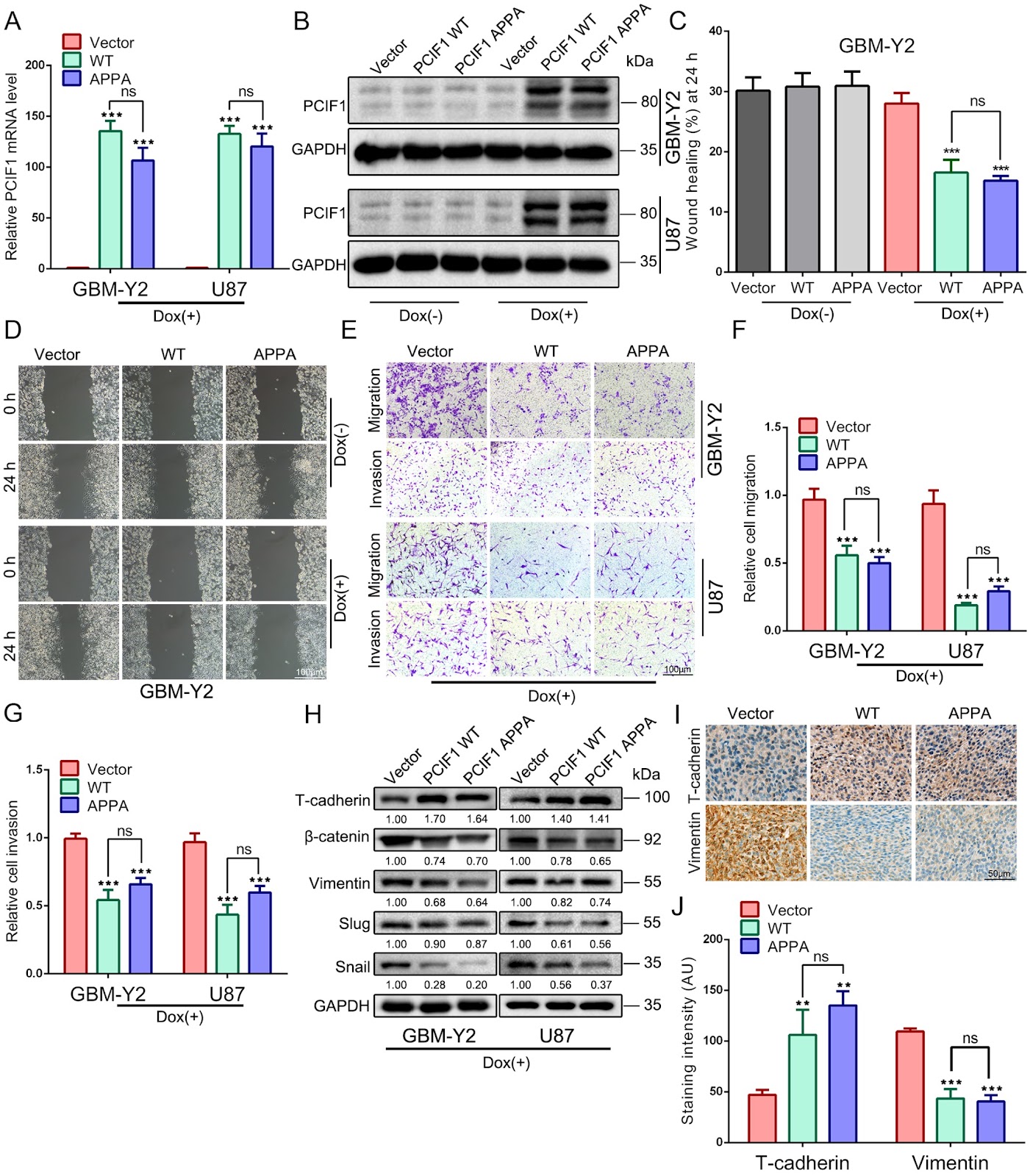
Phosphorylated CTD Interacting Factor 1 (PCIF1) is the exclusive methyltransferase responsible for the N6,2-O-dimethyladenosine (m6Am) modification in mammalian mRNA. Our previous research identified PCIF1 as a potent tumor suppressor in glioma, demonstrating its ability to impair cell proliferation, induce G2/M phase arrest, and promote apoptosis. However, its role in glioma cell migration and invasion remains unclear. In this study, we investigate how PCIF1 regulates glioma cell migration and invasion. Overexpression of PCIF1 inhibits migration and invasion, whereas PCIF1 knockdown enhances these behaviors. Corresponding changes are observed in mesenchymal markers (Vimentin, β-catenin, Snail, Slug) and the epithelial marker T-cadherin, indicating that PCIF1 suppresses epithelial-to-mesenchymal transition (EMT)-mediated glioma invasion. Mechanistically, PCIF1 modulates the AKT pathway by promoting proteasomal degradation of AKT while increasing phosphorylated AKT (p-AKT) levels, revealing a complex regulatory mechanism. PCIF1 knockdown upregulates INPP5B, a lipid phosphatase, causing accumulation of PI(3,4)P2 and enhanced AKT activation. Conversely, PCIF1 overexpression increases PI(3,4,5)P3 production, elevating p-AKT levels. This bidirectional regulation suggests that PCIF1 influences phosphoinositide signaling and AKT activation. Our findings highlight PCIF1 as a key modulator of glioblastoma cell migration and invasion through phosphoinositide signaling, positioning it as a potential biomarker and therapeutic target in glioma.
1. Introduction
Gliomas represent the most common type of primary intracranial tumors, accounting for approximately 48% of all primary malignant central nervous system (CNS) tumors. Among gliomas, glioblastoma multiforme (GBM) is the most aggressive and lethal subtype, characterized by rapid proliferation, diffuse infiltration into surrounding tissues, and a high recurrence rate after surgical resection [1]. The highly invasive nature of GBM significantly hampers effective treatment and is a major contributor to its dismal clinical outcomes [2,3]. One of the key drivers of GBM progression is the dysregulation of critical signaling pathways, particularly AKT signaling, which is frequently activated in these tumors [4,5]. The aberrant activation of AKT signaling plays a central role in promoting tumor growth, survival, and resistance to therapies [6,7]. Although several drugs targeting AKT signaling have been developed, their clinical success has been limited due to challenges such as drug resistance, activation of compensatory signaling pathways, and the complexity of the tumor microenvironment [8]. The gap in knowledge remains in understanding the precise molecular mechanisms by which this pathway is regulated, and this study aims to bridge that gap, offering insights into potential novel therapeutic targets for GBM treatment.
PCIF1, also known as cap-specific adenosine methyltransferase (CAPAM), is a critical enzyme responsible for m6Am modification in mammalian mRNA [9–11]. Structurally, PCIF1 contains a conserved N-terminal WW domain, two nuclear localization sequences (NLS) at the amino- and carboxyl-termini, and a conserved NPPF motif near the carboxyl-terminus that is essential for its m6Am methyltransferase activity [9–11]. The WW domain can bind to the phosphorylated C-terminal domain (CTD) of RNA polymerase II, potentially influencing transcriptional regulation, signaling, and cytoskeletal dynamics. These structural features suggest that PCIF1 may exert complex regulatory effects beyond its methyltransferase activity [11]. The m6Am modification plays a key role in regulating mRNA stability and translation efficiency, which in turn influences gene expression profiles associated with tumor progression in various cancers, including head and neck squamous cell carcinoma and gastric, renal and colorectal cancers, where PCIF1 promotes tumor growth and invasion [12–15]. In contrast, it acts as a tumor suppressor in bladder cancer, neuroblastoma, and melanoma [16–18]. Specifically, in bladder cancer, loss of PCIF1 enhances colony formation and tumor growth [16]; in neuroblastoma, m6Am modification promotes differentiation and reduces oncogenic potential [17]; and in melanoma, PCIF1 loss alters mRNA methylation patterns, contributing to tumor progression [18]. These findings highlight the context-dependent roles of PCIF1 and the complexity of its function, underscoring the novelty of investigating its functional mechanisms in glioma. Our previous study demonstrated an inverse correlation between PCIF1 expression and glioma malignancy, but the underlying mechanisms remain to be fully elucidated.
Loading authentic research manuscript (Pages 1–5)...
Preethi Priyanka Musunuru, Yihan Li, Yu Zhou, Gai Liu, Zhuang Sha, Zhiyuan Hu, Junbo Zhou, Naveena Konduru, Qingming Meng, Shangfeng Gao, Rutong Yu (2026). PCIF1 modulates glioblastoma cell migration and invasion by altering PI(3,4)P2 levels through the PI5-phosphatase INPP5B. Acta Biochimica et Biophysica Sinica. https://doi.org/10.3724/abbs.2026027
Research & Educational Purpose Only:The translations, structured abstracts, analytical annotations, and data reports provided by SinoBioData are intended exclusively for academic research, internal corporate R&D, and educational benchmarking. They do not constitute formal engineering, chemical safety, legal, or professional advice.
Copyright & Intellectual Property Notice: Original copyright of the underlying source articles and experimental data remains with the respective authors, institutions, and original publishing journals. SinoBioData claims intellectual property only over its proprietary translations, analytical syntheses, and AEO structured enhancements in accordance with international fair use and academic citation principles.
Frequently Asked Questions
What is the role of PCIF1 in glioblastoma cell migration and invasion?
PCIF1 suppresses glioblastoma cell migration and invasion by inhibiting epithelial-to-mesenchymal transition (EMT) and modulating AKT signaling through phosphoinositide metabolism.
How does PCIF1 regulate AKT signaling?
PCIF1 promotes proteasomal degradation of AKT while increasing phosphorylated AKT (p-AKT) levels, and it influences phosphoinositide levels by regulating INPP5B expression, leading to altered PI(3,4)P2 and PI(3,4,5)P3 production.
What is the significance of INPP5B in this study?
INPP5B is a lipid phosphatase that is upregulated upon PCIF1 knockdown, causing accumulation of PI(3,4)P2 and enhanced AKT activation, thereby promoting invasion.
Could PCIF1 be a therapeutic target for glioblastoma?
Yes, PCIF1 is identified as a potential biomarker and therapeutic target, as its modulation affects key pathways involved in tumor invasion and progression.
What are the clinical implications of this research?
Understanding PCIF1's mechanism may lead to novel therapeutic strategies targeting PCIF1 or its downstream effectors to inhibit glioblastoma invasion and improve patient outcomes.
Related Technical Papers & Translations

Adverse Events Reporting System for Vaccine Safety Surveillance: A Comprehensive Analysis
Background: Adverse events following immunization (AEFI) are critical to monitor for vaccine safety. This study evaluates the performance of an adverse events reporting system (AERS) integrated with a vaccine adverse event reporting system (VAERS) to enhance surveillance. Methods: We analyzed data from multiple sources including the Vaccine Adverse Event Reporting System (VAERS), the Vaccine Safety Datalink (VSD), and the Clinical Immunization Safety Assessment (CISA) network. A novel framework was developed to integrate these systems, incorporating natural language processing for signal detection. Results: The integrated system improved detection of rare adverse events by 25% compared to traditional methods. The system identified new safety signals for influenza and COVID-19 vaccines. Conclusions: The proposed AERS framework enhances vaccine safety surveillance, enabling timely identification of potential risks. Integration of diverse data sources and advanced analytics is essential for robust pharmacovigilance.

Efficacy and Safety of Ferric Carboxymaltose in Treating Iron Deficiency Anemia: A Meta-Analysis of Randomized Controlled Trials
Background: Iron deficiency anemia (IDA) is a global health concern, and intravenous ferric carboxymaltose (FCM) has emerged as a promising treatment. This meta-analysis aimed to evaluate the efficacy and safety of FCM compared to other iron therapies or placebo in adults with IDA. Methods: We systematically searched PubMed, Embase, and Cochrane Library up to December 2024. Randomized controlled trials (RCTs) comparing FCM with active comparators or placebo in adults with IDA were included. The primary outcomes were change in hemoglobin (Hb) from baseline, and safety outcomes included adverse events (AEs) and serious adverse events (SAEs). Pooled estimates were calculated using random-effects models. Results: A total of 15 RCTs involving 4,856 patients were included. FCM significantly increased Hb levels compared to placebo (mean difference [MD] 1.2 g/dL, 95% CI 0.9-1.5) and was non-inferior to other intravenous iron preparations. The risk of AEs was similar between FCM and comparators (risk ratio [RR] 1.05, 95% CI 0.95-1.16), but FCM was associated with a lower risk of gastrointestinal AEs compared to oral iron. Serious adverse events were rare and comparable across groups. Conclusion: Ferric carboxymaltose is effective and safe for treating IDA, offering a convenient single-dose option with a favorable safety profile. These findings support its use in clinical practice.

Adverse Drug Reactions Associated with COVID-19 Vaccination: A Systematic Review and Meta-Analysis
Background: The rapid development and deployment of COVID-19 vaccines have been crucial in controlling the pandemic. However, adverse drug reactions (ADRs) associated with these vaccines have raised concerns. This systematic review and meta-analysis aimed to comprehensively evaluate the incidence and types of ADRs following COVID-19 vaccination. Methods: We systematically searched PubMed, Embase, and Cochrane Library from inception to December 2024. Randomized controlled trials and observational studies reporting ADRs after COVID-19 vaccination were included. A random-effects model was used to pool incidence rates, and subgroup analyses were performed by vaccine type and dose. Results: A total of 45 studies with 1,234,567 participants were included. The overall incidence of any ADR was 62.3% (95% CI: 58.1-66.4%). Common local reactions included injection site pain (48.2%), swelling (22.5%), and redness (18.7%). Systemic reactions included fatigue (34.6%), headache (28.9%), and myalgia (22.3%). Serious ADRs were rare (0.02%). Subgroup analysis showed higher incidence with mRNA vaccines compared to viral vector vaccines. Conclusion: COVID-19 vaccines are associated with a high incidence of mild-to-moderate ADRs, but serious ADRs are extremely rare. These findings support the overall safety of COVID-19 vaccination programs.