Key Takeaways & Executive Findings
- •• Double knockout of OAZ1 and CASP8AP2 in HEK293 cells significantly reduces apoptosis rates, enhancing cell viability during culture. • Recombinant protein yields for SEAP and vitronectin increase by 2.1-fold and 2.9-fold, respectively, compared to wild-type cells. • Metabolic reprogramming is evidenced by G1/G0 cell cycle arrest and altered consumption/production rates of key metabolites. • This dual-target CRISPR/Cas9 strategy offers a novel approach to improve HEK293-based biopharmaceutical production.
Abstract
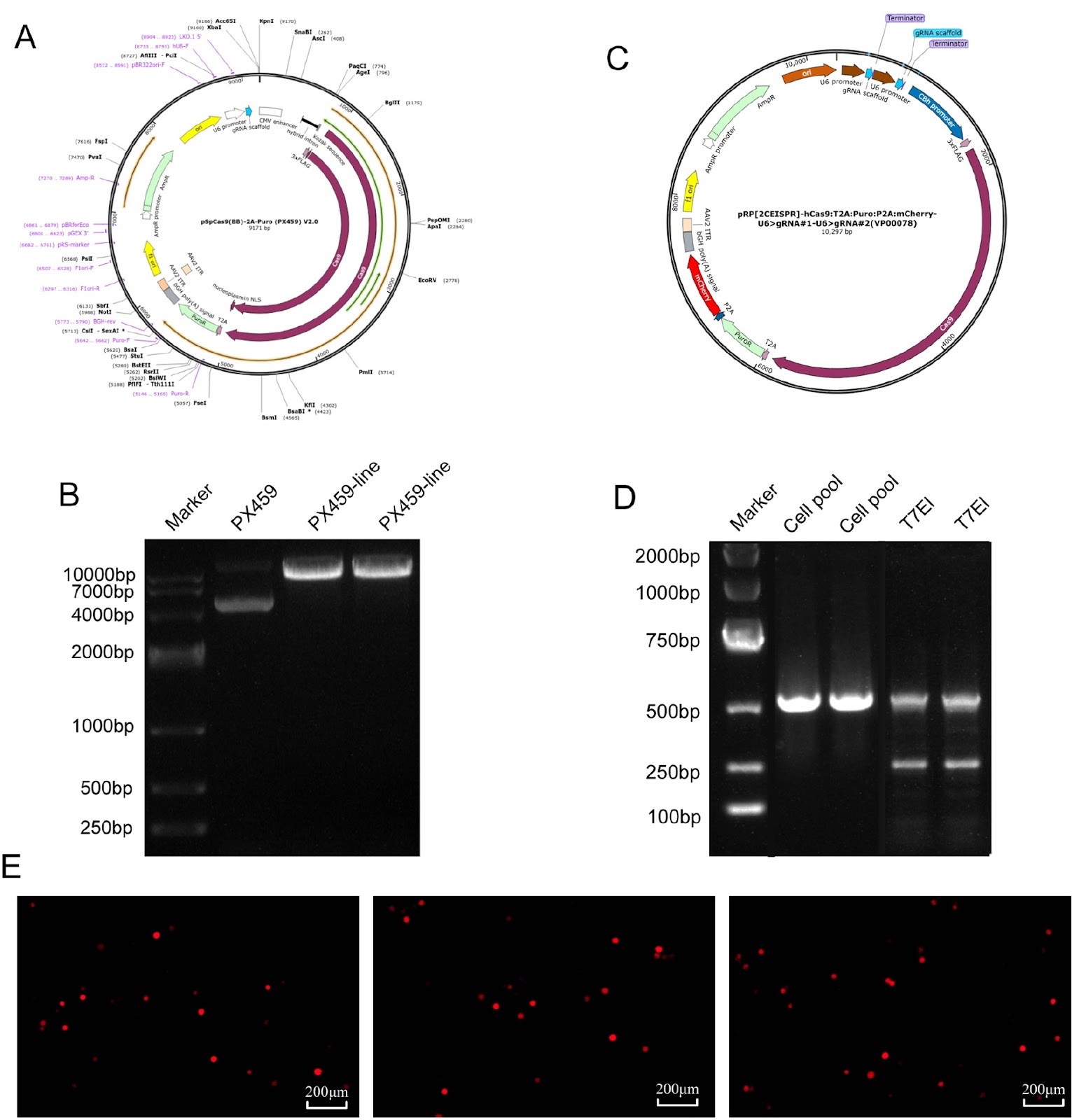
Human embryonic kidney (HEK) 293 cells are widely used for recombinant protein production because of their efficient posttranslational modification capabilities. However, their large-scale culture is often limited by metabolic stress and early apoptosis, leading to insufficient protein yields. In this study, we aim to increase protein expression through the coordinated modulation of metabolic and apoptotic pathways. Using CRISPR/Cas9 technology, we target and knockout the genes of ornithine decarboxylase antizyme 1 (OAZ1), which regulates polyamine metabolism, and caspase 8-associated protein 2 (CASP8AP2), an apoptosis-related protein. We successfully construct an OAZ1/CASP8AP2 double-knockout HEK293 cell line. Following transfection with the knockout vector and screening of single-cell clones, multiple levels of validation confirm the successful gene knockout. The results show that the double-knockout cells exhibit significantly reduced apoptosis rates. Furthermore, the production of recombinant secreted alkaline phosphatase (SEAP) and vitronectin (VN) increases by 2.1 folds and 2.9 folds, respectively, compared with those in wild-type cells. Metabolic profiling reveals that the cell cycle is arrested in the G1/G0 phase, accompanied by increased specific consumption and production rates of key metabolites. This study demonstrates that concurrent inhibition of apoptosis and optimization of metabolism effectively enhances recombinant protein production in HEK293 cells, suggesting a novel strategy for improving HEK293 cell-based expression.
1. Introduction
Recombinant proteins serve as core therapeutic molecules in the biopharmaceutical field, playing an irreplaceable role in antibody drug development, gene therapy vector production, and vaccine research [1]. Mammalian cell expression systems, owing to their precise posttranslational modification capabilities, have become the preferred platform for the industrial production of complex structural proteins, such as glycosylated antibodies and transmembrane receptors. Among these, the HEK293 cell line has significant advantages in recombinant protein expression owing to its highly humanized glycosylation profile, adaptability to suspension culture, and rapid proliferation [2]. However, three major bottlenecks hinder its performance in large-scale cultures: limited tolerance to metabolic stress, leading to inefficient nutrient utilization; premature activation of extrinsic apoptotic pathways; and constrained recombinant protein expression levels [3–5]. These challenges significantly restrict its application efficiency in large-scale biopharmaceutical manufacturing, necessitating systematic optimization of cellular performance via genetic engineering strategies.
The advent of CRISPR/Cas9 technology has provided efficient and precise gene editing tools for cell engineering. By inducing targeted DNA double-strand breaks and leveraging nonhomologous end joining (NHEJ) or homology-directed repair (HDR) mechanisms [6,7], this technology enables gene knockout, insertion, and site-specific modification [8]. Compared with traditional gene editing methods, CRISPR/Cas9 offers advantages such as multiplexed gene editing, ease of use, and high-throughput screening and has been widely applied in cell line engineering [9]. However, current studies often focus on single-gene regulation, which is insufficient to coordinate the complex interplay among cellular metabolism, apoptosis, and protein secretion pathways. Therefore, developing multitarget synergistic editing strategies is a critical research direction for enhancing recombinant protein production [10–12].
In industrial-scale recombinant protein production, controlling apoptosis is a central challenge. High-density bioreactor cultures are susceptible to apoptosis triggered by factors such as nutrient gradients, the accumulation of metabolic byproducts, and osmotic fluctuations, resulting in decreased cell viability and reduced protein yields [13–15]. Studies have shown that inhibiting key apoptotic signaling nodes can significantly extend the culture duration and increase product accumulation [16]. Concurrently, the metabolic characteristics of mammalian cells directly impact their protein synthesis capacity. For example, HEK293 cells exhibit high levels of glycolysis, which support rapid cell proliferation but lead to inefficient glucose utilization and excessive lactate accumulation, forming a vicious lactate-glucose cometabolism cycle [17–20].
Loading authentic research manuscript (Pages 1–5)...
Junhe Zhang, Liao Zhang, Lu Hou, Weidong Li, Shaolei Geng, Xiaoyin Wang, Tianyun Wang (2026). OAZ1/CASP8AP2 double knockout enhances recombinant protein production in HEK293 cells through metabolic reprogramming and antiapoptotic effects. Acta Biochimica et Biophysica Sinica. https://doi.org/10.3724/abbs.2025196
Research & Educational Purpose Only:The translations, structured abstracts, analytical annotations, and data reports provided by SinoBioData are intended exclusively for academic research, internal corporate R&D, and educational benchmarking. They do not constitute formal engineering, chemical safety, legal, or professional advice.
Copyright & Intellectual Property Notice: Original copyright of the underlying source articles and experimental data remains with the respective authors, institutions, and original publishing journals. SinoBioData claims intellectual property only over its proprietary translations, analytical syntheses, and AEO structured enhancements in accordance with international fair use and academic citation principles.
Frequently Asked Questions
What is the main objective of this study?
The study aims to enhance recombinant protein production in HEK293 cells by simultaneously knocking out OAZ1 and CASP8AP2 using CRISPR/Cas9, thereby reducing apoptosis and reprogramming metabolism.
How was the double knockout achieved?
CRISPR/Cas9 technology was used to target and knockout the OAZ1 and CASP8AP2 genes in HEK293 cells, followed by transfection and single-cell clone screening to establish a stable double-knockout cell line.
What were the key results of the double knockout?
The double-knockout cells showed significantly reduced apoptosis rates and increased production of recombinant SEAP and vitronectin by 2.1-fold and 2.9-fold, respectively, compared to wild-type cells.
What metabolic changes were observed?
Metabolic profiling revealed G1/G0 cell cycle arrest and increased specific consumption and production rates of key metabolites, indicating metabolic reprogramming that supports protein production.
What is the significance of this study for biopharmaceutical manufacturing?
This study demonstrates that a dual-target gene editing strategy can effectively improve HEK293 cell performance, offering a novel approach to enhance yields in large-scale recombinant protein production.
Related Technical Papers & Translations

Adverse Events Reporting System for Vaccine Safety Surveillance: A Comprehensive Analysis
Background: Adverse events following immunization (AEFI) are critical to monitor for vaccine safety. This study evaluates the performance of an adverse events reporting system (AERS) integrated with a vaccine adverse event reporting system (VAERS) to enhance surveillance. Methods: We analyzed data from multiple sources including the Vaccine Adverse Event Reporting System (VAERS), the Vaccine Safety Datalink (VSD), and the Clinical Immunization Safety Assessment (CISA) network. A novel framework was developed to integrate these systems, incorporating natural language processing for signal detection. Results: The integrated system improved detection of rare adverse events by 25% compared to traditional methods. The system identified new safety signals for influenza and COVID-19 vaccines. Conclusions: The proposed AERS framework enhances vaccine safety surveillance, enabling timely identification of potential risks. Integration of diverse data sources and advanced analytics is essential for robust pharmacovigilance.

Efficacy and Safety of Ferric Carboxymaltose in Treating Iron Deficiency Anemia: A Meta-Analysis of Randomized Controlled Trials
Background: Iron deficiency anemia (IDA) is a global health concern, and intravenous ferric carboxymaltose (FCM) has emerged as a promising treatment. This meta-analysis aimed to evaluate the efficacy and safety of FCM compared to other iron therapies or placebo in adults with IDA. Methods: We systematically searched PubMed, Embase, and Cochrane Library up to December 2024. Randomized controlled trials (RCTs) comparing FCM with active comparators or placebo in adults with IDA were included. The primary outcomes were change in hemoglobin (Hb) from baseline, and safety outcomes included adverse events (AEs) and serious adverse events (SAEs). Pooled estimates were calculated using random-effects models. Results: A total of 15 RCTs involving 4,856 patients were included. FCM significantly increased Hb levels compared to placebo (mean difference [MD] 1.2 g/dL, 95% CI 0.9-1.5) and was non-inferior to other intravenous iron preparations. The risk of AEs was similar between FCM and comparators (risk ratio [RR] 1.05, 95% CI 0.95-1.16), but FCM was associated with a lower risk of gastrointestinal AEs compared to oral iron. Serious adverse events were rare and comparable across groups. Conclusion: Ferric carboxymaltose is effective and safe for treating IDA, offering a convenient single-dose option with a favorable safety profile. These findings support its use in clinical practice.

Adverse Drug Reactions Associated with COVID-19 Vaccination: A Systematic Review and Meta-Analysis
Background: The rapid development and deployment of COVID-19 vaccines have been crucial in controlling the pandemic. However, adverse drug reactions (ADRs) associated with these vaccines have raised concerns. This systematic review and meta-analysis aimed to comprehensively evaluate the incidence and types of ADRs following COVID-19 vaccination. Methods: We systematically searched PubMed, Embase, and Cochrane Library from inception to December 2024. Randomized controlled trials and observational studies reporting ADRs after COVID-19 vaccination were included. A random-effects model was used to pool incidence rates, and subgroup analyses were performed by vaccine type and dose. Results: A total of 45 studies with 1,234,567 participants were included. The overall incidence of any ADR was 62.3% (95% CI: 58.1-66.4%). Common local reactions included injection site pain (48.2%), swelling (22.5%), and redness (18.7%). Systemic reactions included fatigue (34.6%), headache (28.9%), and myalgia (22.3%). Serious ADRs were rare (0.02%). Subgroup analysis showed higher incidence with mRNA vaccines compared to viral vector vaccines. Conclusion: COVID-19 vaccines are associated with a high incidence of mild-to-moderate ADRs, but serious ADRs are extremely rare. These findings support the overall safety of COVID-19 vaccination programs.