Key Takeaways & Executive Findings
- •• Identified 15 O-glycosites and 10 distinct O-glycan structures on the SARS-CoV-2 spike protein using advanced mass spectrometry. • Demonstrated that ppGalNAc-T6 is a key host enzyme enhancing O-glycosylation of the spike protein, increasing both site occupancy and glycan heterogeneity. • Molecular dynamics simulations revealed that O-glycosylation at protomer interfaces stabilizes the trimeric spike structure via hydrogen bonds and non-polar interactions. • Conservation analysis suggests that most O-glycosites are maintained across SARS-CoV-2 variants, highlighting their potential functional importance.
Abstract
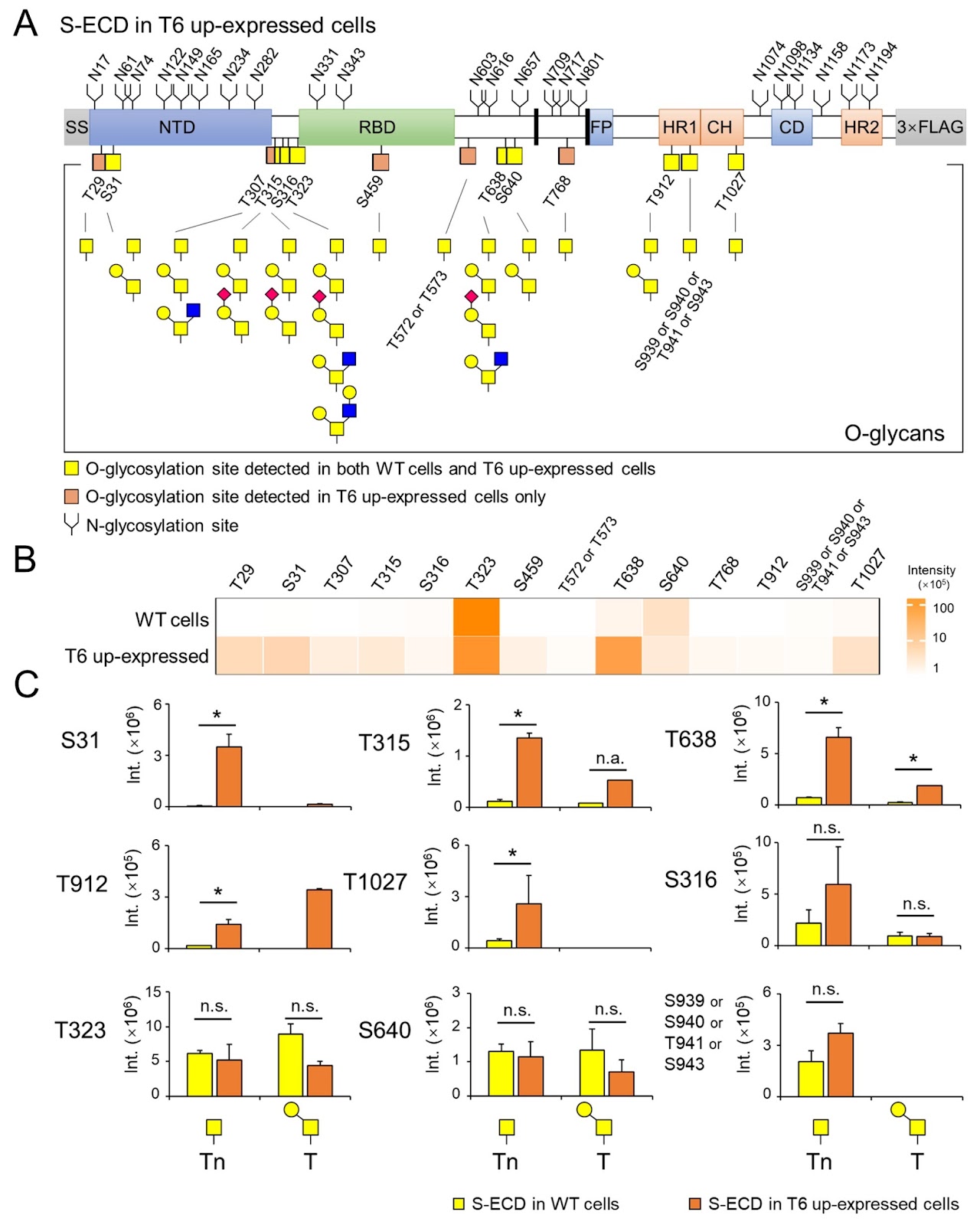
Protein O-glycosylation, also known as mucin-type O-glycosylation, is one of the most abundant glycosylation in mammalian cells. It is initially catalyzed by a family of polypeptide GalNAc transferases (ppGalNAc-Ts). The trimeric spike protein (S) of SARS-CoV-2 is highly glycosylated and facilitates the virus’s entry into host cells and membrane fusion of the virus. However, the functions and relationship between host ppGalNAc-Ts and O-glycosylation on the S protein remain unclear. Herein, we identify 15 O-glycosites and 10 distinct O-glycan structures on the S protein using an HCD-product-dependent triggered ETD mass spectrometric analysis. We observe that the isoenzyme T6 of ppGalNAc-Ts (ppGalNAc-T6) exhibits high O-glycosylation activity for the S protein, as demonstrated by an on-chip catalytic assay. Overexpression of ppGalNAc-T6 in HEK293 cells significantly enhances the O-glycosylation level of the S protein, not only by adding new O-glycosites but also by increasing O-glycan heterogeneity. Molecular dynamics simulations reveal that O-glycosylation on the protomer-interface regions, modified by ppGalNAc-T6, potentially stabilizes the trimeric S protein structure by establishing hydrogen bonds and non-polar interactions between adjacent protomers. Furthermore, mutation frequency analysis indicates that most O-glycosites of the S protein are conserved during the evolution of SARS-CoV-2 variants. Taken together, our finding demonstrate that host O-glycosyltransferases dynamically regulate the O-glycosylation of the S protein, which may influence the trimeric structural stability of the protein. This work provides structural insights into the functional role of specific host O-glycosyltransferases in regulating the O-glycosylation of viral envelope proteins.
1. Introduction
Protein O-linked glycosylation, also known as mucin-type O-glycosylation, is one of the most abundant glycosylation in mammalian cells. More than 80% of secreted and cell membrane proteins undergo O-glycosylation [1]. This type of glycosylation plays crucial roles in modulating various functions, including ligand-receptor interactions, proprotein processing, and subcellular localization sorting [2,3]. The initiation of protein O-glycosylation is facilitated by a glycosyltransferase family known as polypeptide N-acetylgalactosaminyltransferases (ppGalNAc-Ts), which transfer GalNAc from UDP-GalNAc to the Thr/Ser residues of substrate proteins or peptides [4]. In human cells, the ppGalNAc-T family contains up to 20 isoenzymes, exhibiting distinct spatial and temporal expression patterns in tissues and cells. Furthermore, these ppGalNAc-T isoenzymes share both redundant and partially specific preferences for protein substrates [5,6]. Therefore, protein O-glycosylation is a kind of systematic modification in human cells.
Viruses, as simple life forms, exploit the host’s transcription, translation, and modification systems to synthesize and package their required proteins and nucleic acids [7]. Consequently, viral proteins carry post-translational modifications that are homologous to those of the host cells, such as glycosylation. Many envelope proteins of pathogenic viruses, including HIV, MERS, and SARS, are heavily glycosylated [8]. Viruses utilize host glycosylations to evade host immunity, bind to host receptor cells, and regulate hydrolysis by host proteases [9]. Therefore, glycosylation plays a crucial role in interactions between viruses and their hosts.
Severe acute respiratory syndrome coronavirus-2 (SARS-CoV-2), which is responsible for the novel coronavirus disease 2019 (COVID-19), posed a pandemic threat to global public health during 2019–2023 [10]. Currently, both long COVID-19 and sporadic COVID-19 cases continue to burden global health systems [11]. The spike protein (S protein) of SARS-CoV-2 facilitates membrane fusion between the virus and host cells [12]. This type I membrane protein is a homotrimer [13]. It has been reported that two trimeric S proteins can simultaneously bind to one angiotensin converting enzyme 2 (ACE2) homodimer from host cells, and then mediate the membrane fusion process [14]. Each monomer of the S protein is coated with 22 N-glycan sites and numerous O-glycan sites in diverse expression systems [15]. N-glycosylation of the S protein has been extensively studied and found to directly affect interactions.
Loading authentic research manuscript (Pages 1–5)...
Zhijue Xu, Han Zhang, Jiaqi Tian, Xin Ku, Rumeng Wei, Jingli Hou, Can Zhang, Fang Yang, Xia Zou, Yang Li, Hiroyuki Kaji, Sheng-Ce Tao, Atsushi Kuno, Wei Yan, Lin-Tai Da, Yan Zhang (2026). O-glycosylation of SARS-CoV-2 spike protein by host O-glycosyltransferase strengthens its trimeric structure. Acta Biochimica et Biophysica Sinica. https://doi.org/10.3724/abbs.2024127
Research & Educational Purpose Only:The translations, structured abstracts, analytical annotations, and data reports provided by SinoBioData are intended exclusively for academic research, internal corporate R&D, and educational benchmarking. They do not constitute formal engineering, chemical safety, legal, or professional advice.
Copyright & Intellectual Property Notice: Original copyright of the underlying source articles and experimental data remains with the respective authors, institutions, and original publishing journals. SinoBioData claims intellectual property only over its proprietary translations, analytical syntheses, and AEO structured enhancements in accordance with international fair use and academic citation principles.
Frequently Asked Questions
What is the main finding of this study?
The study reveals that host O-glycosyltransferase ppGalNAc-T6 modifies the SARS-CoV-2 spike protein, enhancing its O-glycosylation and stabilizing its trimeric structure through specific molecular interactions.
How was O-glycosylation of the spike protein analyzed?
The researchers used HCD-product-dependent triggered ETD mass spectrometry to identify 15 O-glycosites and 10 distinct O-glycan structures on the spike protein.
What role does ppGalNAc-T6 play in O-glycosylation?
ppGalNAc-T6 exhibits high O-glycosylation activity on the spike protein, and its overexpression increases both the number of O-glycosites and glycan heterogeneity.
How does O-glycosylation affect the spike protein structure?
Molecular dynamics simulations suggest that O-glycosylation at protomer-interface regions stabilizes the trimeric structure by forming hydrogen bonds and non-polar interactions between adjacent protomers.
Are the O-glycosites conserved across SARS-CoV-2 variants?
Mutation frequency analysis indicates that most O-glycosites are conserved during the evolution of SARS-CoV-2 variants, suggesting their functional importance.
Related Technical Papers & Translations

Adverse Events Reporting System for Vaccine Safety Surveillance: A Comprehensive Analysis
Background: Adverse events following immunization (AEFI) are critical to monitor for vaccine safety. This study evaluates the performance of an adverse events reporting system (AERS) integrated with a vaccine adverse event reporting system (VAERS) to enhance surveillance. Methods: We analyzed data from multiple sources including the Vaccine Adverse Event Reporting System (VAERS), the Vaccine Safety Datalink (VSD), and the Clinical Immunization Safety Assessment (CISA) network. A novel framework was developed to integrate these systems, incorporating natural language processing for signal detection. Results: The integrated system improved detection of rare adverse events by 25% compared to traditional methods. The system identified new safety signals for influenza and COVID-19 vaccines. Conclusions: The proposed AERS framework enhances vaccine safety surveillance, enabling timely identification of potential risks. Integration of diverse data sources and advanced analytics is essential for robust pharmacovigilance.

Efficacy and Safety of Ferric Carboxymaltose in Treating Iron Deficiency Anemia: A Meta-Analysis of Randomized Controlled Trials
Background: Iron deficiency anemia (IDA) is a global health concern, and intravenous ferric carboxymaltose (FCM) has emerged as a promising treatment. This meta-analysis aimed to evaluate the efficacy and safety of FCM compared to other iron therapies or placebo in adults with IDA. Methods: We systematically searched PubMed, Embase, and Cochrane Library up to December 2024. Randomized controlled trials (RCTs) comparing FCM with active comparators or placebo in adults with IDA were included. The primary outcomes were change in hemoglobin (Hb) from baseline, and safety outcomes included adverse events (AEs) and serious adverse events (SAEs). Pooled estimates were calculated using random-effects models. Results: A total of 15 RCTs involving 4,856 patients were included. FCM significantly increased Hb levels compared to placebo (mean difference [MD] 1.2 g/dL, 95% CI 0.9-1.5) and was non-inferior to other intravenous iron preparations. The risk of AEs was similar between FCM and comparators (risk ratio [RR] 1.05, 95% CI 0.95-1.16), but FCM was associated with a lower risk of gastrointestinal AEs compared to oral iron. Serious adverse events were rare and comparable across groups. Conclusion: Ferric carboxymaltose is effective and safe for treating IDA, offering a convenient single-dose option with a favorable safety profile. These findings support its use in clinical practice.

Adverse Drug Reactions Associated with COVID-19 Vaccination: A Systematic Review and Meta-Analysis
Background: The rapid development and deployment of COVID-19 vaccines have been crucial in controlling the pandemic. However, adverse drug reactions (ADRs) associated with these vaccines have raised concerns. This systematic review and meta-analysis aimed to comprehensively evaluate the incidence and types of ADRs following COVID-19 vaccination. Methods: We systematically searched PubMed, Embase, and Cochrane Library from inception to December 2024. Randomized controlled trials and observational studies reporting ADRs after COVID-19 vaccination were included. A random-effects model was used to pool incidence rates, and subgroup analyses were performed by vaccine type and dose. Results: A total of 45 studies with 1,234,567 participants were included. The overall incidence of any ADR was 62.3% (95% CI: 58.1-66.4%). Common local reactions included injection site pain (48.2%), swelling (22.5%), and redness (18.7%). Systemic reactions included fatigue (34.6%), headache (28.9%), and myalgia (22.3%). Serious ADRs were rare (0.02%). Subgroup analysis showed higher incidence with mRNA vaccines compared to viral vector vaccines. Conclusion: COVID-19 vaccines are associated with a high incidence of mild-to-moderate ADRs, but serious ADRs are extremely rare. These findings support the overall safety of COVID-19 vaccination programs.