Key Takeaways & Executive Findings
- •• Structure-based optimization identified P119R and H125R mutations that enhance FGF21 activity approximately twofold. • Fc fusion of these mutants significantly improves pharmacokinetic profile, enabling long-acting therapeutic potential. • The engineered Fc-FGF21 analogs show promise for treating obesity-related metabolic disorders. • This study provides a novel strategy for developing next-generation FGF21-based therapies.
Abstract
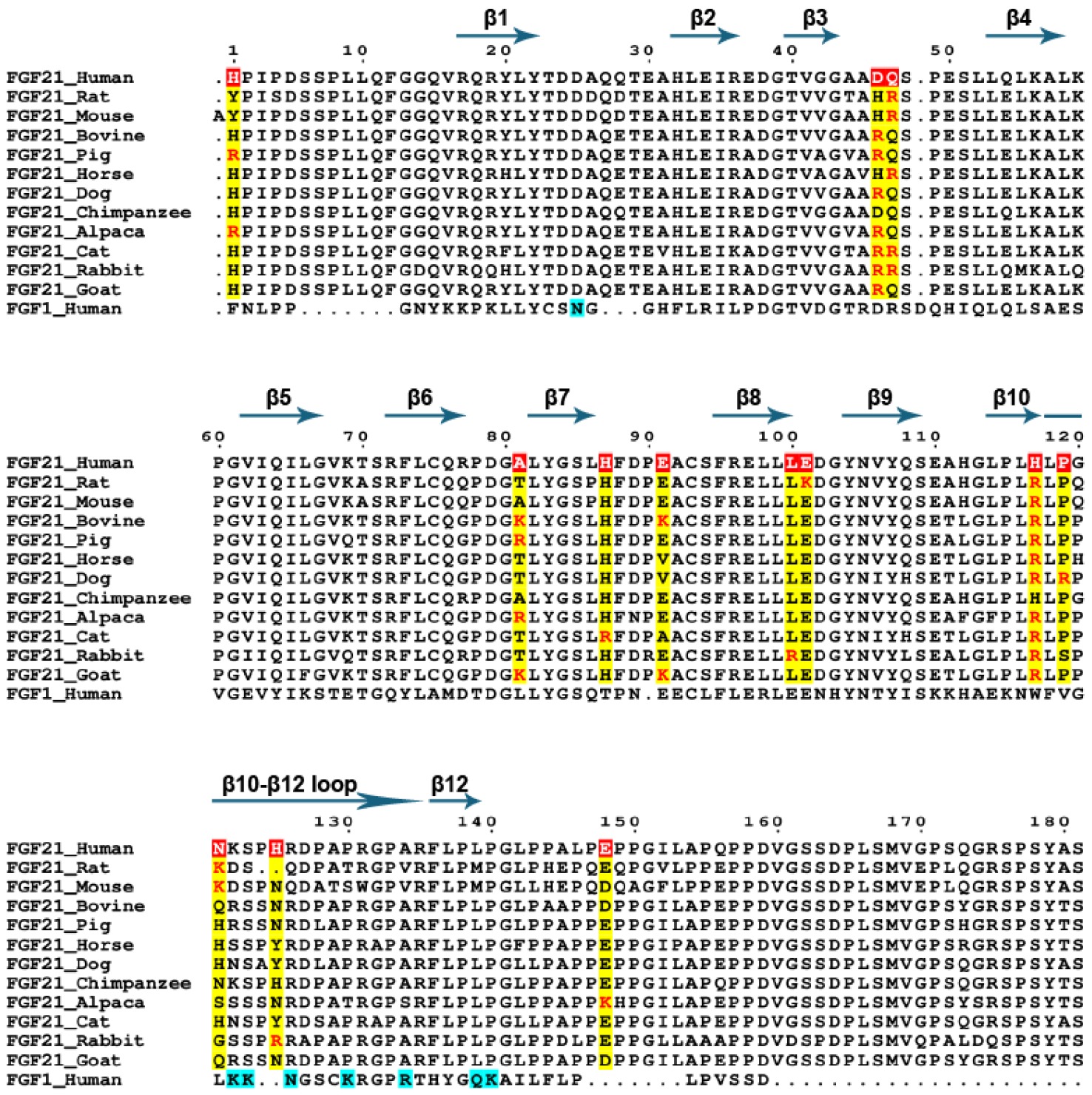
Fibroblast growth factor 21 (FGF21) plays a pivotal role in regulating metabolic processes and energy homeostasis, making it a promising therapeutic avenue for various obesity-related conditions. However, its therapeutic efficacy faces challenges due to its suboptimal pharmacokinetics and bioactivity. To overcome these limitations, we adapt a strategy in which key amino acid residues responsible for enhanced activity are pinpointed through sequence alignment and comparative analysis to develop long-acting FGF21 analogs. The mutant FGF21 analogs are fused with the Fc fragment. Here, we report the design, identification, and characterization of two distinct Fc-fused FGF21 analogs, Fc-FGF21(P119R) and Fc-FGF21(H125R), with significantly augmented potency. These findings hold promise for clinical applications, offering potential interventions for obesity-related metabolic disorders.
1. Introduction
The fibroblast growth factor (FGF) family is a large family of signaling polypeptides that play diverse roles in cell growth, proliferation, differentiation, angiogenesis and metabolism [1‒3]. Among these, fibroblast growth factor 21 (FGF21) is a member of the endocrine FGF19 subfamily [4‒6]. Structurally characterized by its distinctive β-trefoil fold, FGF21 binds to its receptor FGFR1c kinase through its N-terminal segment and its co-receptor β-Klotho (KLB) via its C-terminal tail [7‒9]. The formation of the FGF21-FGFR-KLB signaling complex(s) in a limited number of metabolic or endocrine tissues initiates intracellular signaling through the ERK1/2 cascade [7,10‒13]. The effects of FGF21 are pleotropic, maintaining metabolic and energy homeostasis by lowering blood glucose level and improving blood lipid profiles, with multiple potential metabolic benefits [12,14‒22].
Obesity, fatty liver diseases and diabetes mellitus are among the prevalent metabolic disorders, often complicating other organ-specific diseases [23]. The development of more effective pharmacotherapies is imperative. FGF21 is a competitive candidate. An FGF21 analogue has been planned to enter phase III clinical trials for patients with nonalcoholic steatohepatitis (NASH), liver fibrosis, and hypertriglyceridemia [24,25]. Notably, FGF21 does not induce hypoglycemia, cell proliferation or weight gain [12]. However, its limited pharmacokinetic property and biological potency remain significant challenges for its clinical application [26‒29].
Several strategies have been explored to increase the half-life and activity of FGF21. One such example is LY2405319, which incorporates an additional disulfide bond through the L118C and A134C mutations. This modification is aimed at bolstering its physical stability. Furthermore, LY2405319 has a deletion of four N-terminal amino acids at the N-terminus to mitigate proteolytic cleavage and an S167A mutation to eliminate O-linked glycosylation, facilitating large-scale, homogenous production in yeast [30]. Another innovative approach involves an Fc fusion with two strategic mutation sites in FGF21, effectively reducing aggregation and degradation [31]. Despite these promising advancements, FGF21 and its analogues continue to face challenges related to their relatively low efficacy. Furthermore, in the initial phases of clinical trials, they have not consistently met the primary endpoints for glycemic control [29], indicating that novel improvements are needed. For instance, the introduction of 5 mutation sites into FGF21 on the basis of its structure increases its potency [32]. Introduction of R185W and L166F mutations on the basis of the structure of β-Klotho in the complex of the FGF21 C-terminal peptide resulted in a tenfold increase in the potency of FGF21 [9]. Compared with wild-type FGF21, a novel FGF21-FGF19 chimera with G43C and A31C mutations and a β1-β2 loop from FGF19 exhibited improved anti-diabetic activities [33]. An FGF1ΔHBS-FGF21C-tail chimera, created by substituting the thermally labile and low-receptor-affinity core of FGF21 with an HS binding–deficient endocrinized core of FGF1, exhibited a fivefold longer half-life and a significantly improved efficacy in correcting hyperglycemia and ameliorating insulin resistance in diabetic mice and monkeys [34]. Despite these efforts, there remains untapped potential for further enhancements in the efficacy of FGF21.
Loading authentic research manuscript (Pages 1–5)...
Yiqing Guo, Yuxuan Bao, Zhichao Chen, Zhiheng Rao, Yongde Luo, Sheng Ye, Si Liu (2026). Novel FGF21 analogues through structure-based optimization for therapeutic development. Acta Biochimica et Biophysica Sinica. https://doi.org/10.3724/abbs.2024227
Research & Educational Purpose Only:The translations, structured abstracts, analytical annotations, and data reports provided by SinoBioData are intended exclusively for academic research, internal corporate R&D, and educational benchmarking. They do not constitute formal engineering, chemical safety, legal, or professional advice.
Copyright & Intellectual Property Notice: Original copyright of the underlying source articles and experimental data remains with the respective authors, institutions, and original publishing journals. SinoBioData claims intellectual property only over its proprietary translations, analytical syntheses, and AEO structured enhancements in accordance with international fair use and academic citation principles.
Frequently Asked Questions
What is the main objective of this study?
The study aims to develop novel FGF21 analogues with enhanced activity and improved pharmacokinetic properties through structure-based optimization and Fc fusion.
Which mutations were introduced in FGF21 to enhance its activity?
The researchers designed three FGF21 mutants: L100R, P119R, and H125R. Among these, P119R and H125R were selected for Fc fusion and showed significantly augmented potency.
How did the authors improve the pharmacokinetic profile of FGF21?
They fused the N-terminal portion of the mutant FGF21 with the Fc region of human IgG1, which enhances half-life and reduces degradation.
What are the potential clinical applications of the developed Fc-FGF21 analogs?
The Fc-FGF21 analogs hold promise for treating obesity-related metabolic disorders, such as nonalcoholic steatohepatitis (NASH), diabetes, and hypertriglyceridemia.
What is the significance of the P119R and H125R mutations?
These mutations were identified through sequence and structural analysis to increase FGF21 activity approximately twofold, and when fused with Fc, they provide a long-acting therapeutic option.
Related Technical Papers & Translations

Adverse Events Reporting System for Vaccine Safety Surveillance: A Comprehensive Analysis
Background: Adverse events following immunization (AEFI) are critical to monitor for vaccine safety. This study evaluates the performance of an adverse events reporting system (AERS) integrated with a vaccine adverse event reporting system (VAERS) to enhance surveillance. Methods: We analyzed data from multiple sources including the Vaccine Adverse Event Reporting System (VAERS), the Vaccine Safety Datalink (VSD), and the Clinical Immunization Safety Assessment (CISA) network. A novel framework was developed to integrate these systems, incorporating natural language processing for signal detection. Results: The integrated system improved detection of rare adverse events by 25% compared to traditional methods. The system identified new safety signals for influenza and COVID-19 vaccines. Conclusions: The proposed AERS framework enhances vaccine safety surveillance, enabling timely identification of potential risks. Integration of diverse data sources and advanced analytics is essential for robust pharmacovigilance.

Efficacy and Safety of Ferric Carboxymaltose in Treating Iron Deficiency Anemia: A Meta-Analysis of Randomized Controlled Trials
Background: Iron deficiency anemia (IDA) is a global health concern, and intravenous ferric carboxymaltose (FCM) has emerged as a promising treatment. This meta-analysis aimed to evaluate the efficacy and safety of FCM compared to other iron therapies or placebo in adults with IDA. Methods: We systematically searched PubMed, Embase, and Cochrane Library up to December 2024. Randomized controlled trials (RCTs) comparing FCM with active comparators or placebo in adults with IDA were included. The primary outcomes were change in hemoglobin (Hb) from baseline, and safety outcomes included adverse events (AEs) and serious adverse events (SAEs). Pooled estimates were calculated using random-effects models. Results: A total of 15 RCTs involving 4,856 patients were included. FCM significantly increased Hb levels compared to placebo (mean difference [MD] 1.2 g/dL, 95% CI 0.9-1.5) and was non-inferior to other intravenous iron preparations. The risk of AEs was similar between FCM and comparators (risk ratio [RR] 1.05, 95% CI 0.95-1.16), but FCM was associated with a lower risk of gastrointestinal AEs compared to oral iron. Serious adverse events were rare and comparable across groups. Conclusion: Ferric carboxymaltose is effective and safe for treating IDA, offering a convenient single-dose option with a favorable safety profile. These findings support its use in clinical practice.

Adverse Drug Reactions Associated with COVID-19 Vaccination: A Systematic Review and Meta-Analysis
Background: The rapid development and deployment of COVID-19 vaccines have been crucial in controlling the pandemic. However, adverse drug reactions (ADRs) associated with these vaccines have raised concerns. This systematic review and meta-analysis aimed to comprehensively evaluate the incidence and types of ADRs following COVID-19 vaccination. Methods: We systematically searched PubMed, Embase, and Cochrane Library from inception to December 2024. Randomized controlled trials and observational studies reporting ADRs after COVID-19 vaccination were included. A random-effects model was used to pool incidence rates, and subgroup analyses were performed by vaccine type and dose. Results: A total of 45 studies with 1,234,567 participants were included. The overall incidence of any ADR was 62.3% (95% CI: 58.1-66.4%). Common local reactions included injection site pain (48.2%), swelling (22.5%), and redness (18.7%). Systemic reactions included fatigue (34.6%), headache (28.9%), and myalgia (22.3%). Serious ADRs were rare (0.02%). Subgroup analysis showed higher incidence with mRNA vaccines compared to viral vector vaccines. Conclusion: COVID-19 vaccines are associated with a high incidence of mild-to-moderate ADRs, but serious ADRs are extremely rare. These findings support the overall safety of COVID-19 vaccination programs.