Key Takeaways & Executive Findings
- •• Mature miRNAs are present in the nucleus and can regulate gene expression at the transcriptional level, expanding their canonical cytoplasmic roles. • Nuclear miRNAs interact with DNA, RNA, and proteins, forming nuclear miRISCs that modulate gene transcription and ncRNA maturation. • The presence of Ago proteins in the nucleus supports the formation of functional nuclear miRISCs, enhancing the efficiency of miRNA-mediated regulation. • Understanding nuclear miRNA functions may reveal new therapeutic targets and biomarkers for diseases, given their involvement in various pathological processes.
Abstract
MicroRNAs (miRNAs) are small noncoding RNAs (ncRNAs) that play their roles in the regulation of physiological and pathological processes. Originally, it was assumed that miRNAs only modulate gene expression post-transcriptionally in the cytoplasm by inducing target mRNA degradation. However, with further research, evidence shows that mature miRNAs also exist in the cell nucleus, where they can impact gene transcription and ncRNA maturation in several ways. This review provides an overview of novel models of nuclear miRNA functions. Some of the models remain to be verified by experimental evidence, and more details of the miRNA regulation network remain to be discovered in the future.
1. Introduction
MicroRNAs are a category of endogenous, noncoding small RNAs that have approximately 19–24 nucleotides in length and regulate gene expression through various mechanisms. Since their discovery in 1993 [1], extensive research has been conducted. miRNAs play a critical role in many metabolic processes, including cell differentiation, lineage specification, reprogramming, immune response, and the cell cycle [2‒6]. Moreover, miRNAs are well known to be closely linked to various kinds of diseases, including cancer [7‒9]. Given their association with numerous pathological processes, miRNAs possess significant potential as biological drug targets, and tissue-specific miRNAs can also serve as biomarkers [10,11]. For medical research in this field, it is worth noting that numerous miRNAs are evolutionarily conserved [12], permitting researchers to investigate them using Drosophila, Mus musculus, and even plant models.
Originally, miRNAs were believed to regulate gene expression in a negative manner posttranscriptionally in the cytoplasm. In this conventional pathway, the transcription of a primary miRNA (pri-miRNA) occurs from a miRNA gene, aided by RNA polymerase II (Pol II) or Pol III [13,14]. Next, Drosha and DiGeorge syndrome critical region 8 (DGCR8) cleave the pri-miRNA into pre-miRNA, which is then exported to the cytoplasm with the help of Exportin-5 [15‒18]. In the cytoplasm, Dicer cleaves the pre-miRNA into a miRNA duplex [13,14], which is unwound by cytoplasmic Argonaute (Ago) protein. One strand is loaded into the miRISC, while the other strand is degraded [19]. Subsequently, miRISC serves as a negative regulator to mediate translational repression or mRNA degradation [13,14].
The recruitment of miRNAs to their targets depends mainly on the sequence complementarity between them. The canonical miRNA-target interactions are mediated by the seed sequence, which is a region of 6–8 nucleotides on the 5′ end of the miRNA that forms Watson-Crick base pairs with the target [20]. Noncanonical miRNA-target interactions also exist in the functions of numerous miRNAs, such as miR-24 and let-7 [21,22]. Some of these interactions do not follow simple seed sequence pairing and contain multiple mismatches, bulges and wobbles, indicating that miRNA targeting modes may be complex and flexible.
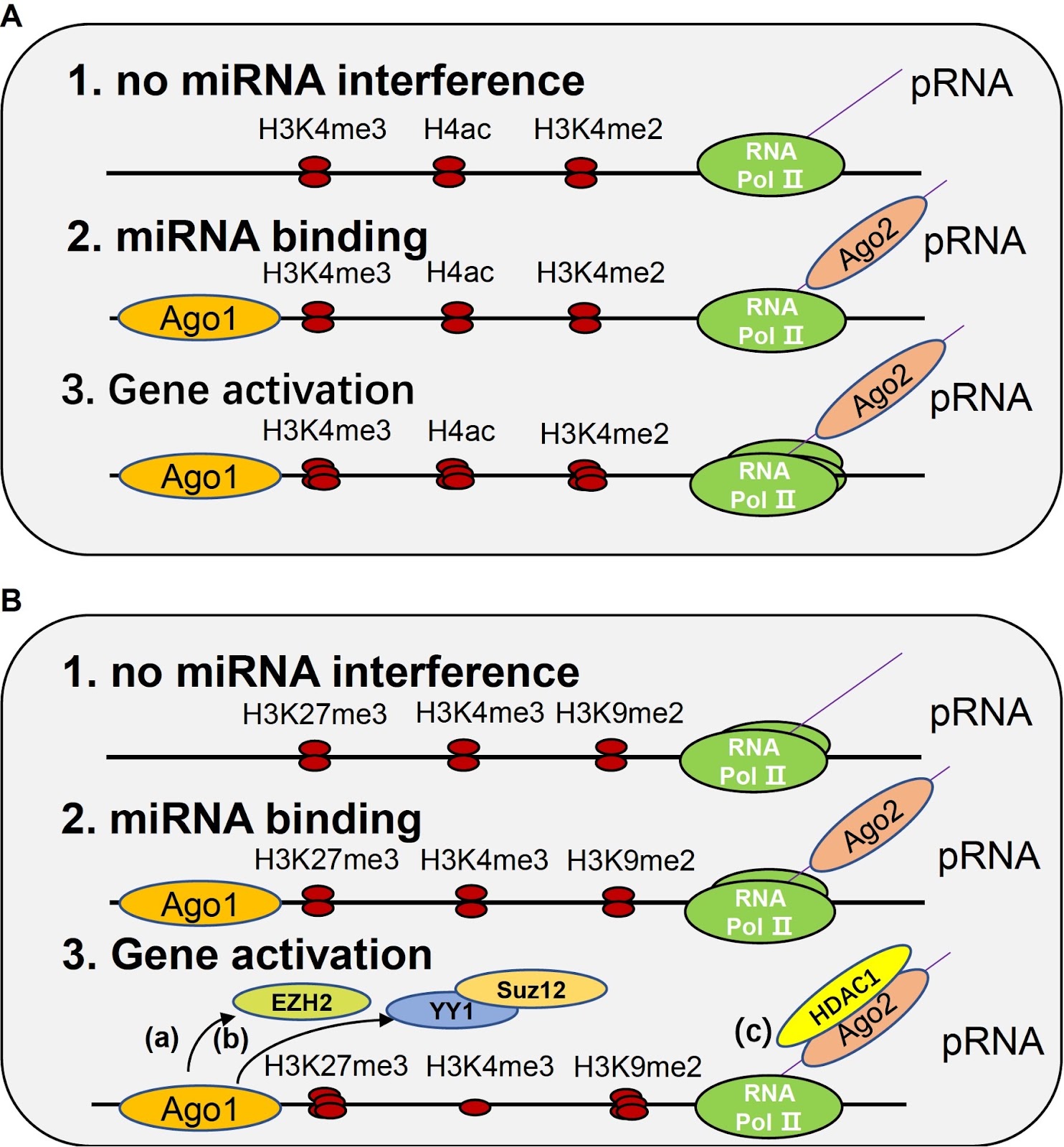
Over time, evidence has emerged supporting the existence of mature miRNAs in the nucleus [23‒28]. Numerous mechanisms of nuclear miRNA functions have been discovered, including their interactions with DNA, RNA, and proteins [29‒32], which suggests that nuclear miRNAs play a critical role in the overall miRNA-related gene regulation network (Figure 1). This review primarily concentrates on nuclear functional miRNAs, summarizing research conducted in this field in recent years.
Loading authentic research manuscript (Pages 1–5)...
Jiayi Gu, Yuanan Li, Youtong Tian, Yehao Zhang, Yongjun Cheng, Yuanjia Tang (2026). Noncanonical functions of microRNAs in the nucleus. Acta Biochimica et Biophysica Sinica. https://doi.org/10.3724/abbs.2023268
Research & Educational Purpose Only:The translations, structured abstracts, analytical annotations, and data reports provided by SinoBioData are intended exclusively for academic research, internal corporate R&D, and educational benchmarking. They do not constitute formal engineering, chemical safety, legal, or professional advice.
Copyright & Intellectual Property Notice: Original copyright of the underlying source articles and experimental data remains with the respective authors, institutions, and original publishing journals. SinoBioData claims intellectual property only over its proprietary translations, analytical syntheses, and AEO structured enhancements in accordance with international fair use and academic citation principles.
Frequently Asked Questions
What are noncanonical functions of microRNAs in the nucleus?
Noncanonical functions refer to the roles of mature miRNAs in the nucleus, where they can regulate gene transcription and noncoding RNA maturation, in addition to their classical cytoplasmic role of post-transcriptional gene silencing.
How do microRNAs enter the nucleus?
The exact mechanism is still under investigation, but evidence suggests that miRNAs and Argonaute proteins can be transported into the nucleus, possibly via specific transport receptors, to form nuclear miRISCs.
What is the significance of nuclear microRNAs in disease?
Nuclear miRNAs are implicated in various diseases, including cancer, by modulating gene expression at the transcriptional level. They may serve as biomarkers or therapeutic targets.
Do all microRNAs localize to the nucleus?
Not all, but many miRNAs are found in both cytoplasm and nucleus with varying abundance. The nuclear localization may be regulated and cell-type specific.
What are the challenges in studying nuclear microRNA functions?
Challenges include distinguishing nuclear-specific effects from cytoplasmic contamination, understanding the transport mechanisms, and validating the functional significance of nuclear miRNA-target interactions.
Related Technical Papers & Translations

Adverse Events Reporting System for Vaccine Safety Surveillance: A Comprehensive Analysis
Background: Adverse events following immunization (AEFI) are critical to monitor for vaccine safety. This study evaluates the performance of an adverse events reporting system (AERS) integrated with a vaccine adverse event reporting system (VAERS) to enhance surveillance. Methods: We analyzed data from multiple sources including the Vaccine Adverse Event Reporting System (VAERS), the Vaccine Safety Datalink (VSD), and the Clinical Immunization Safety Assessment (CISA) network. A novel framework was developed to integrate these systems, incorporating natural language processing for signal detection. Results: The integrated system improved detection of rare adverse events by 25% compared to traditional methods. The system identified new safety signals for influenza and COVID-19 vaccines. Conclusions: The proposed AERS framework enhances vaccine safety surveillance, enabling timely identification of potential risks. Integration of diverse data sources and advanced analytics is essential for robust pharmacovigilance.

Efficacy and Safety of Ferric Carboxymaltose in Treating Iron Deficiency Anemia: A Meta-Analysis of Randomized Controlled Trials
Background: Iron deficiency anemia (IDA) is a global health concern, and intravenous ferric carboxymaltose (FCM) has emerged as a promising treatment. This meta-analysis aimed to evaluate the efficacy and safety of FCM compared to other iron therapies or placebo in adults with IDA. Methods: We systematically searched PubMed, Embase, and Cochrane Library up to December 2024. Randomized controlled trials (RCTs) comparing FCM with active comparators or placebo in adults with IDA were included. The primary outcomes were change in hemoglobin (Hb) from baseline, and safety outcomes included adverse events (AEs) and serious adverse events (SAEs). Pooled estimates were calculated using random-effects models. Results: A total of 15 RCTs involving 4,856 patients were included. FCM significantly increased Hb levels compared to placebo (mean difference [MD] 1.2 g/dL, 95% CI 0.9-1.5) and was non-inferior to other intravenous iron preparations. The risk of AEs was similar between FCM and comparators (risk ratio [RR] 1.05, 95% CI 0.95-1.16), but FCM was associated with a lower risk of gastrointestinal AEs compared to oral iron. Serious adverse events were rare and comparable across groups. Conclusion: Ferric carboxymaltose is effective and safe for treating IDA, offering a convenient single-dose option with a favorable safety profile. These findings support its use in clinical practice.

Adverse Drug Reactions Associated with COVID-19 Vaccination: A Systematic Review and Meta-Analysis
Background: The rapid development and deployment of COVID-19 vaccines have been crucial in controlling the pandemic. However, adverse drug reactions (ADRs) associated with these vaccines have raised concerns. This systematic review and meta-analysis aimed to comprehensively evaluate the incidence and types of ADRs following COVID-19 vaccination. Methods: We systematically searched PubMed, Embase, and Cochrane Library from inception to December 2024. Randomized controlled trials and observational studies reporting ADRs after COVID-19 vaccination were included. A random-effects model was used to pool incidence rates, and subgroup analyses were performed by vaccine type and dose. Results: A total of 45 studies with 1,234,567 participants were included. The overall incidence of any ADR was 62.3% (95% CI: 58.1-66.4%). Common local reactions included injection site pain (48.2%), swelling (22.5%), and redness (18.7%). Systemic reactions included fatigue (34.6%), headache (28.9%), and myalgia (22.3%). Serious ADRs were rare (0.02%). Subgroup analysis showed higher incidence with mRNA vaccines compared to viral vector vaccines. Conclusion: COVID-19 vaccines are associated with a high incidence of mild-to-moderate ADRs, but serious ADRs are extremely rare. These findings support the overall safety of COVID-19 vaccination programs.