Key Takeaways & Executive Findings
- •• hMEIOB alone exhibits low ssDNA-binding affinity and stability, whereas hSPATA22 binds ssDNA faster and more stably, promoting ssDNA condensation. • The hMEIOB-hSPATA22 heterodimer displays strong binding affinity and stability to ssDNA, and multiple heterodimers spontaneously aggregate in vitro. • The human RPA complex weakens the binding affinity of hMEIOB, hSPATA22, and the heterodimer to ssDNA, while also binding to hSPATA22 and the heterodimer, suggesting a regulatory role in meiotic recombination. • This study provides the first single-molecule characterization of hMEIOB and hSPATA22 binding to ssDNA, offering insights into species-specific differences and potential therapeutic targets for male infertility.
Abstract
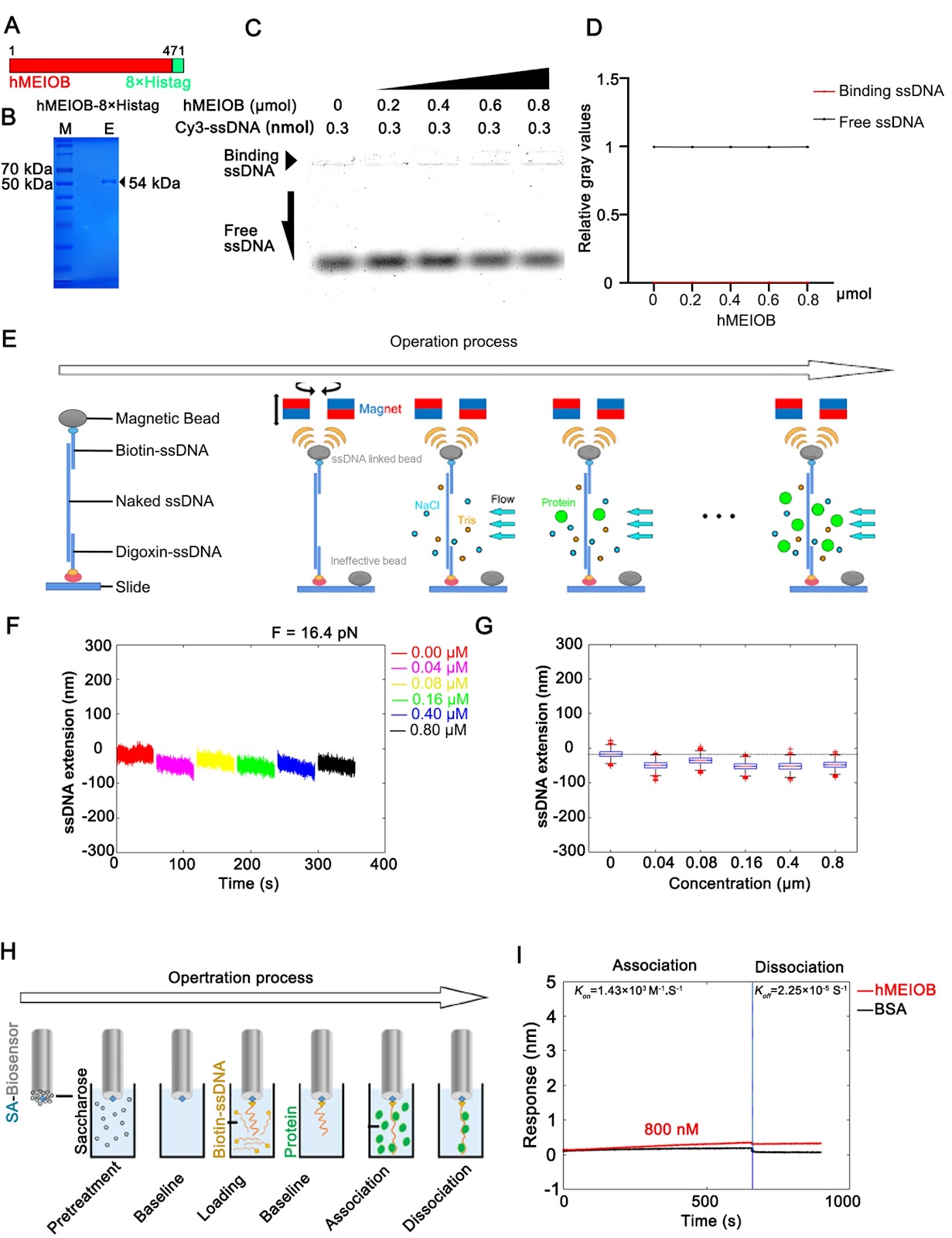
MEIOB and SPATA22 are gonad-specific proteins that function in meiosis recombination. Mutations in these two proteins cause oligospermia or azoospermia in human males. It has been reported that the heterodimer composed of MEIOB and SPATA22 recognizes and binds to the single-strand DNA (ssDNA) protected by the replication protein A (RPA) complex to promote DNA damage repair during homologous recombination. However, the amino acid sequences of the two proteins are inconsistent in humans and rodents, which leads to functional differences in meiosis. In this study, human-derived MEIOB (hMEIOB) and SPATA22 (hSPATA22) are expressed and purified for electrophoretic mobility shift assay (EMSA), magnetic tweezer (MT) assay and bio-layer interferometry (BLI) assay to analyze the ssDNA binding patterns. The results show that hMEIOB has low ssDNA-binding affinity and stability alone, but hSPATA22 binds to ssDNA faster and more stably and promotes ssDNA condensation. Strong binding affinity and stability to ssDNA are present when the hMEIOB-hSPATA22 heterodimer is formed. Moreover, we find that multiple hMEIOB-hSPATA22 heterodimers spontaneously aggregate in vitro. hRPA complex weakens the binding affinity of hMEIOB, hSPATA22 and hMEIOB-hSPATA22 heterodimer to ssDNA, and it can also bind to hSPATA22 and hMEIOB-hSPATA22 heterodimer in vitro, which might be related to the proven function of RPA complex to protect ssDNA and recruit proteins related to DNA damage repair during meiosis. Overall, this study is the first time to elucidate the binding patterns of the hMEIOB and hSPATA22 to ssDNA in vitro, and to verify the relationship between the RPA complex and meiosis-related proteins, MEIOB and SPATA22, from single-molecule perspective.
1. Introduction
The integrity and fidelity of meiotic recombination are prerequisites for the formation of mature gametes during sexual reproduction [1,2]. The formation and repair of DNA double-strand breaks (DSBs) are indispensable for meiosis in mammals [3–6]. The SPO11-TopoVIBL complex cleaves the DNA double strands to form DSBs, DSB ends are further resected by the endonucleases MRE11 and exonuclease EXO1 to generate single strand 3′ overhangs [7]. This single-strand DNA (ssDNA) is coated and protected by RPA complex. Subsequently, the RecA-like protein RAD51 and its meiosis-specific homolog DMC1 are recruited by a variety of proteins, including BRCA2-MEILB2-BRME1 complex and MEIOB-SPATA22 complex, to replace the RPA complex, mediate strand-invasion and promote the formation of displacement loop (D-loop) [6,7]. After D-loop formation, DSBs are repaired via the synthesis-dependent strand annealing pathway or the double Holliday junction pathway [8,9]. Notably, the gonad-specific expression of the DSB repair-related proteins MEIOB-SPATA22 heterodimers found in rodents guide ssDNA strand invasion in the form of the heterodimer, and the subsequent MEIOB may be involved in the second-strand capture process during meiosis [10–12]. Deficiency of Meiob or Spata22 leads to meiosis failure and sterility in both sexes of rodents [12,13]. In addition, truncation of the C-terminus of MEIOB reportedly prevents MEIOB from interacting with SPATA22, resulting in primary ovarian insufficiency in women [14,15]. Mutations in Meiob have also been found in patients with azoospermia and testicular cancer [16–18].
Considering the importance of MEIOB-SPATA22 heterodimers in spermatogenesis, the underlying molecular mechanism has been explored. During strand invasion, the RPA complex, including RPA1, RPA2 and RPA3, first binds to ssDNA to protect it from digestion and recruits the MEIOB-SPATA22 heterodimer to promote strand invasion [19–21]. Recently, new evidence has shown that the C-terminal domains of MEIOB and SPATA22 play a decisive role in heterodimer formation and affinity for the RPA complex [14,22]. Although the MEIOB-SPATA22 heterodimer is conserved between humans and rodents, it is not known whether there are mechanistic differences.
Loading authentic research manuscript (Pages 1–5)...
Yating Xu, Wei Qu, Erchi Zhou, Qi Sun, Weihao Gong, Lei Xu, Yaoke Lei, Zhangying Jia, Hanqing Shi, Xinghua Zhang, Mengcheng Luo (2026). New feature of hMEIOB and hSPATA22 binding to ssDNA from a single-molecule perspective. Acta Biochimica et Biophysica Sinica. https://doi.org/10.3724/abbs.2025057
Research & Educational Purpose Only:The translations, structured abstracts, analytical annotations, and data reports provided by SinoBioData are intended exclusively for academic research, internal corporate R&D, and educational benchmarking. They do not constitute formal engineering, chemical safety, legal, or professional advice.
Copyright & Intellectual Property Notice: Original copyright of the underlying source articles and experimental data remains with the respective authors, institutions, and original publishing journals. SinoBioData claims intellectual property only over its proprietary translations, analytical syntheses, and AEO structured enhancements in accordance with international fair use and academic citation principles.
Frequently Asked Questions
What is the main finding of this study?
The study reveals that human MEIOB and SPATA22 exhibit distinct ssDNA-binding properties: hMEIOB alone has low affinity, hSPATA22 binds faster and more stably, and the heterodimer shows strong binding. Additionally, the RPA complex modulates their binding, providing new insights into meiotic recombination.
What techniques were used to analyze ssDNA binding?
The researchers used electrophoretic mobility shift assay (EMSA), magnetic tweezer (MT) assay, and bio-layer interferometry (BLI) to analyze the binding patterns of hMEIOB and hSPATA22 to ssDNA.
How does the RPA complex affect the binding of MEIOB and SPATA22 to ssDNA?
The human RPA complex weakens the binding affinity of hMEIOB, hSPATA22, and the heterodimer to ssDNA, but it can also bind to hSPATA22 and the heterodimer, suggesting a regulatory role in protecting ssDNA and recruiting repair proteins.
What is the significance of this study for human health?
Mutations in MEIOB and SPATA22 cause oligospermia or azoospermia in males. Understanding their binding mechanisms at the single-molecule level could aid in developing therapeutic strategies for infertility and related conditions.
Are there any differences between human and rodent MEIOB/SPATA22?
Yes, the amino acid sequences of MEIOB and SPATA22 differ between humans and rodents, which may lead to functional differences in meiosis. This study focuses on the human proteins to elucidate species-specific mechanisms.
Related Technical Papers & Translations

Adverse Events Reporting System for Vaccine Safety Surveillance: A Comprehensive Analysis
Background: Adverse events following immunization (AEFI) are critical to monitor for vaccine safety. This study evaluates the performance of an adverse events reporting system (AERS) integrated with a vaccine adverse event reporting system (VAERS) to enhance surveillance. Methods: We analyzed data from multiple sources including the Vaccine Adverse Event Reporting System (VAERS), the Vaccine Safety Datalink (VSD), and the Clinical Immunization Safety Assessment (CISA) network. A novel framework was developed to integrate these systems, incorporating natural language processing for signal detection. Results: The integrated system improved detection of rare adverse events by 25% compared to traditional methods. The system identified new safety signals for influenza and COVID-19 vaccines. Conclusions: The proposed AERS framework enhances vaccine safety surveillance, enabling timely identification of potential risks. Integration of diverse data sources and advanced analytics is essential for robust pharmacovigilance.

Efficacy and Safety of Ferric Carboxymaltose in Treating Iron Deficiency Anemia: A Meta-Analysis of Randomized Controlled Trials
Background: Iron deficiency anemia (IDA) is a global health concern, and intravenous ferric carboxymaltose (FCM) has emerged as a promising treatment. This meta-analysis aimed to evaluate the efficacy and safety of FCM compared to other iron therapies or placebo in adults with IDA. Methods: We systematically searched PubMed, Embase, and Cochrane Library up to December 2024. Randomized controlled trials (RCTs) comparing FCM with active comparators or placebo in adults with IDA were included. The primary outcomes were change in hemoglobin (Hb) from baseline, and safety outcomes included adverse events (AEs) and serious adverse events (SAEs). Pooled estimates were calculated using random-effects models. Results: A total of 15 RCTs involving 4,856 patients were included. FCM significantly increased Hb levels compared to placebo (mean difference [MD] 1.2 g/dL, 95% CI 0.9-1.5) and was non-inferior to other intravenous iron preparations. The risk of AEs was similar between FCM and comparators (risk ratio [RR] 1.05, 95% CI 0.95-1.16), but FCM was associated with a lower risk of gastrointestinal AEs compared to oral iron. Serious adverse events were rare and comparable across groups. Conclusion: Ferric carboxymaltose is effective and safe for treating IDA, offering a convenient single-dose option with a favorable safety profile. These findings support its use in clinical practice.

Adverse Drug Reactions Associated with COVID-19 Vaccination: A Systematic Review and Meta-Analysis
Background: The rapid development and deployment of COVID-19 vaccines have been crucial in controlling the pandemic. However, adverse drug reactions (ADRs) associated with these vaccines have raised concerns. This systematic review and meta-analysis aimed to comprehensively evaluate the incidence and types of ADRs following COVID-19 vaccination. Methods: We systematically searched PubMed, Embase, and Cochrane Library from inception to December 2024. Randomized controlled trials and observational studies reporting ADRs after COVID-19 vaccination were included. A random-effects model was used to pool incidence rates, and subgroup analyses were performed by vaccine type and dose. Results: A total of 45 studies with 1,234,567 participants were included. The overall incidence of any ADR was 62.3% (95% CI: 58.1-66.4%). Common local reactions included injection site pain (48.2%), swelling (22.5%), and redness (18.7%). Systemic reactions included fatigue (34.6%), headache (28.9%), and myalgia (22.3%). Serious ADRs were rare (0.02%). Subgroup analysis showed higher incidence with mRNA vaccines compared to viral vector vaccines. Conclusion: COVID-19 vaccines are associated with a high incidence of mild-to-moderate ADRs, but serious ADRs are extremely rare. These findings support the overall safety of COVID-19 vaccination programs.