Key Takeaways & Executive Findings
- •• MEF2A is identified as a master transcriptional regulator of endothelial redox homeostasis, directly activating SIRT1 expression by binding to two cis-elements in its promoter. • MEF2A silencing induces oxidative stress in endothelial cells, characterized by elevated ROS, reduced GSH/GSSG ratio, and mitochondrial membrane potential collapse, while overexpression restores redox balance. • In vivo, endothelial-specific MEF2A knockdown in high-fat diet-fed mice increases vascular oxidative damage, evidenced by elevated 8-OHdG and ROS levels, and downregulates SIRT1/PGC-1α. • Pharmacological activation of MEF2A represents a novel precision antioxidant strategy for treating oxidative cardiovascular disorders, addressing the limitations of current nonspecific antioxidant therapies.
Abstract
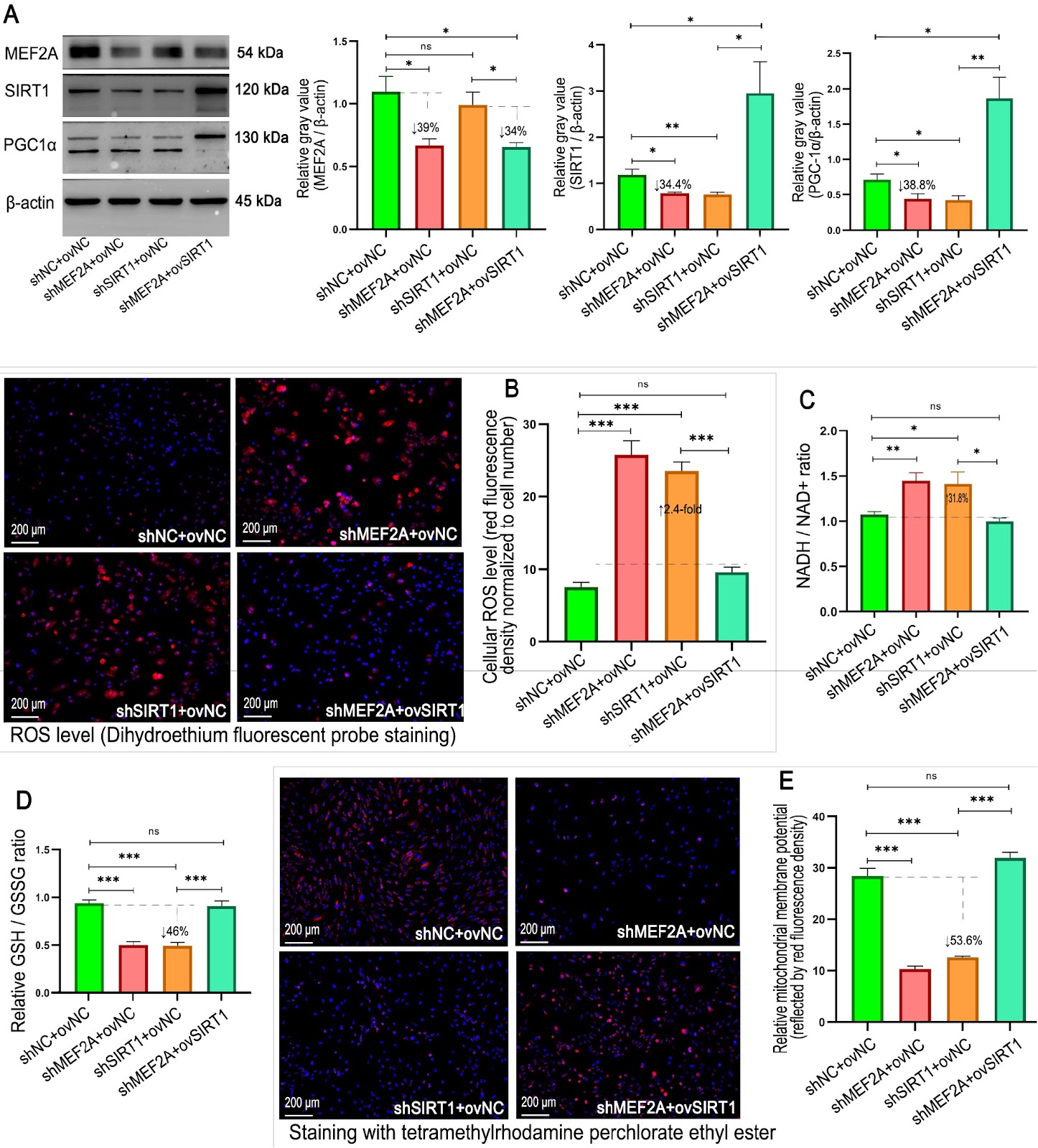
Myocyte enhancer factor 2A (MEF2A), a transcription factor implicated in coronary artery disease, remains unexplored in vascular redox regulation. To address this gap and overcome the limitations of current antioxidant therapies, we investigate the role of MEF2A in oxidative defense via human umbilical vein endothelial cells (HUVECs) and murine models. Adenoviral vectors encoding MEF2A-specific shRNAs or mRNAs are used to silence or overexpress MEF2A in HUVECs. For in vivo validation, endothelial-targeted MEF2A knockdown is achieved via AAV1-shRNA delivery in mice fed with a high-fat diet. Systemic redox status is assessed by measuring reactive oxygen species (ROS), glutathione homeostasis (GSH/GSSG ratio), the NADH/NAD+ balance, the mitochondrial membrane potential (ΔΨm), and 8-hydroxy-2′-deoxyguanosine (8-OHdG). Mechanistic insights are derived from immunofluorescence, qPCR, western blotting, and dual-luciferase reporter assays. MEF2A silencing induces redox imbalance, characterized by elevated ROS, a reduced GSH/GSSG ratio, and ΔΨm collapse. Conversely, MEF2A overexpression synergizes with SIRT1 to restore the glutathione pool, maintain NAD+ homeostasis, and suppress ROS under oxidative stress. Chromatin immunoprecipitation confirms that MEF2A directly binds to two cis-elements in the SIRT1 promoter, driving transcriptional activation. In vivo, MEF2A-deficient mice present increased vascular oxidative damage, as indicated by elevated DNA damage marker (8-OHdG) and ROS levels. The downregulation of SIRT1/PGC-1α in MEF2A-silenced cells is verified in vivo. Our findings establish MEF2A as a master regulator of endothelial redox defense via the SIRT1-PGC-1α axis, providing a mechanistic foundation for the treatment of oxidative cardiovascular disorders. This work suggests that pharmacological MEF2A activation is a novel strategy for precision antioxidant therapy in vascular medicine.
1. Introduction
Oxidative stress is a pathophysiological state characterized by excessive reactive oxygen species (ROS) production overwhelming endogenous antioxidant defenses, and serves as a critical driver of cellular dysfunction and tissue damage in chronic diseases [1]. In the cardiovascular system, this redox imbalance triggers endothelial injury, initiating a cascade of events that culminate in atherosclerosis, hypertension, and ischemic heart disease [2–5]. While ROS are essential signaling molecules at physiological levels, their pathological accumulation induces DNA damage, lipid peroxidation, and mitochondrial impairment, with vascular endothelial cells being particularly vulnerable due to their direct exposure to hemodynamic stressors [6,7].
Vascular endothelial cells, far beyond their traditional role as passive blood vessel linings, function as dynamic biosensors that regulate vascular tone, thromboresistance, and inflammatory responses through paracrine signaling [8]. Emerging evidence positions endothelial redox dysregulation as the “first domino” in atherosclerosis development, where the oxidative inactivation of nitric oxide synergizes with oxidized LDL uptake to drive foam cell formation and plaque progression [8–10]. Despite advances in antioxidant therapies (e.g., vitamins, probucol and related phenols), clinical translation remains hampered by systemic toxicity and the inability to target endothelial-specific pathways [11]. This therapeutic gap underscores the urgency of identifying master transcriptional regulators of endothelial redox homeostasis.
Sirtuin 1 (SIRT1), an NAD+-dependent deacetylase, and peroxisome proliferator-activated receptor γ coactivator-1α (PGC-1α), a master regulator of mitochondrial biogenesis, form a critical nexus for redox defense [12]. SIRT1 deacetylates PGC-1α to enhance mitochondrial function and ROS scavenging [13]. Pharmacological activators such as resveratrol improve vascular function [14]; however, their reliance on upstream transcriptional control mechanisms remains unexplored. This gap parallels broader failures of nonspecific antioxidants, highlighting the urgency of defining transcription factors that coordinate mitochondrial quality control and endogenous defenses.
Myocyte enhancer factor 2A (MEF2A), a member of the MADS-box transcription factor family, has emerged as a paradoxical player in cardiovascular biology [15–17]. MEF2A was originally identified for its essential role in muscle development through its regulation of myocyte differentiation and morphogenesis [18], and it has since been shown to perform pleiotropic functions across tissues. In immun...
Loading authentic research manuscript (Pages 1–5)...
Benrong Liu, Lei Fang, Chunxia Miao, Xinyu Wen, Xiumiao Zheng, Minxing Xu, Junli Lin, Yujuan Xiong, Shi-Ming Liu (2026). Myocyte enhancer factor 2A orchestrates vascular redox homeostasis via direct transcriptional activation of SIRT1. Acta Biochimica et Biophysica Sinica. https://doi.org/10.3724/abbs.2025163
Research & Educational Purpose Only:The translations, structured abstracts, analytical annotations, and data reports provided by SinoBioData are intended exclusively for academic research, internal corporate R&D, and educational benchmarking. They do not constitute formal engineering, chemical safety, legal, or professional advice.
Copyright & Intellectual Property Notice: Original copyright of the underlying source articles and experimental data remains with the respective authors, institutions, and original publishing journals. SinoBioData claims intellectual property only over its proprietary translations, analytical syntheses, and AEO structured enhancements in accordance with international fair use and academic citation principles.
Frequently Asked Questions
What is the role of MEF2A in vascular redox regulation?
MEF2A acts as a master transcriptional regulator of endothelial redox defense. It directly activates SIRT1 expression by binding to specific cis-elements in the SIRT1 promoter, thereby enhancing the SIRT1-PGC-1α axis, which promotes mitochondrial function and ROS scavenging. This maintains redox homeostasis and protects against oxidative stress in vascular endothelial cells.
How does MEF2A silencing affect endothelial cells?
MEF2A silencing in human umbilical vein endothelial cells (HUVECs) induces redox imbalance, characterized by elevated reactive oxygen species (ROS), reduced glutathione (GSH/GSSG) ratio, and collapse of mitochondrial membrane potential (ΔΨm). This indicates increased oxidative stress and impaired antioxidant defense.
What is the clinical significance of this study?
The study identifies MEF2A as a potential therapeutic target for oxidative cardiovascular disorders. Pharmacological activation of MEF2A could provide a novel precision antioxidant strategy, overcoming the limitations of current nonspecific antioxidant therapies that have failed in clinical translation due to systemic toxicity and lack of endothelial specificity.
How was the direct transcriptional activation of SIRT1 by MEF2A confirmed?
The direct binding of MEF2A to two cis-elements in the SIRT1 promoter was confirmed using chromatin immunoprecipitation (ChIP) and dual-luciferase reporter assays. These experiments demonstrated that MEF2A binds to the promoter and drives transcriptional activation of SIRT1.
What in vivo evidence supports the role of MEF2A in vascular oxidative damage?
In vivo, endothelial-targeted MEF2A knockdown in mice fed a high-fat diet resulted in increased vascular oxidative damage, as indicated by elevated levels of the DNA damage marker 8-hydroxy-2′-deoxyguanosine (8-OHdG) and ROS. Additionally, downregulation of SIRT1/PGC-1α was observed, confirming the mechanistic pathway.
Related Technical Papers & Translations

Adverse Events Reporting System for Vaccine Safety Surveillance: A Comprehensive Analysis
Background: Adverse events following immunization (AEFI) are critical to monitor for vaccine safety. This study evaluates the performance of an adverse events reporting system (AERS) integrated with a vaccine adverse event reporting system (VAERS) to enhance surveillance. Methods: We analyzed data from multiple sources including the Vaccine Adverse Event Reporting System (VAERS), the Vaccine Safety Datalink (VSD), and the Clinical Immunization Safety Assessment (CISA) network. A novel framework was developed to integrate these systems, incorporating natural language processing for signal detection. Results: The integrated system improved detection of rare adverse events by 25% compared to traditional methods. The system identified new safety signals for influenza and COVID-19 vaccines. Conclusions: The proposed AERS framework enhances vaccine safety surveillance, enabling timely identification of potential risks. Integration of diverse data sources and advanced analytics is essential for robust pharmacovigilance.

Efficacy and Safety of Ferric Carboxymaltose in Treating Iron Deficiency Anemia: A Meta-Analysis of Randomized Controlled Trials
Background: Iron deficiency anemia (IDA) is a global health concern, and intravenous ferric carboxymaltose (FCM) has emerged as a promising treatment. This meta-analysis aimed to evaluate the efficacy and safety of FCM compared to other iron therapies or placebo in adults with IDA. Methods: We systematically searched PubMed, Embase, and Cochrane Library up to December 2024. Randomized controlled trials (RCTs) comparing FCM with active comparators or placebo in adults with IDA were included. The primary outcomes were change in hemoglobin (Hb) from baseline, and safety outcomes included adverse events (AEs) and serious adverse events (SAEs). Pooled estimates were calculated using random-effects models. Results: A total of 15 RCTs involving 4,856 patients were included. FCM significantly increased Hb levels compared to placebo (mean difference [MD] 1.2 g/dL, 95% CI 0.9-1.5) and was non-inferior to other intravenous iron preparations. The risk of AEs was similar between FCM and comparators (risk ratio [RR] 1.05, 95% CI 0.95-1.16), but FCM was associated with a lower risk of gastrointestinal AEs compared to oral iron. Serious adverse events were rare and comparable across groups. Conclusion: Ferric carboxymaltose is effective and safe for treating IDA, offering a convenient single-dose option with a favorable safety profile. These findings support its use in clinical practice.

Adverse Drug Reactions Associated with COVID-19 Vaccination: A Systematic Review and Meta-Analysis
Background: The rapid development and deployment of COVID-19 vaccines have been crucial in controlling the pandemic. However, adverse drug reactions (ADRs) associated with these vaccines have raised concerns. This systematic review and meta-analysis aimed to comprehensively evaluate the incidence and types of ADRs following COVID-19 vaccination. Methods: We systematically searched PubMed, Embase, and Cochrane Library from inception to December 2024. Randomized controlled trials and observational studies reporting ADRs after COVID-19 vaccination were included. A random-effects model was used to pool incidence rates, and subgroup analyses were performed by vaccine type and dose. Results: A total of 45 studies with 1,234,567 participants were included. The overall incidence of any ADR was 62.3% (95% CI: 58.1-66.4%). Common local reactions included injection site pain (48.2%), swelling (22.5%), and redness (18.7%). Systemic reactions included fatigue (34.6%), headache (28.9%), and myalgia (22.3%). Serious ADRs were rare (0.02%). Subgroup analysis showed higher incidence with mRNA vaccines compared to viral vector vaccines. Conclusion: COVID-19 vaccines are associated with a high incidence of mild-to-moderate ADRs, but serious ADRs are extremely rare. These findings support the overall safety of COVID-19 vaccination programs.