Key Takeaways & Executive Findings
- •• MYB depletion reactivates embryonic ζ-globin in mouse models and human hematopoietic stem cells, offering a therapeutic avenue for α-thalassemia and sickle cell disease. • ETO2 is identified as a novel repressor of ζ-globin, acting via the NuRD complex to modulate histone deacetylation. • The MYB-ETO2 axis co-regulates key erythroid genes more prominently than MYB-KLF1, highlighting a distinct transcriptional mechanism. • ETO2 knockout in primary CD34+ cells from hemoglobin H patients significantly increases ζ-globin expression, and the MYB-ETO2 pathway primarily silences ζ-globin independent of BCL11A.
Abstract
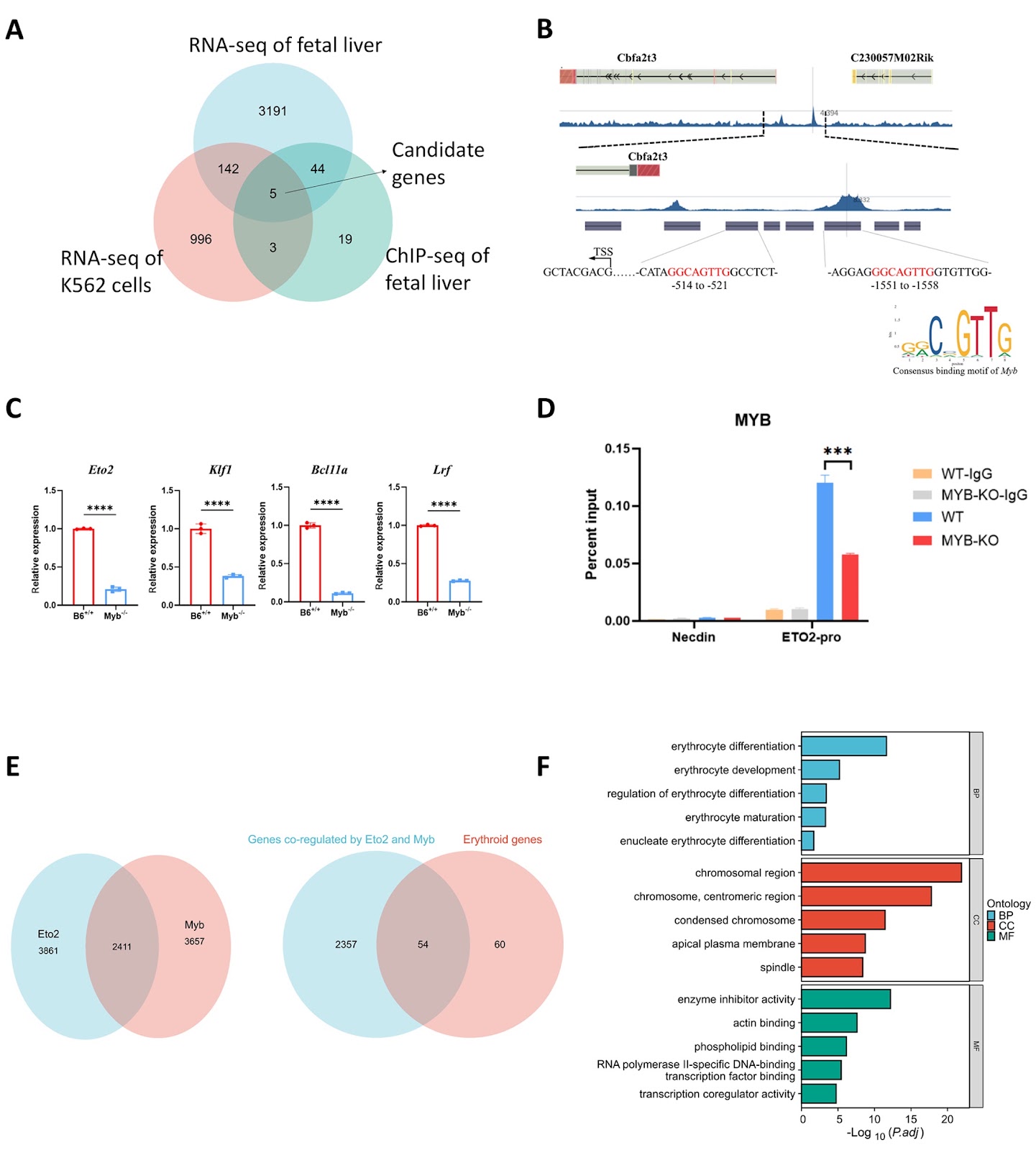
Reactivating the embryonic ζ-globin gene represents a potential therapeutic approach to ameliorate the severe clinical phenotype of α-thalassemia and sickle cell disease. The transcription factor MYB has been extensively proven to be a master regulator of the γ-globin gene, but its role in the regulation of ζ-globin remains incompletely understood. Here, we report a mechanistic study on the derepression of ζ-globin both in vivo and in vitro. We show that MYB depletion in mouse models and human hematopoietic stem cells leads to consistent and remarkable reactivation of ζ-globin. Furthermore, multiomics analysis and functional validation of MYB-knockout and wild-type cell lines reveal that ETO2 functions as a novel repressor of ζ-globin through coordination with NuRD nucleosome remodeling and the deacetylation complex to modulate histone deacetylation of ζ-globin. Additionally, we evaluate the clinical significance of these findings by knocking out ETO2 in primary CD34+ cells from nondeletional hemoglobin H patients, which results in a significant increase in ζ-globin expression. The RNA-seq data reveal that key erythroid genes are more co-regulated by Myb and Eto2 than by Myb and Klf1, highlighting a distinctly enhanced erythroid-specific transcriptional impact within the MYB-ETO2 regulatory axis. Compared with ETO2 knockout alone, codepletion of ETO2 and BCL11A did not significantly activate ζ-globin, suggesting that the MYB-ETO2 pathway primarily silences ζ-globin. Our study reveals a linear MYB-ETO2 signaling pathway crucial for ζ-globin repression and offers new targets for treating α-thalassemia and sickle cell disease.
1. Introduction
Thalassemia is among the most prevalent monogenic disorders worldwide and poses a significant health and economic burden. Approximately 1%–5% of the world’s population is reported to carry α-thalassemia mutations, and 3% is reported to carry β-thalassemia mutations [1–3]. Over the last three decades, considerable progress has been achieved in β-thalassemia treatment, highlighted by research on γ-β hemoglobin switching and pharmacological reactivation of fetal hemoglobin [4–10]. However, gaps are pronounced in the case of α-thalassemia. Mammalian α- and β-like globin genes, which are arranged on the basis of their expression during development, transition from embryonic/fetal to adult forms, reflecting their role across different gestational stages and erythroblast maturation sites. The α-like globin locus in both humans and mice harbors three functional genes, including an embryonic ζ-globin gene and two duplicated adult α-globin genes [11]. The embryonic ζ-globin gene is specifically expressed in primitive erythrocytes derived from the yolk sac, followed by transcriptional repression as a transition to definitive erythropoiesis occurs [12]. Previous experimental evidence has confirmed that the induction of embryonic ζ-globin, by acting as a substitute for deficient adult α-globin, rescues the viability of transgenic mouse models of α-thalassemia and sickle cell disease (SCD), suggesting a potential therapeutic approach for both conditions [13,14]. However, relatively limited attention has been given to the regulatory mechanisms of ζ-globin reactivation.
Erythropoiesis is a differentiation process in which hematopoietic stem cells progressively transform into mature red blood cells through a series of cellular events and the precise regulation of globin gene expression, which is highly regulated by specific transcription factors and growth factors. Substantial efforts have been made over the past few decades to investigate the genetic mechanisms underlying globin gene expression and fetal-to-adult hemoglobin switching, leading to the identification of BCL11A, MYB, KLF1 and LRF as the major modifiers in the regulation of γ-globin gene expression [15–17]. The transcription factor MYB plays an indispensable role not only in definitive erythropoiesis but also in its capacity to repress embryonic (ε-globin) and fetal gene (γ-globin) expression within the β-globin locus. The traditional model posits that MYB action occurs through KLF1, affecting the downstream factors BCL11A and LRF to regulate γ-globin gene expression [16,18–20]. Biallelic deleterious mutations in KLF1 reportedly cause hemolytic anemia with a dramatic increase in ζ-globin expression [21]. Recent studies provided evidence that BCL11A and LRF, two master γ-globin regulators, might have a direct effect on ζ-globin repression.
Loading authentic research manuscript (Pages 1–5)...
Zejun Dong, Yuhua Ye, Wei Zhang, Hualei Luo, Jialong Li, Qianqian Zhang, Xinhua Zhang, Xiang Guo, Xiangmin Xu (2026). MYB represses ζ-globin expression through upregulating ETO2. Acta Biochimica et Biophysica Sinica. https://doi.org/10.3724/abbs.2024239
Research & Educational Purpose Only:The translations, structured abstracts, analytical annotations, and data reports provided by SinoBioData are intended exclusively for academic research, internal corporate R&D, and educational benchmarking. They do not constitute formal engineering, chemical safety, legal, or professional advice.
Copyright & Intellectual Property Notice: Original copyright of the underlying source articles and experimental data remains with the respective authors, institutions, and original publishing journals. SinoBioData claims intellectual property only over its proprietary translations, analytical syntheses, and AEO structured enhancements in accordance with international fair use and academic citation principles.
Frequently Asked Questions
What is the role of MYB in ζ-globin regulation?
MYB represses ζ-globin expression by upregulating ETO2, which in turn recruits the NuRD complex to deacetylate histones at the ζ-globin locus, leading to transcriptional silencing.
How does ETO2 affect ζ-globin expression?
ETO2 functions as a novel repressor of ζ-globin. It coordinates with the NuRD nucleosome remodeling and deacetylation complex to modulate histone deacetylation, thereby silencing ζ-globin expression.
What is the clinical significance of this study?
The study demonstrates that knocking out ETO2 in primary CD34+ cells from nondeletional hemoglobin H patients significantly increases ζ-globin expression, suggesting that targeting the MYB-ETO2 pathway could be a therapeutic strategy for α-thalassemia and sickle cell disease.
Does the MYB-ETO2 pathway interact with BCL11A?
The study found that codepletion of ETO2 and BCL11A did not significantly activate ζ-globin compared to ETO2 knockout alone, indicating that the MYB-ETO2 pathway primarily silences ζ-globin independently of BCL11A.
What methods were used in this study?
The study used mouse models, human hematopoietic stem cells, multiomics analysis, functional validation in MYB-knockout and wild-type cell lines, and RNA-seq to investigate the regulatory mechanisms of ζ-globin expression.
Related Technical Papers & Translations

Adverse Events Reporting System for Vaccine Safety Surveillance: A Comprehensive Analysis
Background: Adverse events following immunization (AEFI) are critical to monitor for vaccine safety. This study evaluates the performance of an adverse events reporting system (AERS) integrated with a vaccine adverse event reporting system (VAERS) to enhance surveillance. Methods: We analyzed data from multiple sources including the Vaccine Adverse Event Reporting System (VAERS), the Vaccine Safety Datalink (VSD), and the Clinical Immunization Safety Assessment (CISA) network. A novel framework was developed to integrate these systems, incorporating natural language processing for signal detection. Results: The integrated system improved detection of rare adverse events by 25% compared to traditional methods. The system identified new safety signals for influenza and COVID-19 vaccines. Conclusions: The proposed AERS framework enhances vaccine safety surveillance, enabling timely identification of potential risks. Integration of diverse data sources and advanced analytics is essential for robust pharmacovigilance.

Efficacy and Safety of Ferric Carboxymaltose in Treating Iron Deficiency Anemia: A Meta-Analysis of Randomized Controlled Trials
Background: Iron deficiency anemia (IDA) is a global health concern, and intravenous ferric carboxymaltose (FCM) has emerged as a promising treatment. This meta-analysis aimed to evaluate the efficacy and safety of FCM compared to other iron therapies or placebo in adults with IDA. Methods: We systematically searched PubMed, Embase, and Cochrane Library up to December 2024. Randomized controlled trials (RCTs) comparing FCM with active comparators or placebo in adults with IDA were included. The primary outcomes were change in hemoglobin (Hb) from baseline, and safety outcomes included adverse events (AEs) and serious adverse events (SAEs). Pooled estimates were calculated using random-effects models. Results: A total of 15 RCTs involving 4,856 patients were included. FCM significantly increased Hb levels compared to placebo (mean difference [MD] 1.2 g/dL, 95% CI 0.9-1.5) and was non-inferior to other intravenous iron preparations. The risk of AEs was similar between FCM and comparators (risk ratio [RR] 1.05, 95% CI 0.95-1.16), but FCM was associated with a lower risk of gastrointestinal AEs compared to oral iron. Serious adverse events were rare and comparable across groups. Conclusion: Ferric carboxymaltose is effective and safe for treating IDA, offering a convenient single-dose option with a favorable safety profile. These findings support its use in clinical practice.

Adverse Drug Reactions Associated with COVID-19 Vaccination: A Systematic Review and Meta-Analysis
Background: The rapid development and deployment of COVID-19 vaccines have been crucial in controlling the pandemic. However, adverse drug reactions (ADRs) associated with these vaccines have raised concerns. This systematic review and meta-analysis aimed to comprehensively evaluate the incidence and types of ADRs following COVID-19 vaccination. Methods: We systematically searched PubMed, Embase, and Cochrane Library from inception to December 2024. Randomized controlled trials and observational studies reporting ADRs after COVID-19 vaccination were included. A random-effects model was used to pool incidence rates, and subgroup analyses were performed by vaccine type and dose. Results: A total of 45 studies with 1,234,567 participants were included. The overall incidence of any ADR was 62.3% (95% CI: 58.1-66.4%). Common local reactions included injection site pain (48.2%), swelling (22.5%), and redness (18.7%). Systemic reactions included fatigue (34.6%), headache (28.9%), and myalgia (22.3%). Serious ADRs were rare (0.02%). Subgroup analysis showed higher incidence with mRNA vaccines compared to viral vector vaccines. Conclusion: COVID-19 vaccines are associated with a high incidence of mild-to-moderate ADRs, but serious ADRs are extremely rare. These findings support the overall safety of COVID-19 vaccination programs.