Key Takeaways & Executive Findings
- •• MOTS-c, a mitochondrial-derived peptide, significantly alleviates bone cancer pain and bone destruction in a mouse model. • The analgesic effect of MOTS-c is mediated via AMPK activation, restoring mitochondrial biogenesis, and suppressing microglial activation and inflammatory factors in the spinal cord. • Peripherally, MOTS-c modulates osteoclast and immune cell function in the tumor microenvironment, providing long-term pain relief. • Chronic MOTS-c administration shows minimal side effects on liver, renal, lipid, and cardiac functions, supporting its safety as a therapeutic candidate.
Abstract
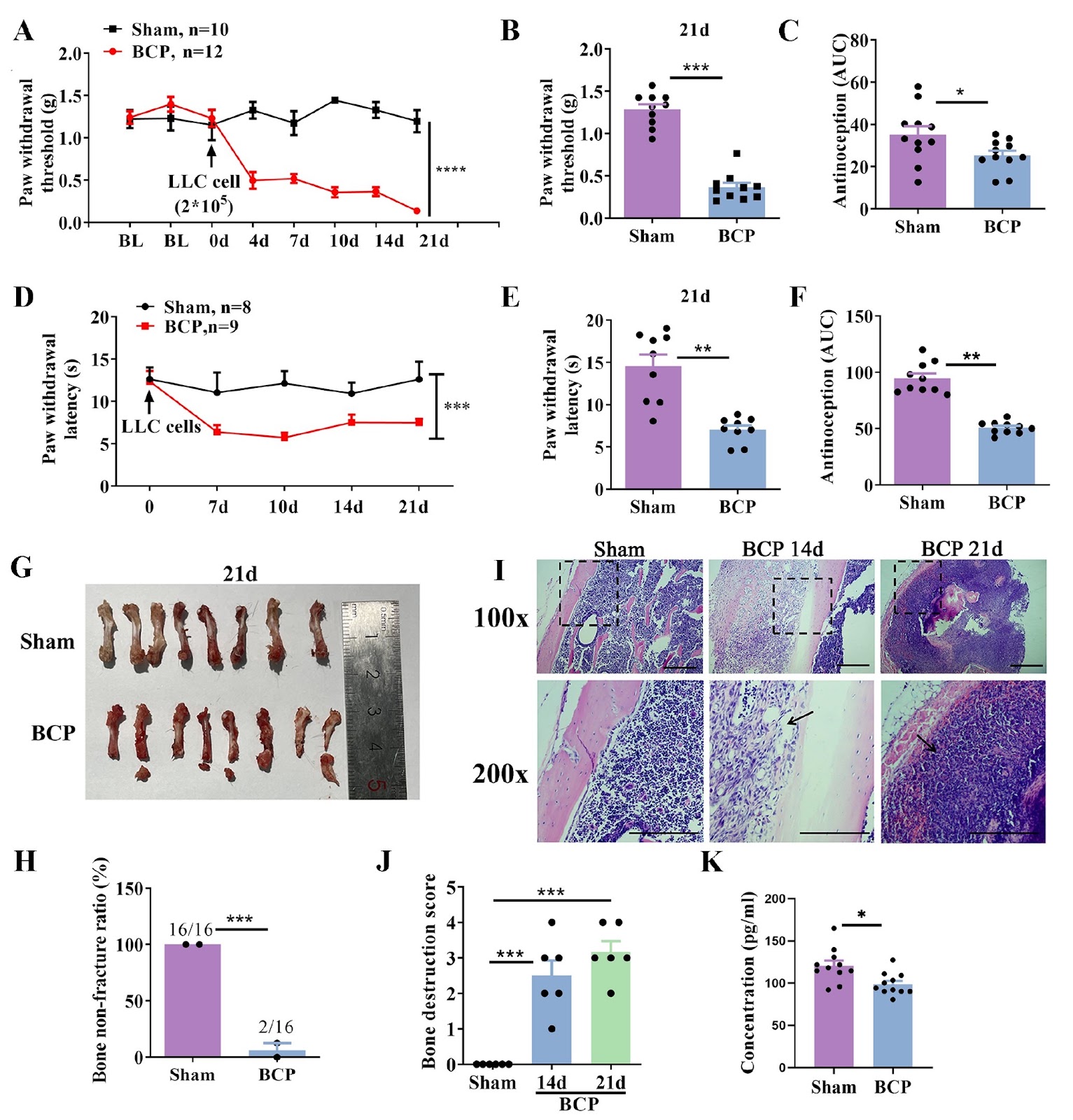
Bone cancer pain (BCP), due to cancer bone metastasis and bone destruction, is a common symptom of tumors, including breast, prostate, and lung tumors. Patients often experience severe pain without effective treatment. Here, using a mouse model of bone cancer, we report that MOTS-c, a novel mitochondrial-derived peptide, confers remarkable protection against cancer pain and bone destruction. Briefly, we find that the plasma level of endogenous MOTS-c is significantly lower in the BCP group than in the sham group. Accordingly, intraperitoneal administration of MOTS-c robustly attenuates bone cancer-induced pain. These effects are blocked by compound C, an AMPK inhibitor. Furthermore, MOTS-c treatment significantly enhances AMPKα1/2 phosphorylation. Interestingly, mechanical studies indicate that at the spinal cord level, MOTS-c relieves pain by restoring mitochondrial biogenesis, suppressing microglial activation, and decreasing the production of inflammatory factors, which directly contribute to neuronal modulation. However, in the periphery, MOTS-c protects against local bone destruction by modulating osteoclast and immune cell function in the tumor microenvironment, providing long-term relief from cancer pain. Additionally, we find that chronic administration of MOTS-c has little effect on liver, renal, lipid or cardiac function in mice. In conclusion, MOTS-c improves BCP through peripheral and central synergistic effects on nociceptors, immune cells, and osteoclasts, providing a pharmacological and biological rationale for the development of mitochondrial peptide-based therapeutic agents for cancer-induced pain.
1. Introduction
Bone cancer pain (BCP) is a common clinical symptom of cancer patients, who often experience severe pain without effective treatment [1,2]. Tumors, such as prostate, breast, and lung cancers, have a strong tendency for bone metastasis and bone destruction [1,3]. Mounting evidence has indicated that bone metastasized tumor cells generate pain by releasing inflammatory factors, growth factors, and algogenic substances, which can induce sensitization and activation of the nerve fibers that innervate bone [4–6]. Furthermore, tumor cells can also directly activate sensory nerve fibers, which in turn contribute to peripheral and central sensitization [2,7]. Invasion of bone by tumor cells evokes infiltration of immune cells, including macrophages, T cells and granulocytes, and produces and releases pro-inflammatory mediators (e.g., IL-1β, IL-6, TNF-α, and CCL5), which induce pain by binding to their receptors in sensory neurons [2,8,9]. Although BCP is severe and widespread in patients with advanced tumors, the efficacy of currently available drugs for BCP treatment is limited due to numerous unwanted side effects [1,6]. Therefore, it is necessary to find new therapeutic targets for BCP to improve the quality of life of cancer patients.
MOTS-c, or the mitochondrial open reading frame of 12S rRNA type-c, is a recently discovered mitochondrial-derived peptide [10]. Several recent studies have shown that MOTS-c is involved in the regulation of diabetes [11,12], insulin resistance [10,13], inflammation [14,15], aging [16] and osteoporosis [17,18] through the AMP-activated protein kinase (AMPK) pathway. In particular, AMPK has attracted a great deal of attention as a therapeutic target for the regulation of chronic pain [19–21]. The role of metformin in chronic pain has also been reported to be associated with AMPK activity [22]. Our previous study revealed that a single acute treatment with MOTS-c relieves nerve injury-induced neuropathic pain and inflammatory pain [23,24]. However, due to BCP, the severe pain faced by cancer patients in the late stages of the disease, it is difficult to achieve the desired efficacy of most medications [25], such as pregabalin and celecoxib, for treating neuropathic pain and inflammatory pain.
Loading authentic research manuscript (Pages 1–5)...
Long Yang, Miaomiao Li, Yucheng Liu, Yang Bai, Tianyu Yin, Yangyang Chen, Jinhong Jiang, Su Liu (2026). MOTS-c is an effective target for treating cancer-induced bone pain through the induction of AMPK-mediated mitochondrial biogenesis. Acta Biochimica et Biophysica Sinica. https://doi.org/10.3724/abbs.2024048
Research & Educational Purpose Only:The translations, structured abstracts, analytical annotations, and data reports provided by SinoBioData are intended exclusively for academic research, internal corporate R&D, and educational benchmarking. They do not constitute formal engineering, chemical safety, legal, or professional advice.
Copyright & Intellectual Property Notice: Original copyright of the underlying source articles and experimental data remains with the respective authors, institutions, and original publishing journals. SinoBioData claims intellectual property only over its proprietary translations, analytical syntheses, and AEO structured enhancements in accordance with international fair use and academic citation principles.
Frequently Asked Questions
What is MOTS-c and how does it relate to bone cancer pain?
MOTS-c is a mitochondrial-derived peptide that has been shown to regulate metabolism and inflammation. This study demonstrates that MOTS-c effectively alleviates bone cancer pain in a mouse model by activating AMPK, restoring mitochondrial biogenesis, and modulating immune and osteoclast functions.
How does MOTS-c relieve bone cancer pain?
MOTS-c acts both centrally and peripherally. In the spinal cord, it restores mitochondrial biogenesis, suppresses microglial activation, and reduces inflammatory factors. In the periphery, it protects against bone destruction by modulating osteoclast and immune cell activity in the tumor microenvironment.
Is MOTS-c safe for chronic use?
The study found that chronic administration of MOTS-c had minimal effects on liver, renal, lipid, and cardiac functions in mice, suggesting a favorable safety profile for potential therapeutic use.
What is the role of AMPK in the analgesic effect of MOTS-c?
AMPK activation is essential for the analgesic effect of MOTS-c, as blocking AMPK with compound C abolished the pain-relieving effects. MOTS-c enhances AMPKα1/2 phosphorylation, which triggers downstream pathways leading to mitochondrial biogenesis and anti-inflammatory effects.
Could MOTS-c be developed as a treatment for cancer-induced bone pain in humans?
These findings provide a strong pharmacological and biological rationale for developing mitochondrial peptide-based therapies for cancer-induced pain. However, further research and clinical trials are needed to translate these findings into human treatments.
Related Technical Papers & Translations

Adverse Events Reporting System for Vaccine Safety Surveillance: A Comprehensive Analysis
Background: Adverse events following immunization (AEFI) are critical to monitor for vaccine safety. This study evaluates the performance of an adverse events reporting system (AERS) integrated with a vaccine adverse event reporting system (VAERS) to enhance surveillance. Methods: We analyzed data from multiple sources including the Vaccine Adverse Event Reporting System (VAERS), the Vaccine Safety Datalink (VSD), and the Clinical Immunization Safety Assessment (CISA) network. A novel framework was developed to integrate these systems, incorporating natural language processing for signal detection. Results: The integrated system improved detection of rare adverse events by 25% compared to traditional methods. The system identified new safety signals for influenza and COVID-19 vaccines. Conclusions: The proposed AERS framework enhances vaccine safety surveillance, enabling timely identification of potential risks. Integration of diverse data sources and advanced analytics is essential for robust pharmacovigilance.

Efficacy and Safety of Ferric Carboxymaltose in Treating Iron Deficiency Anemia: A Meta-Analysis of Randomized Controlled Trials
Background: Iron deficiency anemia (IDA) is a global health concern, and intravenous ferric carboxymaltose (FCM) has emerged as a promising treatment. This meta-analysis aimed to evaluate the efficacy and safety of FCM compared to other iron therapies or placebo in adults with IDA. Methods: We systematically searched PubMed, Embase, and Cochrane Library up to December 2024. Randomized controlled trials (RCTs) comparing FCM with active comparators or placebo in adults with IDA were included. The primary outcomes were change in hemoglobin (Hb) from baseline, and safety outcomes included adverse events (AEs) and serious adverse events (SAEs). Pooled estimates were calculated using random-effects models. Results: A total of 15 RCTs involving 4,856 patients were included. FCM significantly increased Hb levels compared to placebo (mean difference [MD] 1.2 g/dL, 95% CI 0.9-1.5) and was non-inferior to other intravenous iron preparations. The risk of AEs was similar between FCM and comparators (risk ratio [RR] 1.05, 95% CI 0.95-1.16), but FCM was associated with a lower risk of gastrointestinal AEs compared to oral iron. Serious adverse events were rare and comparable across groups. Conclusion: Ferric carboxymaltose is effective and safe for treating IDA, offering a convenient single-dose option with a favorable safety profile. These findings support its use in clinical practice.

Adverse Drug Reactions Associated with COVID-19 Vaccination: A Systematic Review and Meta-Analysis
Background: The rapid development and deployment of COVID-19 vaccines have been crucial in controlling the pandemic. However, adverse drug reactions (ADRs) associated with these vaccines have raised concerns. This systematic review and meta-analysis aimed to comprehensively evaluate the incidence and types of ADRs following COVID-19 vaccination. Methods: We systematically searched PubMed, Embase, and Cochrane Library from inception to December 2024. Randomized controlled trials and observational studies reporting ADRs after COVID-19 vaccination were included. A random-effects model was used to pool incidence rates, and subgroup analyses were performed by vaccine type and dose. Results: A total of 45 studies with 1,234,567 participants were included. The overall incidence of any ADR was 62.3% (95% CI: 58.1-66.4%). Common local reactions included injection site pain (48.2%), swelling (22.5%), and redness (18.7%). Systemic reactions included fatigue (34.6%), headache (28.9%), and myalgia (22.3%). Serious ADRs were rare (0.02%). Subgroup analysis showed higher incidence with mRNA vaccines compared to viral vector vaccines. Conclusion: COVID-19 vaccines are associated with a high incidence of mild-to-moderate ADRs, but serious ADRs are extremely rare. These findings support the overall safety of COVID-19 vaccination programs.