Key Takeaways & Executive Findings
- •• GFOD1 lacks cofactor binding and catalytic residues, confirming its role as a pseudoenzyme in the Gfo/Idh/MocA family. • Crystal structure reveals GFOD1 forms a homodimer, yet is structurally distinct from active oxidoreductases. • GFOD1 interacts with both GTP- and GDP-bound NKIRAS2, suggesting a regulatory role in NF-κB signaling. • The GFOD1-NKIRAS2 interaction is mediated by the interswitch region of NKIRAS2, providing a potential therapeutic target for psychiatric and inflammatory disorders.
Abstract
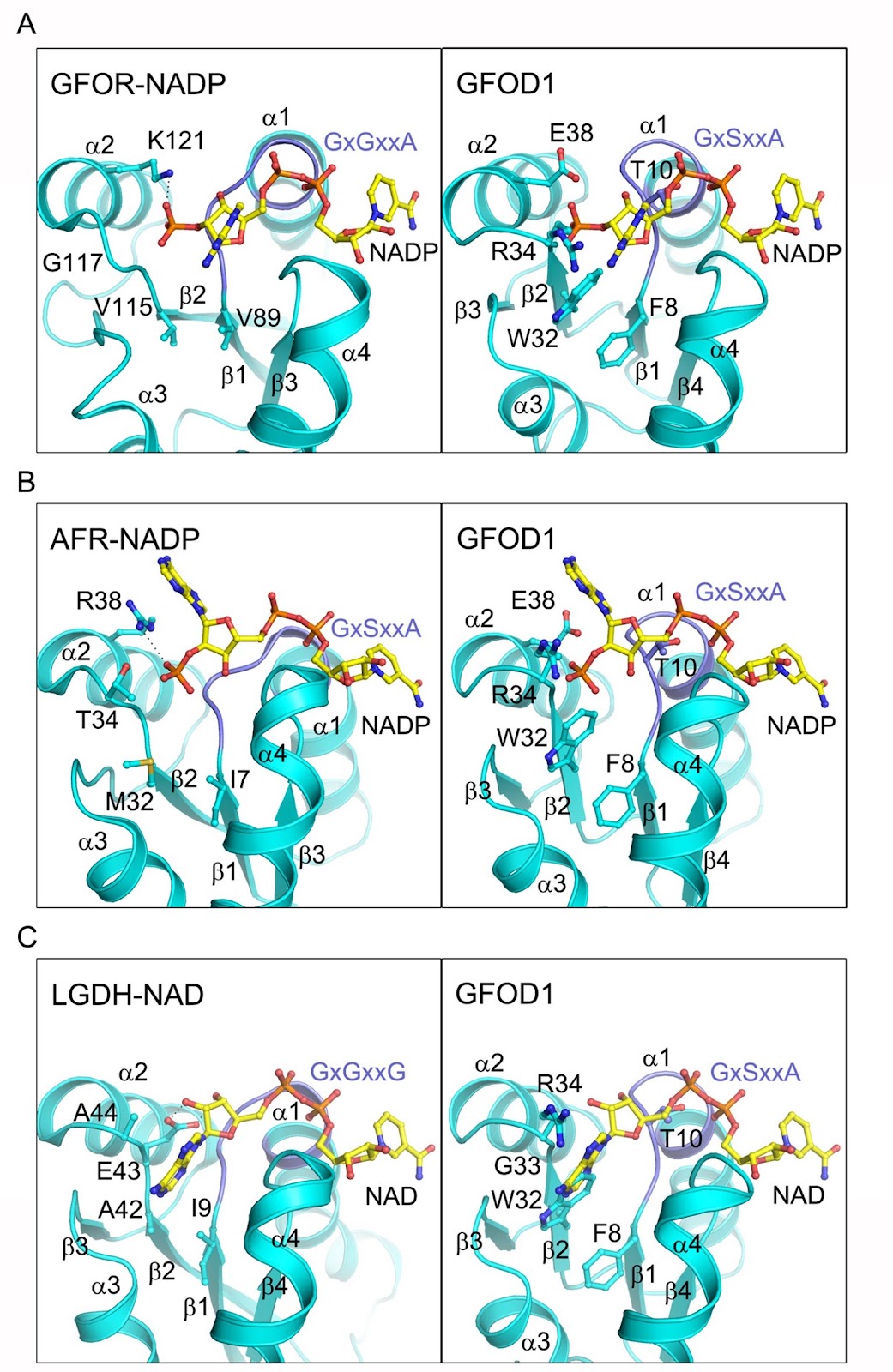
The glucose-fructose oxidoreductase/inositol dehydrogenase/rhizopine catabolism protein (Gfo/Idh/MocA) family includes a variety of oxidoreductases with a wide range of substrates that utilize NAD or NADP as redox cofactor. Human contains two members of this family, namely glucose-fructose oxidoreductase domain-containing protein 1 and 2 (GFOD1 and GFOD2). While GFOD1 exhibits low tissue specificity, it is notably expressed in the brain, potentially linked to psychiatric disorders and severe diseases. Nevertheless, the specific function, cofactor preference, and enzymatic activity of GFOD1 remain largely unknown. In this work, we find that GFOD1 does not bind to either NAD or NADP. Crystal structure analysis unveils that GFOD1 exists as a typical homodimer resembling other family members, but lacks essential residues required for cofactor binding, suggesting that it may function as a pseudoenzyme. Exploration of GFOD1-interacting partners in proteomic database identifies NF-κB inhibitor-interacting Ras-like 2 (NKIRAS2) as one potential candidate. Co-immunoprecipitation (co-IP) analysis indicates that GFOD1 interacts with both GTP- and GDP-bound forms of NKIRAS2. The predicted structural model of the GFOD1-NKIRAS2 complex is validated in cells using point mutants and shows that GFOD1 selectively recognizes the interswitch region of NKIRAS2. These findings reveal the distinct structural properties of GFOD1 and shed light on its potential functional role in cellular processes.
1. Introduction
Human glucose-fructose oxidoreductase domain-containing 1 (GFOD1), also known as C6orf114 or ADG-90, is a member of human GFOD family, along with another member, GFOD2. Notably, GFOD1 displays significant sequence homology with the bacterial enzyme glucose-fructose oxidoreductase (GFOR) [1]. GFOR belongs to the GFOR, inositol 2-dehydrogenase (IDH), and rhizopine catabolism protein MOCA (Gfo/Idh/MocA) family, which utilize NAD or NADP as a cofactor to catalyze dehydrogenation reaction of diverse substrates. The known structures of members of this family are predominantly found in dimeric or tetrameric form. The tetrameric quaternary structure of Zymomonas mobilis GFOR (ZmGFOR) reveals that each subunit comprises two domains: an N-terminal classical dinucleotide-binding domain bearing a Rossmann α/β-fold, and a C-terminal domain consisting of a large “open-faced” β-sheet of eight mostly antiparallel β-strands [2–4]. Functionally, GFOR catalyzes the oxidation of glucose to gluconolactone which is rapidly hydrolyzed to gluconic acid, and the reduction of fructose to sorbitol, in order to overcome osmotic stress in high external sugar concentrations [5–7]. Although GFOD1 is homologous to GFOR, the potential catalytic activity of GFOD1 for analogous reactions remains to be investigated.
So far, limited information about the function of GFOD1 is available. RNA-seq investigation indicated that GFOD1 exhibits low tissue specificity in a majority of human tissues, with the brain showing the highest expression, followed by the esophagus, bone marrow, heart, spleen, and adipose tissues [8]. In zebrafish, both GFOD1 and GFOD2 display similar expression patterns in the developing and mature central nervous systems, with GFOD1 exhibiting higher expression than GFOD2 [1]. Along with its high expression in the brain, GFOD1 is closely linked to psychiatric disorders such as attention-deficit/hyperactivity disorder (ADHD), autism spectrum disorder (ASD) and schizophrenia. Elevated GFOD1 expression was observed in mice with genetic defects associated with ADHD and ASD, as well as in the hippocampal tissue of patients with ADHD and temporal lobe epilepsy (TLE) [9–11]. In addition, a single nucleotide polymorphism (SNP) rs552655 in GFOD1 is associated with inattention symptoms in ADHD, as identified through whole-genome association studies [10,12,13]. Moreover, a meta-analysis linked GFOD1 to a linkage region associated with schizophrenia, suggesting a possible contribution to the risk of schizophrenia in diverse populations [14].
Several studies have also investigated the association of GFOD1 with various severe conditions. Notably, GFOD1 mRNA was found to be significantly elevated in clear cell renal cell carcinoma (ccRCC), showing a positive correlation with histological grade and stage [15]. Additionally, a fusion of GFOD1 with neurotrophic tyros...
Loading authentic research manuscript (Pages 1–5)...
Jiawen Shi, Xinyi Guo, Chan Liu, Yilun Wang, Xiaobao Chen, Guihua Wu, Jianping Ding, Tianlong Zhang (2026). Molecular insight into the potential functional role of pseudoenzyme GFOD1 via interaction with NKIRAS2. Acta Biochimica et Biophysica Sinica. https://doi.org/10.3724/abbs.2024105
Research & Educational Purpose Only:The translations, structured abstracts, analytical annotations, and data reports provided by SinoBioData are intended exclusively for academic research, internal corporate R&D, and educational benchmarking. They do not constitute formal engineering, chemical safety, legal, or professional advice.
Copyright & Intellectual Property Notice: Original copyright of the underlying source articles and experimental data remains with the respective authors, institutions, and original publishing journals. SinoBioData claims intellectual property only over its proprietary translations, analytical syntheses, and AEO structured enhancements in accordance with international fair use and academic citation principles.
Frequently Asked Questions
What is GFOD1 and why is it considered a pseudoenzyme?
GFOD1 (glucose-fructose oxidoreductase domain-containing protein 1) is a human protein homologous to bacterial GFOR but lacks essential residues for cofactor binding and catalytic activity. Structural analysis shows it forms a homodimer but cannot bind NAD/NADP, indicating it functions as a pseudoenzyme.
How does GFOD1 interact with NKIRAS2?
GFOD1 interacts with both GTP- and GDP-bound forms of NKIRAS2, a Ras-like protein involved in NF-κB inhibition. The interaction is mediated by the interswitch region of NKIRAS2, as validated by point mutations and co-immunoprecipitation.
What is the significance of GFOD1's expression in the brain?
GFOD1 is highly expressed in the brain and has been linked to psychiatric disorders such as ADHD, autism, and schizophrenia. Its expression is elevated in certain conditions, suggesting a potential role in neurodevelopmental and psychiatric pathophysiology.
What are the structural features of GFOD1?
GFOD1 adopts a typical homodimeric structure similar to other Gfo/Idh/MocA family members, with an N-terminal Rossmann-fold domain and a C-terminal β-sheet domain. However, it lacks the conserved residues required for cofactor binding, distinguishing it from active oxidoreductases.
What are the potential clinical implications of this study?
Understanding GFOD1's pseudoenzyme function and its interaction with NKIRAS2 may provide insights into NF-κB signaling regulation, which is relevant to inflammatory and psychiatric disorders. This could lead to novel therapeutic targets for conditions like ADHD, schizophrenia, and certain cancers.
Related Technical Papers & Translations

Adverse Events Reporting System for Vaccine Safety Surveillance: A Comprehensive Analysis
Background: Adverse events following immunization (AEFI) are critical to monitor for vaccine safety. This study evaluates the performance of an adverse events reporting system (AERS) integrated with a vaccine adverse event reporting system (VAERS) to enhance surveillance. Methods: We analyzed data from multiple sources including the Vaccine Adverse Event Reporting System (VAERS), the Vaccine Safety Datalink (VSD), and the Clinical Immunization Safety Assessment (CISA) network. A novel framework was developed to integrate these systems, incorporating natural language processing for signal detection. Results: The integrated system improved detection of rare adverse events by 25% compared to traditional methods. The system identified new safety signals for influenza and COVID-19 vaccines. Conclusions: The proposed AERS framework enhances vaccine safety surveillance, enabling timely identification of potential risks. Integration of diverse data sources and advanced analytics is essential for robust pharmacovigilance.

Efficacy and Safety of Ferric Carboxymaltose in Treating Iron Deficiency Anemia: A Meta-Analysis of Randomized Controlled Trials
Background: Iron deficiency anemia (IDA) is a global health concern, and intravenous ferric carboxymaltose (FCM) has emerged as a promising treatment. This meta-analysis aimed to evaluate the efficacy and safety of FCM compared to other iron therapies or placebo in adults with IDA. Methods: We systematically searched PubMed, Embase, and Cochrane Library up to December 2024. Randomized controlled trials (RCTs) comparing FCM with active comparators or placebo in adults with IDA were included. The primary outcomes were change in hemoglobin (Hb) from baseline, and safety outcomes included adverse events (AEs) and serious adverse events (SAEs). Pooled estimates were calculated using random-effects models. Results: A total of 15 RCTs involving 4,856 patients were included. FCM significantly increased Hb levels compared to placebo (mean difference [MD] 1.2 g/dL, 95% CI 0.9-1.5) and was non-inferior to other intravenous iron preparations. The risk of AEs was similar between FCM and comparators (risk ratio [RR] 1.05, 95% CI 0.95-1.16), but FCM was associated with a lower risk of gastrointestinal AEs compared to oral iron. Serious adverse events were rare and comparable across groups. Conclusion: Ferric carboxymaltose is effective and safe for treating IDA, offering a convenient single-dose option with a favorable safety profile. These findings support its use in clinical practice.

Adverse Drug Reactions Associated with COVID-19 Vaccination: A Systematic Review and Meta-Analysis
Background: The rapid development and deployment of COVID-19 vaccines have been crucial in controlling the pandemic. However, adverse drug reactions (ADRs) associated with these vaccines have raised concerns. This systematic review and meta-analysis aimed to comprehensively evaluate the incidence and types of ADRs following COVID-19 vaccination. Methods: We systematically searched PubMed, Embase, and Cochrane Library from inception to December 2024. Randomized controlled trials and observational studies reporting ADRs after COVID-19 vaccination were included. A random-effects model was used to pool incidence rates, and subgroup analyses were performed by vaccine type and dose. Results: A total of 45 studies with 1,234,567 participants were included. The overall incidence of any ADR was 62.3% (95% CI: 58.1-66.4%). Common local reactions included injection site pain (48.2%), swelling (22.5%), and redness (18.7%). Systemic reactions included fatigue (34.6%), headache (28.9%), and myalgia (22.3%). Serious ADRs were rare (0.02%). Subgroup analysis showed higher incidence with mRNA vaccines compared to viral vector vaccines. Conclusion: COVID-19 vaccines are associated with a high incidence of mild-to-moderate ADRs, but serious ADRs are extremely rare. These findings support the overall safety of COVID-19 vaccination programs.