Key Takeaways & Executive Findings
- •• Mitochondrial dysfunction impairs adipocyte browning by suppressing UCP1 expression and disrupting key signaling pathways (PPAR-γ/PGC-1α and AMPK/mTOR), leading to reduced energy expenditure and insulin resistance. • The review highlights the intersection of mitochondrial dysfunction with neurodegenerative disorders via oxidative stress, suggesting a systemic link between metabolic and neurological diseases. • Structural mitochondrial anomalies and mtDNA-nuclear DNA crosstalk complicate therapeutic targeting, emphasizing the need for advanced research approaches. • Future precision therapies, such as gene editing and single-cell omics, hold promise for restoring mitochondrial function and enhancing adipocyte browning to combat obesity and related metabolic syndromes.
Abstract
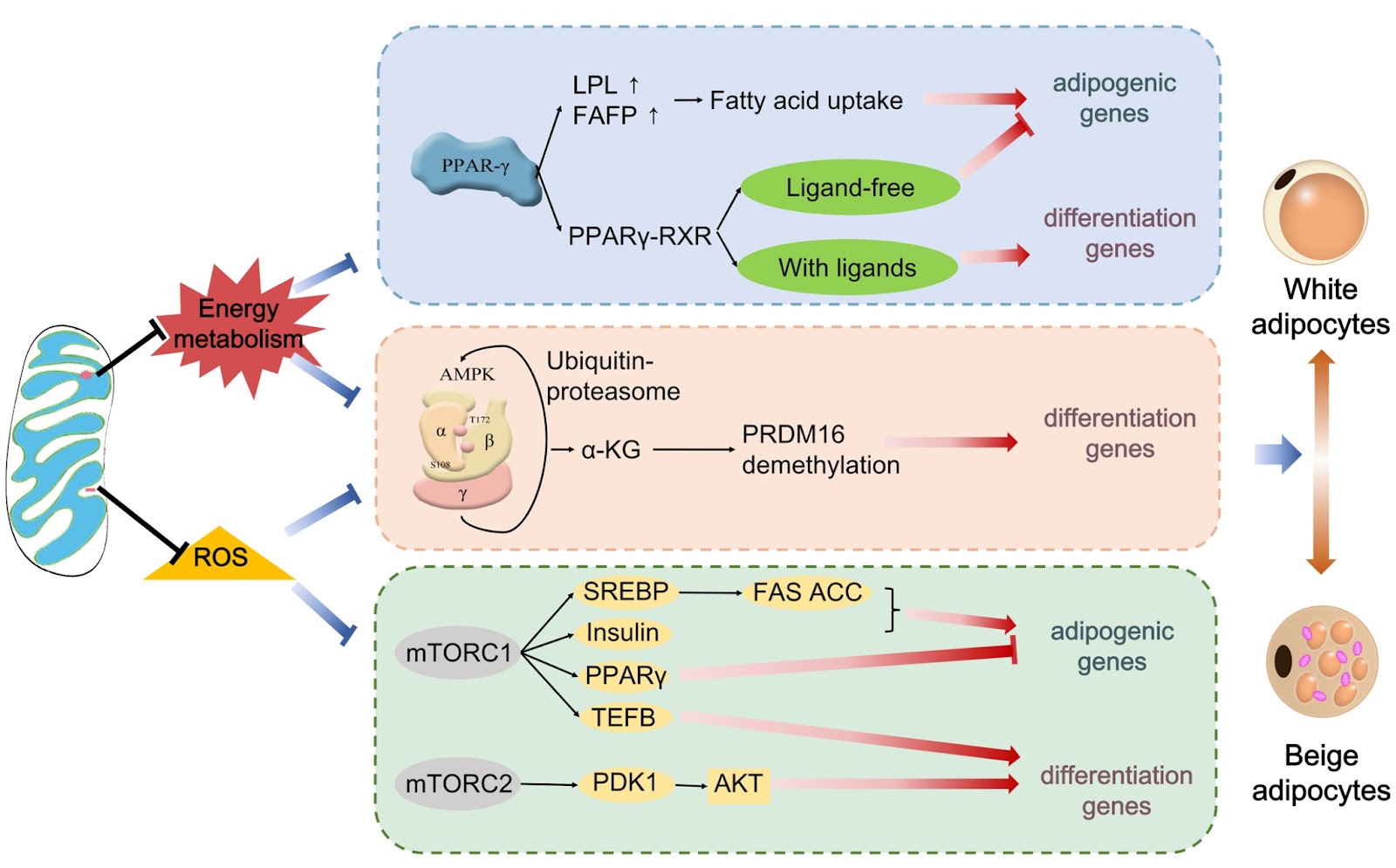
Mitochondrial dysfunction critically disrupts adipocyte remodeling by impairing the thermogenic browning process essential for combating obesity through the upregulation of uncoupling protein 1 (UCP1) and mitochondrial biogenesis. Deficiencies in mitochondrial metabolism, dynamics (including fusion/fission), and autophagy suppress adipocyte plasticity, directly inhibiting UCP1 expression and destabilizing the PPAR-γ/PGC-1α and adenosine 5′-monophosphate (AMP)-activated protein kinase (AMPK)/mammalian target of rapamycin (mTOR) signaling pathways. These disruptions reduce energy expenditure, exacerbate insulin resistance, and promote metabolic syndrome. Moreover, mitochondrial inactivation intersects with neurodegenerative disorders via oxidative stress induced by β-amyloid and α-synuclein aggregation, amplifying systemic metabolic dysregulation. Structural mitochondrial anomalies further impede lipid utilization and adipose tissue adaptation, but unresolved crosstalk between mtDNA and nuclear DNA complicates therapeutic targeting. Future research must prioritize spatiotemporal mapping of mitochondrial dynamics in adipocyte differentiation via single-cell omics to identify key regulatory nodes. Addressing these mechanisms could unlock precision therapies, such as gene editing, to restore mitochondrial function, enhance adipocyte browning, and mitigate obesity, related pathologies alongside neurodegenerative and age-associated diseases.
1. Introduction
The global prevalence of obesity has reached alarming levels, escalating into a major public health crisis that now affects over two billion people worldwide [1]. Most epidemiological data on obesity rely on body mass index (BMI). The World Health Organization defines overweight as a BMI between 25.0 and 29.9 kg/m2, whereas obesity is classified as a BMI ≥ 30.0 kg/m2. Severe obesity, associated with heightened health risks, is characterized by a BMI ≥ 40 kg/m2 [2]. Notably, a BMI > 30 kg/m2 serves as the standard threshold for adult obesity, and when the BMI exceeds 40 kg/m2, the risk of obesity-related mortality increases by 100% compared with individuals with a normal weight [3].
Regional analyses highlight significant global trends in obesity prevalence. In China, the standardized mean BMI increased from 22.7 kg/m2 in 2004 to 24.4 kg/m2 in 2018, whereas the prevalence of obesity increased sharply from 3.1% to 8.1% [4]. This trend is not isolated: globally, both men and women exhibit parallel increases in obesity rates. Gender disparities persist across all regions, with the prevalence of obesity being higher among women (18%) than among men (14%). The global age-standardized obesity rate climbed from 8.8% in 1990 to 18.5% in 2022, with the incidence in males increasing from 4.8% to 14.0% over the same period. Between 1990 and 2022, obesity rates rose by more than 20% among women in 49 regions and among men in 24 regions [5]. These escalating trends underscore the profound public health impact of obesity and the urgent need for targeted interventions.
Loading authentic research manuscript (Pages 1–5)...
Yunwen Xu, Shiqin Xie, Luoyang Han, Liang Xu, Yuqin Zhu (2026). Mitochondrial dysfunction in adipocyte differentiation: implications for obesity and metabolic syndrome intervention. Acta Biochimica et Biophysica Sinica. https://doi.org/10.3724/abbs.2025153
Research & Educational Purpose Only:The translations, structured abstracts, analytical annotations, and data reports provided by SinoBioData are intended exclusively for academic research, internal corporate R&D, and educational benchmarking. They do not constitute formal engineering, chemical safety, legal, or professional advice.
Copyright & Intellectual Property Notice: Original copyright of the underlying source articles and experimental data remains with the respective authors, institutions, and original publishing journals. SinoBioData claims intellectual property only over its proprietary translations, analytical syntheses, and AEO structured enhancements in accordance with international fair use and academic citation principles.
Frequently Asked Questions
What is the role of mitochondrial dysfunction in adipocyte differentiation?
Mitochondrial dysfunction impairs the thermogenic browning process of adipocytes by suppressing UCP1 expression and disrupting key signaling pathways such as PPAR-γ/PGC-1α and AMPK/mTOR, leading to reduced energy expenditure and increased insulin resistance.
How does mitochondrial dysfunction contribute to obesity and metabolic syndrome?
Mitochondrial dysfunction reduces energy expenditure and promotes insulin resistance, exacerbating obesity and metabolic syndrome. It also intersects with neurodegenerative disorders via oxidative stress, amplifying systemic metabolic dysregulation.
What are the potential therapeutic strategies for restoring mitochondrial function in adipocytes?
Future precision therapies, such as gene editing and single-cell omics, aim to restore mitochondrial function, enhance adipocyte browning, and mitigate obesity and related pathologies.
What is the significance of the crosstalk between mtDNA and nuclear DNA in mitochondrial dysfunction?
The unresolved crosstalk between mtDNA and nuclear DNA complicates therapeutic targeting, as it affects mitochondrial dynamics and function, and understanding this interaction is crucial for developing effective interventions.
What research approaches are recommended for future studies on mitochondrial dynamics in adipocyte differentiation?
Future research should prioritize spatiotemporal mapping of mitochondrial dynamics using single-cell omics to identify key regulatory nodes and develop targeted therapies.
Related Technical Papers & Translations

Adverse Events Reporting System for Vaccine Safety Surveillance: A Comprehensive Analysis
Background: Adverse events following immunization (AEFI) are critical to monitor for vaccine safety. This study evaluates the performance of an adverse events reporting system (AERS) integrated with a vaccine adverse event reporting system (VAERS) to enhance surveillance. Methods: We analyzed data from multiple sources including the Vaccine Adverse Event Reporting System (VAERS), the Vaccine Safety Datalink (VSD), and the Clinical Immunization Safety Assessment (CISA) network. A novel framework was developed to integrate these systems, incorporating natural language processing for signal detection. Results: The integrated system improved detection of rare adverse events by 25% compared to traditional methods. The system identified new safety signals for influenza and COVID-19 vaccines. Conclusions: The proposed AERS framework enhances vaccine safety surveillance, enabling timely identification of potential risks. Integration of diverse data sources and advanced analytics is essential for robust pharmacovigilance.

Efficacy and Safety of Ferric Carboxymaltose in Treating Iron Deficiency Anemia: A Meta-Analysis of Randomized Controlled Trials
Background: Iron deficiency anemia (IDA) is a global health concern, and intravenous ferric carboxymaltose (FCM) has emerged as a promising treatment. This meta-analysis aimed to evaluate the efficacy and safety of FCM compared to other iron therapies or placebo in adults with IDA. Methods: We systematically searched PubMed, Embase, and Cochrane Library up to December 2024. Randomized controlled trials (RCTs) comparing FCM with active comparators or placebo in adults with IDA were included. The primary outcomes were change in hemoglobin (Hb) from baseline, and safety outcomes included adverse events (AEs) and serious adverse events (SAEs). Pooled estimates were calculated using random-effects models. Results: A total of 15 RCTs involving 4,856 patients were included. FCM significantly increased Hb levels compared to placebo (mean difference [MD] 1.2 g/dL, 95% CI 0.9-1.5) and was non-inferior to other intravenous iron preparations. The risk of AEs was similar between FCM and comparators (risk ratio [RR] 1.05, 95% CI 0.95-1.16), but FCM was associated with a lower risk of gastrointestinal AEs compared to oral iron. Serious adverse events were rare and comparable across groups. Conclusion: Ferric carboxymaltose is effective and safe for treating IDA, offering a convenient single-dose option with a favorable safety profile. These findings support its use in clinical practice.

Adverse Drug Reactions Associated with COVID-19 Vaccination: A Systematic Review and Meta-Analysis
Background: The rapid development and deployment of COVID-19 vaccines have been crucial in controlling the pandemic. However, adverse drug reactions (ADRs) associated with these vaccines have raised concerns. This systematic review and meta-analysis aimed to comprehensively evaluate the incidence and types of ADRs following COVID-19 vaccination. Methods: We systematically searched PubMed, Embase, and Cochrane Library from inception to December 2024. Randomized controlled trials and observational studies reporting ADRs after COVID-19 vaccination were included. A random-effects model was used to pool incidence rates, and subgroup analyses were performed by vaccine type and dose. Results: A total of 45 studies with 1,234,567 participants were included. The overall incidence of any ADR was 62.3% (95% CI: 58.1-66.4%). Common local reactions included injection site pain (48.2%), swelling (22.5%), and redness (18.7%). Systemic reactions included fatigue (34.6%), headache (28.9%), and myalgia (22.3%). Serious ADRs were rare (0.02%). Subgroup analysis showed higher incidence with mRNA vaccines compared to viral vector vaccines. Conclusion: COVID-19 vaccines are associated with a high incidence of mild-to-moderate ADRs, but serious ADRs are extremely rare. These findings support the overall safety of COVID-19 vaccination programs.