Key Takeaways & Executive Findings
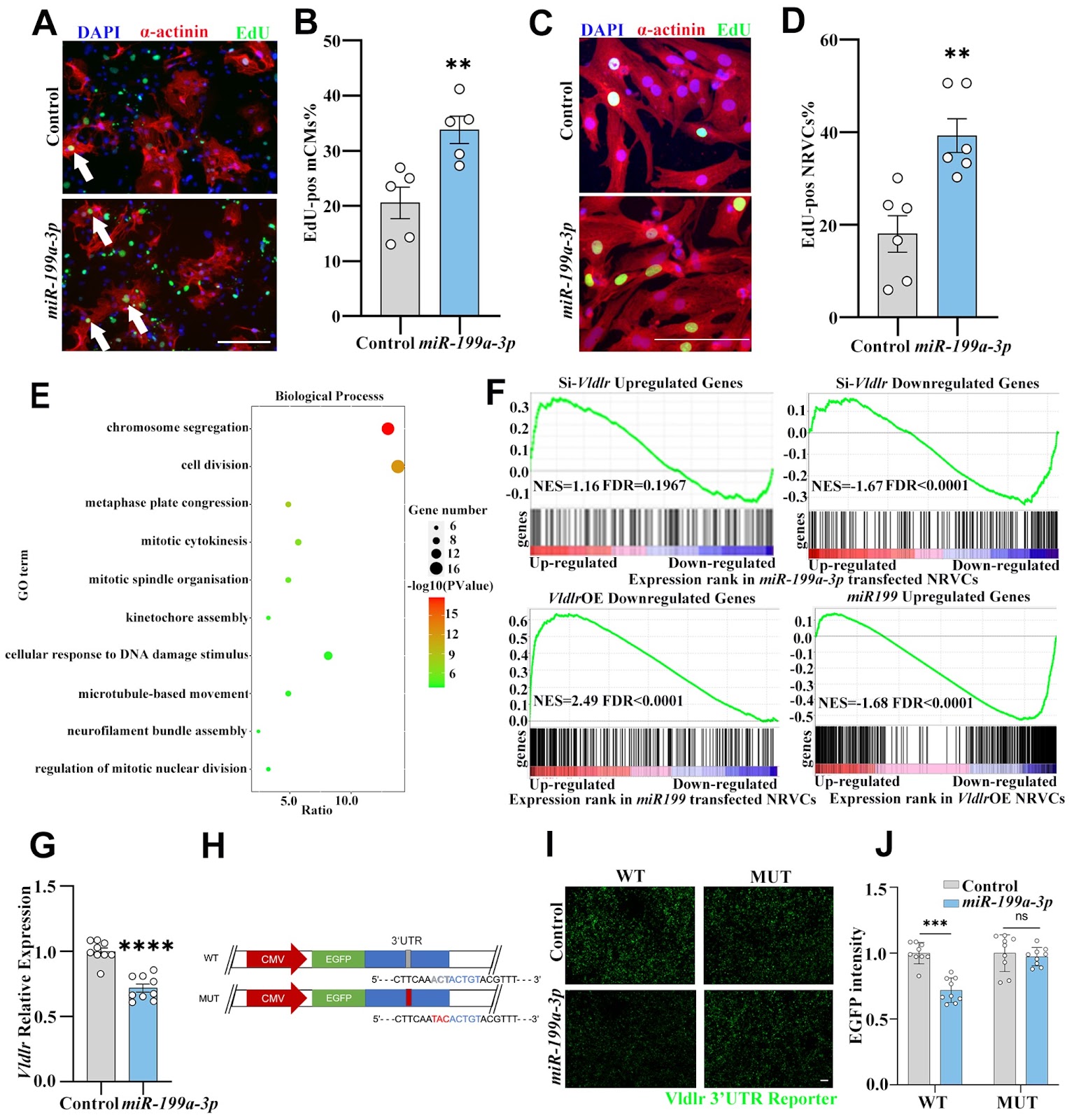
- •• miR-199a-3p directly targets the 3'UTR of Vldlr, suppressing its expression and promoting cardiomyocyte proliferation. • Vldlr acts as a functional target of miR-199a-3p, as its overexpression blunts the pro-proliferative effect. • The miR-199a-3p-Vldlr axis regulates RB1 phosphorylation at S807/811, which is essential for cardiomyocyte proliferation. • This study identifies a novel miR-199a-3p-Vldlr-RB1 axis, offering potential therapeutic targets for cardiac regeneration.
Abstract
The proliferative capacity of cardiomyocytes is limited in adult mammals, and replacing lost tissue following acute ischemic injury is challenging. Previous studies have demonstrated that miR-199a-3p can promote cardiomyocyte proliferation, but the exact mechanism by which this occurs remains unclear, although multiple targets of miR-199a-3p have been identified. We recently showed that very-low-density-lipoprotein receptor (Vldlr) inhibits cardiomyocyte proliferation, and in this study we aim to test whether Vldlr is a functional target gene of miR-199a-3p. 3′UTR reporter assays demonstrate that miR-199a-3p directly binds to the 3′UTR of Vldlr and inhibits its translation. Overexpressing Vldlr blunts the pro-proliferative effect of miR-199a-3p on cardiomyocytes, suggesting that Vldlr is indeed a functional target of miR-199a-3p. Mechanistically, Vldlr reduces S807/811 phosphorylation of RB1, and inhibiting CDK4/6 to prevent RB1 phosphorylation can block the pro-proliferative effect of both Vldlr knockdown and miR-199a-3p, suggesting that RB1 phosphorylation is required for the cardiomyocyte proliferation induced by miR-199a-3p and Vldlr knockdown. The findings of this study reveal Vldlr as a novel functional target of miR-199a-3p in cardiomyocytes and identify RB1 as a downstream effector of cardiomyocyte proliferation. The identification of the role of the miR-199a-3p-Vldlr-RB1 axis in cardiomyocyte proliferation may provide potential therapeutic targets for cardiac regenerative medicine.
1. Introduction
The adult mammalian heart lacks regenerative capacity, mainly because cardiomyocytes (CMs) exit the cell cycle during maturation [1]. The loss of cardiomyocytes in cardiac diseases such as myocardial infarction cannot be compensated with new cardiomyocytes, thus compromising the contractility of the remaining myocardium, ultimately leading to heart failure and death when the extent of injury is severe [2]. Numerous studies have identified various regulators of cardiomyocyte proliferation in cultured cardiomyocytes and in small animal models [2]; however, only a few have shown effectiveness in promoting adult cardiomyocyte proliferation in large animal models [3,4]. Elucidating the molecular mechanism by which these factors promote adult cardiomyocyte proliferation in large animals may provide a better understanding of human cardiomyocyte regeneration and cardiac regeneration, as well as potential pharmaceutical targets suitable for human patients.
MicroRNAs (miRNAs), small noncoding RNAs that have diverse functions, including the promotion of mRNA degradation and the inhibition of mRNA translation, have been demonstrated to play multifaceted roles in cardiac development, disease control and regeneration [5]. A functional screening revealed that miR-199a-3p can induce robust proliferation of neonatal, as well as adult, rodent cardiomyocytes [6]. Importantly, in a swine model, miR-199a-3p effectively promoted adult cardiomyocyte proliferation after myocardial infarction while causing lethal arrhythmia, possibly due to uncontrolled dedifferentiation of cardiomyocytes [3]. Given the robust ability of miR-199a-3p to induce cardiomyocyte proliferation, there has been a persistent quest to identify its functional targets. Critical transcription factors, including Homer1 and Hopx [6–8]; transcription suppressors, such as NACC2 [9]; regulators of Hippo pathways, including TAOK1 and β-TrCP [10]; and cell membrane receptors, such as Cd151 [11], have been found to be functional targets of miR-199a-3p in cardiomyocytes. However, most microRNAs function by targeting multiple mRNAs, and there may be unidentified targets of miR-199a-3p that are critical in regulating the CM cell cycle. In addition, the deleterious effects of overexpressing miR-199a-3p in adult swine hearts, including tachyarrhythmia, are attributed to possible arrhythmogenic targets and/or coexpressed miR-199a-5p [3]. Therefore, identifying novel functional targets of miR-199a-3p will not only elucidate the mechanisms by which miR-199a-3p regulates cardiomyocyte proliferation but also shed light on the core cell cycle regulation of cardiomyocyte. This may lead to the discovery of novel and specific therapeutic targets for cardiac regenerative medicine, thereby avoiding the off-target effects of miR-199a-3p.
Our previous research on signaling from noncardiomyocytes regulating cardiomyocyte proliferation identified very-low-density-lipoprotein receptor (Vldlr) as a plasma membrane receptor on cardiomyocytes that inhibits proliferation when the suppressive ligand TSP-1 is abundant in the adult heart [12]. Interestingly, both miR-199a-3p and Vldlr have been shown to regulate YAP activity in cardiomyocytes [10,12], and miR-199a-3p, as well as other pro-proliferative microRNAs, may target multiple components of the signaling pathways involved in cardiomyocyte proliferation.
Loading authentic research manuscript (Pages 1–5)...
Rui Jiang, Lijuan Pei, Hongjie Zhang, Fenglian He, Yuhan Min, Xinhang Li, Ke Wei (2026). miR-199a-3p suppresses Vldlr expression to promote cardiomyocyte proliferation. Acta Biochimica et Biophysica Sinica. https://doi.org/10.3724/abbs.2024240
Research & Educational Purpose Only:The translations, structured abstracts, analytical annotations, and data reports provided by SinoBioData are intended exclusively for academic research, internal corporate R&D, and educational benchmarking. They do not constitute formal engineering, chemical safety, legal, or professional advice.
Copyright & Intellectual Property Notice: Original copyright of the underlying source articles and experimental data remains with the respective authors, institutions, and original publishing journals. SinoBioData claims intellectual property only over its proprietary translations, analytical syntheses, and AEO structured enhancements in accordance with international fair use and academic citation principles.
Frequently Asked Questions
What is the role of miR-199a-3p in cardiomyocyte proliferation?
miR-199a-3p promotes cardiomyocyte proliferation by directly targeting and suppressing the expression of Vldlr, a receptor that inhibits proliferation. This leads to increased RB1 phosphorylation, which is required for cell cycle progression.
How does Vldlr affect cardiomyocyte proliferation?
Vldlr acts as an inhibitor of cardiomyocyte proliferation. It reduces RB1 phosphorylation at S807/811, thereby blocking cell cycle progression. Knockdown of Vldlr promotes proliferation, and this effect is dependent on RB1 phosphorylation.
What is the significance of the miR-199a-3p-Vldlr-RB1 axis?
This axis is a novel signaling pathway that regulates cardiomyocyte proliferation. Understanding this axis provides potential therapeutic targets for cardiac regeneration, potentially enabling the repair of damaged heart tissue after myocardial infarction.
What methods were used to identify Vldlr as a target of miR-199a-3p?
The study used 3'UTR reporter assays to demonstrate direct binding of miR-199a-3p to the Vldlr 3'UTR, and overexpression experiments to confirm that Vldlr blunts the pro-proliferative effect of miR-199a-3p.
What are the potential clinical applications of this research?
The findings could lead to the development of targeted therapies that modulate the miR-199a-3p-Vldlr-RB1 axis to promote cardiomyocyte proliferation and cardiac regeneration, potentially improving outcomes for patients with heart failure or myocardial infarction.
Related Technical Papers & Translations

Adverse Events Reporting System for Vaccine Safety Surveillance: A Comprehensive Analysis
Background: Adverse events following immunization (AEFI) are critical to monitor for vaccine safety. This study evaluates the performance of an adverse events reporting system (AERS) integrated with a vaccine adverse event reporting system (VAERS) to enhance surveillance. Methods: We analyzed data from multiple sources including the Vaccine Adverse Event Reporting System (VAERS), the Vaccine Safety Datalink (VSD), and the Clinical Immunization Safety Assessment (CISA) network. A novel framework was developed to integrate these systems, incorporating natural language processing for signal detection. Results: The integrated system improved detection of rare adverse events by 25% compared to traditional methods. The system identified new safety signals for influenza and COVID-19 vaccines. Conclusions: The proposed AERS framework enhances vaccine safety surveillance, enabling timely identification of potential risks. Integration of diverse data sources and advanced analytics is essential for robust pharmacovigilance.

Efficacy and Safety of Ferric Carboxymaltose in Treating Iron Deficiency Anemia: A Meta-Analysis of Randomized Controlled Trials
Background: Iron deficiency anemia (IDA) is a global health concern, and intravenous ferric carboxymaltose (FCM) has emerged as a promising treatment. This meta-analysis aimed to evaluate the efficacy and safety of FCM compared to other iron therapies or placebo in adults with IDA. Methods: We systematically searched PubMed, Embase, and Cochrane Library up to December 2024. Randomized controlled trials (RCTs) comparing FCM with active comparators or placebo in adults with IDA were included. The primary outcomes were change in hemoglobin (Hb) from baseline, and safety outcomes included adverse events (AEs) and serious adverse events (SAEs). Pooled estimates were calculated using random-effects models. Results: A total of 15 RCTs involving 4,856 patients were included. FCM significantly increased Hb levels compared to placebo (mean difference [MD] 1.2 g/dL, 95% CI 0.9-1.5) and was non-inferior to other intravenous iron preparations. The risk of AEs was similar between FCM and comparators (risk ratio [RR] 1.05, 95% CI 0.95-1.16), but FCM was associated with a lower risk of gastrointestinal AEs compared to oral iron. Serious adverse events were rare and comparable across groups. Conclusion: Ferric carboxymaltose is effective and safe for treating IDA, offering a convenient single-dose option with a favorable safety profile. These findings support its use in clinical practice.

Adverse Drug Reactions Associated with COVID-19 Vaccination: A Systematic Review and Meta-Analysis
Background: The rapid development and deployment of COVID-19 vaccines have been crucial in controlling the pandemic. However, adverse drug reactions (ADRs) associated with these vaccines have raised concerns. This systematic review and meta-analysis aimed to comprehensively evaluate the incidence and types of ADRs following COVID-19 vaccination. Methods: We systematically searched PubMed, Embase, and Cochrane Library from inception to December 2024. Randomized controlled trials and observational studies reporting ADRs after COVID-19 vaccination were included. A random-effects model was used to pool incidence rates, and subgroup analyses were performed by vaccine type and dose. Results: A total of 45 studies with 1,234,567 participants were included. The overall incidence of any ADR was 62.3% (95% CI: 58.1-66.4%). Common local reactions included injection site pain (48.2%), swelling (22.5%), and redness (18.7%). Systemic reactions included fatigue (34.6%), headache (28.9%), and myalgia (22.3%). Serious ADRs were rare (0.02%). Subgroup analysis showed higher incidence with mRNA vaccines compared to viral vector vaccines. Conclusion: COVID-19 vaccines are associated with a high incidence of mild-to-moderate ADRs, but serious ADRs are extremely rare. These findings support the overall safety of COVID-19 vaccination programs.