Key Takeaways & Executive Findings
- •• miR-194-3p is significantly upregulated during TGF-β-induced EMT in embryonic epicardial cells, and its overexpression promotes EMT while its inhibition attenuates the process. • miR-194-3p directly targets p120-catenin, negatively regulating its expression, which in turn modulates β-catenin levels and the cell adhesion pathway. • Silencing p120-catenin rescues the EMT suppression caused by miR-194-3p inhibition, confirming the mechanistic link. • These findings highlight miR-194-3p as a potential therapeutic target for cardiac repair and regeneration, given its role in epicardial EMT.
Abstract
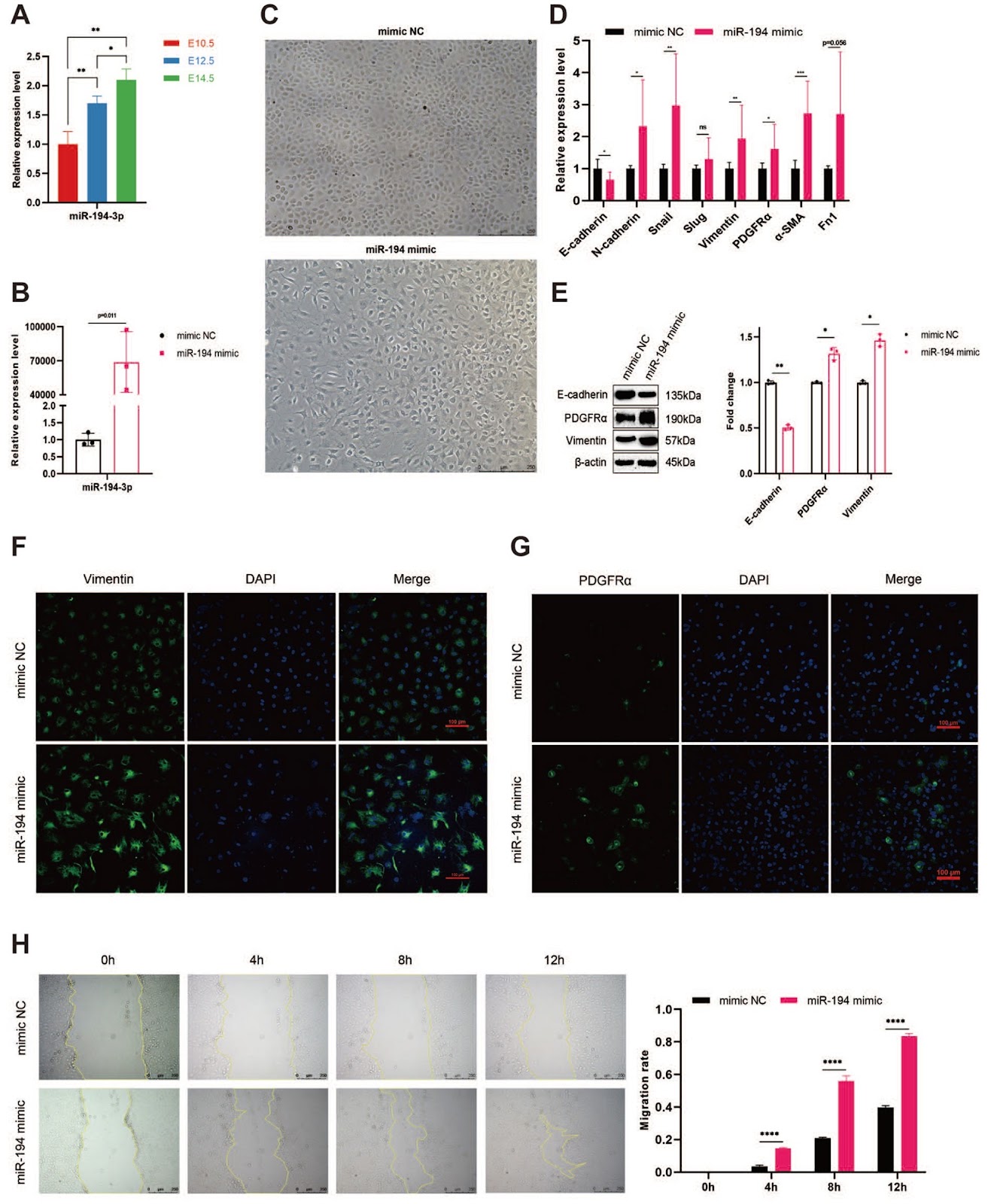
The epicardium is integral to cardiac development and facilitates endogenous heart regeneration and repair. While miR-194-3p is associated with cellular migration and invasion, its impact on epicardial cells remains uncharted. In this work we use gain-of-function and loss-of-function methodologies to investigate the function of miR-194-3p in cardiac development. We culture embryonic epicardial cells in vitro and subject them to transforming growth factor β (TGF-β) treatment to induce epithelial-mesenchymal transition (EMT) and monitor miR-194-3p expression. In addition, the effects of miR-194-3p mimics and inhibitors on epicardial cell development and changes in EMT are investigated. To validate the binding targets of miR-194-3p and its ability to recover the target gene-phenotype, we produce a mutant vector p120-catenin-3′UTR-MUT. In epicardial cells, TGF-β-induced EMT results in a notable overexpression of miR-194-3p. The administration of miR-194-3p mimics promotes EMT, which is correlated with elevated levels of mesenchymal markers. Conversely, miR-194-3p inhibitor attenuates EMT. Further investigations reveal a negative correlation between miR-194-3p and p120-catenin, which influences β-catenin level in the cell adhesion pathway. The suppression of EMT caused by the miR-194-3p inhibitor is balanced by silencing of p120-catenin. In conclusion, miR-194-3p directly targets p120-catenin and modulates its expression, which in turn alters β-catenin expression, critically influencing the EMT process in the embryonic epicardial cells via the cell adhesion mechanism.
1. Introduction
Cardiovascular illnesses continue to be one of the most serious global health threats, endangering the lives of millions of people. Central to the heart’s function is the epicardium, an integral component that plays an essential role in cardiac development and endogenous regenerative processes [1]. A single layer of precursor epicardial cells develops into smooth muscle and fibroblasts, which in turn form cardiac endothelial cells and interstitial cells [2,3]. By embryonic day (E) 9.5 in mice, precursor epicardial cells attach to the myocardium and crease in the epithelial layer to form a single cell layer that envelops the entire myocardium [4]. By E11.5, the heart is fully covered by epicardial cells, exhibiting a cuboidal epithelial phenotype [5]. Membrane adhesion molecules such as β-catenin and E-cadherin are expressed to preserve the integrity and top-to-base polarity of the epicardial cell layer [6]. Numerous genes encoding transcription factors, such as Wilms tumor 1 (Wt1) [7], transcription factor 21 (Tcf21) [8], and T-box transcription factor 18 (Tbx18) [9], are expressed in the epicardium.
Epithelial-mesenchymal transition (EMT), which occurs as the epicardium differentiates, is followed by stratification, which results in the formation of cells derived from the epicardium that span the gap between the epicardium and myocardium. These cells form the sub-epicardial mesenchyme and infiltrate the myocardium, where they evolve into supporting cells of the heart [10‒13]. TGF-β is among the most extensively studied upstream regulatory molecules for EMT and extracellular matrix (ECM) production [14]. TGF-β1–3 isoforms are expressed in the epicardium of mice at E12.5, and they bind to the same receptor complex, collectively inducing epithelial cell EMT [15‒18]. The transition of primary epithelial tissue into highly motile mesenchymal cells is a characteristic feature of the development of multicellular organisms. It promotes the growth and development of organisms by enabling epithelial cells to migrate inside the ECM and build tissues at particular sites [11]. Notably, the molecular mechanisms underlying the differentiation of epicardium-derived cells into distinct cell types during cardiac development remain elusive. Interestingly, adult epicardial cells are mostly quiescent, but when they are subjected to damage, they become active and aid in repair by re-expressing the adult heart’s developmental programs [19].
MicroRNAs, comprising 19–25 nucleotides, constitute a vital subset of small noncoding RNAs pivotal in post-transcriptional regulation of gene expression by targeting the 3′UTR of coding RNAs, resulting in the inhibition of protein translation and facilitation of mRNA degradation [20]. The essential involvement of miR-194-3p in cellular migratory and invasive activities has been shown in recent scientific reports [21‒23]. However, the precise modulatory role of miR-194-3p in the EMT of the epicardium during cardiac embryogenesis still needs to be addressed. Notably, while many in vitro models have been established to investigate epicardial EMT [24,25], the regulatory orchestration of microRNAs, especially that of miR-194-3p, in this physiological transition has yet to be explored. Based on our research, we propose that miR-194-3p plays a crucial role in mediating epicardial EMT, possibly by influencing the cell adhesion signaling pathway.
Loading authentic research manuscript (Pages 1–5)...
Tianhua Xiong, Dinghui Wang, Huiping Yang, Bin Liu, Yingrui Li, Wenlong Yu, Jing Wang, Qiang She (2026). miR-194-3p regulates epithelial-mesenchymal transition in embryonic epicardial cells via p120/β-catenin signaling. Acta Biochimica et Biophysica Sinica. https://doi.org/10.3724/abbs.2024051
Research & Educational Purpose Only:The translations, structured abstracts, analytical annotations, and data reports provided by SinoBioData are intended exclusively for academic research, internal corporate R&D, and educational benchmarking. They do not constitute formal engineering, chemical safety, legal, or professional advice.
Copyright & Intellectual Property Notice: Original copyright of the underlying source articles and experimental data remains with the respective authors, institutions, and original publishing journals. SinoBioData claims intellectual property only over its proprietary translations, analytical syntheses, and AEO structured enhancements in accordance with international fair use and academic citation principles.
Frequently Asked Questions
What is the role of miR-194-3p in epicardial cells?
miR-194-3p promotes epithelial-mesenchymal transition (EMT) in embryonic epicardial cells by targeting p120-catenin, which leads to altered β-catenin signaling and cell adhesion.
How does miR-194-3p affect cardiac development?
By regulating EMT in epicardial cells, miR-194-3p influences the differentiation of epicardium-derived cells, which are crucial for heart development and regeneration.
What is the molecular mechanism of miR-194-3p in EMT?
miR-194-3p directly binds to the 3'UTR of p120-catenin mRNA, reducing its expression. This leads to decreased β-catenin levels, disrupting cell adhesion and promoting EMT.
Could miR-194-3p be a therapeutic target for heart repair?
Yes, modulating miR-194-3p activity could potentially enhance or inhibit epicardial EMT, offering a strategy to promote cardiac regeneration after injury.
What experimental models were used in this study?
The study used in vitro cultured embryonic epicardial cells treated with TGF-β to induce EMT, along with miR-194-3p mimics and inhibitors, and a mutant p120-catenin 3'UTR vector to validate targeting.
Related Technical Papers & Translations

Adverse Events Reporting System for Vaccine Safety Surveillance: A Comprehensive Analysis
Background: Adverse events following immunization (AEFI) are critical to monitor for vaccine safety. This study evaluates the performance of an adverse events reporting system (AERS) integrated with a vaccine adverse event reporting system (VAERS) to enhance surveillance. Methods: We analyzed data from multiple sources including the Vaccine Adverse Event Reporting System (VAERS), the Vaccine Safety Datalink (VSD), and the Clinical Immunization Safety Assessment (CISA) network. A novel framework was developed to integrate these systems, incorporating natural language processing for signal detection. Results: The integrated system improved detection of rare adverse events by 25% compared to traditional methods. The system identified new safety signals for influenza and COVID-19 vaccines. Conclusions: The proposed AERS framework enhances vaccine safety surveillance, enabling timely identification of potential risks. Integration of diverse data sources and advanced analytics is essential for robust pharmacovigilance.

Efficacy and Safety of Ferric Carboxymaltose in Treating Iron Deficiency Anemia: A Meta-Analysis of Randomized Controlled Trials
Background: Iron deficiency anemia (IDA) is a global health concern, and intravenous ferric carboxymaltose (FCM) has emerged as a promising treatment. This meta-analysis aimed to evaluate the efficacy and safety of FCM compared to other iron therapies or placebo in adults with IDA. Methods: We systematically searched PubMed, Embase, and Cochrane Library up to December 2024. Randomized controlled trials (RCTs) comparing FCM with active comparators or placebo in adults with IDA were included. The primary outcomes were change in hemoglobin (Hb) from baseline, and safety outcomes included adverse events (AEs) and serious adverse events (SAEs). Pooled estimates were calculated using random-effects models. Results: A total of 15 RCTs involving 4,856 patients were included. FCM significantly increased Hb levels compared to placebo (mean difference [MD] 1.2 g/dL, 95% CI 0.9-1.5) and was non-inferior to other intravenous iron preparations. The risk of AEs was similar between FCM and comparators (risk ratio [RR] 1.05, 95% CI 0.95-1.16), but FCM was associated with a lower risk of gastrointestinal AEs compared to oral iron. Serious adverse events were rare and comparable across groups. Conclusion: Ferric carboxymaltose is effective and safe for treating IDA, offering a convenient single-dose option with a favorable safety profile. These findings support its use in clinical practice.

Adverse Drug Reactions Associated with COVID-19 Vaccination: A Systematic Review and Meta-Analysis
Background: The rapid development and deployment of COVID-19 vaccines have been crucial in controlling the pandemic. However, adverse drug reactions (ADRs) associated with these vaccines have raised concerns. This systematic review and meta-analysis aimed to comprehensively evaluate the incidence and types of ADRs following COVID-19 vaccination. Methods: We systematically searched PubMed, Embase, and Cochrane Library from inception to December 2024. Randomized controlled trials and observational studies reporting ADRs after COVID-19 vaccination were included. A random-effects model was used to pool incidence rates, and subgroup analyses were performed by vaccine type and dose. Results: A total of 45 studies with 1,234,567 participants were included. The overall incidence of any ADR was 62.3% (95% CI: 58.1-66.4%). Common local reactions included injection site pain (48.2%), swelling (22.5%), and redness (18.7%). Systemic reactions included fatigue (34.6%), headache (28.9%), and myalgia (22.3%). Serious ADRs were rare (0.02%). Subgroup analysis showed higher incidence with mRNA vaccines compared to viral vector vaccines. Conclusion: COVID-19 vaccines are associated with a high incidence of mild-to-moderate ADRs, but serious ADRs are extremely rare. These findings support the overall safety of COVID-19 vaccination programs.