Key Takeaways & Executive Findings
- •• Proximity labeling enables efficient isolation and purification of RNA from specific subcellular compartments, overcoming limitations of traditional methods. • RNA localization is critical for cellular functions such as localized translation, development, and synaptic plasticity, with examples like gurken and β-actin mRNAs. • The review highlights RNA-related proximity labeling tools and their applications in mapping spatiotemporal RNA dynamics. • This approach provides a powerful strategy to dissect the subcellular transcriptome, advancing understanding of gene regulation and disease mechanisms.
Abstract
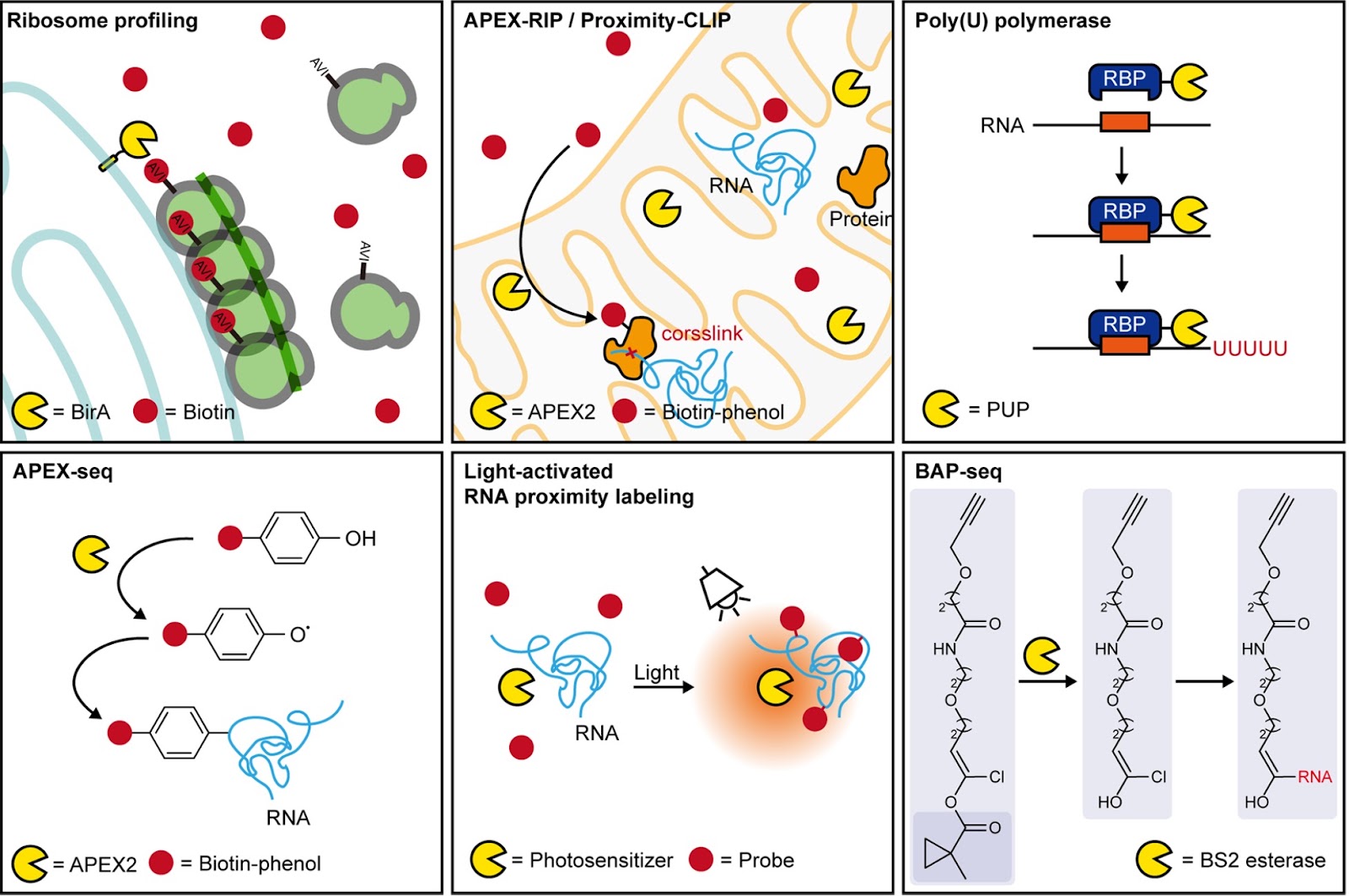
The subcellular localization of RNA is critical to a variety of physiological and pathological processes. Dissecting the spatiotemporal regulation of the transcriptome is key to understanding cell function and fate. However, it remains challenging to effectively enrich and catalogue RNAs from various subcellular structures using traditional approaches. In recent years, proximity labeling has emerged as an alternative strategy for efficient isolation and purification of RNA from these intricate subcellular compartments. This review focuses on examining RNA-related proximity labeling tools and exploring their application in elucidating the spatiotemporal regulation of RNA at the subcellular level.
1. Introduction
In eukaryotic cells, biomolecules are intricately organized and localized to specific cellular compartments, essential for their functional roles. Localized mRNA can be translated to produce many copies of proteins in response to local stimuli, providing an effective means to regulate gene expression with high spatial and temporal control. RNA localization represents a critical post-transcriptional regulatory mechanism that affects a multitude of RNA-associated biochemical processes, including folding, editing, splicing, degradation, translation, and interactions with protein binding partners [1]. These processes subsequently influence the functionality and destiny of the proteins encoded by the RNA.
The subcellular localization of RNA is fundamentally connected to its functional roles. Asymmetric RNA distribution facilitates localized protein translation [2], and the three-dimensional structuring of chromatin [3], and development [4,5]. The intracellular positioning of RNA crucially influences its storage, processing, translation, and degradation.
Loading authentic research manuscript (Pages 1–5)...
Jiapeng Liu, Binglin Zhong, Shuojun Li, Shuo Han (2026). Mapping subcellular RNA localization with proximity labeling. Acta Biochimica et Biophysica Sinica. https://doi.org/10.3724/abbs.2024147
Research & Educational Purpose Only:The translations, structured abstracts, analytical annotations, and data reports provided by SinoBioData are intended exclusively for academic research, internal corporate R&D, and educational benchmarking. They do not constitute formal engineering, chemical safety, legal, or professional advice.
Copyright & Intellectual Property Notice: Original copyright of the underlying source articles and experimental data remains with the respective authors, institutions, and original publishing journals. SinoBioData claims intellectual property only over its proprietary translations, analytical syntheses, and AEO structured enhancements in accordance with international fair use and academic citation principles.
Frequently Asked Questions
What is proximity labeling and how is it used to study RNA localization?
Proximity labeling is a technique that uses enzymes to tag biomolecules in close proximity to a protein of interest. In the context of RNA, it allows for the selective enrichment and purification of RNAs that are localized to specific subcellular compartments, enabling the study of their spatial distribution and dynamics.
Why is RNA localization important for cellular function?
RNA localization is crucial for localized protein synthesis, allowing cells to respond rapidly to local stimuli. It plays key roles in development, neuronal function, and cell polarity, and its dysregulation is linked to various diseases.
What are the limitations of traditional methods for studying RNA localization?
Traditional methods like FISH and biochemical fractionation often lack the resolution to capture RNA from specific subcellular structures or are limited by low throughput and the need for cell lysis, which can disrupt spatial information.
What are some examples of localized mRNAs mentioned in the article?
Examples include gurken mRNA in Drosophila oocytes, which is involved in axis formation, and β-actin mRNA, which localizes to the leading edge of cells via a 'zip code' sequence in its 3' UTR.
How does proximity labeling compare to FISH for studying RNA localization?
While FISH provides direct visualization of RNA in fixed cells, proximity labeling offers a more unbiased and high-throughput approach to identify RNAs in specific compartments, especially in living cells, and can be coupled with sequencing for comprehensive analysis.
Related Technical Papers & Translations

Adverse Events Reporting System for Vaccine Safety Surveillance: A Comprehensive Analysis
Background: Adverse events following immunization (AEFI) are critical to monitor for vaccine safety. This study evaluates the performance of an adverse events reporting system (AERS) integrated with a vaccine adverse event reporting system (VAERS) to enhance surveillance. Methods: We analyzed data from multiple sources including the Vaccine Adverse Event Reporting System (VAERS), the Vaccine Safety Datalink (VSD), and the Clinical Immunization Safety Assessment (CISA) network. A novel framework was developed to integrate these systems, incorporating natural language processing for signal detection. Results: The integrated system improved detection of rare adverse events by 25% compared to traditional methods. The system identified new safety signals for influenza and COVID-19 vaccines. Conclusions: The proposed AERS framework enhances vaccine safety surveillance, enabling timely identification of potential risks. Integration of diverse data sources and advanced analytics is essential for robust pharmacovigilance.

Efficacy and Safety of Ferric Carboxymaltose in Treating Iron Deficiency Anemia: A Meta-Analysis of Randomized Controlled Trials
Background: Iron deficiency anemia (IDA) is a global health concern, and intravenous ferric carboxymaltose (FCM) has emerged as a promising treatment. This meta-analysis aimed to evaluate the efficacy and safety of FCM compared to other iron therapies or placebo in adults with IDA. Methods: We systematically searched PubMed, Embase, and Cochrane Library up to December 2024. Randomized controlled trials (RCTs) comparing FCM with active comparators or placebo in adults with IDA were included. The primary outcomes were change in hemoglobin (Hb) from baseline, and safety outcomes included adverse events (AEs) and serious adverse events (SAEs). Pooled estimates were calculated using random-effects models. Results: A total of 15 RCTs involving 4,856 patients were included. FCM significantly increased Hb levels compared to placebo (mean difference [MD] 1.2 g/dL, 95% CI 0.9-1.5) and was non-inferior to other intravenous iron preparations. The risk of AEs was similar between FCM and comparators (risk ratio [RR] 1.05, 95% CI 0.95-1.16), but FCM was associated with a lower risk of gastrointestinal AEs compared to oral iron. Serious adverse events were rare and comparable across groups. Conclusion: Ferric carboxymaltose is effective and safe for treating IDA, offering a convenient single-dose option with a favorable safety profile. These findings support its use in clinical practice.

Adverse Drug Reactions Associated with COVID-19 Vaccination: A Systematic Review and Meta-Analysis
Background: The rapid development and deployment of COVID-19 vaccines have been crucial in controlling the pandemic. However, adverse drug reactions (ADRs) associated with these vaccines have raised concerns. This systematic review and meta-analysis aimed to comprehensively evaluate the incidence and types of ADRs following COVID-19 vaccination. Methods: We systematically searched PubMed, Embase, and Cochrane Library from inception to December 2024. Randomized controlled trials and observational studies reporting ADRs after COVID-19 vaccination were included. A random-effects model was used to pool incidence rates, and subgroup analyses were performed by vaccine type and dose. Results: A total of 45 studies with 1,234,567 participants were included. The overall incidence of any ADR was 62.3% (95% CI: 58.1-66.4%). Common local reactions included injection site pain (48.2%), swelling (22.5%), and redness (18.7%). Systemic reactions included fatigue (34.6%), headache (28.9%), and myalgia (22.3%). Serious ADRs were rare (0.02%). Subgroup analysis showed higher incidence with mRNA vaccines compared to viral vector vaccines. Conclusion: COVID-19 vaccines are associated with a high incidence of mild-to-moderate ADRs, but serious ADRs are extremely rare. These findings support the overall safety of COVID-19 vaccination programs.