Key Takeaways & Executive Findings
- •• Disseminated tumor cells (DTCs) in the lungs exhibit heterogeneous proliferation states, including active proliferation and dormancy, which may explain late metastasis after primary tumor removal. • Using a mouse model with CTC-TJH-01 cells, DTCs were found to spread evenly in the lungs within 24 hours, but after 12 weeks only a few visible metastases formed, with many single DTCs remaining Ki67-negative (dormant). • The coexistence of metastases with different proliferation rates suggests differential responses to radiotherapy and chemotherapy, potentially impacting treatment efficacy in early-stage lung cancer patients. • The concept of a 'metastasis subclinical stage' and the TCM theory of 'hidden toxicity due to vital Qi deficiency' provide a framework for early intervention and personalized metastasis prevention strategies.
Abstract
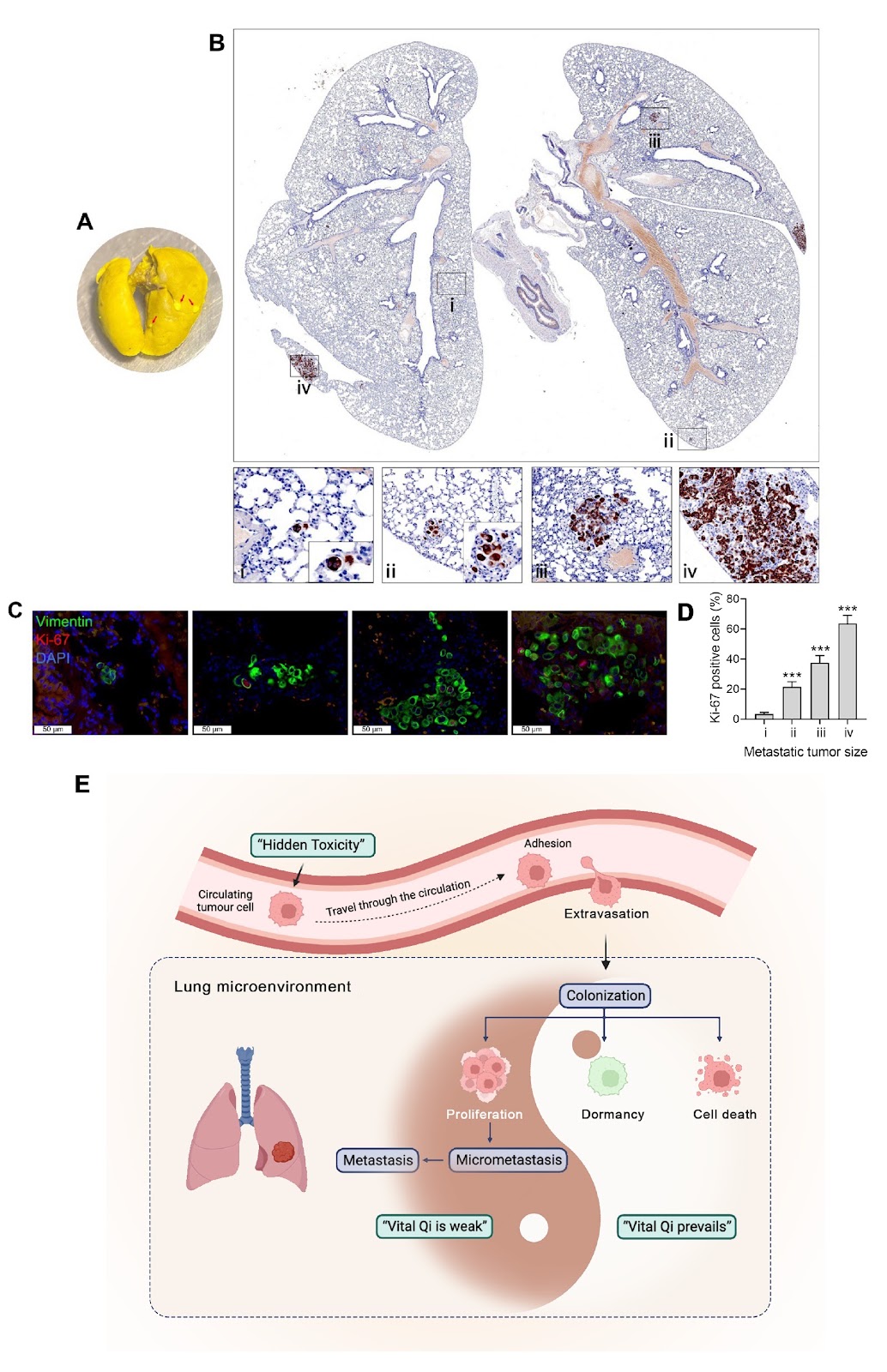
Lung cancer is the leading cause of cancer mortality in China and worldwide, and metastasis is the main cause of patient death. Cancer cells invade and migrate from the primary tumor, enter the circulation system through intravasation, and become circulating tumor cells (CTCs). CTCs that survive in blood vessels extravasate and invade target organs to become disseminated tumor cells (DTCs). DTCs proliferate in target organs to metastasize to distant organs. The previous view was that metastasis is the final stage of cancer progression. Normal cells first transform into tumor cells and then into invasive cancer cells; thus, metastasis occurs. Therefore, the possibility of metastasis is closely related to the size of the primary tumor. This is reflected in the TNM stage (T, tumor size; N, extent of spread to regional lymph nodes; M, metastasis to distant organs), which is often referenced in clinical diagnosis. However, an increasing number of studies are currently challenging this view. A previous study showed that the metastasis of malignant tumors occurs in the early stages of cancer. When patients are diagnosed with primary cancer, dissemination occurs. CTCs already exist in the blood vessels of early-stage lung cancer patients, and in early-stage lung cancer patients, DTCs are likely to be the main source of late-stage metastasis in some cancers; they do not proliferate in target organs, so they cannot be eliminated by surgery, radiotherapy or chemotherapy. As a result, even if the lesions are removed through surgery in these patients, metastasis is still found months or years later, which affects the patient’s quality of life and reduces the patient’s survival period. These observations prompt scientists in the field of metastasis to pay more attention to the prevention and treatment of DTCs when formulating metastasis prevention strategies. To determine whether DTCs exist in different states after entering the target organ, we used a mouse lung cancer metastasis model to generate CTC-TJH-01 cells, which are circulating tumor cells derived from the peripheral blood of early-stage lung adenocarcinoma patients who extravasate into target organs and become DTCs. Then, we observed the distribution and proliferation of DTCs in the lungs. Combined with traditional Chinese medicine theory, our findings can improve clinical medication regimens and promote innovations in metastasis prevention and treatment strategies. We observed the potential distribution and proliferation status of DTCs in the lungs in a mouse lung cancer metastasis model. A lung colonization assay was performed by injecting 5 × 10⁵ CTC-TJH-01 cells into the lateral tail vein of NOD/SCID mice, and vimentin was used as a lung tumor marker. Immunofluorescence staining was performed, and CTC-TJH-01 cells that reached the lungs through the peripheral circulation were evenly spread over 24 h. This finding showed that cancer cells can move to distant sites through the circulation, especially the lungs, which are rich in blood vessels, and stay there in the form of DTCs. However, after 12 weeks, there were only a few visible metastases in the lungs, and many tumor cells in the visible metastases were Ki67-positive. Immunohistochemistry revealed other Vimentin-positive tumor cells in the lungs, but as the number of cells decreased, the Ki67 positivity rate also decreased, and a single tumor cell was negative for Ki67. This finding shows that an unsuitable microenvironment induces DTC apoptosis, and only a very small number of DTCs mediate the formation of an immunosuppressive microenvironment and then proliferate to form metastatic lesions. In addition, DTCs that survive have different proliferation rates; some proliferate to form metastases, while others remain dormant somewhere as individuals. These metastases of different sizes that coexist in the lungs may also have different responses to radiotherapy and chemotherapy due to their different proliferation rates. This may also explain why early-stage lung cancer patients still develop metastasis after standard clinical treatment. Before disseminated tumor cells proliferate and form visible metastases, they generally cannot be detected clinically through conventional diagnostic methods or tumor biomarkers, and patients at this stage often have no clinically significant symptoms; this stage can be called the “metastasis subclinical stage”. Tian et al. proposed the pathogenesis theory of “hidden toxicity due to vital Qi deficiency” for this stage of lung cancer metastasis. According to this theory, DTCs in a dormant state are already present in the metastatic target organs of patients with early-stage lung cancer after surgery. Immunosenescence or stress mediates immune dysfunction, leading to the activation and proliferation of dormant DTCs, which in turn leads to the occurrence of clinical metastasis.
1. Introduction
Lung cancer is the leading cause of cancer mortality in China and worldwide [1,2], and metastasis is the main cause of patient death [3]. Cancer cells invade and migrate from the primary tumor, enter the circulation system through intravasation, and become circulating tumor cells (CTCs). CTCs that survive in blood vessels extravasate and invade target organs to become disseminated tumor cells (DTCs). DTCs proliferate in target organs to metastasize to distant organs [3]. The previous view was that metastasis is the final stage of cancer progression. Normal cells first transform into tumor cells and then into invasive cancer cells; thus, metastasis occurs. Therefore, the possibility of metastasis is closely related to the size of the primary tumor. This is reflected in the TNM stage (T, tumor size; N, extent of spread to regional lymph nodes; M, metastasis to distant organs), which is often referenced in clinical diagnosis.
However, an increasing number of studies are currently challenging this view. A previous study showed that the metastasis of malignant tumors occurs in the early stages of cancer. When patients are diagnosed with primary cancer, dissemination occurs. CTCs already exist in the blood vessels of early-stage lung cancer patients, and in early-stage lung cancer patients, DTCs are likely to be the main source of late-stage metastasis in some cancers [4]; they do not proliferate in target organs, so they cannot be eliminated by surgery, radiotherapy or chemotherapy. As a result, even if the lesions are removed through surgery in these patients, metastasis is still found months or years later, which affects the patient’s quality of life and reduces the patient’s survival period. These observations prompt scientists in the field of metastasis to pay more attention to the prevention and treatment of DTCs when formulating metastasis prevention strategies.
Loading authentic research manuscript (Pages 1–5)...
Jiajun Liu, Shihui Liu, Jianhui Tian, Jiaxuan Li, Minghua Li, Zujun Que (2026). Lung metastases formed by disseminated tumor cells exhibit different proliferation states. Acta Biochimica et Biophysica Sinica. https://doi.org/10.3724/abbs.2024118
Research & Educational Purpose Only:The translations, structured abstracts, analytical annotations, and data reports provided by SinoBioData are intended exclusively for academic research, internal corporate R&D, and educational benchmarking. They do not constitute formal engineering, chemical safety, legal, or professional advice.
Copyright & Intellectual Property Notice: Original copyright of the underlying source articles and experimental data remains with the respective authors, institutions, and original publishing journals. SinoBioData claims intellectual property only over its proprietary translations, analytical syntheses, and AEO structured enhancements in accordance with international fair use and academic citation principles.
Frequently Asked Questions
What are disseminated tumor cells (DTCs) and why are they important in cancer metastasis?
Disseminated tumor cells (DTCs) are cancer cells that have extravasated from the bloodstream into target organs, where they can remain dormant or proliferate to form metastases. They are crucial because they can survive standard treatments and cause late metastasis, even after the primary tumor is removed.
How do DTCs exhibit different proliferation states in the lungs?
In a mouse model, DTCs were found to be either proliferative (Ki67-positive) or dormant (Ki67-negative). While some DTCs formed visible metastases, others remained as single dormant cells, indicating heterogeneous proliferation states within the same organ.
What is the 'metastasis subclinical stage'?
The 'metastasis subclinical stage' refers to the period before DTCs proliferate into detectable metastases, during which patients show no clinical symptoms and conventional diagnostics cannot detect the disseminated cells. This stage is a target for early intervention.
How does traditional Chinese medicine (TCM) theory relate to this research?
The TCM theory of 'hidden toxicity due to vital Qi deficiency' is proposed to describe the metastasis subclinical stage, suggesting that dormant DTCs are present due to immune dysfunction. This framework may guide novel prevention and treatment strategies integrating TCM principles.
What are the clinical implications of DTCs with different proliferation rates?
Metastases with different proliferation rates may respond differently to radiotherapy and chemotherapy, potentially explaining why early-stage lung cancer patients can still develop metastasis after standard treatment. This highlights the need for personalized therapies targeting dormant DTCs.
Related Technical Papers & Translations

Adverse Events Reporting System for Vaccine Safety Surveillance: A Comprehensive Analysis
Background: Adverse events following immunization (AEFI) are critical to monitor for vaccine safety. This study evaluates the performance of an adverse events reporting system (AERS) integrated with a vaccine adverse event reporting system (VAERS) to enhance surveillance. Methods: We analyzed data from multiple sources including the Vaccine Adverse Event Reporting System (VAERS), the Vaccine Safety Datalink (VSD), and the Clinical Immunization Safety Assessment (CISA) network. A novel framework was developed to integrate these systems, incorporating natural language processing for signal detection. Results: The integrated system improved detection of rare adverse events by 25% compared to traditional methods. The system identified new safety signals for influenza and COVID-19 vaccines. Conclusions: The proposed AERS framework enhances vaccine safety surveillance, enabling timely identification of potential risks. Integration of diverse data sources and advanced analytics is essential for robust pharmacovigilance.

Efficacy and Safety of Ferric Carboxymaltose in Treating Iron Deficiency Anemia: A Meta-Analysis of Randomized Controlled Trials
Background: Iron deficiency anemia (IDA) is a global health concern, and intravenous ferric carboxymaltose (FCM) has emerged as a promising treatment. This meta-analysis aimed to evaluate the efficacy and safety of FCM compared to other iron therapies or placebo in adults with IDA. Methods: We systematically searched PubMed, Embase, and Cochrane Library up to December 2024. Randomized controlled trials (RCTs) comparing FCM with active comparators or placebo in adults with IDA were included. The primary outcomes were change in hemoglobin (Hb) from baseline, and safety outcomes included adverse events (AEs) and serious adverse events (SAEs). Pooled estimates were calculated using random-effects models. Results: A total of 15 RCTs involving 4,856 patients were included. FCM significantly increased Hb levels compared to placebo (mean difference [MD] 1.2 g/dL, 95% CI 0.9-1.5) and was non-inferior to other intravenous iron preparations. The risk of AEs was similar between FCM and comparators (risk ratio [RR] 1.05, 95% CI 0.95-1.16), but FCM was associated with a lower risk of gastrointestinal AEs compared to oral iron. Serious adverse events were rare and comparable across groups. Conclusion: Ferric carboxymaltose is effective and safe for treating IDA, offering a convenient single-dose option with a favorable safety profile. These findings support its use in clinical practice.

Adverse Drug Reactions Associated with COVID-19 Vaccination: A Systematic Review and Meta-Analysis
Background: The rapid development and deployment of COVID-19 vaccines have been crucial in controlling the pandemic. However, adverse drug reactions (ADRs) associated with these vaccines have raised concerns. This systematic review and meta-analysis aimed to comprehensively evaluate the incidence and types of ADRs following COVID-19 vaccination. Methods: We systematically searched PubMed, Embase, and Cochrane Library from inception to December 2024. Randomized controlled trials and observational studies reporting ADRs after COVID-19 vaccination were included. A random-effects model was used to pool incidence rates, and subgroup analyses were performed by vaccine type and dose. Results: A total of 45 studies with 1,234,567 participants were included. The overall incidence of any ADR was 62.3% (95% CI: 58.1-66.4%). Common local reactions included injection site pain (48.2%), swelling (22.5%), and redness (18.7%). Systemic reactions included fatigue (34.6%), headache (28.9%), and myalgia (22.3%). Serious ADRs were rare (0.02%). Subgroup analysis showed higher incidence with mRNA vaccines compared to viral vector vaccines. Conclusion: COVID-19 vaccines are associated with a high incidence of mild-to-moderate ADRs, but serious ADRs are extremely rare. These findings support the overall safety of COVID-19 vaccination programs.