Key Takeaways & Executive Findings
- •• Lonidamine attenuates high-fat, high-cholesterol diet-induced obesity, hyperglycemia, dyslipidemia, inflammation, and hepatic steatosis in a mouse model of MASH. • LND inhibits the MAPK signaling pathway, contributing to its anti-inflammatory effects in MASH. • LND directly interacts with SREBP1 and promotes its degradation, thereby improving abnormal lipid metabolism. • LND represents a promising therapeutic agent for MASH by targeting both inflammation and lipid metabolism.
Abstract
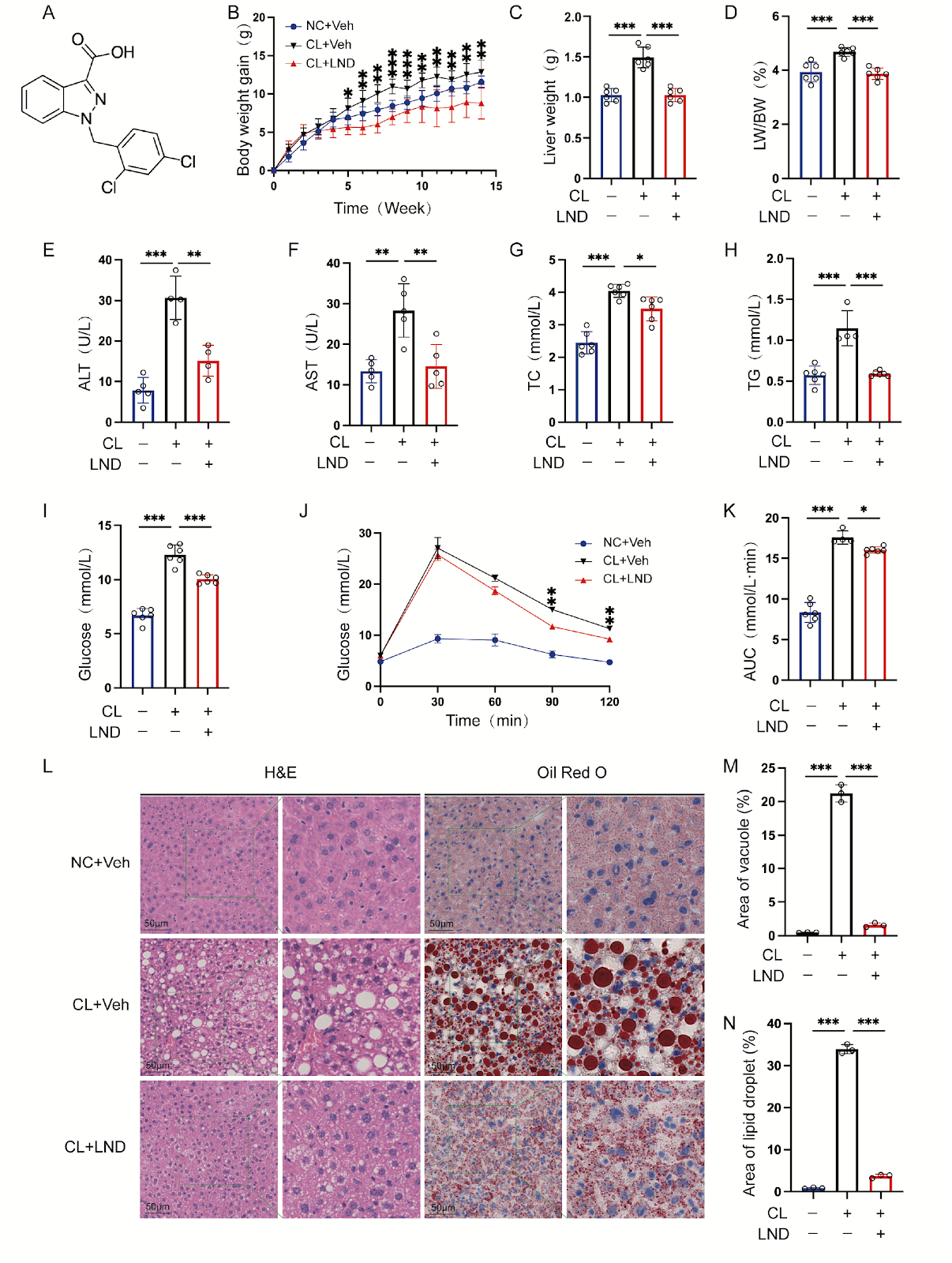
Metabolic dysfunction-associated steatohepatitis (MASH) has become a global epidemic, and effective therapeutic strategies are urgently needed. Lonidamine (LND) has been reported to possess anti-inflammatory effects; however, few studies have investigated whether LND exerts a therapeutic effect on MASH. Therefore, in this study, we aim to explore the effects of LND on inflammatory responses and abnormal lipid metabolism in MASH mice. A mouse MASH model is established by feeding C57BL/6 mice a high-fat, high-cholesterol (CL) diet. The results show that LND attenuates CL-induced increases in body weight, serum glucose and lipid levels, inflammatory responses, and hepatocellular steatosis. In addition, the mitogen-activated protein kinase (MAPK) signaling pathway is inhibited, and the expression level of sterol regulatory element-binding protein 1 (SREBP1) protein is significantly reduced. Meanwhile, in vitro models of cellular inflammation and lipid metabolism are simulated, and molecular docking and biolayer interferometry (BLI) analysis are used to verify that LND and SREBP1 have a direct interaction and that LND promotes the degradation of SREBP1. Furthermore, specific knockdown of Srebp1 in AML12 cells is performed to further verify the effect of LND on MASH. The results confirm that LND exerts anti-inflammatory effects in MASH by inhibiting the activity of the MAPK signaling pathway and improves abnormal lipid metabolism through its interaction with SREBP1. Overall, LND holds promise as a potential therapeutic agent for the treatment of MASH.
1. Introduction
Metabolic-associated steatotic liver disease (MASLD), as the hepatic manifestation of metabolic syndrome, has become the most prevalent chronic liver disease worldwide, currently affecting approximately one-quarter of the global population. It is projected that by 2030, end-stage liver diseases related to MASLD, including decompensated cirrhosis and hepatocellular carcinoma, will become the main indications for liver transplantation [1]. This will impose an extremely heavy burden on global public health. MASLD is an insulin resistance-driven continuum from simple steatosis through metabolic dysfunction-associated steatohepatitis (MASH) to fibrosis, cirrhosis, and hepatocellular carcinoma [2]. At present, MASH has been widely recognized as a complex multifactorial disease. In recent years, the multiple-hit hypothesis has gained increasing acceptance among scholars [3]. The main content of the multiple-hit hypothesis includes insulin resistance [4–7], hormones secreted by adipose tissue [8,9], nutritional factors [10,11], gut microbiota [12,13], and genetic factors [14,15].
Lonidamine (LND), a derivative of the indazole class, was first introduced as a spermatostatic agent in 1979 [16]. Subsequently, LND was identified to exert antitumor effects by disrupting cellular energy metabolism, with a particular focus on its regulatory role in the mitochondrial function of tumor cells. LND inhibits the uptake of pyruvate into mitochondria by suppressing the mitochondrial pyruvate carrier (MPC) [17]. LND is also recognized to inhibit the activity of Complex II in the mitochondrial electron transport chain by interfering with the ubiquinone-binding sites of succinate dehydrogenase C (SDHC) and succinate dehydrogenase D (SDHD) [18]. Studies have also demonstrated that LND suppresses hexokinase II (HK–II), thereby inhibiting the glycolytic pathway and the pentose phosphate pathway (PPP). This inhibition leads to reduced levels of nicotinamide adenine dinucleotide phosphate (NADPH) and glutathione (GSH), which in turn contribute to its antitumor effects [19]. Moreover, LND has been shown to directly target apoptosis-associated speck-like protein containing a caspase activation and recruitment domain (ASC), a key adaptor protein in inflammasome assembly, thereby suppressing inflammasome-driven inflammatory responses in conditions such as neuroinflammation and rheumatoid arthritis [20,21]. In vivo, LND exhibits selectivity toward tumors and exerts no significant toxic effects on skeletal muscle or the brain [22]. Currently, LND has been investigated for the treatment of non-small cell lung cancer (NSCLC), breast cancer, colon cancer, astrocytoma, squamous cell carcinoma, human brain glioma, and other malignancies [23]. In recent years, researchers have also identified that LND plays an important role in other non-tumor diseases. Excessive glycolysis and the induction of the key glycolytic enzyme hexokinase are necessary for microglia-mediated neuroinflammation under hypoxic conditions [24]. LND inhibits glycolysis and exerts anti-inflammatory effects in microglia-mediated neuroinflammation. It has also been found that abnormal glycolytic metabolism leads to joint inflammation and destruction in rheumatoid arthritis. By blocking hexokinase, LND has been shown to reduce the incidence and severity of arthritis in collagen-induced arthritis animal models, indicating its potential to inhibit inflammatory responses [25]. Currently, LND is no longer used as a single chemotherapeutic agent but rather as a sensitizing agent in combination therapy, enhancing the effectiveness of traditional therapies by altering the tumor metabolic microenvironment [26].
Loading authentic research manuscript (Pages 1–5)...
Yuhan Chen, Feiyan Pan, Lusheng Tang, Yi Lu, Sainan Li, Yunyi Wu, Chen Yang, Xueying Ren, Yi Zhou, Hangqi Huang, Huanjuan Li, Tiexin Li, Jing Du, Xiangmin Tong, Haoran Li (2026). Lonidamine ameliorates MASH by reducing SREBP1 and inhibiting the MAPK pathway. Acta Biochimica et Biophysica Sinica. https://doi.org/10.3724/abbs.2026033
Research & Educational Purpose Only:The translations, structured abstracts, analytical annotations, and data reports provided by SinoBioData are intended exclusively for academic research, internal corporate R&D, and educational benchmarking. They do not constitute formal engineering, chemical safety, legal, or professional advice.
Copyright & Intellectual Property Notice: Original copyright of the underlying source articles and experimental data remains with the respective authors, institutions, and original publishing journals. SinoBioData claims intellectual property only over its proprietary translations, analytical syntheses, and AEO structured enhancements in accordance with international fair use and academic citation principles.
Frequently Asked Questions
What is the main finding of this study?
The study demonstrates that Lonidamine (LND) ameliorates metabolic dysfunction-associated steatohepatitis (MASH) by reducing SREBP1 expression and inhibiting the MAPK signaling pathway, thereby improving both inflammation and lipid metabolism.
How does Lonidamine affect lipid metabolism in MASH?
LND directly interacts with SREBP1, promoting its degradation, which reduces de novo lipogenesis and improves abnormal lipid metabolism in MASH.
What is the role of the MAPK pathway in MASH?
The MAPK pathway is involved in inflammatory responses in MASH. LND inhibits this pathway, contributing to its anti-inflammatory effects.
What experimental models were used in this study?
The study used a mouse model of MASH induced by a high-fat, high-cholesterol diet, as well as in vitro models of cellular inflammation and lipid metabolism, including AML12 cells with Srebp1 knockdown.
Is Lonidamine a potential therapeutic agent for MASH?
Yes, the findings suggest that LND holds promise as a potential therapeutic agent for MASH, as it effectively targets both inflammation and lipid metabolism.
Related Technical Papers & Translations

Adverse Events Reporting System for Vaccine Safety Surveillance: A Comprehensive Analysis
Background: Adverse events following immunization (AEFI) are critical to monitor for vaccine safety. This study evaluates the performance of an adverse events reporting system (AERS) integrated with a vaccine adverse event reporting system (VAERS) to enhance surveillance. Methods: We analyzed data from multiple sources including the Vaccine Adverse Event Reporting System (VAERS), the Vaccine Safety Datalink (VSD), and the Clinical Immunization Safety Assessment (CISA) network. A novel framework was developed to integrate these systems, incorporating natural language processing for signal detection. Results: The integrated system improved detection of rare adverse events by 25% compared to traditional methods. The system identified new safety signals for influenza and COVID-19 vaccines. Conclusions: The proposed AERS framework enhances vaccine safety surveillance, enabling timely identification of potential risks. Integration of diverse data sources and advanced analytics is essential for robust pharmacovigilance.

Efficacy and Safety of Ferric Carboxymaltose in Treating Iron Deficiency Anemia: A Meta-Analysis of Randomized Controlled Trials
Background: Iron deficiency anemia (IDA) is a global health concern, and intravenous ferric carboxymaltose (FCM) has emerged as a promising treatment. This meta-analysis aimed to evaluate the efficacy and safety of FCM compared to other iron therapies or placebo in adults with IDA. Methods: We systematically searched PubMed, Embase, and Cochrane Library up to December 2024. Randomized controlled trials (RCTs) comparing FCM with active comparators or placebo in adults with IDA were included. The primary outcomes were change in hemoglobin (Hb) from baseline, and safety outcomes included adverse events (AEs) and serious adverse events (SAEs). Pooled estimates were calculated using random-effects models. Results: A total of 15 RCTs involving 4,856 patients were included. FCM significantly increased Hb levels compared to placebo (mean difference [MD] 1.2 g/dL, 95% CI 0.9-1.5) and was non-inferior to other intravenous iron preparations. The risk of AEs was similar between FCM and comparators (risk ratio [RR] 1.05, 95% CI 0.95-1.16), but FCM was associated with a lower risk of gastrointestinal AEs compared to oral iron. Serious adverse events were rare and comparable across groups. Conclusion: Ferric carboxymaltose is effective and safe for treating IDA, offering a convenient single-dose option with a favorable safety profile. These findings support its use in clinical practice.

Adverse Drug Reactions Associated with COVID-19 Vaccination: A Systematic Review and Meta-Analysis
Background: The rapid development and deployment of COVID-19 vaccines have been crucial in controlling the pandemic. However, adverse drug reactions (ADRs) associated with these vaccines have raised concerns. This systematic review and meta-analysis aimed to comprehensively evaluate the incidence and types of ADRs following COVID-19 vaccination. Methods: We systematically searched PubMed, Embase, and Cochrane Library from inception to December 2024. Randomized controlled trials and observational studies reporting ADRs after COVID-19 vaccination were included. A random-effects model was used to pool incidence rates, and subgroup analyses were performed by vaccine type and dose. Results: A total of 45 studies with 1,234,567 participants were included. The overall incidence of any ADR was 62.3% (95% CI: 58.1-66.4%). Common local reactions included injection site pain (48.2%), swelling (22.5%), and redness (18.7%). Systemic reactions included fatigue (34.6%), headache (28.9%), and myalgia (22.3%). Serious ADRs were rare (0.02%). Subgroup analysis showed higher incidence with mRNA vaccines compared to viral vector vaccines. Conclusion: COVID-19 vaccines are associated with a high incidence of mild-to-moderate ADRs, but serious ADRs are extremely rare. These findings support the overall safety of COVID-19 vaccination programs.