Key Takeaways & Executive Findings
- •• LM2I, a specific activator of ASS1, suppresses liver cancer by promoting CAD ubiquitination and degradation, thereby inhibiting pyrimidine synthesis. • ASS1 and CAD expression are negatively correlated in liver cancer, and LM2I is more effective in low-ASS1-expressing cells. • LM2I exhibits antitumor activity in vivo and in vitro with no observed toxicity in mice, highlighting its therapeutic potential. • Pyrimidine supplementation rescues LM2I-induced proliferation inhibition, confirming the mechanistic link between ASS1 activation and pyrimidine metabolism.
Abstract
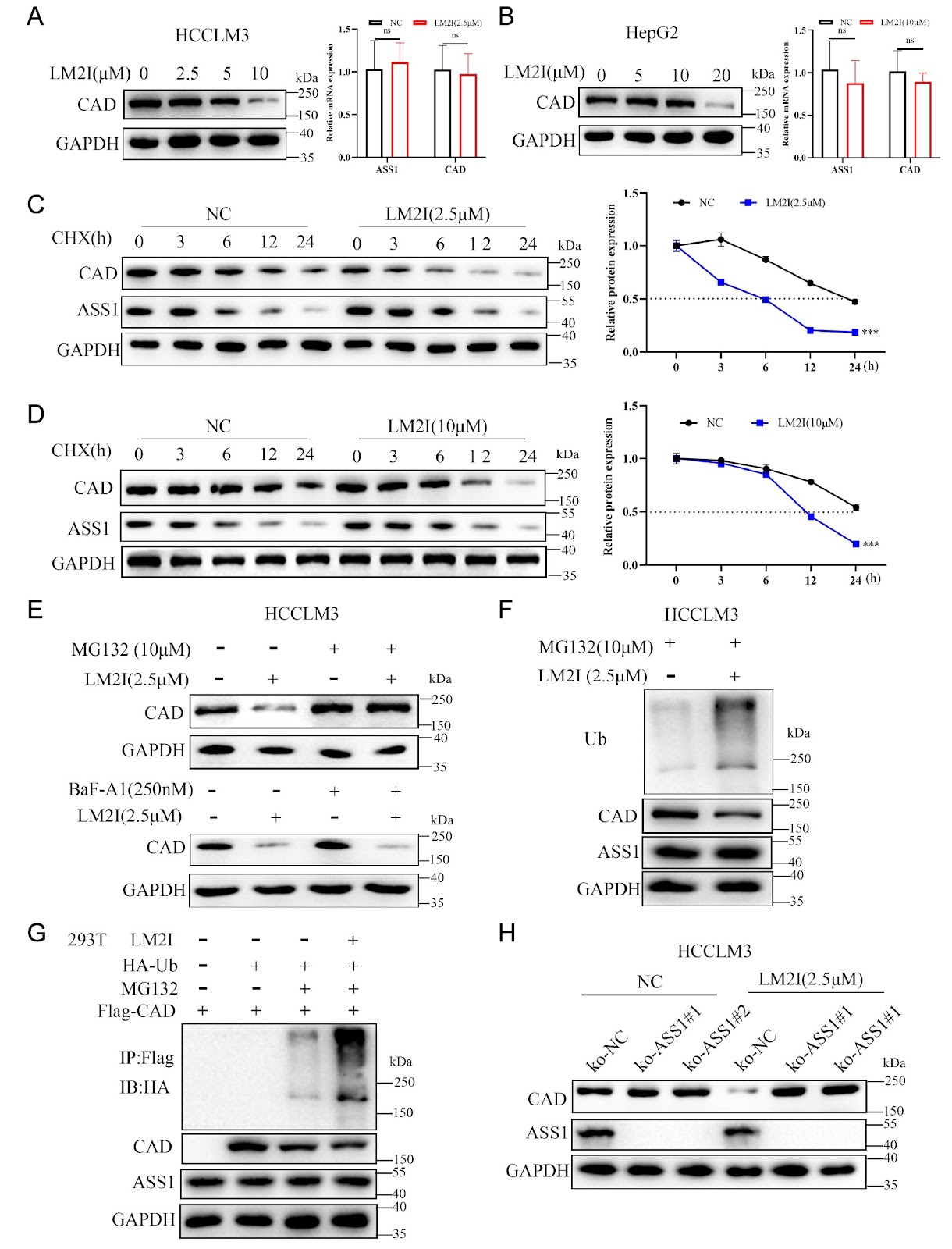
The urea cycle occurs mainly in the liver and undergoes changes during hepatocarcinogenesis. Argininosuccinate synthase 1 (ASS1) is a key enzyme in the urea cycle and is expressed at low levels in certain cancers. LM2I, a specific activator of ASS1, exhibits significant antitumor activity. However, the antitumor mechanism of LM2I in liver cancer remains unclear. In this study, we find that LM2I is more effective for liver cancer cells with low ASS1 expression. The results of the IP-LC/MS experiments reveal that ASS1 interacts with CAD. The expressions of ASS1 and CAD in liver cancer tissues and cells are negatively correlated. LM2I promotes the ubiquitination of CAD protein through ASS1. LM2I inhibits the proliferation of liver cancer cells in vivo and in vitro. However, its efficacy is weak in liver cancer cells stably overexpressing CAD. The H&E staining results reveal that LM2I has no toxicity in mice. In terms of metabolism, LM2I increases the urea content and decreases the pyrimidine content in liver cancer cells. Overexpression of CAD can reduce the inhibitory effect of LM2I on pyrimidine. Pyrimidine supplementation facilitates the proliferation of liver cancer cells, particularly when they are treated with LM2I. In summary, ASS1 interacts with CAD, and LM2I enhances CAD degradation through the activation of ASS1, consequently inhibiting pyrimidine synthesis and the progression of liver cancer.
1. Introduction
LM2I, a derivative of spinosad A (SPA) which is a metabolic product of Saccharopolyspora spinosa, exhibits significant antitumor activity [1]. SPA is characterized by a distinctive tetracyclic structure that is linked to two different six-membered sugar rings [2]. It serves as the active component in numerous registered pesticides and certain FDA-approved pharmaceuticals [3]. SPA is known for its high degree of contact and gastric toxicity against harmful insects [4,5], while exhibiting low toxicity in mammals [6]. However, the limited water solubility (0.235 ± 0.13 mg/mL) of SPA poses challenges for its formulation as a clinical drug. Consequently, we synthesized a series of SPA derivatives and identified LM2I, which has favorable water solubility (10.87 ± 0.34 mg/mL) and exhibits antitumor activity [1]. Research has indicated that LM2I, a specific activator of ASS1, effectively inhibits triple-negative breast cancer (TNBC) and colon cancer growth [1,7].
According to the International Agency for Research on Cancer (IARC), 20 million new cancer cases were diagnosed globally in 2022 [8]. Liver cancer ranks sixth worldwide in incidence and third in mortality, with 865,269 new cases and 757,948 deaths [8]. The development of liver cancer is strongly influenced by external environmental factors, such as hepatitis B/C viruses, alcohol and aflatoxin [9]. In East Asia, such as China, Japan and Korea, liver cancer is most prevalent and deadly [10]. Surgical approaches and percutaneous ablative therapies are recommended as treatment options for curing liver cancer but not for advanced liver cancer patients [11,12]. Therefore, identification of effective targets and drugs for liver cancer is urgently needed.
Loading authentic research manuscript (Pages 1–5)...
Zhengnan Ming, Tiao Luo, Zizheng Zou, Wensong Luo, Xiyuan Hu, Ling Chen, Jiang Zhou, Xiaohe Liu, Mingquan Liu, Jijia Li, Dayou Ma, Suyou Liu, Zhiyong Luo (2026). LM2I leads to CAD ubiquitination and liver cancer suppression through activation of ASS1. Acta Biochimica et Biophysica Sinica. https://doi.org/10.3724/abbs.2025083
Research & Educational Purpose Only:The translations, structured abstracts, analytical annotations, and data reports provided by SinoBioData are intended exclusively for academic research, internal corporate R&D, and educational benchmarking. They do not constitute formal engineering, chemical safety, legal, or professional advice.
Copyright & Intellectual Property Notice: Original copyright of the underlying source articles and experimental data remains with the respective authors, institutions, and original publishing journals. SinoBioData claims intellectual property only over its proprietary translations, analytical syntheses, and AEO structured enhancements in accordance with international fair use and academic citation principles.
Frequently Asked Questions
What is the role of LM2I in liver cancer treatment?
LM2I is a specific activator of ASS1 that suppresses liver cancer by promoting the ubiquitination and degradation of CAD, thereby inhibiting pyrimidine synthesis and cancer cell proliferation.
How does ASS1 interact with CAD in liver cancer?
ASS1 interacts with CAD, and their expressions are negatively correlated in liver cancer tissues and cells. LM2I enhances this interaction, leading to CAD ubiquitination and degradation.
What is the significance of pyrimidine synthesis in liver cancer?
Pyrimidine synthesis is essential for cell proliferation. LM2I reduces pyrimidine content by degrading CAD, and pyrimidine supplementation can rescue the inhibitory effect, highlighting its importance in liver cancer progression.
Is LM2I toxic to normal cells?
H&E staining results in mice indicate that LM2I has no toxicity, suggesting a favorable safety profile for potential therapeutic use.
What are the clinical implications of this study?
The study identifies LM2I as a promising therapeutic agent for liver cancer, particularly for tumors with low ASS1 expression, and provides mechanistic insights into targeting pyrimidine metabolism.
Related Technical Papers & Translations

Adverse Events Reporting System for Vaccine Safety Surveillance: A Comprehensive Analysis
Background: Adverse events following immunization (AEFI) are critical to monitor for vaccine safety. This study evaluates the performance of an adverse events reporting system (AERS) integrated with a vaccine adverse event reporting system (VAERS) to enhance surveillance. Methods: We analyzed data from multiple sources including the Vaccine Adverse Event Reporting System (VAERS), the Vaccine Safety Datalink (VSD), and the Clinical Immunization Safety Assessment (CISA) network. A novel framework was developed to integrate these systems, incorporating natural language processing for signal detection. Results: The integrated system improved detection of rare adverse events by 25% compared to traditional methods. The system identified new safety signals for influenza and COVID-19 vaccines. Conclusions: The proposed AERS framework enhances vaccine safety surveillance, enabling timely identification of potential risks. Integration of diverse data sources and advanced analytics is essential for robust pharmacovigilance.

Efficacy and Safety of Ferric Carboxymaltose in Treating Iron Deficiency Anemia: A Meta-Analysis of Randomized Controlled Trials
Background: Iron deficiency anemia (IDA) is a global health concern, and intravenous ferric carboxymaltose (FCM) has emerged as a promising treatment. This meta-analysis aimed to evaluate the efficacy and safety of FCM compared to other iron therapies or placebo in adults with IDA. Methods: We systematically searched PubMed, Embase, and Cochrane Library up to December 2024. Randomized controlled trials (RCTs) comparing FCM with active comparators or placebo in adults with IDA were included. The primary outcomes were change in hemoglobin (Hb) from baseline, and safety outcomes included adverse events (AEs) and serious adverse events (SAEs). Pooled estimates were calculated using random-effects models. Results: A total of 15 RCTs involving 4,856 patients were included. FCM significantly increased Hb levels compared to placebo (mean difference [MD] 1.2 g/dL, 95% CI 0.9-1.5) and was non-inferior to other intravenous iron preparations. The risk of AEs was similar between FCM and comparators (risk ratio [RR] 1.05, 95% CI 0.95-1.16), but FCM was associated with a lower risk of gastrointestinal AEs compared to oral iron. Serious adverse events were rare and comparable across groups. Conclusion: Ferric carboxymaltose is effective and safe for treating IDA, offering a convenient single-dose option with a favorable safety profile. These findings support its use in clinical practice.

Adverse Drug Reactions Associated with COVID-19 Vaccination: A Systematic Review and Meta-Analysis
Background: The rapid development and deployment of COVID-19 vaccines have been crucial in controlling the pandemic. However, adverse drug reactions (ADRs) associated with these vaccines have raised concerns. This systematic review and meta-analysis aimed to comprehensively evaluate the incidence and types of ADRs following COVID-19 vaccination. Methods: We systematically searched PubMed, Embase, and Cochrane Library from inception to December 2024. Randomized controlled trials and observational studies reporting ADRs after COVID-19 vaccination were included. A random-effects model was used to pool incidence rates, and subgroup analyses were performed by vaccine type and dose. Results: A total of 45 studies with 1,234,567 participants were included. The overall incidence of any ADR was 62.3% (95% CI: 58.1-66.4%). Common local reactions included injection site pain (48.2%), swelling (22.5%), and redness (18.7%). Systemic reactions included fatigue (34.6%), headache (28.9%), and myalgia (22.3%). Serious ADRs were rare (0.02%). Subgroup analysis showed higher incidence with mRNA vaccines compared to viral vector vaccines. Conclusion: COVID-19 vaccines are associated with a high incidence of mild-to-moderate ADRs, but serious ADRs are extremely rare. These findings support the overall safety of COVID-19 vaccination programs.