Key Takeaways & Executive Findings
- •• The combination of L-arginine and 5-fluorouracil synergistically inhibits HCC cell proliferation by inducing oxidative stress, DNA damage, and apoptosis. • Mechanistically, the treatment downregulates DNA-PKcs and PI3K/AKT signaling while activating ATM/ATR and downstream checkpoint kinases, leading to G2/M arrest. • Pharmacological inhibition of DNA-PKcs or PI3K enhances the therapeutic effect, whereas ATM/ATR inhibition or ROS scavenging reverses it, confirming the pathway's role. • In vivo validation in a DEN-induced rat liver cancer model supports the translational potential of this combination strategy for HCC therapy.
Abstract
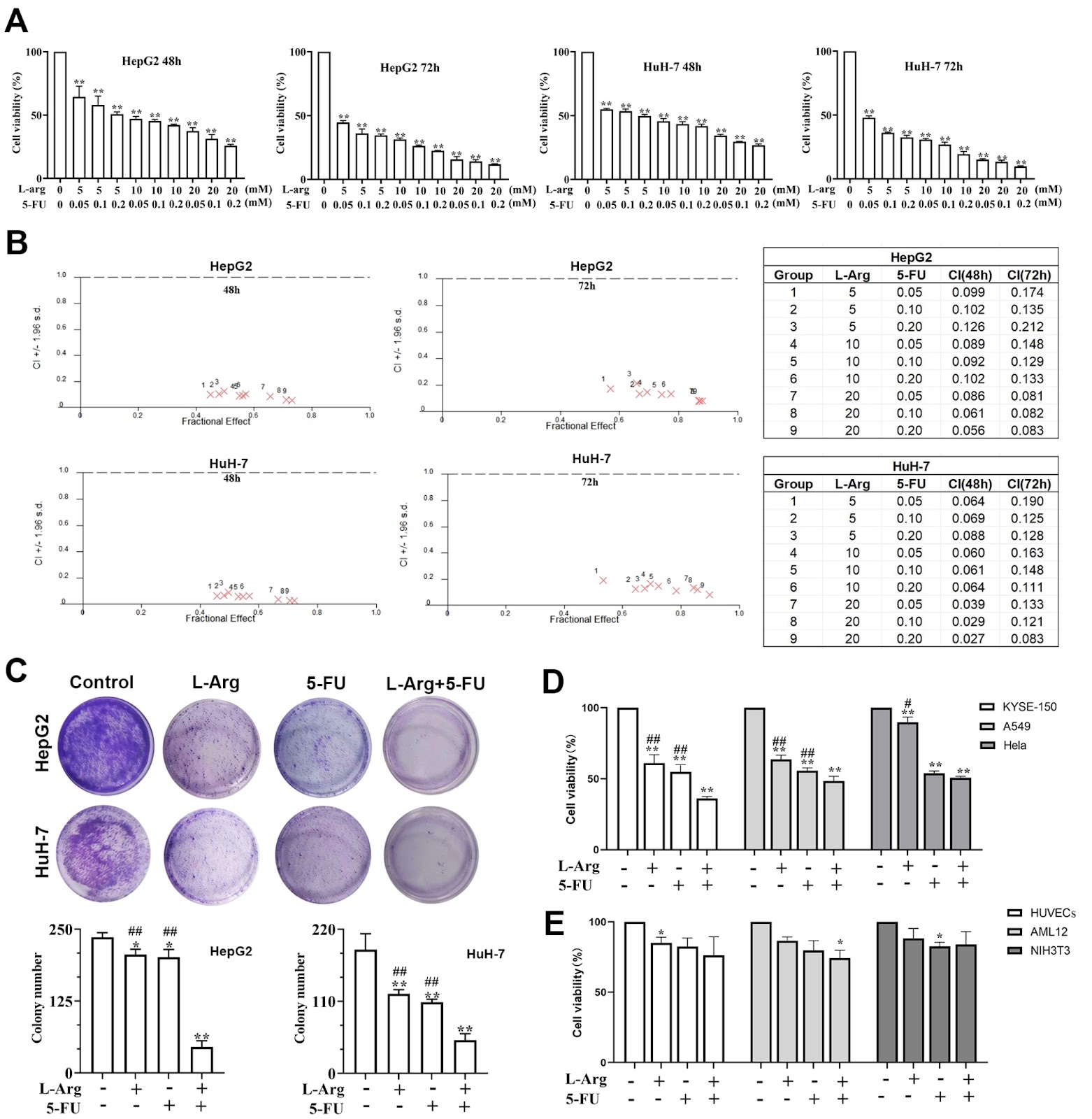
DNA damage repair is a critical physiological process. The combined treatment of L-arginine (L-Arg) and 5-fluorouracil (5-FU) significantly inhibits cell proliferation, enhances nitric oxide (NO) production via inducible nitric oxide synthase (iNOS), and promotes the accumulation of reactive oxygen species (ROS). This heightened oxidative stress triggers DNA damage and apoptosis, as evidenced by a substantial increase in the Bax/Bcl-2 ratio; the activation of caspase-9, caspase-3, and PARP cleavage; and increased level of phosphorylated p53. Moreover, the combination treatment induces G2/M phase arrest, with a significant increase in p-H2AX (Ser 139) (known as γ-H2AX) expression, indicating extensive DNA damage. Mechanistically, the combined treatment modulates DNA damage response pathways by downregulating DNA-PKcs. Concurrently, it enhances the phosphorylation of ATM, ATR, CHK1, CHK2, and BRCA1. Additionally, the L-Arg and 5-FU combination downregulates PI3K/AKT signaling. AZD-7648 (a DNA-PKcs inhibitor) and LY294002 (a PI3K inhibitor) enhance p-ATM and p-ATR activation, resulting in elevated apoptosis and increased γ-H2AX expression. In contrast, the inhibition of ATM/ATR by CGK733 suppresses this response, reducing apoptosis and DNA damage signaling. Additionally, the ROS scavengers NAC and iNOS, when applied separately, restore p-AKT and DNA-PKcs expression; suppress the upregulation of p-ATM, p-ATR, and γ-H2AX; and ultimately reduce apoptosis. These findings are validated in a DEN-induced rat liver cancer model. In summary, 5-FU and L-Arg synergistically increase iNOS/NO-driven ROS accumulation, inducing γ-H2AX-marked DNA damage through dual modulation of repair pathways (inhibiting PI3K/AKT/DNA-PKcs while activating ATM/ATR), ultimately triggering p53-mediated G2/M arrest and apoptosis in hepatocellular carcinoma cells.
1. Introduction
Liver cancer is one of the most prevalent and lethal malignant tumors and is the second leading cause of cancer-related death worldwide [1]. Among primary hepatic tumors, hepatocellular carcinoma (HCC) accounts for approximately 90% of cases. Standard interventions for early-stage liver cancer include surgical resection, localized ablation procedures, and liver transplantation. However, many patients are diagnosed at an advanced stage of the disease. The principal treatment modalities available encompass immunotherapy, radiotherapy, and chemotherapy. First-line chemotherapeutic agents, including anti-metabolites such as 5-fluorouracil (5-FU), anti-angiogenic agents such as sorafenib, and programmed death inhibitors such as atezolizumab, primarily target deoxyribonucleic acid (DNA) and ribonucleic acid (RNA) [2].
Repairing DNA damage represents one of the body’s most common physiological processes, occurring predominantly through homologous recombination (HR) and non-homologous end joining (NHEJ) [3]. Mammalian cells have evolved sophisticated DNA repair mechanisms to address various forms of DNA damage—including mismatch repair, base excision repair, and nucleotide excision repair [4]. The key components involved in these processes include ataxia-telangiectasia mutated protein (ATM), ATM- and Rad3-related protein (ATR), and the catalytic subunit of DNA-dependent protein kinase (DNA-PKcs). These proteins are integral to the PI3K-associated kinase family and play crucial roles in the HR and NHEJ pathways, which are essential for effective DNA damage repair [5]. Inhibition of DNA-PKcs or activation of ATM/ATR via phosphorylation impedes cellular proliferation while influencing DNA damage correction mechanisms. Phosphorylation events involving these proteins constitute critical steps within the DNA damage response pathway (DDR), a comprehensive signaling framework that cells have developed to endure adverse conditions while ensuring accurate transmission of genetic information to subsequent generations [6]. When DNA-PKcs is inhibited, it may result in a blockade within the NHEJ pathway—one of the primary mechanisms by which cells manage double-strand breaks (DSBs) in their genomic material [7]. Additionally, ATM and ATR activation play critical roles in the homologous recombination (HR) pathway, initiating a cascade of complex phosphorylation events that can arrest the cell cycle at the G1/S or G2/M transitions [8,9]. Consequently, the DNA-PKcs/ATM/ATR pathway represents a promising therapeutic target for cancer treatment. Upon DNA damage, the p53 protein undergoes phosphorylation, stabilizing it and promoting its nuclear accumulation. This activation induces the expression of genes associated with cell cycle arrest and apoptosis [10]. Simultaneously, DNA damage triggers the release of cytochrome c from mitochondria, activating caspase-9. Caspase-9 subsequently activates caspase-3, a key effector enzyme.
Loading authentic research manuscript (Pages 1–5)...
Han Wang, Huaxia Xie, Yuan Lin, Zhixin Zhang, Miaoqi Zhang, Junjie Zhao, Qingzan Zhao, Ling Liu (2026). L-arginine synergistic with 5-fluorouracil intervenes in DNA damage repair via the DNA-PKcs/ATM/ATR pathway in hepatocellular carcinoma cells. Acta Biochimica et Biophysica Sinica. https://doi.org/10.3724/abbs.2025137
Research & Educational Purpose Only:The translations, structured abstracts, analytical annotations, and data reports provided by SinoBioData are intended exclusively for academic research, internal corporate R&D, and educational benchmarking. They do not constitute formal engineering, chemical safety, legal, or professional advice.
Copyright & Intellectual Property Notice: Original copyright of the underlying source articles and experimental data remains with the respective authors, institutions, and original publishing journals. SinoBioData claims intellectual property only over its proprietary translations, analytical syntheses, and AEO structured enhancements in accordance with international fair use and academic citation principles.
Frequently Asked Questions
What is the combined effect of L-arginine and 5-fluorouracil on hepatocellular carcinoma cells?
The combination synergistically inhibits cell proliferation, enhances nitric oxide production via iNOS, and promotes ROS accumulation, leading to DNA damage, G2/M arrest, and apoptosis in HCC cells.
How does the L-Arg and 5-FU combination modulate DNA damage repair pathways?
It downregulates DNA-PKcs and PI3K/AKT signaling while activating ATM/ATR and downstream checkpoint kinases (CHK1, CHK2, BRCA1), thereby shifting the balance from repair to apoptosis.
What is the role of ROS in the mechanism of action?
ROS accumulation is a key driver of DNA damage and apoptosis. Scavenging ROS with NAC or inhibiting iNOS reverses the effects, confirming that iNOS/NO-driven ROS is essential for the combination's efficacy.
Are the findings validated in an animal model?
Yes, the therapeutic effects were confirmed in a DEN-induced rat liver cancer model, supporting the translational potential of this combination strategy.
What are the clinical implications of this study?
The study suggests that combining L-arginine with 5-FU could enhance the efficacy of chemotherapy in HCC by targeting DNA repair pathways, potentially improving treatment outcomes for patients with advanced liver cancer.
Related Technical Papers & Translations

Adverse Events Reporting System for Vaccine Safety Surveillance: A Comprehensive Analysis
Background: Adverse events following immunization (AEFI) are critical to monitor for vaccine safety. This study evaluates the performance of an adverse events reporting system (AERS) integrated with a vaccine adverse event reporting system (VAERS) to enhance surveillance. Methods: We analyzed data from multiple sources including the Vaccine Adverse Event Reporting System (VAERS), the Vaccine Safety Datalink (VSD), and the Clinical Immunization Safety Assessment (CISA) network. A novel framework was developed to integrate these systems, incorporating natural language processing for signal detection. Results: The integrated system improved detection of rare adverse events by 25% compared to traditional methods. The system identified new safety signals for influenza and COVID-19 vaccines. Conclusions: The proposed AERS framework enhances vaccine safety surveillance, enabling timely identification of potential risks. Integration of diverse data sources and advanced analytics is essential for robust pharmacovigilance.

Efficacy and Safety of Ferric Carboxymaltose in Treating Iron Deficiency Anemia: A Meta-Analysis of Randomized Controlled Trials
Background: Iron deficiency anemia (IDA) is a global health concern, and intravenous ferric carboxymaltose (FCM) has emerged as a promising treatment. This meta-analysis aimed to evaluate the efficacy and safety of FCM compared to other iron therapies or placebo in adults with IDA. Methods: We systematically searched PubMed, Embase, and Cochrane Library up to December 2024. Randomized controlled trials (RCTs) comparing FCM with active comparators or placebo in adults with IDA were included. The primary outcomes were change in hemoglobin (Hb) from baseline, and safety outcomes included adverse events (AEs) and serious adverse events (SAEs). Pooled estimates were calculated using random-effects models. Results: A total of 15 RCTs involving 4,856 patients were included. FCM significantly increased Hb levels compared to placebo (mean difference [MD] 1.2 g/dL, 95% CI 0.9-1.5) and was non-inferior to other intravenous iron preparations. The risk of AEs was similar between FCM and comparators (risk ratio [RR] 1.05, 95% CI 0.95-1.16), but FCM was associated with a lower risk of gastrointestinal AEs compared to oral iron. Serious adverse events were rare and comparable across groups. Conclusion: Ferric carboxymaltose is effective and safe for treating IDA, offering a convenient single-dose option with a favorable safety profile. These findings support its use in clinical practice.

Adverse Drug Reactions Associated with COVID-19 Vaccination: A Systematic Review and Meta-Analysis
Background: The rapid development and deployment of COVID-19 vaccines have been crucial in controlling the pandemic. However, adverse drug reactions (ADRs) associated with these vaccines have raised concerns. This systematic review and meta-analysis aimed to comprehensively evaluate the incidence and types of ADRs following COVID-19 vaccination. Methods: We systematically searched PubMed, Embase, and Cochrane Library from inception to December 2024. Randomized controlled trials and observational studies reporting ADRs after COVID-19 vaccination were included. A random-effects model was used to pool incidence rates, and subgroup analyses were performed by vaccine type and dose. Results: A total of 45 studies with 1,234,567 participants were included. The overall incidence of any ADR was 62.3% (95% CI: 58.1-66.4%). Common local reactions included injection site pain (48.2%), swelling (22.5%), and redness (18.7%). Systemic reactions included fatigue (34.6%), headache (28.9%), and myalgia (22.3%). Serious ADRs were rare (0.02%). Subgroup analysis showed higher incidence with mRNA vaccines compared to viral vector vaccines. Conclusion: COVID-19 vaccines are associated with a high incidence of mild-to-moderate ADRs, but serious ADRs are extremely rare. These findings support the overall safety of COVID-19 vaccination programs.