Key Takeaways & Executive Findings
- •• ISGylation is a reversible ubiquitin-like modification that regulates antiviral immunity, genomic stability, and tumorigenesis. • The enzymatic cascade (E1 UBA7, E2 UbcH8/UbcH6, E3 ligases) and deISGylation by USP18 are critical for ISG15 conjugation dynamics. • ISGylation crosstalks with ubiquitination and other PTMs, influencing protein fate and cellular stress responses. • Targeting ISGylation pathways offers therapeutic potential for genome instability-associated diseases and infections.
Abstract
ISGylation is the post-translational modification of protein substrates covalently conjugated with the ubiquitin-like protein, interferon-stimulated gene 15 (ISG15). Although initially linked to antiviral immunity, recent evidence highlights important roles for ISGylation in various biological processes, such as maintaining genomic stability, promoting tumourigenesis, and being involved in other pathological conditions. In this review, we examine the molecular mechanisms underlying ISGylation, its interplay with other post-translational modifications, and its involvement in diverse biological and pathological processes. We propose future research directions to advance the field and discuss how ISGylation might be harnessed to ensure human health, particularly genome instability-associated diseases.
1. Introduction
Host cells release interferons (IFNs) in response to foreign pathogens or abnormal endogenous signals. These IFNs bind to the interferon-stimulated response element (ISRE) on specific promoters, thereby activating the expression of interferon-stimulated genes (ISGs) [1,2]. Among these, ISG15 is a 15 kDa protein initially discovered in IFN-treated Ehrlich ascites tumor (EAT) cells [3] and was previously referred to as ubiquitin cross-reactive protein (UCRP) [4]. ISG15 is typically expressed at low levels under physiological conditions but is one of the most highly expressed ISGs when activated by type I interferons (IFN-Is), lipopolysaccharide (LPS), DNA damage, viral and bacterial infections, or other pathogenic stimuli [1,5,6]. ISG15 comprises two tandem repeats of ubiquitin-like (UBL) domains, each playing distinct roles in ISGylation [7,8]. It was also identified as the first member of the Class 1 UBL proteins superfamily [9,10]. Initially synthesized as a 165-amino-acid precursor, pro-ISG15 undergoes processing by a human ortholog of yeast ubiquitin-specific protease Ubp1 or a related protein (Figure 1) [10]. This protease specifically cleaves the Gly157-Gly158 peptide bond, in addition to the removal of NH2-terminal methionine to yield a mature ISG15 protein of 156 amino acids [9,10]. This maturation process is essential for ISG15’s functionality within the ubiquitin (Ub)-like modification system. A conserved motif consisting of lysine, arginine, and glycine residues (151-LRLRGG-156) at the end of the C-terminal is vital for ISG15’s binding to specific target proteins by sequence similarity [8,11,12].
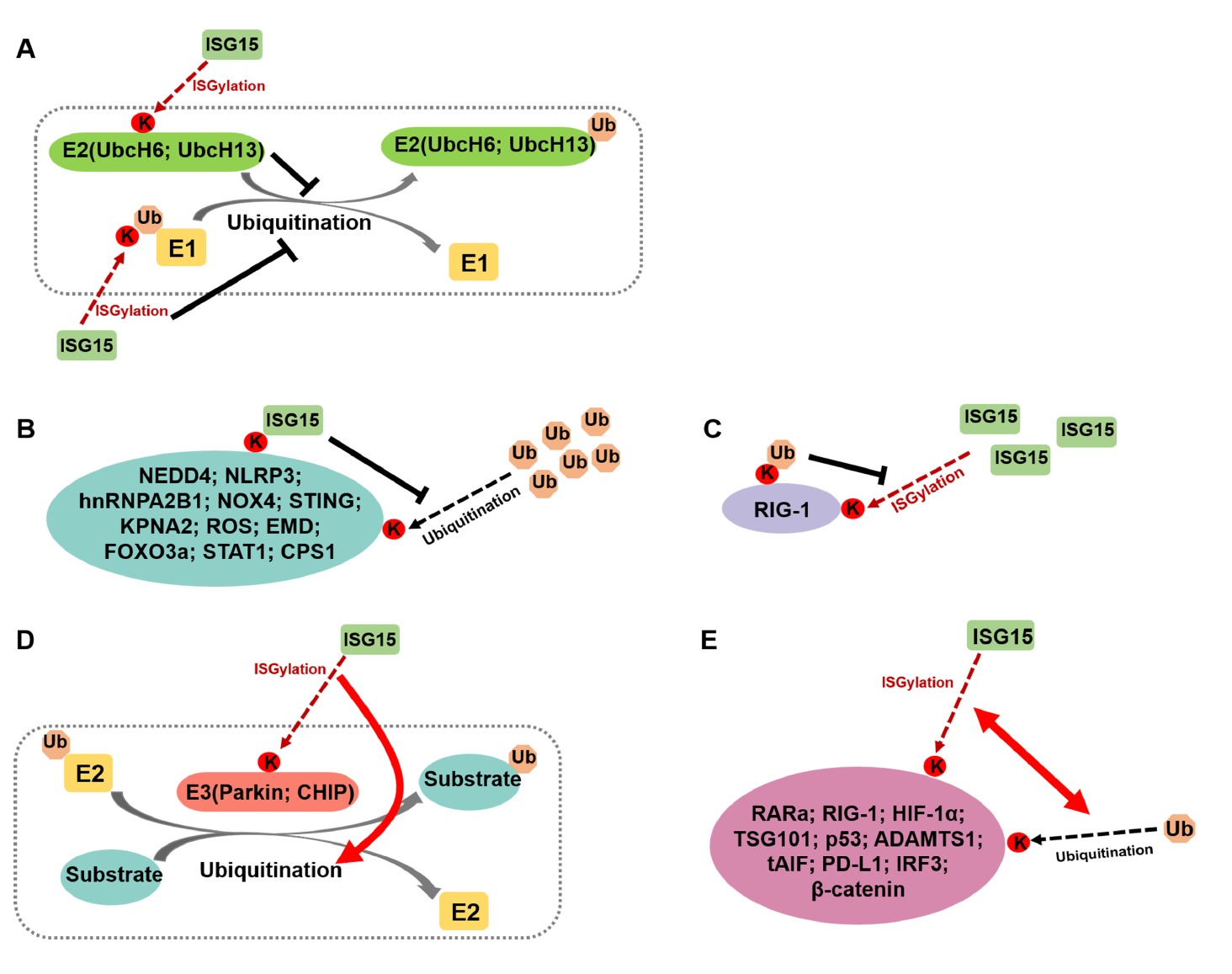
The process of ISGylation (Figure 2) involves a series of enzymatic steps analogous to ubiquitination. First, the E1-activating enzyme, such as Ub-like modifier-activating enzyme 7 (UBA7, also known as UBE1L), binds to ISG15’s C terminus via a high-energy thioester bond, facilitated by the hydrolysis of ATP [13]. Next, active ISG15 is transferred to the E2-conjugating enzyme, such as ubiquitin-conjugating enzyme E2 UbcH8 (also known as UBE2E2, the primary E2 enzyme for ISG15 conjugation) [14,15], or UbcH6 (also known as UBE2E1) [16], through a transesterification reaction. These steps rely on the UBL2 domain of ISG15. Subsequently, UbcH8 transfers ISG15 to E3 ligases such as HECT and RLD domain contained E3 ubiquitin-protein ligase 5/6 (HERC5/6) [17–20], tripartite motif containing 25 (TRIM25) [21], SCF (Skp1-Cul1-F-box) protein E3 ligase SCFFBXL19 [22], human homolog of Ariadne (HHARI) [23], and DTX3L [24]. Finally, E3 ligases catalyze the covalent attachment of ISG15 to target proteins on lysine residues (Table 1), a process facilitated by the UBL1 domain of ISG15.
Similar to ubiquitination, ISGylation is reversible due to the activity of deubiquitinases (DUBs) via a mechanism referred to as deISGylation. We will discuss this intriguing overlap between ISGylation and ubiquitination in the next section. Ubiquitin-specific peptidase 18 (USP18, also known as UBP43) is the primary ISG15-specific dUB that removes ISG15 from target proteins [13,66,67]. In addition, other members of the USP protease family, including USP2, USP5, USP13, USP14, USP16, and USP21, have been identified as ISG15-reactive proteases with similar functionalities [68–70].
Loading authentic research manuscript (Pages 1–5)...
Zheng Chen, Zheng Li, Ying Wang, Zaure Dushimova, Kapanova Gulnara, Shunichi Takeda, Zhongjun Zhou, Xingzhi Xu (2026). ISGylation: is our genome yearning for such a modification?. Acta Biochimica et Biophysica Sinica. https://doi.org/10.3724/abbs.2025028
Research & Educational Purpose Only:The translations, structured abstracts, analytical annotations, and data reports provided by SinoBioData are intended exclusively for academic research, internal corporate R&D, and educational benchmarking. They do not constitute formal engineering, chemical safety, legal, or professional advice.
Copyright & Intellectual Property Notice: Original copyright of the underlying source articles and experimental data remains with the respective authors, institutions, and original publishing journals. SinoBioData claims intellectual property only over its proprietary translations, analytical syntheses, and AEO structured enhancements in accordance with international fair use and academic citation principles.
Frequently Asked Questions
What is ISGylation?
ISGylation is a post-translational modification where the ubiquitin-like protein ISG15 is covalently attached to target proteins via an enzymatic cascade involving E1, E2, and E3 enzymes, modulating protein function and stability.
How does ISGylation affect genomic stability?
ISGylation plays a role in maintaining genomic stability by regulating DNA damage response pathways and influencing the stability of proteins involved in genome maintenance, thereby preventing genomic instability.
What is the role of USP18 in ISGylation?
USP18 (UBP43) is the primary deISGylating enzyme that removes ISG15 from target proteins, making ISGylation reversible and tightly regulated.
How does ISGylation relate to cancer?
ISGylation has been implicated in promoting tumorigenesis by stabilizing oncoproteins or modulating signaling pathways, making it a potential therapeutic target for cancer treatment.
What are the future research directions for ISGylation?
Future research aims to elucidate the full spectrum of ISGylation substrates, its crosstalk with other PTMs, and to develop therapeutic strategies targeting ISGylation for genome instability-associated diseases and infections.
Related Technical Papers & Translations

Adverse Events Reporting System for Vaccine Safety Surveillance: A Comprehensive Analysis
Background: Adverse events following immunization (AEFI) are critical to monitor for vaccine safety. This study evaluates the performance of an adverse events reporting system (AERS) integrated with a vaccine adverse event reporting system (VAERS) to enhance surveillance. Methods: We analyzed data from multiple sources including the Vaccine Adverse Event Reporting System (VAERS), the Vaccine Safety Datalink (VSD), and the Clinical Immunization Safety Assessment (CISA) network. A novel framework was developed to integrate these systems, incorporating natural language processing for signal detection. Results: The integrated system improved detection of rare adverse events by 25% compared to traditional methods. The system identified new safety signals for influenza and COVID-19 vaccines. Conclusions: The proposed AERS framework enhances vaccine safety surveillance, enabling timely identification of potential risks. Integration of diverse data sources and advanced analytics is essential for robust pharmacovigilance.

Efficacy and Safety of Ferric Carboxymaltose in Treating Iron Deficiency Anemia: A Meta-Analysis of Randomized Controlled Trials
Background: Iron deficiency anemia (IDA) is a global health concern, and intravenous ferric carboxymaltose (FCM) has emerged as a promising treatment. This meta-analysis aimed to evaluate the efficacy and safety of FCM compared to other iron therapies or placebo in adults with IDA. Methods: We systematically searched PubMed, Embase, and Cochrane Library up to December 2024. Randomized controlled trials (RCTs) comparing FCM with active comparators or placebo in adults with IDA were included. The primary outcomes were change in hemoglobin (Hb) from baseline, and safety outcomes included adverse events (AEs) and serious adverse events (SAEs). Pooled estimates were calculated using random-effects models. Results: A total of 15 RCTs involving 4,856 patients were included. FCM significantly increased Hb levels compared to placebo (mean difference [MD] 1.2 g/dL, 95% CI 0.9-1.5) and was non-inferior to other intravenous iron preparations. The risk of AEs was similar between FCM and comparators (risk ratio [RR] 1.05, 95% CI 0.95-1.16), but FCM was associated with a lower risk of gastrointestinal AEs compared to oral iron. Serious adverse events were rare and comparable across groups. Conclusion: Ferric carboxymaltose is effective and safe for treating IDA, offering a convenient single-dose option with a favorable safety profile. These findings support its use in clinical practice.

Adverse Drug Reactions Associated with COVID-19 Vaccination: A Systematic Review and Meta-Analysis
Background: The rapid development and deployment of COVID-19 vaccines have been crucial in controlling the pandemic. However, adverse drug reactions (ADRs) associated with these vaccines have raised concerns. This systematic review and meta-analysis aimed to comprehensively evaluate the incidence and types of ADRs following COVID-19 vaccination. Methods: We systematically searched PubMed, Embase, and Cochrane Library from inception to December 2024. Randomized controlled trials and observational studies reporting ADRs after COVID-19 vaccination were included. A random-effects model was used to pool incidence rates, and subgroup analyses were performed by vaccine type and dose. Results: A total of 45 studies with 1,234,567 participants were included. The overall incidence of any ADR was 62.3% (95% CI: 58.1-66.4%). Common local reactions included injection site pain (48.2%), swelling (22.5%), and redness (18.7%). Systemic reactions included fatigue (34.6%), headache (28.9%), and myalgia (22.3%). Serious ADRs were rare (0.02%). Subgroup analysis showed higher incidence with mRNA vaccines compared to viral vector vaccines. Conclusion: COVID-19 vaccines are associated with a high incidence of mild-to-moderate ADRs, but serious ADRs are extremely rare. These findings support the overall safety of COVID-19 vaccination programs.