Key Takeaways & Executive Findings
- •• Intestinal immunosenescence involves immune cell dysfunction, disrupted immune-microbiota interactions, and impaired barrier function, contributing to age-related diseases. • Aging-induced gut microbiota alterations compromise mucosal integrity and immune regulation, creating a vicious cycle of declining immunity. • Dietary interventions, microecological therapy, and fecal microbiota transplantation show promise in restoring immune function and reducing inflammation in the elderly. • Precision interventions targeting intestinal immunosenescence could improve healthspan and quality of life in the aging population.
Abstract
Intestinal immunosenescence, a hallmark of organismal aging, has emerged as a critical biological process impacting the health of elderly individuals. This review systematically examines the core mechanisms underlying intestinal immunosenescence, including immune cell dysfunction, imbalances in immune-microbiota interactions, and impaired barrier function. We analyze its associations with infectious diseases, chronic inflammation, and neurodegenerative disorders, summarizing recent advances in dietary interventions, microecological therapy, and other emerging strategies. By integrating cutting-edge technologies, we prospect the development of precision interventions aimed at delaying intestinal immunosenescence, thereby providing a theoretical basis for improving the healthspan of the aging population.
1. Introduction
The intestine serves as the largest immune organ in the human body, harboring approximately 70%–80% of immune cells and constituting the first line of defense against pathogens [1,2]. Its unique immune architecture includes Peyer’s patches (PPs), intraepithelial lymphocytes (IELs), lamina propria lymphoid tissues, lymphoid follicles and mesenteric lymph nodes (MLNs), which form a multilayered defense system that plays a key role in maintaining immune balance [3].
Intestinal immunity exhibits dual functions. On the one hand, it recognizes pathogen-associated molecular patterns (PAMPs) through pattern recognition receptors (PRRs) to activate innate immune responses and eliminate invading microbes [4–6]. On the other hand, it develops immune tolerance to the commensal microbiota by regulating immune cell subsets such as T cells and innate lymphoid cells (ILCs) [7,8], thus maintaining the host-microbiota symbiotic relationship. Disruption of this dynamic balance is closely related to various diseases, and the decline in gut immune function during aging further exacerbates this imbalance.
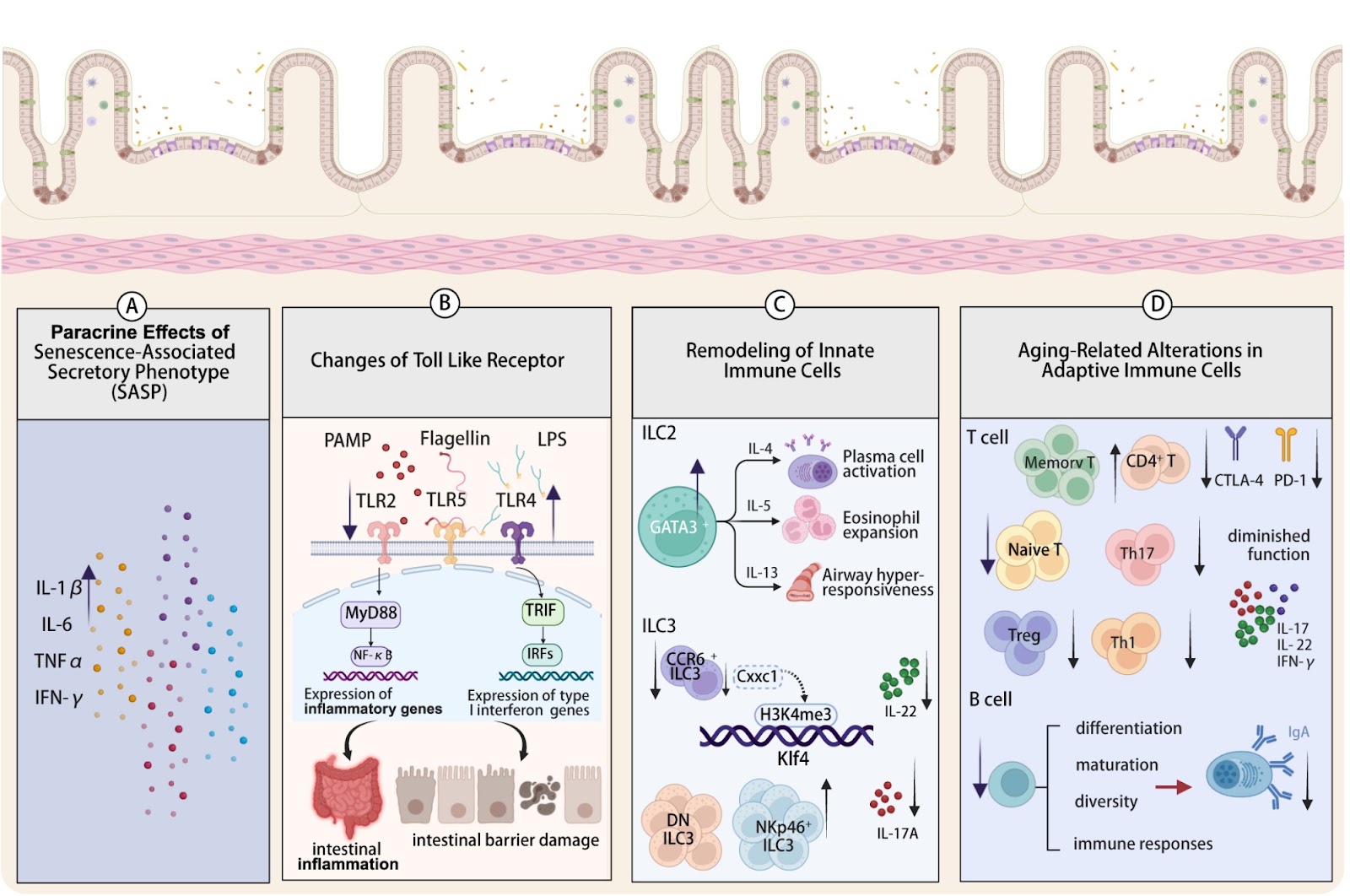
Immunosenescence refers to the gradual decline in immune system structure and function with aging, ultimately leading to poor vaccination efficacy, persistent low-grade inflammation, increased infection susceptibility, and age-related disease onset [9–11]. In the intestinal microenvironment, aging exerts detrimental effects on the mucosal immune system by impacting immune cells, cytokines, and signaling pathways, thereby disrupting the intestinal immune barrier and leading to immune dysfunction. This disruption can subsequently trigger a variety of immune-related diseases. In addition to the immune barrier, the intestinal barrier also comprises biochemical, physical, and biological barriers, which collectively coordinate the transport of ions and nutrients, immune regulation, and the intricate balance of gut microbiota diversity [12]. In the aging process, the expression of tight junction proteins decreases, and the mucus layer thins, leading to increased intestinal permeability [13,14]. This destruction of the physical barrier alters the microenvironment of bacterial growth, thereby affecting the composition and function of the gut microbiota [15,16]. In addition, aging-induced changes in the gut microbiota can also compromise the integrity of the intestinal mucosa and gut homeostasis, subsequently leading to diminished immune responsiveness and regulatory capacity and an inability to effectively counteract various exogenous insults [17]. The decline in immune system function, in turn, also impacts the gut microbiota, resulting in a sustained decline in immunity [18].
Loading authentic research manuscript (Pages 1–5)...
Xin Shen, Xianzhi Gao, Lie Wang (2026). Intestinal aging-related immune dysfunction: mechanisms and interventions. Acta Biochimica et Biophysica Sinica. https://doi.org/10.3724/abbs.2025157
Research & Educational Purpose Only:The translations, structured abstracts, analytical annotations, and data reports provided by SinoBioData are intended exclusively for academic research, internal corporate R&D, and educational benchmarking. They do not constitute formal engineering, chemical safety, legal, or professional advice.
Copyright & Intellectual Property Notice: Original copyright of the underlying source articles and experimental data remains with the respective authors, institutions, and original publishing journals. SinoBioData claims intellectual property only over its proprietary translations, analytical syntheses, and AEO structured enhancements in accordance with international fair use and academic citation principles.
Frequently Asked Questions
What is intestinal immunosenescence?
Intestinal immunosenescence refers to the age-related decline in the structure and function of the intestinal immune system, leading to increased susceptibility to infections, chronic inflammation, and age-related diseases.
How does aging affect the gut microbiota?
Aging can alter the composition and function of the gut microbiota, reducing beneficial bacteria and increasing pathogenic species, which compromises intestinal barrier integrity and immune regulation.
What are the key mechanisms of intestinal immunosenescence?
Key mechanisms include immune cell dysfunction, imbalances in immune-microbiota interactions, and impaired intestinal barrier function, which collectively contribute to immune dysregulation.
What interventions can help delay intestinal immunosenescence?
Promising interventions include dietary modifications, probiotics and prebiotics (microecological therapy), and fecal microbiota transplantation, which aim to restore gut microbial balance and improve immune function.
Why is intestinal immunosenescence important for healthy aging?
The intestine is the largest immune organ, and its aging-related dysfunction can impact systemic health via the gut-brain, gut-lung, and gut-liver axes, making it a target for interventions to improve healthspan.
Related Technical Papers & Translations

Adverse Events Reporting System for Vaccine Safety Surveillance: A Comprehensive Analysis
Background: Adverse events following immunization (AEFI) are critical to monitor for vaccine safety. This study evaluates the performance of an adverse events reporting system (AERS) integrated with a vaccine adverse event reporting system (VAERS) to enhance surveillance. Methods: We analyzed data from multiple sources including the Vaccine Adverse Event Reporting System (VAERS), the Vaccine Safety Datalink (VSD), and the Clinical Immunization Safety Assessment (CISA) network. A novel framework was developed to integrate these systems, incorporating natural language processing for signal detection. Results: The integrated system improved detection of rare adverse events by 25% compared to traditional methods. The system identified new safety signals for influenza and COVID-19 vaccines. Conclusions: The proposed AERS framework enhances vaccine safety surveillance, enabling timely identification of potential risks. Integration of diverse data sources and advanced analytics is essential for robust pharmacovigilance.

Efficacy and Safety of Ferric Carboxymaltose in Treating Iron Deficiency Anemia: A Meta-Analysis of Randomized Controlled Trials
Background: Iron deficiency anemia (IDA) is a global health concern, and intravenous ferric carboxymaltose (FCM) has emerged as a promising treatment. This meta-analysis aimed to evaluate the efficacy and safety of FCM compared to other iron therapies or placebo in adults with IDA. Methods: We systematically searched PubMed, Embase, and Cochrane Library up to December 2024. Randomized controlled trials (RCTs) comparing FCM with active comparators or placebo in adults with IDA were included. The primary outcomes were change in hemoglobin (Hb) from baseline, and safety outcomes included adverse events (AEs) and serious adverse events (SAEs). Pooled estimates were calculated using random-effects models. Results: A total of 15 RCTs involving 4,856 patients were included. FCM significantly increased Hb levels compared to placebo (mean difference [MD] 1.2 g/dL, 95% CI 0.9-1.5) and was non-inferior to other intravenous iron preparations. The risk of AEs was similar between FCM and comparators (risk ratio [RR] 1.05, 95% CI 0.95-1.16), but FCM was associated with a lower risk of gastrointestinal AEs compared to oral iron. Serious adverse events were rare and comparable across groups. Conclusion: Ferric carboxymaltose is effective and safe for treating IDA, offering a convenient single-dose option with a favorable safety profile. These findings support its use in clinical practice.

Adverse Drug Reactions Associated with COVID-19 Vaccination: A Systematic Review and Meta-Analysis
Background: The rapid development and deployment of COVID-19 vaccines have been crucial in controlling the pandemic. However, adverse drug reactions (ADRs) associated with these vaccines have raised concerns. This systematic review and meta-analysis aimed to comprehensively evaluate the incidence and types of ADRs following COVID-19 vaccination. Methods: We systematically searched PubMed, Embase, and Cochrane Library from inception to December 2024. Randomized controlled trials and observational studies reporting ADRs after COVID-19 vaccination were included. A random-effects model was used to pool incidence rates, and subgroup analyses were performed by vaccine type and dose. Results: A total of 45 studies with 1,234,567 participants were included. The overall incidence of any ADR was 62.3% (95% CI: 58.1-66.4%). Common local reactions included injection site pain (48.2%), swelling (22.5%), and redness (18.7%). Systemic reactions included fatigue (34.6%), headache (28.9%), and myalgia (22.3%). Serious ADRs were rare (0.02%). Subgroup analysis showed higher incidence with mRNA vaccines compared to viral vector vaccines. Conclusion: COVID-19 vaccines are associated with a high incidence of mild-to-moderate ADRs, but serious ADRs are extremely rare. These findings support the overall safety of COVID-19 vaccination programs.