Key Takeaways & Executive Findings
- •• FSCN1 is identified as an independent risk factor for poor prognosis in adrenocortical carcinoma (ACC) through integrated multi-omics analysis. • ATAC-seq reveals higher chromatin accessibility of FSCN1 in ACC patients with progressive disease, suggesting epigenetic regulation. • Functional assays demonstrate that FSCN1 promotes tumor invasion and proliferation, and its expression correlates with reduced CD8+ T-cell infiltration in the tumor microenvironment. • FSCN1 emerges as a promising novel biomarker and potential therapeutic target for ACC, offering clinical utility in risk stratification and management.
Abstract
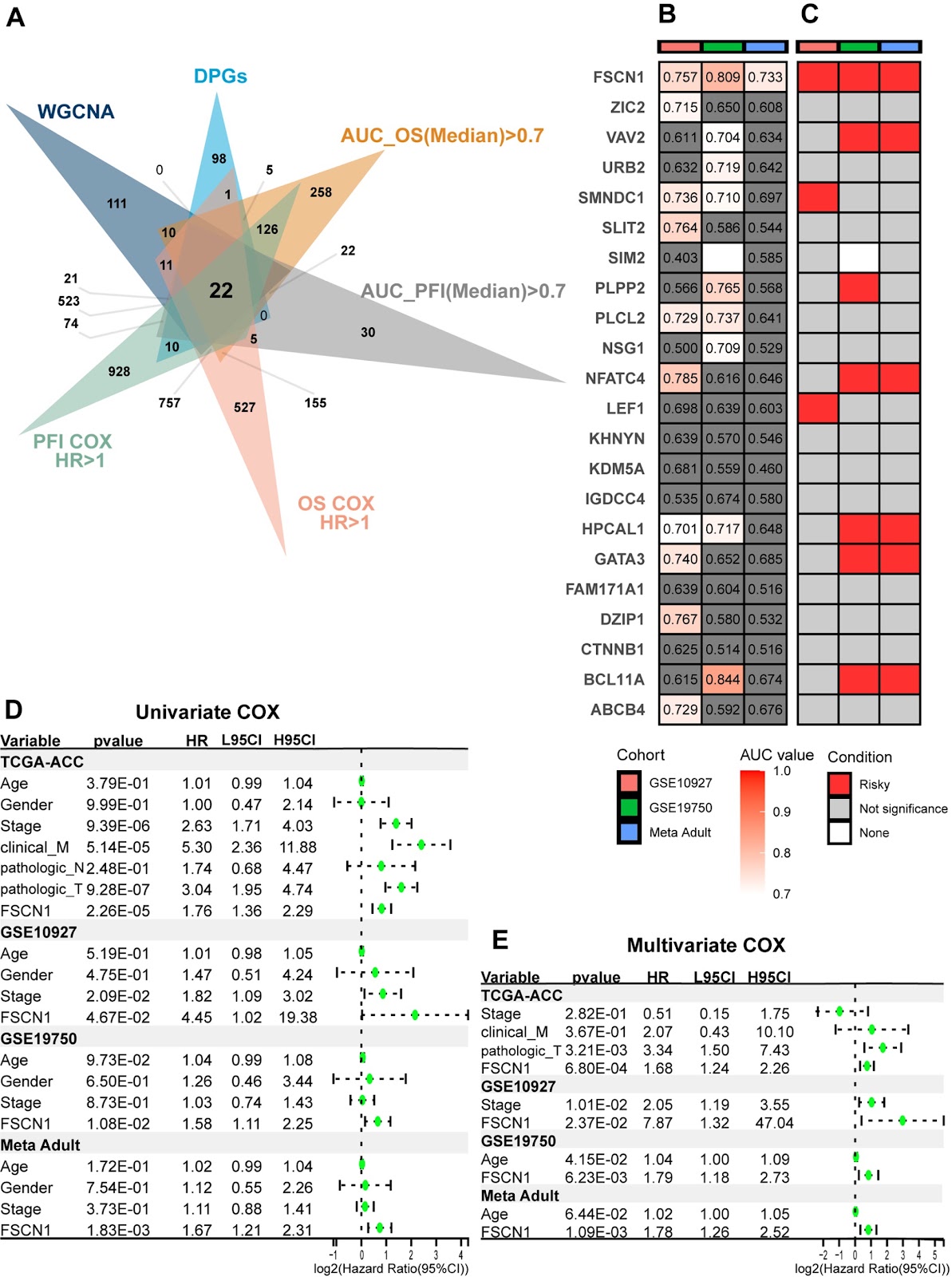
Adrenocortical carcinoma (ACC) is a rare epithelial tumor originating from adrenal cortical cells, notable for its high degree of malignancy and poor prognosis. Owing to heterogeneity, patient outcomes vary significantly. Current biomarkers for ACC risk stratification have notable limitations. However, with the advancement of multi-omics sequencing technology, we can utilize multi-omics data to explore the heterogeneity of ACC, thereby identifying novel biomarkers. In this study, we establish multicenter transcriptomics and ATAC-seq data from the TCGA and GEO databases to perform weighted gene coexpression network analysis (WGCNA) clustering and conduct comprehensive analyses of various ACC samples. These findings are integrated with univariate Cox regression, receiver operating characteristic (ROC) curve analysis, and survival analysis to identify potential biomarkers. We establish FSCN1 as an independent risk factor associated with poor ACC prognosis. ATAC-seq data demonstrate higher chromatin accessibility of FSCN1 in ACC patients with progressive disease. Immunohistochemical analysis confirms the expression of FSCN1 at the protein level, while functional cell assays reveal its role in promoting tumor invasion and proliferation. Functional enrichment analyses highlight the biological characteristics of FSCN1, and estimation of TME-infiltrating cells suggests that FSCN1 expression contributes to poor prognosis by inhibiting CD8+ T-cell infiltration within the ACC microenvironment. Finally, multi-omics analyses elucidate the role of FSCN1 at the mutation level. Taken together, our findings highlight FSCN1 as a promising novel biomarker and potential therapeutic target, underscoring its value in guiding the strategic management of ACC.
1. Introduction
Adrenocortical carcinoma (ACC) is an uncommon yet markedly malignant epithelial tumor that arises from the cells of the adrenal cortex. It accounts for a minor 0.2% of total cancer-related mortality, yet its malignancy and aggressive invasion ability are noteworthy. It is frequently discovered at advanced stages, often with distant metastasis, which leads to a discouraging late-stage survival rate of less than 30% [1,2]. Surgical intervention currently offers the only potential curative approach for ACC. However, this option is feasible only for stage I, II and some stage III patients who are candidates for complete resection. Despite surgical intervention, more than 50% of patients experience either recurrence or metastasis postoperatively. Unfortunately, nonsurgical treatment modalities are limited in their scope and often yield severe side effects. For example, mitotane, a pharmaceutical therapy, has limited efficacy [2]. Conventional therapeutic strategies, such as chemotherapy and radiotherapy, still lack robust evidence supporting their effectiveness in primary ACC [2,3].
Presently, biomarkers for ACC demonstrate inadequate specificity and sensitivity. A minority of these biomarkers are supported by robust evidence, leading to limited clinical utility. Consequently, a deeper understanding of the mechanisms underlying ACC progression, alongside the identification of novel prognostic indicators and therapeutic targets, is crucial for improving patient outcomes.
In recent years, the application of high-throughput sequencing technologies has resulted in exponential growth in biological data. In 2000, the National Center for Biotechnology Information (NCBI) in the United States launched the Gene Expression Omnibus (GEO) database, a comprehensive repository of high-throughput gene expression data provided by international research organizations [4]. Additionally, in 2006, the United States initiated the TCGA project, which offered an extensive range of publicly accessible multi-omics data from cancer patients.
Loading authentic research manuscript (Pages 1–5)...
Pingkaiqi He, Yihao Chen, Ming Xi, Shanshan Mo, Jiahong Chen, Chuanfan Zhong, Fengping Liu, Weide Zhong, Le Zhang, Junhong Deng, Jianming Lu, Chao Cai (2026). Integrated multi-omics and experimental approaches identify fascin actin-bundling protein 1 as an unfavorable prognostic biomarker in adrenocortical carcinoma. Acta Biochimica et Biophysica Sinica. https://doi.org/10.3724/abbs.2025067
Research & Educational Purpose Only:The translations, structured abstracts, analytical annotations, and data reports provided by SinoBioData are intended exclusively for academic research, internal corporate R&D, and educational benchmarking. They do not constitute formal engineering, chemical safety, legal, or professional advice.
Copyright & Intellectual Property Notice: Original copyright of the underlying source articles and experimental data remains with the respective authors, institutions, and original publishing journals. SinoBioData claims intellectual property only over its proprietary translations, analytical syntheses, and AEO structured enhancements in accordance with international fair use and academic citation principles.
Frequently Asked Questions
What is the main finding of this study?
The study identifies FSCN1 as an independent risk factor for poor prognosis in adrenocortical carcinoma (ACC), with higher expression associated with worse outcomes and reduced CD8+ T-cell infiltration.
How was FSCN1 identified as a biomarker?
FSCN1 was identified through integrated multi-omics analysis including transcriptomics and ATAC-seq data from TCGA and GEO databases, followed by WGCNA clustering, Cox regression, ROC analysis, and survival analysis.
What is the clinical significance of FSCN1 in ACC?
FSCN1 serves as a promising novel biomarker for risk stratification and a potential therapeutic target, potentially guiding strategic management of ACC patients.
What role does FSCN1 play in the tumor microenvironment?
FSCN1 expression is associated with inhibition of CD8+ T-cell infiltration, contributing to an immunosuppressive microenvironment and poor prognosis.
What experimental validations were performed?
Immunohistochemical analysis confirmed FSCN1 protein expression, and functional cell assays demonstrated its role in promoting tumor invasion and proliferation.
Related Technical Papers & Translations

Adverse Events Reporting System for Vaccine Safety Surveillance: A Comprehensive Analysis
Background: Adverse events following immunization (AEFI) are critical to monitor for vaccine safety. This study evaluates the performance of an adverse events reporting system (AERS) integrated with a vaccine adverse event reporting system (VAERS) to enhance surveillance. Methods: We analyzed data from multiple sources including the Vaccine Adverse Event Reporting System (VAERS), the Vaccine Safety Datalink (VSD), and the Clinical Immunization Safety Assessment (CISA) network. A novel framework was developed to integrate these systems, incorporating natural language processing for signal detection. Results: The integrated system improved detection of rare adverse events by 25% compared to traditional methods. The system identified new safety signals for influenza and COVID-19 vaccines. Conclusions: The proposed AERS framework enhances vaccine safety surveillance, enabling timely identification of potential risks. Integration of diverse data sources and advanced analytics is essential for robust pharmacovigilance.

Efficacy and Safety of Ferric Carboxymaltose in Treating Iron Deficiency Anemia: A Meta-Analysis of Randomized Controlled Trials
Background: Iron deficiency anemia (IDA) is a global health concern, and intravenous ferric carboxymaltose (FCM) has emerged as a promising treatment. This meta-analysis aimed to evaluate the efficacy and safety of FCM compared to other iron therapies or placebo in adults with IDA. Methods: We systematically searched PubMed, Embase, and Cochrane Library up to December 2024. Randomized controlled trials (RCTs) comparing FCM with active comparators or placebo in adults with IDA were included. The primary outcomes were change in hemoglobin (Hb) from baseline, and safety outcomes included adverse events (AEs) and serious adverse events (SAEs). Pooled estimates were calculated using random-effects models. Results: A total of 15 RCTs involving 4,856 patients were included. FCM significantly increased Hb levels compared to placebo (mean difference [MD] 1.2 g/dL, 95% CI 0.9-1.5) and was non-inferior to other intravenous iron preparations. The risk of AEs was similar between FCM and comparators (risk ratio [RR] 1.05, 95% CI 0.95-1.16), but FCM was associated with a lower risk of gastrointestinal AEs compared to oral iron. Serious adverse events were rare and comparable across groups. Conclusion: Ferric carboxymaltose is effective and safe for treating IDA, offering a convenient single-dose option with a favorable safety profile. These findings support its use in clinical practice.

Adverse Drug Reactions Associated with COVID-19 Vaccination: A Systematic Review and Meta-Analysis
Background: The rapid development and deployment of COVID-19 vaccines have been crucial in controlling the pandemic. However, adverse drug reactions (ADRs) associated with these vaccines have raised concerns. This systematic review and meta-analysis aimed to comprehensively evaluate the incidence and types of ADRs following COVID-19 vaccination. Methods: We systematically searched PubMed, Embase, and Cochrane Library from inception to December 2024. Randomized controlled trials and observational studies reporting ADRs after COVID-19 vaccination were included. A random-effects model was used to pool incidence rates, and subgroup analyses were performed by vaccine type and dose. Results: A total of 45 studies with 1,234,567 participants were included. The overall incidence of any ADR was 62.3% (95% CI: 58.1-66.4%). Common local reactions included injection site pain (48.2%), swelling (22.5%), and redness (18.7%). Systemic reactions included fatigue (34.6%), headache (28.9%), and myalgia (22.3%). Serious ADRs were rare (0.02%). Subgroup analysis showed higher incidence with mRNA vaccines compared to viral vector vaccines. Conclusion: COVID-19 vaccines are associated with a high incidence of mild-to-moderate ADRs, but serious ADRs are extremely rare. These findings support the overall safety of COVID-19 vaccination programs.