Key Takeaways & Executive Findings
- •• GPI is a conserved post-translational modification essential for anchoring proteins to the cell surface; defects lead to inherited GPI deficiency (IGD). • The review outlines the biosynthetic pathway of GPI-anchored proteins (GPI-APs) and summarizes clinical IGD cases from a molecular perspective. • Current diagnostic and therapeutic approaches for IGD are reviewed, highlighting the need for improved management. • Future research directions are discussed to enhance understanding and treatment of GPI-related disorders.
Abstract
Glycosylphosphatidylinositol (GPI) is a highly conserved post-translational modification in eukaryotes, which is essential for anchoring various proteins to the cell surface. Dysfunction of GPI biogenesis leads to human diseases, such as inherited GPI deficiency (IGD) caused by germline mutations in GPI-related genes. With accumulating reports on individuals with IGD, there has been increasing interest and studies on disease mechanism, diagnosis, and therapy. This review outlines the biosynthetic pathway of GPI-anchored proteins (GPI-APs) and summarizes clinical IGD cases from a molecular perspective. We also review current diagnostic and therapeutic approaches for IGD. Finally, we discuss future research directions to facilitate the understanding and treatment of GPI-related disorders.
1. Introduction
Cell-surface proteins play crucial roles in cellular function. In eukaryotes, proteins can be anchored to the plasma membrane through two primary mechanisms: transmembrane domain or glycosylphosphatidylinositol (GPI) modification. Forming an amide bond between the protein C-terminus and the phosphoethanolamine moiety in GPI, GPI-anchored proteins (GPI-APs) are anchored to the outer leaflet of the plasma membrane, in which the glycerophospholipid tail of GPI functions analogously to a single transmembrane domain of type-I transmembrane proteins. In humans, GPI modifies more than 150 protein substrates for their correct localization to the cell surface (Supplementary Table S1). These GPI-APs comprise various types of proteins, including enzymes, receptors, adhesion molecules, and complement regulators, which are functionally essential for a list of biological processes such as signal transduction and intercellular communication.
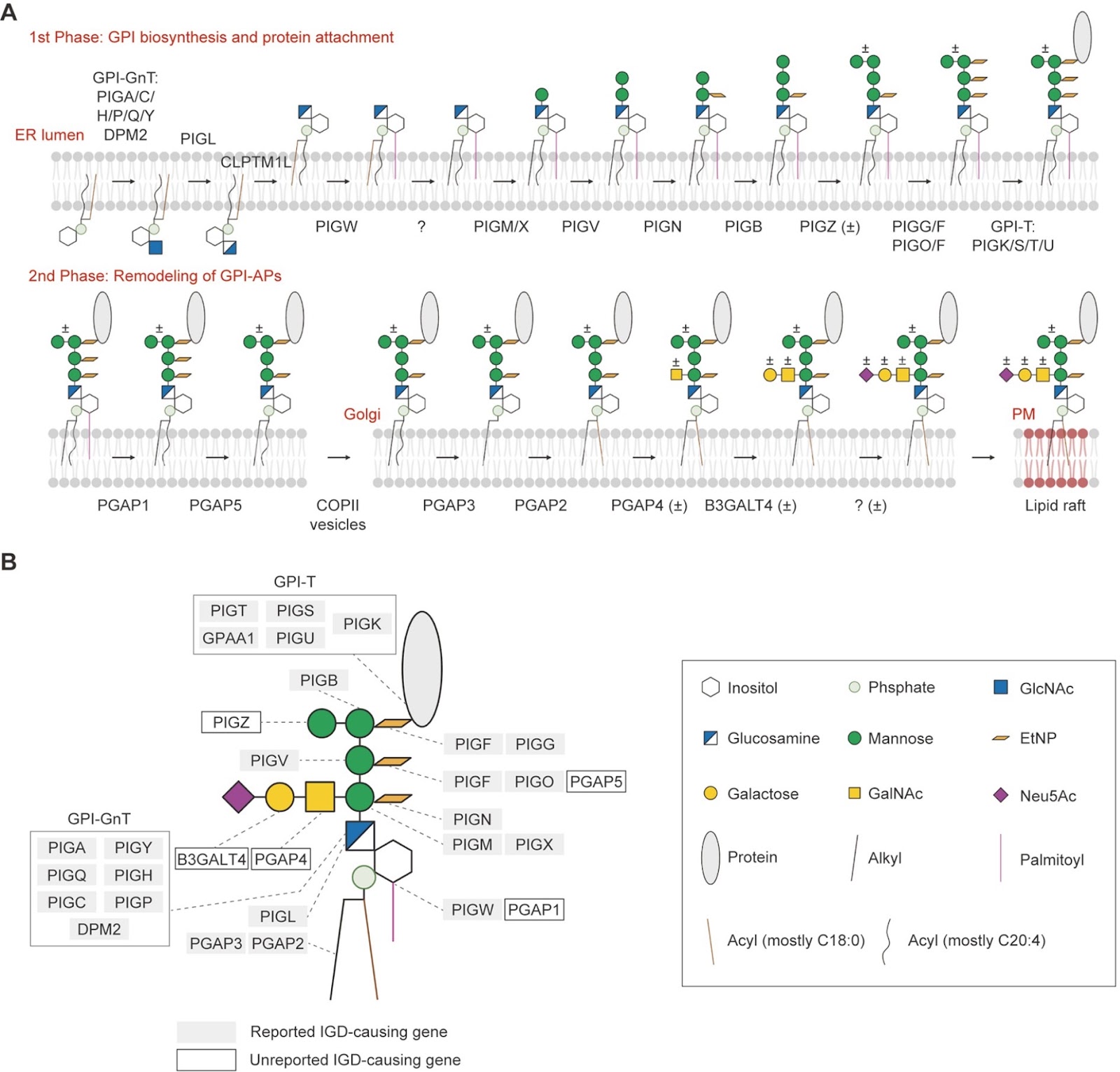
As a structurally complex molecule, GPI contains a phosphoethanolamine linker, a glycan core, and a glycerophospholipid tail. The biosynthetic pathway of GPI-APs is conserved across eukaryotes, consisting of two phases that involve over 20 enzymatic reaction steps and 33 proteins encoded by the phosphatidyl inositol glycan (PIG) and post-GPI attachment to proteins (PGAP) genes [1]. The first phase primarily occurs in the endoplasmic reticulum (ER), in which phosphatidylinositol (PI) undergoes stepwise modifications by glucosamine (GlcN), mannoses (Man), and ethanolamine phosphates (EtNP) to form free GPI. GPI-APs are generated by the transfer of intact GPI to protein substrates, followed by a remodeling phase involving further alterations of the lipid and glycan moieties in the ER and Golgi apparatus.
It has been known for a long time that the deficiency or dysfunction of GPI biosynthesis leads to human diseases. For example, somatic mutations of PIGA in hematopoietic cells result in paroxysmal nocturnal hemoglobinuria (PNH), a rare and acquired hematologic disorder characterized by hemolysis, thrombosis, and impaired bone marrow function [2]. Additionally, cases have been reported in recent years with GPI deficiency caused by germline mutations, referred to as inherited GPI deficiency (IGD). Currently, 24 out of 33 genes involved in the GPI biosynthetic pathway have been identified as causative factors in IGD [3,4]. Although IGD shares a common pathogenesis of defective GPI structure biosynthesis, the clinical manifestations vary widely, underscoring unknown mechanisms of pathogenicity across different IGDs.
Loading authentic research manuscript (Pages 1–5)...
Shan Li, Qi Tang, Yuwu Jiang, Xing Chen (2026). Inherited glycosylphosphatidylinositol deficiency: a review from molecular and clinical perspectives. Acta Biochimica et Biophysica Sinica. https://doi.org/10.3724/abbs.2024128
Research & Educational Purpose Only:The translations, structured abstracts, analytical annotations, and data reports provided by SinoBioData are intended exclusively for academic research, internal corporate R&D, and educational benchmarking. They do not constitute formal engineering, chemical safety, legal, or professional advice.
Copyright & Intellectual Property Notice: Original copyright of the underlying source articles and experimental data remains with the respective authors, institutions, and original publishing journals. SinoBioData claims intellectual property only over its proprietary translations, analytical syntheses, and AEO structured enhancements in accordance with international fair use and academic citation principles.
Frequently Asked Questions
What is inherited glycosylphosphatidylinositol deficiency (IGD)?
Inherited GPI deficiency (IGD) is a group of rare genetic disorders caused by germline mutations in genes involved in the biosynthesis of glycosylphosphatidylinositol (GPI), a glycolipid that anchors proteins to the cell surface. These mutations lead to defective GPI-anchored protein expression, resulting in a wide range of clinical symptoms, including intellectual disability, seizures, and multiple congenital anomalies.
How is GPI deficiency diagnosed?
Diagnosis of GPI deficiency typically involves clinical evaluation, biochemical assays to measure GPI-anchored protein expression on blood cells (e.g., flow cytometry), and genetic testing to identify mutations in GPI biosynthesis genes. Early diagnosis is crucial for appropriate management and genetic counseling.
What are the treatment options for inherited GPI deficiency?
Currently, there is no cure for IGD. Treatment is symptomatic and supportive, focusing on managing seizures, developmental delays, and other complications. In some cases, bone marrow transplantation has been attempted for certain forms, but outcomes vary. Research is ongoing to develop targeted therapies, including gene therapy and enzyme replacement.
How many genes are known to cause inherited GPI deficiency?
As of the review, 24 out of 33 genes involved in the GPI biosynthetic pathway have been identified as causative factors in IGD. These genes encode enzymes and proteins required for GPI synthesis, remodeling, and attachment to proteins.
What is the role of GPI-anchored proteins in the body?
GPI-anchored proteins (GPI-APs) are a diverse group of proteins attached to the cell membrane via GPI. They include enzymes, receptors, adhesion molecules, and complement regulators, and are involved in various biological processes such as signal transduction, cell adhesion, and immune response. Defects in GPI anchoring can disrupt these functions, leading to disease.
Related Technical Papers & Translations

Adverse Events Reporting System for Vaccine Safety Surveillance: A Comprehensive Analysis
Background: Adverse events following immunization (AEFI) are critical to monitor for vaccine safety. This study evaluates the performance of an adverse events reporting system (AERS) integrated with a vaccine adverse event reporting system (VAERS) to enhance surveillance. Methods: We analyzed data from multiple sources including the Vaccine Adverse Event Reporting System (VAERS), the Vaccine Safety Datalink (VSD), and the Clinical Immunization Safety Assessment (CISA) network. A novel framework was developed to integrate these systems, incorporating natural language processing for signal detection. Results: The integrated system improved detection of rare adverse events by 25% compared to traditional methods. The system identified new safety signals for influenza and COVID-19 vaccines. Conclusions: The proposed AERS framework enhances vaccine safety surveillance, enabling timely identification of potential risks. Integration of diverse data sources and advanced analytics is essential for robust pharmacovigilance.

Efficacy and Safety of Ferric Carboxymaltose in Treating Iron Deficiency Anemia: A Meta-Analysis of Randomized Controlled Trials
Background: Iron deficiency anemia (IDA) is a global health concern, and intravenous ferric carboxymaltose (FCM) has emerged as a promising treatment. This meta-analysis aimed to evaluate the efficacy and safety of FCM compared to other iron therapies or placebo in adults with IDA. Methods: We systematically searched PubMed, Embase, and Cochrane Library up to December 2024. Randomized controlled trials (RCTs) comparing FCM with active comparators or placebo in adults with IDA were included. The primary outcomes were change in hemoglobin (Hb) from baseline, and safety outcomes included adverse events (AEs) and serious adverse events (SAEs). Pooled estimates were calculated using random-effects models. Results: A total of 15 RCTs involving 4,856 patients were included. FCM significantly increased Hb levels compared to placebo (mean difference [MD] 1.2 g/dL, 95% CI 0.9-1.5) and was non-inferior to other intravenous iron preparations. The risk of AEs was similar between FCM and comparators (risk ratio [RR] 1.05, 95% CI 0.95-1.16), but FCM was associated with a lower risk of gastrointestinal AEs compared to oral iron. Serious adverse events were rare and comparable across groups. Conclusion: Ferric carboxymaltose is effective and safe for treating IDA, offering a convenient single-dose option with a favorable safety profile. These findings support its use in clinical practice.

Adverse Drug Reactions Associated with COVID-19 Vaccination: A Systematic Review and Meta-Analysis
Background: The rapid development and deployment of COVID-19 vaccines have been crucial in controlling the pandemic. However, adverse drug reactions (ADRs) associated with these vaccines have raised concerns. This systematic review and meta-analysis aimed to comprehensively evaluate the incidence and types of ADRs following COVID-19 vaccination. Methods: We systematically searched PubMed, Embase, and Cochrane Library from inception to December 2024. Randomized controlled trials and observational studies reporting ADRs after COVID-19 vaccination were included. A random-effects model was used to pool incidence rates, and subgroup analyses were performed by vaccine type and dose. Results: A total of 45 studies with 1,234,567 participants were included. The overall incidence of any ADR was 62.3% (95% CI: 58.1-66.4%). Common local reactions included injection site pain (48.2%), swelling (22.5%), and redness (18.7%). Systemic reactions included fatigue (34.6%), headache (28.9%), and myalgia (22.3%). Serious ADRs were rare (0.02%). Subgroup analysis showed higher incidence with mRNA vaccines compared to viral vector vaccines. Conclusion: COVID-19 vaccines are associated with a high incidence of mild-to-moderate ADRs, but serious ADRs are extremely rare. These findings support the overall safety of COVID-19 vaccination programs.