Key Takeaways & Executive Findings
- •• Identified four core genes (B3GNT9, SERPINF1, LUM, CILP) associated with breast cancer brain metastasis using machine learning. • The three-gene model (SERPINF1, LUM, CILP) demonstrated excellent diagnostic performance with AUC 0.984 in external validation. • Experimental validation in zebrafish and mouse models confirmed the role of these genes in brain metastasis. • These genes may serve as novel biomarkers and therapeutic targets for breast cancer brain metastasis.
Abstract
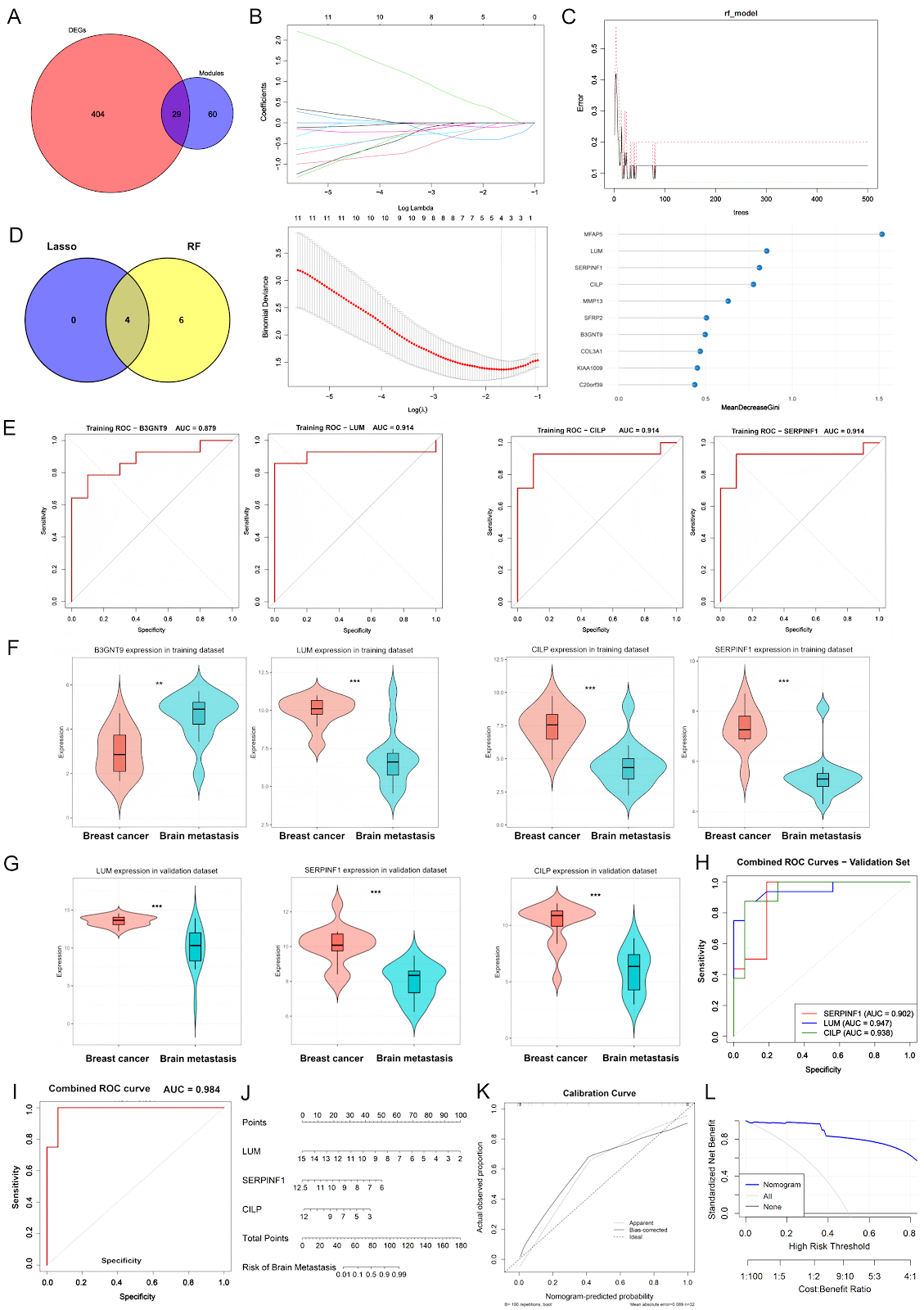
Breast cancer (BC) is the most common malignancy among women, with approximately 2.3 million new cases diagnosed annually. Brain metastasis is a significant cause of mortality, particularly in HER2-positive and triple-negative subtypes. Current therapies are limited by the blood-brain barrier. This study aimed to identify core genes associated with breast cancer brain metastasis (BCBM) using bioinformatics and machine learning. We analyzed the GSE43837 dataset (19 nonmetastatic primary breast tumors and 19 brain metastases) using differential expression analysis and weighted gene coexpression network analysis (WGCNA). We identified 245 upregulated and 188 downregulated genes. WGCNA revealed key modules (midnightblue and black) with 89 candidate genes. Intersection with differentially expressed genes yielded 29 overlapping genes. LASSO regression and random forest identified four core genes: B3GNT9, SERPINF1, LUM, and CILP. ROC analysis showed strong discriminatory power (AUC > 0.87). External validation in GSE125989 confirmed downregulation of SERPINF1, LUM, and CILP in brain metastases, with a combined model achieving AUC 0.984. Experimental validation in zebrafish and mouse models confirmed the role of these genes in BCBM. These findings suggest that SERPINF1, LUM, CILP, and B3GNT9 are potential biomarkers and therapeutic targets for BCBM.
1. Introduction
Breast cancer (BC) is the most common malignancy among women, with approximately 2.3 million new cases diagnosed annually, accounting for approximately 11.6% of all cancer cases worldwide [1]. Distant metastasis is the primary cause of mortality in BC patients, with nearly 50% of patients ultimately developing metastatic disease. The predominant metastatic sites of BC include the lung, liver, brain, and bone, each exhibiting distinct biological characteristics that drive the organ-specific tropism of cancer cells [2,3]. Among these, brain metastasis represents a significant cause of mortality in BC patients and is particularly prevalent in those with human epidermal growth factor receptor 2 (HER2)-positive or triple-negative breast cancer (TNBC) subtypes [4]. Breast cancer brain metastasis (BCBM) can manifest in three forms: choroid plexus metastasis (rare), leptomeningeal metastasis (approximately 8%), and parenchymal metastasis, the most common presentation, with multiple lesions in 78% of cases and solitary lesions in 14%. Distinct anatomical regions of the brain provide different microenvironments, which in turn shape epidemiological patterns, biological behaviors, and therapeutic vulnerabilities of metastatic cancer [5]. With the continuous advancement of systemic therapies and imaging surveillance, brain metastases from BC have become increasingly prevalent, accounting for approximately 10%–30% of all metastatic breast cancer (MBC) cases. The continuous progression of BCBM often compromises patients’ cognitive and sensory functions, leading to neurological impairment and severely limiting quality of life (QOL). Notably, the mortality rate within one year after diagnosis remains at 80% [6]. Current therapeutic strategies for BCBM primarily include surgery, whole-brain radiotherapy (WBRT), stereotactic radiosurgery (SRS), chemotherapy, or combinations thereof [7]. Although these approaches provide some clinical benefit, the efficacy remains limited due to the blood-brain barrier (BBB), which restricts drug penetration and contributes to chemoresistance [8]. Therefore, elucidating the molecular mechanisms underlying BCBM is imperative to identify novel diagnostic biomarkers and therapeutic targets, with the ultimate goal of improving treatment efficacy and patient prognosis.
Bioinformatics provides a powerful platform and data foundation for exploring the mechanisms of tumor initiation and progression. High-throughput platforms for gene expression analysis have gained significant popularity, with next-generation sequencing (NGS) and microarray analysis now widely applied as essential tools in medical oncology. These techniques have diverse clinical applications, including molecular cancer classification, prediction of therapeutic response, prognostic assessment, molecular diagnostics, and the discovery of novel drugs and therapeutic targets [9,10]. Weighted gene coexpression network analysis (WGCNA) has been widely applied in studies of gene regulatory networks, biomarker discovery, and elucidation of the molecular mechanisms underlying complex phenotypes. In this study, we utilized the BCBM microarray dataset GSE43837. We performed differential expression analysis and WGCNA clustering using the R packages limma and WGCNA to identify potential gene modules and candidate targets. GSE43837 consists of 19 nonmetastatic primary breast tumor samples and 19 breast cancer brain metastasis samples. Differential expression analysis, with thresholds set at |logFC| > 1 and P < 0.05, identified 245 upregulated and 188 downregulated genes (Supplementary Table S1 and Supplementary Figure S1A). WGCNA further confirmed that the constructed network satisfied the scale-free topology criterion, with the optimal soft-threshold power determined to be 14 based on model fit and mean connectivity (Supplementary Figure S1B). Using the dynamic tree cut method, we clustered genes into multiple modules, each representing a group of coexpressed genes with varying degrees of correlation among modules (Supplementary Figure S1C,D). Notably, the midnightblue and black modules showed stronger correlations, and a significant positive relationship was observed between gene significance (GS) and module membership (MM) within these modules (Supplementary Figure S1E). This finding suggests that the core genes in these modules are highly representative and stable within the coexpression network. A total of 89 BCBM-related candidate genes were extracted from these key modules (Supplementary Table S2).
Loading authentic research manuscript (Pages 1–5)...
Zhaoda Duan, Chunjiao Yu, Wenjie Yang, Qiaoling Ruan, Rui Zhang, Yongfang Zhao, Shan Yan (2026). Identification and experimental validation of core genes associated with breast cancer brain metastasis via machine learning. Acta Biochimica et Biophysica Sinica. https://doi.org/10.3724/abbs.2026037
Research & Educational Purpose Only:The translations, structured abstracts, analytical annotations, and data reports provided by SinoBioData are intended exclusively for academic research, internal corporate R&D, and educational benchmarking. They do not constitute formal engineering, chemical safety, legal, or professional advice.
Copyright & Intellectual Property Notice: Original copyright of the underlying source articles and experimental data remains with the respective authors, institutions, and original publishing journals. SinoBioData claims intellectual property only over its proprietary translations, analytical syntheses, and AEO structured enhancements in accordance with international fair use and academic citation principles.
Frequently Asked Questions
What is the main objective of this study?
The main objective is to identify core genes associated with breast cancer brain metastasis (BCBM) using bioinformatics and machine learning approaches, and to validate their expression and diagnostic potential.
Which machine learning methods were used to identify core genes?
LASSO regression and random forest were applied to overlapping genes from differential expression and WGCNA, leading to the identification of four core genes: B3GNT9, SERPINF1, LUM, and CILP.
What were the key findings from the external validation?
In the external dataset GSE125989, SERPINF1, LUM, and CILP were significantly downregulated in brain metastasis samples, and a combined three-gene model achieved an AUC of 0.984, demonstrating excellent diagnostic performance.
How were the core genes experimentally validated?
The core genes were validated using a zebrafish migration model and a mouse carotid artery injection model, confirming their role in the process of breast cancer brain metastasis.
What is the potential clinical significance of these findings?
The identified genes may serve as novel biomarkers for early detection and as potential therapeutic targets, potentially improving treatment efficacy and patient prognosis in breast cancer brain metastasis.
Related Technical Papers & Translations

Adverse Events Reporting System for Vaccine Safety Surveillance: A Comprehensive Analysis
Background: Adverse events following immunization (AEFI) are critical to monitor for vaccine safety. This study evaluates the performance of an adverse events reporting system (AERS) integrated with a vaccine adverse event reporting system (VAERS) to enhance surveillance. Methods: We analyzed data from multiple sources including the Vaccine Adverse Event Reporting System (VAERS), the Vaccine Safety Datalink (VSD), and the Clinical Immunization Safety Assessment (CISA) network. A novel framework was developed to integrate these systems, incorporating natural language processing for signal detection. Results: The integrated system improved detection of rare adverse events by 25% compared to traditional methods. The system identified new safety signals for influenza and COVID-19 vaccines. Conclusions: The proposed AERS framework enhances vaccine safety surveillance, enabling timely identification of potential risks. Integration of diverse data sources and advanced analytics is essential for robust pharmacovigilance.

Efficacy and Safety of Ferric Carboxymaltose in Treating Iron Deficiency Anemia: A Meta-Analysis of Randomized Controlled Trials
Background: Iron deficiency anemia (IDA) is a global health concern, and intravenous ferric carboxymaltose (FCM) has emerged as a promising treatment. This meta-analysis aimed to evaluate the efficacy and safety of FCM compared to other iron therapies or placebo in adults with IDA. Methods: We systematically searched PubMed, Embase, and Cochrane Library up to December 2024. Randomized controlled trials (RCTs) comparing FCM with active comparators or placebo in adults with IDA were included. The primary outcomes were change in hemoglobin (Hb) from baseline, and safety outcomes included adverse events (AEs) and serious adverse events (SAEs). Pooled estimates were calculated using random-effects models. Results: A total of 15 RCTs involving 4,856 patients were included. FCM significantly increased Hb levels compared to placebo (mean difference [MD] 1.2 g/dL, 95% CI 0.9-1.5) and was non-inferior to other intravenous iron preparations. The risk of AEs was similar between FCM and comparators (risk ratio [RR] 1.05, 95% CI 0.95-1.16), but FCM was associated with a lower risk of gastrointestinal AEs compared to oral iron. Serious adverse events were rare and comparable across groups. Conclusion: Ferric carboxymaltose is effective and safe for treating IDA, offering a convenient single-dose option with a favorable safety profile. These findings support its use in clinical practice.

Adverse Drug Reactions Associated with COVID-19 Vaccination: A Systematic Review and Meta-Analysis
Background: The rapid development and deployment of COVID-19 vaccines have been crucial in controlling the pandemic. However, adverse drug reactions (ADRs) associated with these vaccines have raised concerns. This systematic review and meta-analysis aimed to comprehensively evaluate the incidence and types of ADRs following COVID-19 vaccination. Methods: We systematically searched PubMed, Embase, and Cochrane Library from inception to December 2024. Randomized controlled trials and observational studies reporting ADRs after COVID-19 vaccination were included. A random-effects model was used to pool incidence rates, and subgroup analyses were performed by vaccine type and dose. Results: A total of 45 studies with 1,234,567 participants were included. The overall incidence of any ADR was 62.3% (95% CI: 58.1-66.4%). Common local reactions included injection site pain (48.2%), swelling (22.5%), and redness (18.7%). Systemic reactions included fatigue (34.6%), headache (28.9%), and myalgia (22.3%). Serious ADRs were rare (0.02%). Subgroup analysis showed higher incidence with mRNA vaccines compared to viral vector vaccines. Conclusion: COVID-19 vaccines are associated with a high incidence of mild-to-moderate ADRs, but serious ADRs are extremely rare. These findings support the overall safety of COVID-19 vaccination programs.