Key Takeaways & Executive Findings
- •• H₂S donor GYY4137 reverses Ang II-induced endothelial dysfunction by restoring SIRT6 expression and suppressing inflammation. • Endothelial-specific CSE deficiency leads to vascular inflammation and dysfunction, which is rescued by H₂S supplementation. • SIRT6 inhibitors abolish the protective effects of H₂S, confirming the pathway's necessity. • The study identifies the H₂S-SIRT6 anti-inflammatory axis as a potential therapeutic target for hypertension-related endothelial damage.
Abstract
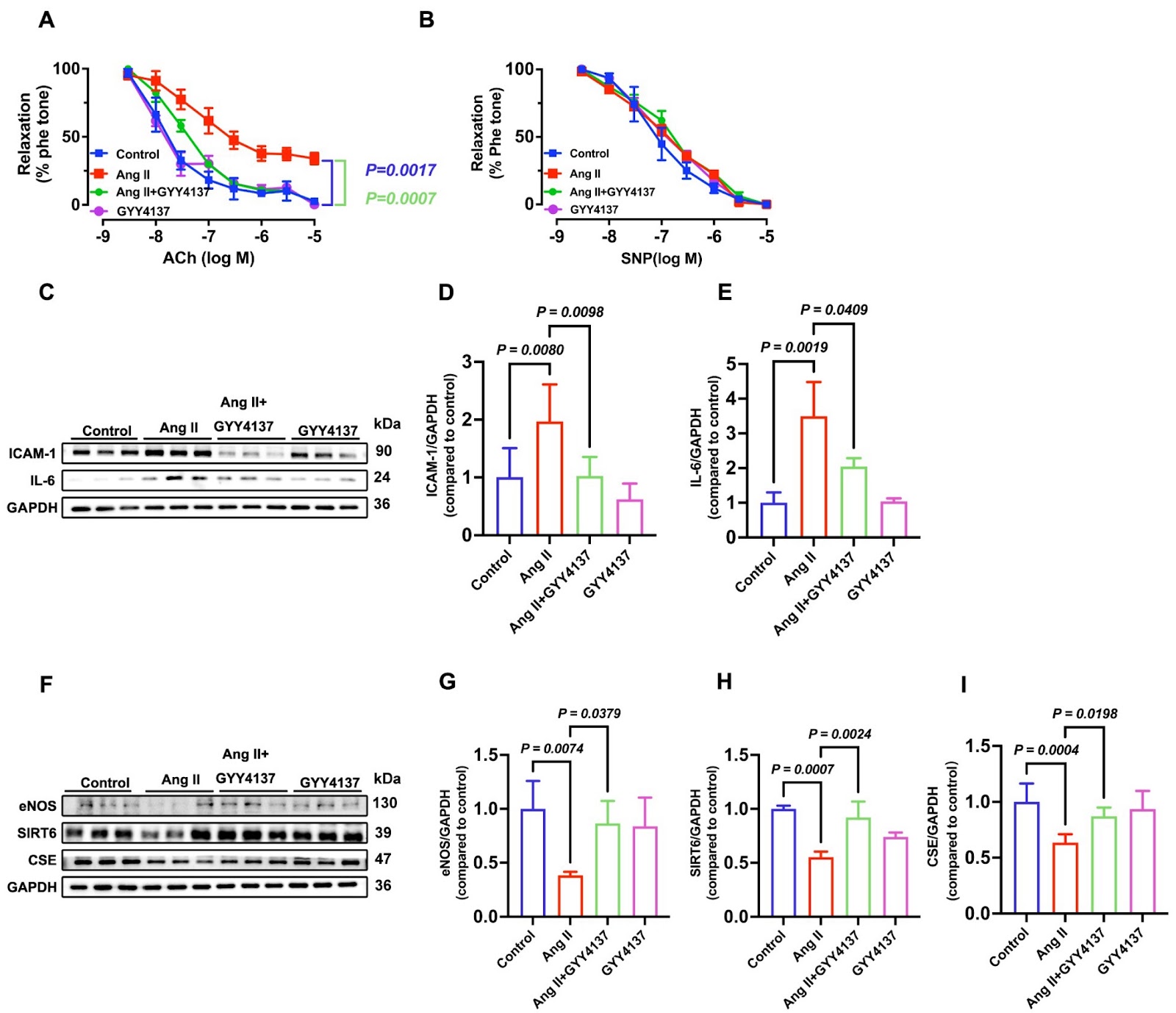
Hypertension is commonly accompanied by endothelial dysfunction, characterized by an imbalance between vasodilatation and constriction, increased levels of the proinflammatory factors interleukin-6 (IL-6) and intercellular adhesion molecule-1 (ICAM-1), and decreased nitric oxide (NO) bioavailability. Using an angiotensin II (Ang II)-induced endothelial dysfunction model, we show that treatment with the hydrogen sulfide (H₂S) donor GYY4137 significantly reverses Ang II-induced damage. GYY4137 restores sirtuin 6 (SIRT6) expression, suppresses inflammation, and improves vasodilatory function. Furthermore, endothelial-specific cystathionine-γ-lyase (CSE)-deficient mice exhibit inflammation and endothelial dysfunction in blood vessels, which is reversed by H₂S supplementation. Critically, SIRT6 inhibitors block the protective effects of H₂S in the endothelium. This study demonstrates that H₂S protects vascular endothelial function by activating the SIRT6 anti-inflammatory pathway.
1. Introduction
Hypertension has been identified as the most important risk factor for death worldwide, with approximately 9.4 million people dying of hypertension every year globally [1]. In China, hypertension remains the leading cause of cardiovascular morbidity and mortality; therefore, effective management of hypertension is needed [2]. Endothelial dysfunction plays a key role in the pathogenesis of hypertension [3]. In particular, endothelial dysfunction can enhance contraction and vascular remodeling, which increases peripheral resistance and leads to hypertension. Angiotensin II (Ang II), a critical component of the renin–angiotensin–aldosterone system, controls blood pressure by impairing endothelial function and inducing smooth muscle cell contraction [4]. Recent studies have shown that both salt-induced and Ang II-mediated hypertension are associated with increased inflammation and cytokine production, as well as endothelial dysfunction [5]. In addition to its role as a potent vasoconstrictor and regulator of blood pressure and fluid homeostasis, Ang II is involved in the development of vascular lesions in cardiovascular disease through the activation of various immune cells and cellular inflammation [6]. Ang II has been shown to facilitate the adhesion and infiltration of inflammatory cells into the aortic wall [7]. Numerous studies have demonstrated that inflammation affects nitric oxide (NO) synthesis and vascular smooth muscle function. Specifically, the influence of inflammation on endothelium-dependent vasodilation is mediated by delaying NO synthesis and degrading NO, promoting an increase in the levels of vasoconstrictive factors and a decrease in the levels of diastolic factors. Despite extensive research on the etiology and pathogenesis of hypertension, new therapeutic mechanisms remain underexplored.
SIRT6, a member of the mammalian sirtuin family, is a protease with multiple catalytic activities in the nucleus, including histone deacetylation, ADP-ribosylation, and lysine deacylation. SIRT6 plays a critical role in maintaining genome stability and DNA repair [8] and participates in numerous physiological regulatory mechanisms, such as cell proliferation, differentiation, and aging. SIRT6 overexpression inhibits various inflammatory responses, such as collagen-induced arthritis and hypoxia-induced inflammation [9]. Studies have also shown that SIRT6 reduces endothelial cell inflammation induced by tiny cholesterol crystals and reverses endothelial dysfunction by increasing the level of angiotensin-converting enzyme 2 [10].
H2S, the third gas transmitter discovered after NO and carbon monoxide, has attracted considerable attention because of its ability to preserve blood vessel function, regulate vascular tone, and inhibit cell proliferation [11]. Studies have shown that H2S restores endothelial NO-dependent vascular function in patients with hyperglycemia via a cAMP response element-binding (CREB)-dependent pathway [12], attenuates disturbed flow-induced vascular remodeling by inhibiting LDHB-mediated autophagic flux [13], stimulates NO production and protects human umbilical vein endothelial cells (HUVECs) by inducing the protein kinase B (Akt) endothelial nitric oxide synthase (eNOS) signaling pathway [14]. Moreover, H2S has been found to preserve cellular function through SIRT6. In particular, exogenous H2S inhibits cellular senescence through the SIRT6/adenosine monophosphate-activated protein kinase (AMPK) signaling pathway, thereby alleviating myocardial fibrosis associated wi
Loading authentic research manuscript (Pages 1–5)...
Fan Lu, Xueyuan Qin, Shanshan Lu, Jie Wan, Yuxin Miao, Xu Teng, Sheng Jin, Lin Xiao, Hongmei Xue, Qi Guo, Danyang Tian, Yuming Wu (2026). Hydrogen sulfide improves vascular endothelial function in hypertensive states through SIRT6 anti-inflammatory signaling. Acta Biochimica et Biophysica Sinica. https://doi.org/10.3724/abbs.2025221
Research & Educational Purpose Only:The translations, structured abstracts, analytical annotations, and data reports provided by SinoBioData are intended exclusively for academic research, internal corporate R&D, and educational benchmarking. They do not constitute formal engineering, chemical safety, legal, or professional advice.
Copyright & Intellectual Property Notice: Original copyright of the underlying source articles and experimental data remains with the respective authors, institutions, and original publishing journals. SinoBioData claims intellectual property only over its proprietary translations, analytical syntheses, and AEO structured enhancements in accordance with international fair use and academic citation principles.
Frequently Asked Questions
What is the role of hydrogen sulfide (H₂S) in vascular endothelial function?
H₂S improves vascular endothelial function by activating the SIRT6 anti-inflammatory pathway, which suppresses inflammation and restores nitric oxide bioavailability, thereby reversing endothelial dysfunction in hypertensive states.
How does angiotensin II contribute to endothelial dysfunction?
Angiotensin II impairs endothelial function by inducing inflammation, increasing proinflammatory cytokines like IL-6 and ICAM-1, and reducing nitric oxide production, leading to vasoconstriction and vascular remodeling.
What is the significance of SIRT6 in this study?
SIRT6 is a key mediator of H₂S's protective effects. H₂S restores SIRT6 expression, which suppresses inflammation and improves vasodilation. Inhibiting SIRT6 blocks these benefits, confirming its critical role.
What experimental models were used?
The study used an angiotensin II-induced endothelial dysfunction model and endothelial-specific cystathionine-γ-lyase (CSE)-deficient mice to investigate the effects of H₂S supplementation.
What are the potential therapeutic implications?
The H₂S-SIRT6 anti-inflammatory axis represents a novel therapeutic target for treating hypertension-related endothelial dysfunction and associated cardiovascular diseases.
Related Technical Papers & Translations

Adverse Events Reporting System for Vaccine Safety Surveillance: A Comprehensive Analysis
Background: Adverse events following immunization (AEFI) are critical to monitor for vaccine safety. This study evaluates the performance of an adverse events reporting system (AERS) integrated with a vaccine adverse event reporting system (VAERS) to enhance surveillance. Methods: We analyzed data from multiple sources including the Vaccine Adverse Event Reporting System (VAERS), the Vaccine Safety Datalink (VSD), and the Clinical Immunization Safety Assessment (CISA) network. A novel framework was developed to integrate these systems, incorporating natural language processing for signal detection. Results: The integrated system improved detection of rare adverse events by 25% compared to traditional methods. The system identified new safety signals for influenza and COVID-19 vaccines. Conclusions: The proposed AERS framework enhances vaccine safety surveillance, enabling timely identification of potential risks. Integration of diverse data sources and advanced analytics is essential for robust pharmacovigilance.

Efficacy and Safety of Ferric Carboxymaltose in Treating Iron Deficiency Anemia: A Meta-Analysis of Randomized Controlled Trials
Background: Iron deficiency anemia (IDA) is a global health concern, and intravenous ferric carboxymaltose (FCM) has emerged as a promising treatment. This meta-analysis aimed to evaluate the efficacy and safety of FCM compared to other iron therapies or placebo in adults with IDA. Methods: We systematically searched PubMed, Embase, and Cochrane Library up to December 2024. Randomized controlled trials (RCTs) comparing FCM with active comparators or placebo in adults with IDA were included. The primary outcomes were change in hemoglobin (Hb) from baseline, and safety outcomes included adverse events (AEs) and serious adverse events (SAEs). Pooled estimates were calculated using random-effects models. Results: A total of 15 RCTs involving 4,856 patients were included. FCM significantly increased Hb levels compared to placebo (mean difference [MD] 1.2 g/dL, 95% CI 0.9-1.5) and was non-inferior to other intravenous iron preparations. The risk of AEs was similar between FCM and comparators (risk ratio [RR] 1.05, 95% CI 0.95-1.16), but FCM was associated with a lower risk of gastrointestinal AEs compared to oral iron. Serious adverse events were rare and comparable across groups. Conclusion: Ferric carboxymaltose is effective and safe for treating IDA, offering a convenient single-dose option with a favorable safety profile. These findings support its use in clinical practice.

Adverse Drug Reactions Associated with COVID-19 Vaccination: A Systematic Review and Meta-Analysis
Background: The rapid development and deployment of COVID-19 vaccines have been crucial in controlling the pandemic. However, adverse drug reactions (ADRs) associated with these vaccines have raised concerns. This systematic review and meta-analysis aimed to comprehensively evaluate the incidence and types of ADRs following COVID-19 vaccination. Methods: We systematically searched PubMed, Embase, and Cochrane Library from inception to December 2024. Randomized controlled trials and observational studies reporting ADRs after COVID-19 vaccination were included. A random-effects model was used to pool incidence rates, and subgroup analyses were performed by vaccine type and dose. Results: A total of 45 studies with 1,234,567 participants were included. The overall incidence of any ADR was 62.3% (95% CI: 58.1-66.4%). Common local reactions included injection site pain (48.2%), swelling (22.5%), and redness (18.7%). Systemic reactions included fatigue (34.6%), headache (28.9%), and myalgia (22.3%). Serious ADRs were rare (0.02%). Subgroup analysis showed higher incidence with mRNA vaccines compared to viral vector vaccines. Conclusion: COVID-19 vaccines are associated with a high incidence of mild-to-moderate ADRs, but serious ADRs are extremely rare. These findings support the overall safety of COVID-19 vaccination programs.