Key Takeaways & Executive Findings
- •• Hsp90α is significantly upregulated in chemoresistant pancreatic cancer patients and cell lines, correlating with poor prognosis. • Hsp90α promotes chemoresistance by competitively binding to Keap1, leading to Nrf2 nuclear translocation and activation of the GPX4 pathway, which suppresses ferroptosis. • Targeting the Hsp90α-Keap1-Nrf2-GPX4 axis may overcome chemoresistance in pancreatic cancer by restoring ferroptosis sensitivity. • This study provides a theoretical foundation for developing novel therapeutic strategies to improve pancreatic cancer treatment outcomes.
Abstract
Chemoresistance is the primary reason for poor prognosis in patients with pancreatic cancer (PC). Recent studies have indicated that ferroptosis may improve chemoresistance, but the underlying mechanisms remain unclear. In this study, significant upregulation of heat shock protein 90α (Hsp90α) expression is detected in the peripheral blood and tissue samples of patients with chemoresistant PC. Further studies reveal that Hsp90α promotes the proliferation, migration, and invasion of a chemoresistant pancreatic cell line (Panc-1-gem) by suppressing ferroptosis. Hsp90α competitively binds to Kelch-like ECH-associated protein 1 (Keap1), liberating nuclear factor erythroid 2-related factor 2 (Nrf2) from Keap1 sequestration. Nrf2 subsequently translocates into the nucleus and activates the glutathione peroxidase 4 (GPX4) pathway, thereby suppressing ferroptosis. This process further worsens the chemoresistance of PC cells. This study provides valuable insight into potential molecular targets to overcome chemoresistance in PC. It sheds light on the intricate mechanisms linking Hsp90α and ferroptosis to chemoresistance in PC and provides a theoretical foundation for the development of novel therapeutic strategies.
1. Introduction
Pancreatic cancer (PC) is characterized by its highly malignant nature, rapid progression, and poor response to treatment, primarily due to chemotherapy resistance [1]. This resistance can arise from both intrinsic factors and acquired resistance mechanisms [2]. The precise mechanisms underlying gemcitabine-induced resistance in PC remain largely unknown, although previous studies have suggested that epithelial-mesenchymal transition, aberrant gene expression, gene mutation, dysregulation of critical signaling pathways, such as the NF-κB and Akt signaling pathways, apoptosis, and the presence of stromal cells, highly resistant cells, and cancer stem cells are involved in the chemoresistance of PC [3‒6].
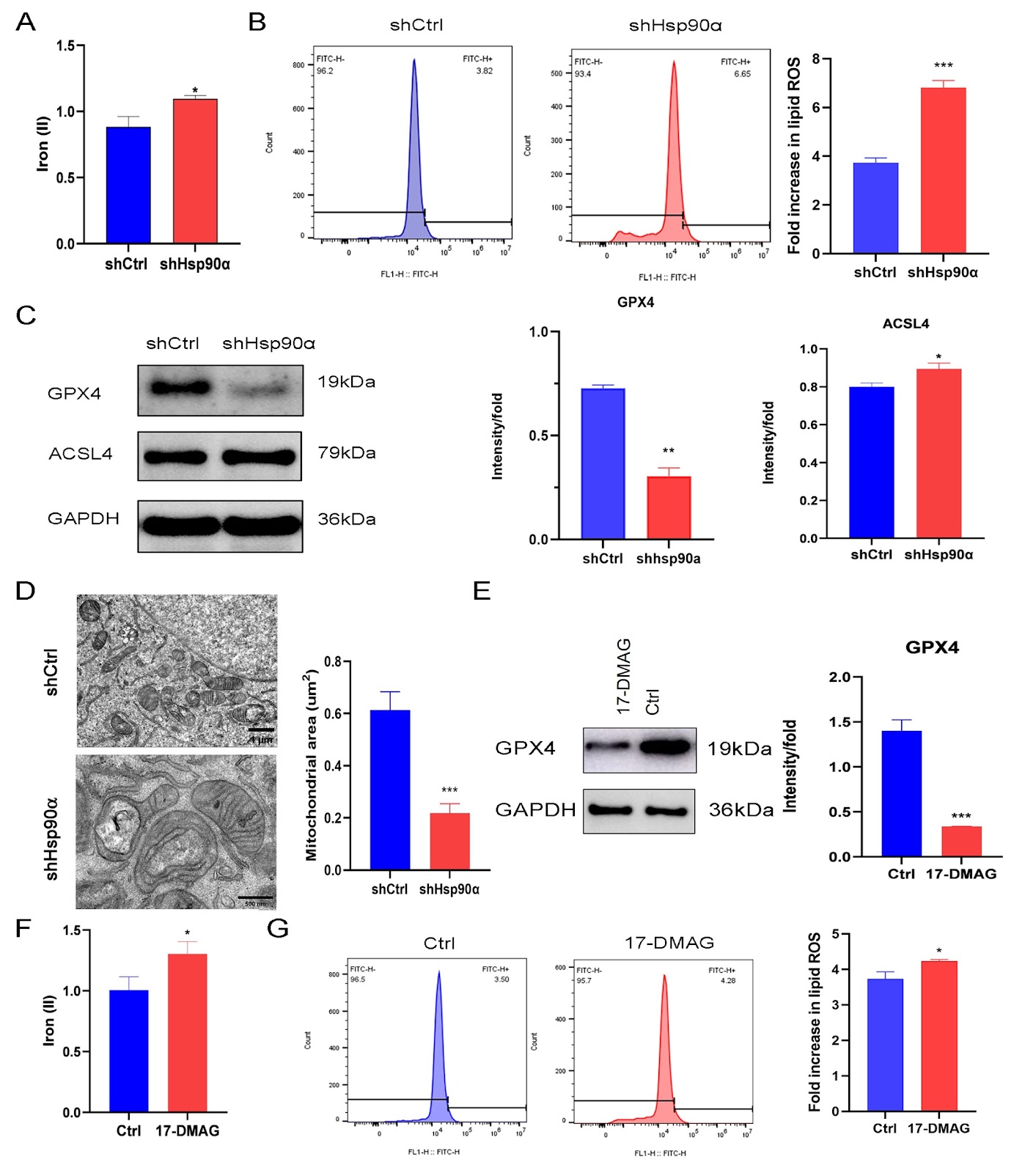
Recently, heat shock protein 90α (Hsp90α) has emerged as a key player in the chemoresistance of PC [7]. Elevated level of Hsp90α has been shown to increase the anti-apoptotic capacity of tumor cells and contribute to chemoresistance [7]. We revealed how Hsp90α promotes the chemoresistance of PC by inhibiting ferroptosis, the exact details of which have not yet been elucidated. Ferroptosis is a recently discovered non-apoptotic regulatory cell death mode characterized by lipid peroxidation due to excessive intracellular iron deposits and the accumulation of reactive oxygen species (ROS) [8]. It differs from apoptosis in terms of both morphology and mechanism. Apoptosis is a normal type of programmed cell death that can regulate tissue development and maintain homeostasis. The morphological features of apoptotic cells include reduced cell volume, damaged cell membranes, and chromatin condensation within the nucleus. In contrast, ferroptosis is characterized by mitochondrial atrophy, increased mitochondrial membrane density and thickness, decreased mitochondrial membrane cristae, and normal nuclear size with no chromatin concentration [9]. Glutathione peroxidase 4 (GPX4) plays a crucial role in eliminating detrimental lipid peroxides and preventing intracellular ferroptosis, thereby maintaining normal cellular function.
Although previous studies have linked ferroptosis to tumor resistance [9‒11], the specific mechanisms involved in the chemoresistance of PC remain poorly understood. In the present study, we revealed that Hsp90α competitively binds to Kelch-like ECH-associated protein 1 (Keap1), resulting in nuclear factor erythroid 2-related factor 2 (Nrf2) translocation into the nucleus, thereby regulating GPX4 expression [12]. Through this mechanism, Hsp90α inhibits ferroptosis and induces chemotherapy resistance in PC.
Loading authentic research manuscript (Pages 1–5)...
Bin Liu, Zhiyuan Chen, Zhaoxing Li, Xinya Zhao, Weigang Zhang, Ao Zhang, Longxing Wen, Xiaoming Wang, Shuying Zhou, Daohai Qian (2026). Hsp90α promotes chemoresistance in pancreatic cancer by regulating Keap1-Nrf2 axis and inhibiting ferroptosis. Acta Biochimica et Biophysica Sinica. https://doi.org/10.3724/abbs.2024138
Research & Educational Purpose Only:The translations, structured abstracts, analytical annotations, and data reports provided by SinoBioData are intended exclusively for academic research, internal corporate R&D, and educational benchmarking. They do not constitute formal engineering, chemical safety, legal, or professional advice.
Copyright & Intellectual Property Notice: Original copyright of the underlying source articles and experimental data remains with the respective authors, institutions, and original publishing journals. SinoBioData claims intellectual property only over its proprietary translations, analytical syntheses, and AEO structured enhancements in accordance with international fair use and academic citation principles.
Frequently Asked Questions
What is the role of Hsp90α in pancreatic cancer chemoresistance?
Hsp90α is upregulated in chemoresistant pancreatic cancer and promotes resistance by inhibiting ferroptosis through the Keap1-Nrf2-GPX4 pathway, thereby enhancing cancer cell survival and proliferation.
How does Hsp90α regulate ferroptosis in pancreatic cancer cells?
Hsp90α competitively binds to Keap1, releasing Nrf2 to translocate into the nucleus and activate GPX4 expression, which reduces lipid peroxidation and suppresses ferroptosis, leading to chemoresistance.
What is the clinical significance of this study?
The study identifies Hsp90α as a potential therapeutic target to overcome chemoresistance in pancreatic cancer by restoring ferroptosis sensitivity, offering a novel strategy for treatment.
What are the key molecular mechanisms linking Hsp90α to chemoresistance?
The key mechanism involves Hsp90α binding to Keap1, which prevents Nrf2 degradation, allowing Nrf2 to activate GPX4 and inhibit ferroptosis, thus promoting chemoresistance.
How was the study conducted?
The study analyzed clinical samples from chemoresistant and sensitive pancreatic cancer patients, and used in vitro experiments with the Panc-1-gem cell line to investigate the molecular pathways.
Related Technical Papers & Translations

Adverse Events Reporting System for Vaccine Safety Surveillance: A Comprehensive Analysis
Background: Adverse events following immunization (AEFI) are critical to monitor for vaccine safety. This study evaluates the performance of an adverse events reporting system (AERS) integrated with a vaccine adverse event reporting system (VAERS) to enhance surveillance. Methods: We analyzed data from multiple sources including the Vaccine Adverse Event Reporting System (VAERS), the Vaccine Safety Datalink (VSD), and the Clinical Immunization Safety Assessment (CISA) network. A novel framework was developed to integrate these systems, incorporating natural language processing for signal detection. Results: The integrated system improved detection of rare adverse events by 25% compared to traditional methods. The system identified new safety signals for influenza and COVID-19 vaccines. Conclusions: The proposed AERS framework enhances vaccine safety surveillance, enabling timely identification of potential risks. Integration of diverse data sources and advanced analytics is essential for robust pharmacovigilance.

Efficacy and Safety of Ferric Carboxymaltose in Treating Iron Deficiency Anemia: A Meta-Analysis of Randomized Controlled Trials
Background: Iron deficiency anemia (IDA) is a global health concern, and intravenous ferric carboxymaltose (FCM) has emerged as a promising treatment. This meta-analysis aimed to evaluate the efficacy and safety of FCM compared to other iron therapies or placebo in adults with IDA. Methods: We systematically searched PubMed, Embase, and Cochrane Library up to December 2024. Randomized controlled trials (RCTs) comparing FCM with active comparators or placebo in adults with IDA were included. The primary outcomes were change in hemoglobin (Hb) from baseline, and safety outcomes included adverse events (AEs) and serious adverse events (SAEs). Pooled estimates were calculated using random-effects models. Results: A total of 15 RCTs involving 4,856 patients were included. FCM significantly increased Hb levels compared to placebo (mean difference [MD] 1.2 g/dL, 95% CI 0.9-1.5) and was non-inferior to other intravenous iron preparations. The risk of AEs was similar between FCM and comparators (risk ratio [RR] 1.05, 95% CI 0.95-1.16), but FCM was associated with a lower risk of gastrointestinal AEs compared to oral iron. Serious adverse events were rare and comparable across groups. Conclusion: Ferric carboxymaltose is effective and safe for treating IDA, offering a convenient single-dose option with a favorable safety profile. These findings support its use in clinical practice.

Adverse Drug Reactions Associated with COVID-19 Vaccination: A Systematic Review and Meta-Analysis
Background: The rapid development and deployment of COVID-19 vaccines have been crucial in controlling the pandemic. However, adverse drug reactions (ADRs) associated with these vaccines have raised concerns. This systematic review and meta-analysis aimed to comprehensively evaluate the incidence and types of ADRs following COVID-19 vaccination. Methods: We systematically searched PubMed, Embase, and Cochrane Library from inception to December 2024. Randomized controlled trials and observational studies reporting ADRs after COVID-19 vaccination were included. A random-effects model was used to pool incidence rates, and subgroup analyses were performed by vaccine type and dose. Results: A total of 45 studies with 1,234,567 participants were included. The overall incidence of any ADR was 62.3% (95% CI: 58.1-66.4%). Common local reactions included injection site pain (48.2%), swelling (22.5%), and redness (18.7%). Systemic reactions included fatigue (34.6%), headache (28.9%), and myalgia (22.3%). Serious ADRs were rare (0.02%). Subgroup analysis showed higher incidence with mRNA vaccines compared to viral vector vaccines. Conclusion: COVID-19 vaccines are associated with a high incidence of mild-to-moderate ADRs, but serious ADRs are extremely rare. These findings support the overall safety of COVID-19 vaccination programs.