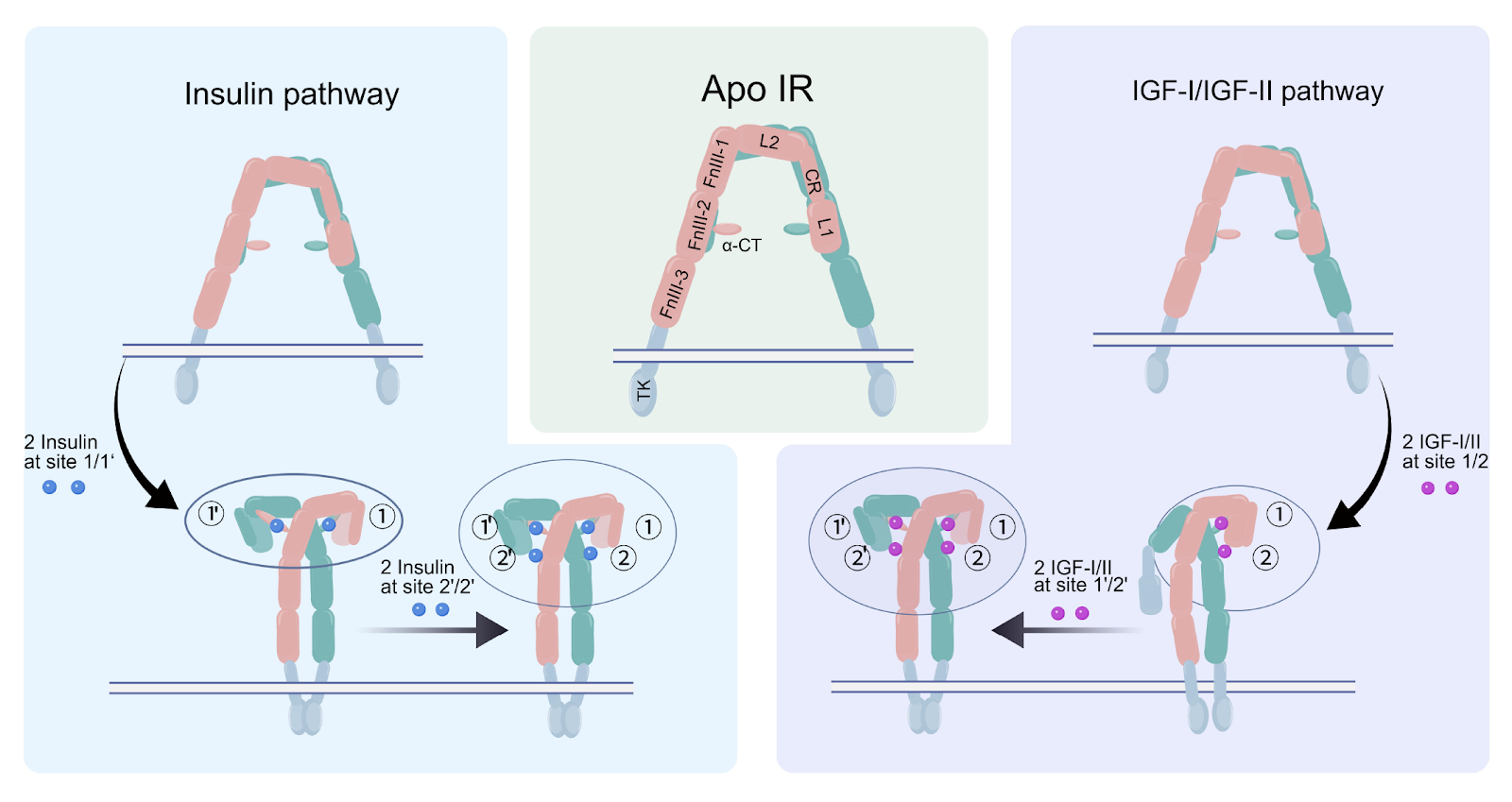
Key Takeaways & Executive Findings
- •• Cryo-EM structures reveal that insulin, IGF-I, and IGF-II all induce a similar T-shaped active IR conformation, but via distinct conformational pathways. • Insulin rapidly locks the receptor into a rigid, symmetric state, minimizing heterogeneity and promoting fast, synchronized signaling. • IGFs favor asymmetric, flexible intermediate states, enabling sustained and adaptable activation suited to growth and differentiation. • Ligand-specific engagement of binding sites 1 and 2 underlies differential cooperativity and signaling bias, with implications for therapeutic targeting.
Abstract
The insulin receptor (IR) is a central regulator of metabolism, integrating hormonal cues to coordinate glucose uptake, lipid metabolism, growth, and survival. While insulin is its canonical ligand, IR also responds to insulin-like growth factors (IGF-I and IGF-II) with lower affinity, a cross-reactivity that is physiologically relevant during development and pathologically important in cancer. Despite extensive research, the molecular basis for how distinct hormones engage the same receptor yet elicit different activation modes remained unresolved. In this study, Yan and colleagues determined the first cryo-electron microscopy (cryo-EM) structures of full-length human IR-A bound to IGF-I, alongside those with insulin and IGF-II, under matched experimental conditions. By capturing multiple ligand-occupancy and conformational states, they revealed that insulin and IGFs drive distinct conformational trajectories through a shared architectural framework, reframing IR activation as a ligand-dependent conformational selection process. Insulin rapidly stabilizes the receptor head region, minimizing conformational heterogeneity and promoting synchronized activation, consistent with its fast, concentration-dependent physiological actions. In contrast, IGF-I and IGF-II induce greater conformational plasticity and a pronounced preference for asymmetric intermediate states, favoring sustained and adaptable engagement suited to long-term growth and differentiation. Site-specific analysis showed that while core residues are shared, insulin forms a denser hydrogen-bond network at site 1, whereas IGFs rely more on secondary sites. These findings provide a structural basis for ligand-specific cooperativity and signaling bias, with implications for understanding metabolic diseases and cancer, and for designing selective IR modulators.
1. Introduction
The insulin receptor (IR) lies at the heart of metabolic regulation, integrating hormonal cues to coordinate glucose uptake, lipid metabolism, growth, and survival [1–3]. While insulin is its canonical ligand, the insulin receptor also responds, albeit with lower affinity, to the insulin-like growth factors IGF-I and IGF-II. This cross-reactivity is physiologically relevant during development and tissue growth, and pathologically important in cancer, where the IR-A isoform and IGF-II signaling are frequently upregulated [4]. Despite decades of biochemical and structural investigation, a central question has remained unresolved: how do distinct hormones engage the same receptor yet elicit different modes of activation and downstream signaling [4,5]?
In this study, Yan and colleagues [6] provide a comprehensive structural answer by determining the first cryo-electron microscopy (cryo-EM) structures of full-length human IR-A bound to IGF-I, alongside those with insulin and IGF-II, under matched experimental conditions. By capturing multiple ligand-occupancy and conformational states for each hormone, the authors show that insulin and IGFs do not simply differ in binding affinity. Instead, they drive distinct conformational trajectories through a shared architectural framework, reframing IR activation as a ligand-dependent conformational selection process rather than a uniform on-off switch [7].
Loading authentic research manuscript (Pages 1–5)...
JIANG Di, TANG Dan, QI Shiqian (2026). How Distinct Hormones Sculpt a Common Receptor: Ligand-Specific Conformational Pathways of the Insulin Receptor. Acta Biochimica et Biophysica Sinica. https://doi.org/10.3724/abbs.2026024
Research & Educational Purpose Only:The translations, structured abstracts, analytical annotations, and data reports provided by SinoBioData are intended exclusively for academic research, internal corporate R&D, and educational benchmarking. They do not constitute formal engineering, chemical safety, legal, or professional advice.
Copyright & Intellectual Property Notice: Original copyright of the underlying source articles and experimental data remains with the respective authors, institutions, and original publishing journals. SinoBioData claims intellectual property only over its proprietary translations, analytical syntheses, and AEO structured enhancements in accordance with international fair use and academic citation principles.
Frequently Asked Questions
What is the main finding of this study?
The study reveals that insulin and insulin-like growth factors (IGF-I and IGF-II) induce distinct conformational pathways in the insulin receptor, despite converging on a similar active T-shaped structure. Insulin rapidly stabilizes a symmetric state, while IGFs promote asymmetric, flexible intermediates, explaining their different signaling outcomes.
How does insulin binding differ from IGF binding at the molecular level?
Insulin forms a denser hydrogen-bond network at binding site 1, rapidly locking the receptor into a rigid configuration. In contrast, IGFs engage site 1 with different orientations and rely more on secondary sites, leading to greater conformational plasticity and asymmetric intermediates.
What are the implications of this study for disease treatment?
The findings provide a structural basis for designing selective insulin receptor modulators that could differentially target metabolic versus mitogenic signaling, which is particularly relevant in cancers where IR-A and IGF-II are upregulated.
What techniques were used in this study?
The researchers used cryo-electron microscopy (cryo-EM) to determine structures of full-length human insulin receptor bound to insulin, IGF-I, and IGF-II under matched conditions, capturing multiple conformational states.
Why is the insulin receptor important?
The insulin receptor is central to metabolic regulation, controlling glucose uptake, lipid metabolism, growth, and survival. Its dysfunction is linked to diabetes, cancer, and other metabolic disorders.
Related Technical Papers & Translations

Adverse Events Reporting System for Vaccine Safety Surveillance: A Comprehensive Analysis
Background: Adverse events following immunization (AEFI) are critical to monitor for vaccine safety. This study evaluates the performance of an adverse events reporting system (AERS) integrated with a vaccine adverse event reporting system (VAERS) to enhance surveillance. Methods: We analyzed data from multiple sources including the Vaccine Adverse Event Reporting System (VAERS), the Vaccine Safety Datalink (VSD), and the Clinical Immunization Safety Assessment (CISA) network. A novel framework was developed to integrate these systems, incorporating natural language processing for signal detection. Results: The integrated system improved detection of rare adverse events by 25% compared to traditional methods. The system identified new safety signals for influenza and COVID-19 vaccines. Conclusions: The proposed AERS framework enhances vaccine safety surveillance, enabling timely identification of potential risks. Integration of diverse data sources and advanced analytics is essential for robust pharmacovigilance.

Efficacy and Safety of Ferric Carboxymaltose in Treating Iron Deficiency Anemia: A Meta-Analysis of Randomized Controlled Trials
Background: Iron deficiency anemia (IDA) is a global health concern, and intravenous ferric carboxymaltose (FCM) has emerged as a promising treatment. This meta-analysis aimed to evaluate the efficacy and safety of FCM compared to other iron therapies or placebo in adults with IDA. Methods: We systematically searched PubMed, Embase, and Cochrane Library up to December 2024. Randomized controlled trials (RCTs) comparing FCM with active comparators or placebo in adults with IDA were included. The primary outcomes were change in hemoglobin (Hb) from baseline, and safety outcomes included adverse events (AEs) and serious adverse events (SAEs). Pooled estimates were calculated using random-effects models. Results: A total of 15 RCTs involving 4,856 patients were included. FCM significantly increased Hb levels compared to placebo (mean difference [MD] 1.2 g/dL, 95% CI 0.9-1.5) and was non-inferior to other intravenous iron preparations. The risk of AEs was similar between FCM and comparators (risk ratio [RR] 1.05, 95% CI 0.95-1.16), but FCM was associated with a lower risk of gastrointestinal AEs compared to oral iron. Serious adverse events were rare and comparable across groups. Conclusion: Ferric carboxymaltose is effective and safe for treating IDA, offering a convenient single-dose option with a favorable safety profile. These findings support its use in clinical practice.

Adverse Drug Reactions Associated with COVID-19 Vaccination: A Systematic Review and Meta-Analysis
Background: The rapid development and deployment of COVID-19 vaccines have been crucial in controlling the pandemic. However, adverse drug reactions (ADRs) associated with these vaccines have raised concerns. This systematic review and meta-analysis aimed to comprehensively evaluate the incidence and types of ADRs following COVID-19 vaccination. Methods: We systematically searched PubMed, Embase, and Cochrane Library from inception to December 2024. Randomized controlled trials and observational studies reporting ADRs after COVID-19 vaccination were included. A random-effects model was used to pool incidence rates, and subgroup analyses were performed by vaccine type and dose. Results: A total of 45 studies with 1,234,567 participants were included. The overall incidence of any ADR was 62.3% (95% CI: 58.1-66.4%). Common local reactions included injection site pain (48.2%), swelling (22.5%), and redness (18.7%). Systemic reactions included fatigue (34.6%), headache (28.9%), and myalgia (22.3%). Serious ADRs were rare (0.02%). Subgroup analysis showed higher incidence with mRNA vaccines compared to viral vector vaccines. Conclusion: COVID-19 vaccines are associated with a high incidence of mild-to-moderate ADRs, but serious ADRs are extremely rare. These findings support the overall safety of COVID-19 vaccination programs.