Key Takeaways & Executive Findings
- •• Phage pressure downregulates quorum-sensing genes (luxS and lsr operon) while upregulating H-NS, linking H-NS to QS suppression. • Knockout of luxS/lsr or overexpression of H-NS reduces phage sensitivity and downregulates CPS synthase genes without altering capsular uronic acid or phage adsorption, indicating an intracellular defense mechanism. • The H-NS-QS regulatory link is conserved across hypervirulent (HvKP) and carbapenem-resistant (CRKP) strains, suggesting broad clinical relevance. • This novel mechanism offers potential targets for enhancing phage therapy against multidrug-resistant Klebsiella pneumoniae.
Abstract
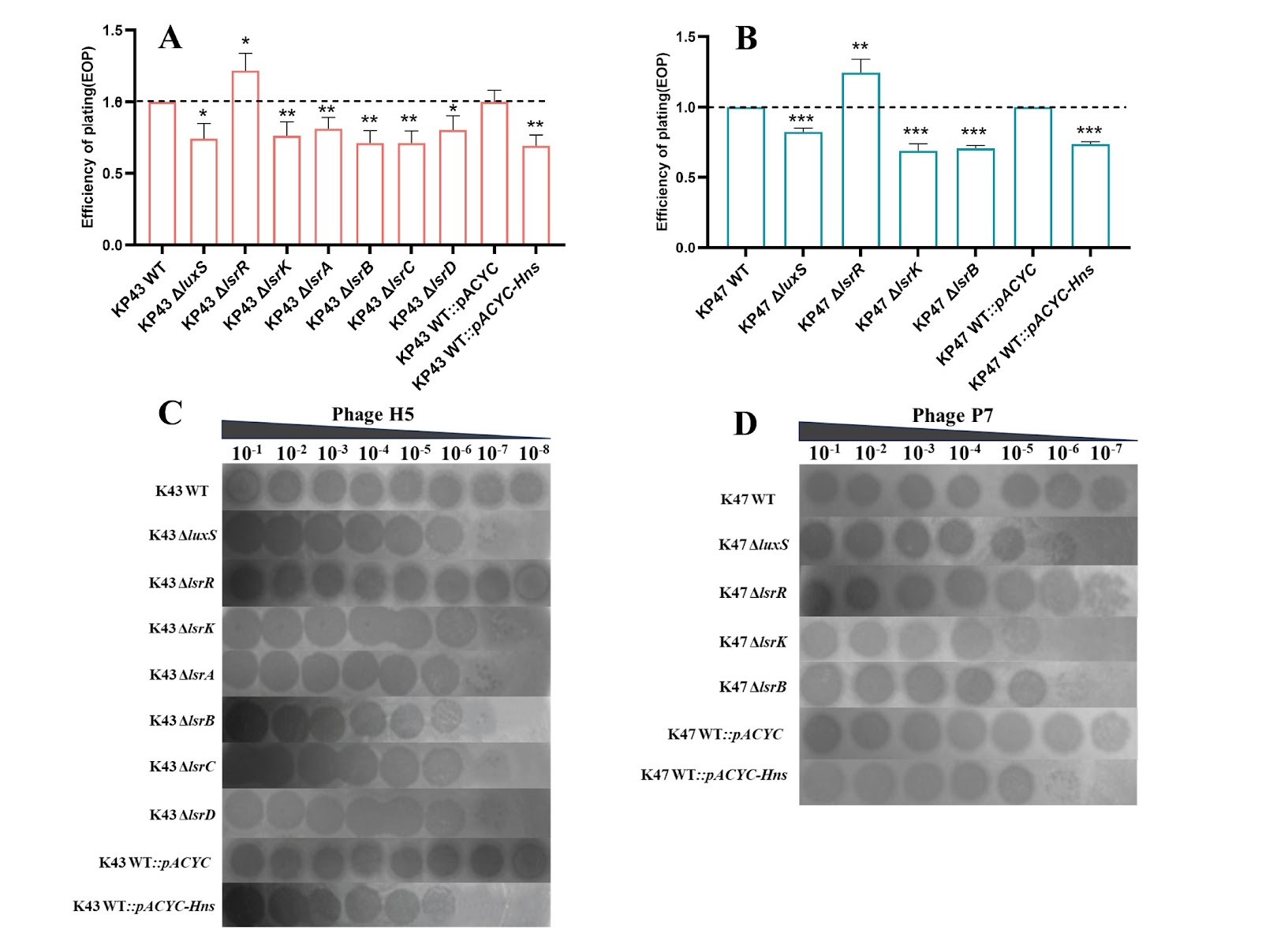
The molecular mechanisms underlying Klebsiella pneumoniae (KP) resistance to phages have not been fully elucidated, especially those involving the quorum-sensing (QS) system and the global regulator H-NS. In this work, we investigate the relationship between H-NS and QS in phage resistance by detecting transcriptional variation under phage pressure with RT-qPCR. LuxS and lsr operon knockout strains are generated via CRISPR editing, and H-NS-overexpressing mutants are constructed using plasmid-based overexpression. We also determine phage susceptibility by measuring the efficiency of plating (EOP). The capsular uronic acid content and phage adsorption efficiency are evaluated. The results show that phage pressure strongly downregulates luxS and lsr operon gene expressions but upregulates the transcription of H-NS. Knockout of either luxS/lsr operon genes or overexpression of H-NS results in diminished phage sensitivity and the downregulation of CPS synthase genes. However, these changes do not reduce the capsular uronic acid content or affect phage adsorption rates, suggesting that H-NS-mediated resistance is independent of capsular modulation. In addition, this H-NS-QS regulatory link is conserved between HvKP and CRKP. H-NS enhances phage resistance by suppressing QS through a mechanism independent of capsular polysaccharide modulation, as evidenced by unaltered phage adsorption and statistically insignificant changes in capsular uronic acid. This provides a novel explanation for a resistance mechanism involving intracellular defenses (e.g., abortive infection) and provides possible avenues for improving phage therapy targeting multidrug-resistant K. pneumoniae.
1. Introduction
Klebsiella pneumoniae is a major pathogen of hospital-acquired infections, causing various diseases, including pneumonia, sepsis, and intra-abdominal infections. The global spread of carbapenem-resistant K. pneumoniae (CRKP) and highly virulent K. pneumoniae (HvKP) has added great challenges to clinical treatment [1,2]. Phage therapy is considered a new means to effectively combat multidrug-resistant bacterial infections because of its advantages of selective killing and less pan-resistance [3,4]. Bacteria have evolved various mechanisms to resist phage infection, such as CRISPR-Cas system-mediated immune defense against phages [5], adsorption blockade due to mutations in receptor proteins [6], and abortive infection [7]. Therefore, bacterial resistance regulatory mechanisms are very diverse, which hinders the effectiveness of phage therapy, and further exploration of bacterial resistance regulatory networks is needed for the effective treatment of bacterial infections.
Quorum sensing (QS) is a control system that consists of sensing population size and population coordination among bacteria through small signaling molecules, which are involved in regulating biofilm production, pathogenesis-related gene expression, and metabolic response [8]. In recent years, QS has also been reported to be involved in regulating the interactions between bacteria and phages; e.g., LasI/LasR can regulate phage infection by affecting the expression of its outer membrane proteins in Pseudomonas aeruginosa [9]. In addition, the QS signaling molecules (CAI-1 and AI-2) of Vibrio cholerae can also affect host survival by directly regulating phage lysis-related decisions [10]. However, reports on whether the QS system of KP is involved in the regulation of phage resistance have not yet been reported in the literature, and the molecular mechanism of phage resistance is still unknown.
Histone-like nucleoid structuring protein (H-NS) is a highly conserved global transcriptional regulator in gram-negative bacteria that regulates chromosome structure and gene expression by binding to DNA and plays a central role in the environmental stress response (e.g., osmotic pressure changes and acidic environments) [11]. Recent studies have shown that H-NS can limit bacterial adaptive evolution by inhibiting the lateral transfer of virulence island genes [12], but its functional association with the QS system and its role in phage resistance have not been explored. On the basis of these findings, the present study proposes the scientific hypothesis that H-NS may mediate phage resistance in KPs by modulating key pathways of the QS system and that this mechanism is generalizable across different clinical strains.
Loading authentic research manuscript (Pages 1–5)...
Yajing Song, Changhui Huang, Hailong Ou, Kai Zhou (2026). H-NS enhances phage resistance in Klebsiella pneumoniae by suppressing quorum sensing. Acta Biochimica et Biophysica Sinica. https://doi.org/10.3724/abbs.2025218
Research & Educational Purpose Only:The translations, structured abstracts, analytical annotations, and data reports provided by SinoBioData are intended exclusively for academic research, internal corporate R&D, and educational benchmarking. They do not constitute formal engineering, chemical safety, legal, or professional advice.
Copyright & Intellectual Property Notice: Original copyright of the underlying source articles and experimental data remains with the respective authors, institutions, and original publishing journals. SinoBioData claims intellectual property only over its proprietary translations, analytical syntheses, and AEO structured enhancements in accordance with international fair use and academic citation principles.
Frequently Asked Questions
What is the main finding of this study?
The study reveals that H-NS enhances phage resistance in Klebsiella pneumoniae by suppressing quorum sensing, independent of capsular polysaccharide modulation.
How does H-NS affect phage resistance?
H-NS overexpression or knockout of quorum-sensing genes (luxS/lsr) reduces phage sensitivity, likely through an intracellular defense mechanism such as abortive infection, without altering phage adsorption or capsular uronic acid content.
Is the H-NS-QS regulatory link conserved across different strains?
Yes, the link is conserved between hypervirulent (HvKP) and carbapenem-resistant (CRKP) strains, suggesting broad clinical relevance.
What are the implications for phage therapy?
Understanding this resistance mechanism could help improve phage therapy by targeting the H-NS-QS axis to enhance phage efficacy against multidrug-resistant K. pneumoniae.
What methods were used in this study?
The study used RT-qPCR for transcriptional analysis, CRISPR editing to generate knockout strains, plasmid-based overexpression, efficiency of plating (EOP) assays, and measurements of capsular uronic acid and phage adsorption.
Related Technical Papers & Translations

Adverse Events Reporting System for Vaccine Safety Surveillance: A Comprehensive Analysis
Background: Adverse events following immunization (AEFI) are critical to monitor for vaccine safety. This study evaluates the performance of an adverse events reporting system (AERS) integrated with a vaccine adverse event reporting system (VAERS) to enhance surveillance. Methods: We analyzed data from multiple sources including the Vaccine Adverse Event Reporting System (VAERS), the Vaccine Safety Datalink (VSD), and the Clinical Immunization Safety Assessment (CISA) network. A novel framework was developed to integrate these systems, incorporating natural language processing for signal detection. Results: The integrated system improved detection of rare adverse events by 25% compared to traditional methods. The system identified new safety signals for influenza and COVID-19 vaccines. Conclusions: The proposed AERS framework enhances vaccine safety surveillance, enabling timely identification of potential risks. Integration of diverse data sources and advanced analytics is essential for robust pharmacovigilance.

Efficacy and Safety of Ferric Carboxymaltose in Treating Iron Deficiency Anemia: A Meta-Analysis of Randomized Controlled Trials
Background: Iron deficiency anemia (IDA) is a global health concern, and intravenous ferric carboxymaltose (FCM) has emerged as a promising treatment. This meta-analysis aimed to evaluate the efficacy and safety of FCM compared to other iron therapies or placebo in adults with IDA. Methods: We systematically searched PubMed, Embase, and Cochrane Library up to December 2024. Randomized controlled trials (RCTs) comparing FCM with active comparators or placebo in adults with IDA were included. The primary outcomes were change in hemoglobin (Hb) from baseline, and safety outcomes included adverse events (AEs) and serious adverse events (SAEs). Pooled estimates were calculated using random-effects models. Results: A total of 15 RCTs involving 4,856 patients were included. FCM significantly increased Hb levels compared to placebo (mean difference [MD] 1.2 g/dL, 95% CI 0.9-1.5) and was non-inferior to other intravenous iron preparations. The risk of AEs was similar between FCM and comparators (risk ratio [RR] 1.05, 95% CI 0.95-1.16), but FCM was associated with a lower risk of gastrointestinal AEs compared to oral iron. Serious adverse events were rare and comparable across groups. Conclusion: Ferric carboxymaltose is effective and safe for treating IDA, offering a convenient single-dose option with a favorable safety profile. These findings support its use in clinical practice.

Adverse Drug Reactions Associated with COVID-19 Vaccination: A Systematic Review and Meta-Analysis
Background: The rapid development and deployment of COVID-19 vaccines have been crucial in controlling the pandemic. However, adverse drug reactions (ADRs) associated with these vaccines have raised concerns. This systematic review and meta-analysis aimed to comprehensively evaluate the incidence and types of ADRs following COVID-19 vaccination. Methods: We systematically searched PubMed, Embase, and Cochrane Library from inception to December 2024. Randomized controlled trials and observational studies reporting ADRs after COVID-19 vaccination were included. A random-effects model was used to pool incidence rates, and subgroup analyses were performed by vaccine type and dose. Results: A total of 45 studies with 1,234,567 participants were included. The overall incidence of any ADR was 62.3% (95% CI: 58.1-66.4%). Common local reactions included injection site pain (48.2%), swelling (22.5%), and redness (18.7%). Systemic reactions included fatigue (34.6%), headache (28.9%), and myalgia (22.3%). Serious ADRs were rare (0.02%). Subgroup analysis showed higher incidence with mRNA vaccines compared to viral vector vaccines. Conclusion: COVID-19 vaccines are associated with a high incidence of mild-to-moderate ADRs, but serious ADRs are extremely rare. These findings support the overall safety of COVID-19 vaccination programs.