Key Takeaways & Executive Findings
- •• A genome-wide association study identified rs6856089 and linked SNPs as significantly associated with platinum-based chemotherapy-induced myelosuppression in NSCLC patients. • Patients carrying the A allele of rs6856089 had a markedly lower risk of myelosuppression (OR = 0.1300, P = 7.59 × 10⁻⁸). • Gene-based analysis implicated EMCN, encoding endomucin, a hematopoietic stem cell marker, as a potential mediator of myelosuppression. • These findings provide a scientific basis for personalized therapeutic approaches to reduce myelosuppression in NSCLC patients receiving platinum-based chemotherapy.
Abstract
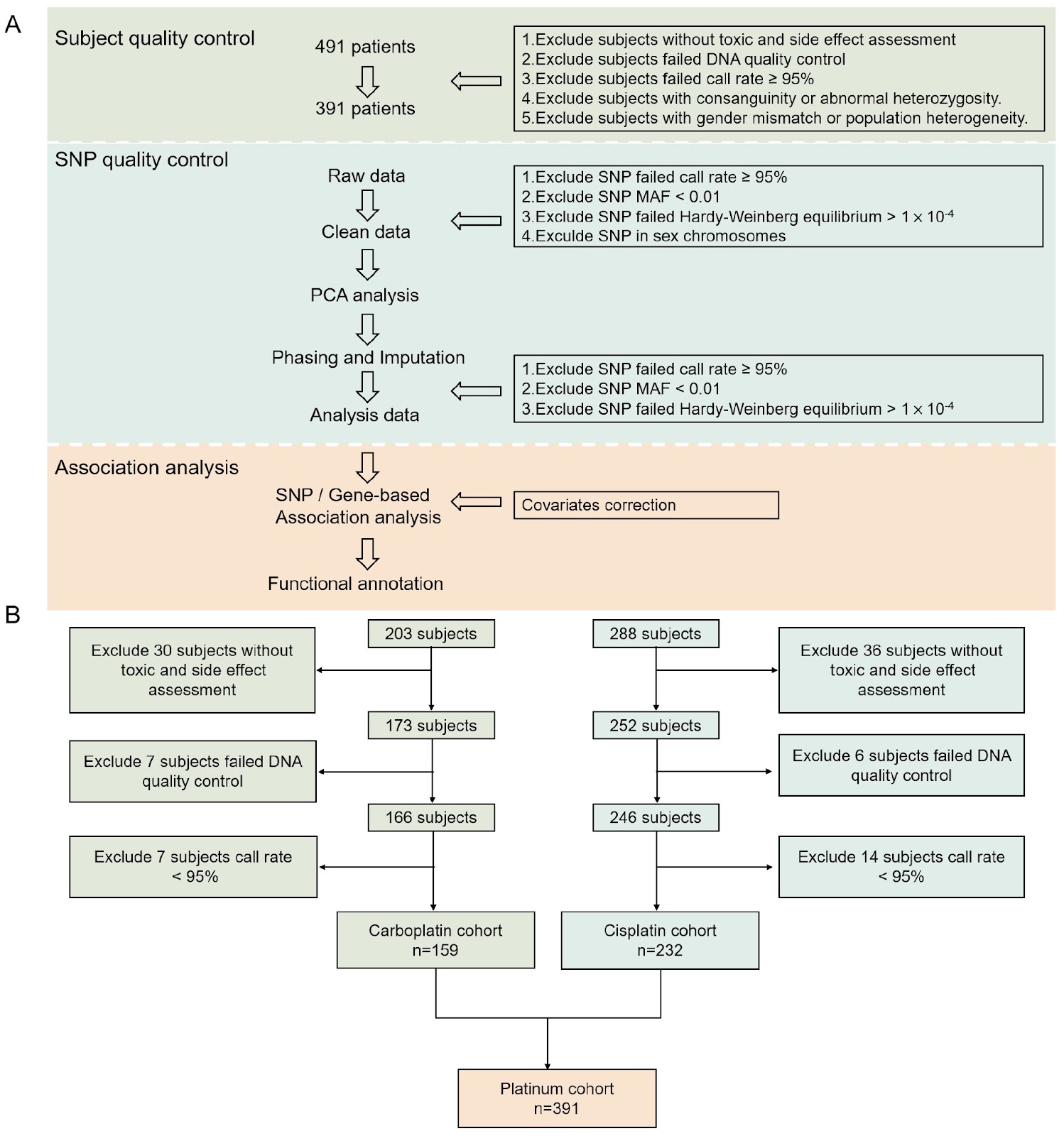
Platinum-based chemotherapy remains the mainstay for non-small cell lung cancer (NSCLC), but it frequently causes dose-limiting myelosuppression, with significant individual variability in susceptibility. However, the genetic basis of myelosuppression side effects remains elusive, greatly hindering personalized therapeutic approaches. In this study, we perform a comprehensive genome-wide association analysis on 491 NSCLC patients receiving platinum-based chemotherapy, examining 4,690,998 single-nucleotide polymorphisms (SNPs) to identify relevant genetic variants. LDBlockShow, FUMA, and MAGMA are utilized to explore linkage disequilibrium, expression quantitative trait loci (eQTLs), chromatin interaction, and conduct gene-based and gene set-based analysis of candidate SNPs. The GWAS results reveal that rs6856089 and its linked SNPs are significantly associated with platinum-based chemotherapy-induced myelosuppression. Specifically, patients with the A allele of rs6856089 have a significantly lower risk of myelosuppression [odds ratio (OR) = 0.1300, P = 7.59 × 10⁻⁸]. Furthermore, gene-based analysis reveals that EMCN (P = 2.47 × 10⁻⁵), which encodes endomucin, a marker for hematopoietic stem cells, might mediate myelosuppression. This study provides a scientific basis for the individual differences in platinum-based chemotherapy-induced myelosuppression.
1. Introduction
Non-small cell lung cancer (NSCLC), accounting for 80% of lung cancer cases, poses a significant threat to human health owing to its high prevalence and mortality rates [1,2]. Platinum-based chemotherapy, particularly cisplatin and carboplatin, remains the cornerstone treatment for NSCLC. These agents can inhibit DNA replication by binding to DNA, forming adducts, and destroying tumor cells [3]. However, the effectiveness of platinum-based chemotherapy is limited by severe side effects, including myelosuppression, nephrotoxicity, and neurotoxicity [4,5], of which myelosuppression is a significant concern because of its high incidence and serious outcomes. The occurrence of myelosuppression not only leads to a reduced dosage or delayed treatment but also impacts the prognosis and quality of life of patients [6]. The bone marrow is the primary site for blood cell production and contains numerous rapidly dividing hematopoietic stem cells. Platinum-based chemotherapy can severely impact the proliferation of bone marrow progenitors through its ability to inhibit DNA replication, disrupting hematopoiesis. This severe adverse effect is clinically characterized by leukopenia, neutropenia, and thrombocytopenia [7] and is graded from I to IV according to the Common Terminology Criteria for Adverse Events (CTCAE).
Susceptibility to platinum-based chemotherapy-induced myelosuppression varies greatly among individuals, underscoring the need to identify predictive biomarkers. Pharmacogenomic studies hold promise in identifying genetic variants associated with drug response, including both efficacy and side effects [8]. However, current methods for predicting chemotherapy-induced myelosuppression are insufficient, warranting further relevant studies. Previous studies by our group and others have demonstrated that genetic variation plays a fundamental role in inter-individual variability in drug efficacy and side effects [9–17]. Nonetheless, the specific underlying mechanism of platinum-based chemotherapy-induced myelosuppression has yet to be elucidated.
Loading authentic research manuscript (Pages 1–5)...
Hanxue Huang, Junyan Liu, Qi Xiao, Chenxue Mao, Lei She, Lulu Yu, Bing Yu, Mengrong Lei, Ying Gao, Baimei He, Pinhua Pan, Xi Li, Jiye Yin, Zhaoqian Liu (2026). GWAS study of myelosuppression among NSCLC patients receiving platinum-based combination chemotherapy. Acta Biochimica et Biophysica Sinica. https://doi.org/10.3724/abbs.2025013
Research & Educational Purpose Only:The translations, structured abstracts, analytical annotations, and data reports provided by SinoBioData are intended exclusively for academic research, internal corporate R&D, and educational benchmarking. They do not constitute formal engineering, chemical safety, legal, or professional advice.
Copyright & Intellectual Property Notice: Original copyright of the underlying source articles and experimental data remains with the respective authors, institutions, and original publishing journals. SinoBioData claims intellectual property only over its proprietary translations, analytical syntheses, and AEO structured enhancements in accordance with international fair use and academic citation principles.
Frequently Asked Questions
What was the main objective of this GWAS study?
The main objective was to identify genetic variants associated with myelosuppression in NSCLC patients receiving platinum-based chemotherapy, using a genome-wide association study on 491 Chinese Han patients.
Which genetic variant was found to be significantly associated with myelosuppression?
The study found that rs6856089 and its linked SNPs were significantly associated with platinum-based chemotherapy-induced myelosuppression. Patients with the A allele of rs6856089 had a significantly lower risk of myelosuppression (OR = 0.1300, P = 7.59 × 10⁻⁸).
What is the potential role of EMCN in myelosuppression?
Gene-based analysis revealed that EMCN, which encodes endomucin, a marker for hematopoietic stem cells, might mediate myelosuppression. This suggests that EMCN could be a key gene in the susceptibility to chemotherapy-induced myelosuppression.
How many patients and SNPs were analyzed in this study?
The study analyzed 491 NSCLC patients and examined 4,690,998 single-nucleotide polymorphisms (SNPs) in the genome-wide association analysis.
What is the clinical significance of this study?
The findings provide a scientific basis for individual differences in platinum-based chemotherapy-induced myelosuppression, potentially enabling personalized therapeutic approaches to reduce this severe side effect in NSCLC patients.
Related Technical Papers & Translations

Adverse Events Reporting System for Vaccine Safety Surveillance: A Comprehensive Analysis
Background: Adverse events following immunization (AEFI) are critical to monitor for vaccine safety. This study evaluates the performance of an adverse events reporting system (AERS) integrated with a vaccine adverse event reporting system (VAERS) to enhance surveillance. Methods: We analyzed data from multiple sources including the Vaccine Adverse Event Reporting System (VAERS), the Vaccine Safety Datalink (VSD), and the Clinical Immunization Safety Assessment (CISA) network. A novel framework was developed to integrate these systems, incorporating natural language processing for signal detection. Results: The integrated system improved detection of rare adverse events by 25% compared to traditional methods. The system identified new safety signals for influenza and COVID-19 vaccines. Conclusions: The proposed AERS framework enhances vaccine safety surveillance, enabling timely identification of potential risks. Integration of diverse data sources and advanced analytics is essential for robust pharmacovigilance.

Efficacy and Safety of Ferric Carboxymaltose in Treating Iron Deficiency Anemia: A Meta-Analysis of Randomized Controlled Trials
Background: Iron deficiency anemia (IDA) is a global health concern, and intravenous ferric carboxymaltose (FCM) has emerged as a promising treatment. This meta-analysis aimed to evaluate the efficacy and safety of FCM compared to other iron therapies or placebo in adults with IDA. Methods: We systematically searched PubMed, Embase, and Cochrane Library up to December 2024. Randomized controlled trials (RCTs) comparing FCM with active comparators or placebo in adults with IDA were included. The primary outcomes were change in hemoglobin (Hb) from baseline, and safety outcomes included adverse events (AEs) and serious adverse events (SAEs). Pooled estimates were calculated using random-effects models. Results: A total of 15 RCTs involving 4,856 patients were included. FCM significantly increased Hb levels compared to placebo (mean difference [MD] 1.2 g/dL, 95% CI 0.9-1.5) and was non-inferior to other intravenous iron preparations. The risk of AEs was similar between FCM and comparators (risk ratio [RR] 1.05, 95% CI 0.95-1.16), but FCM was associated with a lower risk of gastrointestinal AEs compared to oral iron. Serious adverse events were rare and comparable across groups. Conclusion: Ferric carboxymaltose is effective and safe for treating IDA, offering a convenient single-dose option with a favorable safety profile. These findings support its use in clinical practice.

Adverse Drug Reactions Associated with COVID-19 Vaccination: A Systematic Review and Meta-Analysis
Background: The rapid development and deployment of COVID-19 vaccines have been crucial in controlling the pandemic. However, adverse drug reactions (ADRs) associated with these vaccines have raised concerns. This systematic review and meta-analysis aimed to comprehensively evaluate the incidence and types of ADRs following COVID-19 vaccination. Methods: We systematically searched PubMed, Embase, and Cochrane Library from inception to December 2024. Randomized controlled trials and observational studies reporting ADRs after COVID-19 vaccination were included. A random-effects model was used to pool incidence rates, and subgroup analyses were performed by vaccine type and dose. Results: A total of 45 studies with 1,234,567 participants were included. The overall incidence of any ADR was 62.3% (95% CI: 58.1-66.4%). Common local reactions included injection site pain (48.2%), swelling (22.5%), and redness (18.7%). Systemic reactions included fatigue (34.6%), headache (28.9%), and myalgia (22.3%). Serious ADRs were rare (0.02%). Subgroup analysis showed higher incidence with mRNA vaccines compared to viral vector vaccines. Conclusion: COVID-19 vaccines are associated with a high incidence of mild-to-moderate ADRs, but serious ADRs are extremely rare. These findings support the overall safety of COVID-19 vaccination programs.