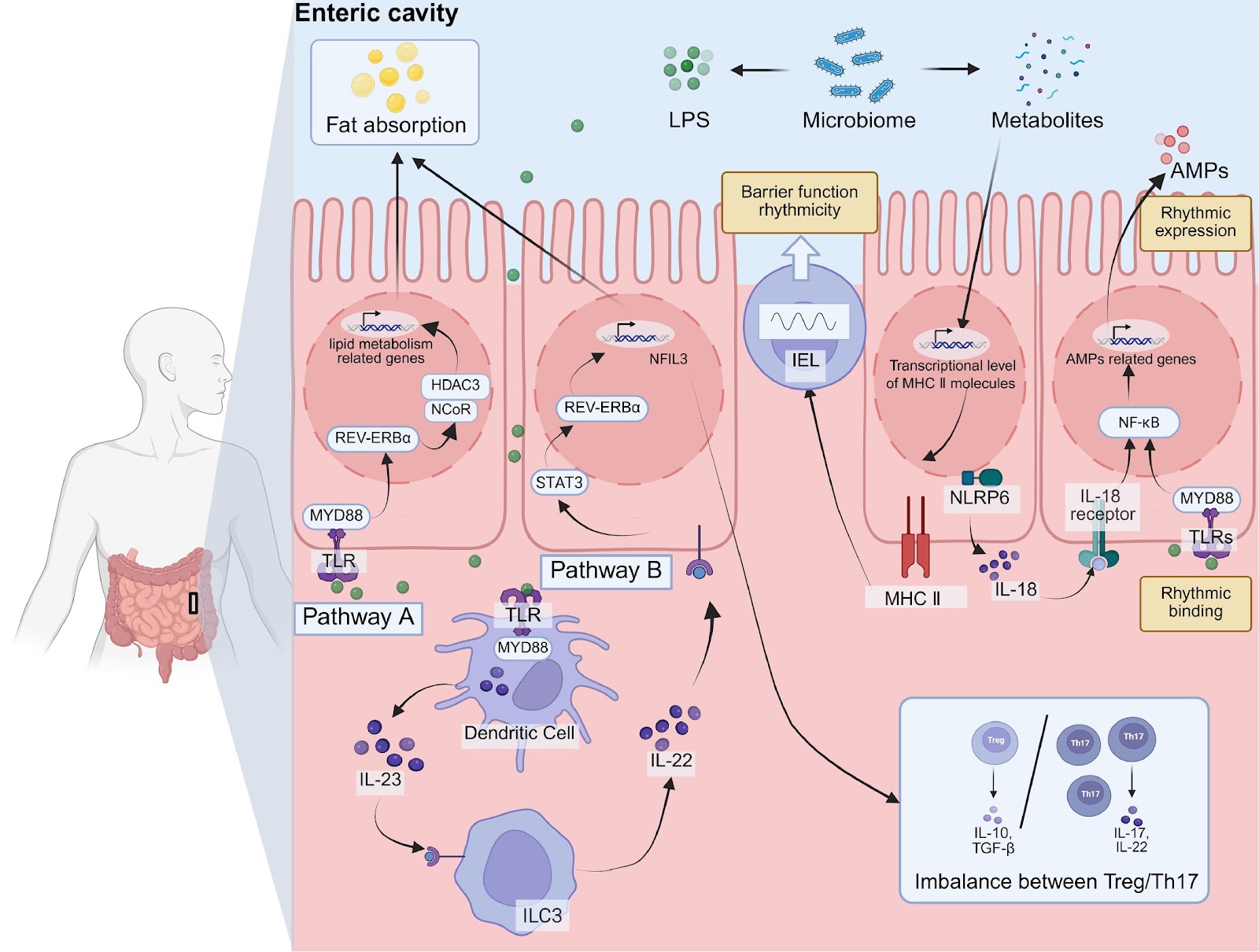
Key Takeaways & Executive Findings
- •• Host circadian clocks regulate gut microbial diurnal oscillations via rhythmic behaviors, establishing a bidirectional temporal dialogue. • Disruption of this crosstalk by modern lifestyle factors leads to loss of microbial rhythms, impaired intestinal barrier, and systemic metabolic dysregulation. • Microbial metabolites such as butyrate and propionate oscillate rhythmically and directly modulate host metabolic processes. • Targeting microbial rhythms offers promising therapeutic strategies to reset host immunity and metabolism in immunometabolic diseases.
Abstract
Emerging studies have revealed that disruptions in circadian crosstalk between the gut microbiota and the host play an essential role in the pathogenesis of metabolic disorders. Under physiological conditions, host circadian clocks regulate microbial diurnal oscillations through rhythmic behaviors, including feeding patterns and sleep-wake cycles. This temporal regulation manifests as robust 24-hour oscillations in microbial community composition, spatial organization, and metabolic activity. These rhythmic microbial signals and their metabolic outputs are subsequently translated into host immune modulation, establishing a bidirectional temporal dialogue between the host and microbiota. Modern lifestyle disruptions, including erratic eating patterns and shift work, desynchronize this temporal dialogue, leading to the loss of microbial rhythms, impaired intestinal barrier function, maladaptive immune responses, chronic inflammation, and systemic metabolic dysregulation. This review delineates the mechanisms through which host-microbiota circadian crosstalk governs immunometabolic homeostasis, provides a mechanistic framework for understanding immunometabolic diseases, and highlights therapeutic strategies that target microbial rhythms to reset host immunity and metabolism.
1. Introduction
The Earth's rotation over 24 hours establishes a daily cycle of light and darkness, acting as a universal clock that has driven the development of circadian rhythms in almost all living organisms [1]. These molecular oscillators, which are centered on transcriptional-translational feedback loops that involve "Bmal1/Clock" and "Per/Cry" genes, enable organisms to anticipate and adapt to daily environmental fluctuations, optimizing physiological processes such as metabolism, immune function, and behavior [2,3]. Circadian rhythms are characterized by three fundamental properties: (1) sustained oscillations with extreme precision under constant environmental conditions; (2) temperature compensation, as evidenced by period stability despite environmental temperature variations; (3) synchronization of the endogenous pacemaker to the environmental light-dark cycle [4]. Remarkably, these properties are conserved even in isolated mammalian cells, underscoring their evolutionary optimization under natural selection [4–6].
In humans, circadian regulation extends beyond sleep-wake cycles to orchestrate systemic metabolism, immune function, and neurobehavioral processes. Accumulating evidence implicates that the gut microbiota, a complex ecosystem comprising approximately 100 trillion microbes encoding 150-fold more genetic material than the human genome, serves as a critical mediator of host circadian physiology [7,8]. The microbiota, referred to as the "forgotten organ", demonstrates circadian fluctuations in its composition, the production of metabolites and spatial organization, synchronizing with host rhythms to regulate energy harvest, immune homeostasis, and metabolic gene expression [9]. For instance, microbial-derived butyrate and propionate oscillate rhythmically under normal conditions, directly modulating hepatic gluconeogenesis and adipose tissue lipolysis while synchronizing circadian oscillators in the liver and adipocytes, thereby linking microbial rhythms to host metabolic outputs.
For the gut microbial diurnal rhythm, a recent investigation demonstrated circadian transcriptional oscillations of molecular clock genes in Escherichia coli, namely, radA, a kaiC homologue [10], indicating that the gut microbiota may have endogenous rhythms. However, the prevailing consensus among current studies suggests that the gut microbial diurnal rhythm might be modulated by particular environmental stimuli within the gut, including dietary patterns, behaviors, and the expression of host clock genes [11]. This bidirectional temporal dialogue between the host and microbiota results in crosstalk, wherein host clocks regulate microbial oscillation through host rhythmic behaviors such as feeding rhythms, whereas microbial oscillations reciprocally entrain and modulate the host immune system. Modern lifestyle challenges, including pervasive shift work, chronic jet lag, and Western-style dietary patterns, disrupt this delicate temporal dialogue and lead to the development of immunometabolic diseases. A comprehensive understanding of the mechanisms underlying circadian host-microbiota crosstalk in immunometabolism remains to be elucidated. This review therefore aims to synthesize current evidence on the specific mechanisms underlying the circadian crosstalk between the host and microbiota, and how this dialogue regulates host immunometabolism. We further discuss the emerging therapeutic strategies targeting the microbiota to restore circadian alignment and improve metabolic health.
Loading authentic research manuscript (Pages 1–5)...
Zitong Zhao, Siyan Wu, Tingting Wang, Yue Zhao (2026). Gut microbiota circadian rhythms: a key regulator of immunometabolic homeostasis. Acta Biochimica et Biophysica Sinica. https://doi.org/10.3724/abbs.2025220
Research & Educational Purpose Only:The translations, structured abstracts, analytical annotations, and data reports provided by SinoBioData are intended exclusively for academic research, internal corporate R&D, and educational benchmarking. They do not constitute formal engineering, chemical safety, legal, or professional advice.
Copyright & Intellectual Property Notice: Original copyright of the underlying source articles and experimental data remains with the respective authors, institutions, and original publishing journals. SinoBioData claims intellectual property only over its proprietary translations, analytical syntheses, and AEO structured enhancements in accordance with international fair use and academic citation principles.
Frequently Asked Questions
What is the role of gut microbiota circadian rhythms in immunometabolic homeostasis?
Gut microbiota circadian rhythms are crucial for maintaining immunometabolic homeostasis. Host circadian clocks regulate microbial diurnal oscillations, which in turn modulate host immune responses and metabolic processes. Disruption of this crosstalk can lead to metabolic disorders.
How do modern lifestyle factors affect gut microbiota rhythms?
Modern lifestyle factors such as erratic eating patterns, shift work, and chronic jet lag can desynchronize the temporal dialogue between host and microbiota, leading to loss of microbial rhythms, impaired intestinal barrier function, and systemic metabolic dysregulation.
What are the key microbial metabolites involved in circadian regulation?
Microbial-derived metabolites such as butyrate and propionate oscillate rhythmically and directly modulate hepatic gluconeogenesis and adipose tissue lipolysis, while also synchronizing circadian oscillators in the liver and adipocytes.
Can targeting microbial rhythms be a therapeutic strategy?
Yes, targeting microbial rhythms to reset host immunity and metabolism is a promising therapeutic strategy for immunometabolic diseases. This may involve dietary interventions, probiotics, or other approaches to restore circadian alignment.
Related Technical Papers & Translations

Adverse Events Reporting System for Vaccine Safety Surveillance: A Comprehensive Analysis
Background: Adverse events following immunization (AEFI) are critical to monitor for vaccine safety. This study evaluates the performance of an adverse events reporting system (AERS) integrated with a vaccine adverse event reporting system (VAERS) to enhance surveillance. Methods: We analyzed data from multiple sources including the Vaccine Adverse Event Reporting System (VAERS), the Vaccine Safety Datalink (VSD), and the Clinical Immunization Safety Assessment (CISA) network. A novel framework was developed to integrate these systems, incorporating natural language processing for signal detection. Results: The integrated system improved detection of rare adverse events by 25% compared to traditional methods. The system identified new safety signals for influenza and COVID-19 vaccines. Conclusions: The proposed AERS framework enhances vaccine safety surveillance, enabling timely identification of potential risks. Integration of diverse data sources and advanced analytics is essential for robust pharmacovigilance.

Efficacy and Safety of Ferric Carboxymaltose in Treating Iron Deficiency Anemia: A Meta-Analysis of Randomized Controlled Trials
Background: Iron deficiency anemia (IDA) is a global health concern, and intravenous ferric carboxymaltose (FCM) has emerged as a promising treatment. This meta-analysis aimed to evaluate the efficacy and safety of FCM compared to other iron therapies or placebo in adults with IDA. Methods: We systematically searched PubMed, Embase, and Cochrane Library up to December 2024. Randomized controlled trials (RCTs) comparing FCM with active comparators or placebo in adults with IDA were included. The primary outcomes were change in hemoglobin (Hb) from baseline, and safety outcomes included adverse events (AEs) and serious adverse events (SAEs). Pooled estimates were calculated using random-effects models. Results: A total of 15 RCTs involving 4,856 patients were included. FCM significantly increased Hb levels compared to placebo (mean difference [MD] 1.2 g/dL, 95% CI 0.9-1.5) and was non-inferior to other intravenous iron preparations. The risk of AEs was similar between FCM and comparators (risk ratio [RR] 1.05, 95% CI 0.95-1.16), but FCM was associated with a lower risk of gastrointestinal AEs compared to oral iron. Serious adverse events were rare and comparable across groups. Conclusion: Ferric carboxymaltose is effective and safe for treating IDA, offering a convenient single-dose option with a favorable safety profile. These findings support its use in clinical practice.

Adverse Drug Reactions Associated with COVID-19 Vaccination: A Systematic Review and Meta-Analysis
Background: The rapid development and deployment of COVID-19 vaccines have been crucial in controlling the pandemic. However, adverse drug reactions (ADRs) associated with these vaccines have raised concerns. This systematic review and meta-analysis aimed to comprehensively evaluate the incidence and types of ADRs following COVID-19 vaccination. Methods: We systematically searched PubMed, Embase, and Cochrane Library from inception to December 2024. Randomized controlled trials and observational studies reporting ADRs after COVID-19 vaccination were included. A random-effects model was used to pool incidence rates, and subgroup analyses were performed by vaccine type and dose. Results: A total of 45 studies with 1,234,567 participants were included. The overall incidence of any ADR was 62.3% (95% CI: 58.1-66.4%). Common local reactions included injection site pain (48.2%), swelling (22.5%), and redness (18.7%). Systemic reactions included fatigue (34.6%), headache (28.9%), and myalgia (22.3%). Serious ADRs were rare (0.02%). Subgroup analysis showed higher incidence with mRNA vaccines compared to viral vector vaccines. Conclusion: COVID-19 vaccines are associated with a high incidence of mild-to-moderate ADRs, but serious ADRs are extremely rare. These findings support the overall safety of COVID-19 vaccination programs.