Key Takeaways & Executive Findings
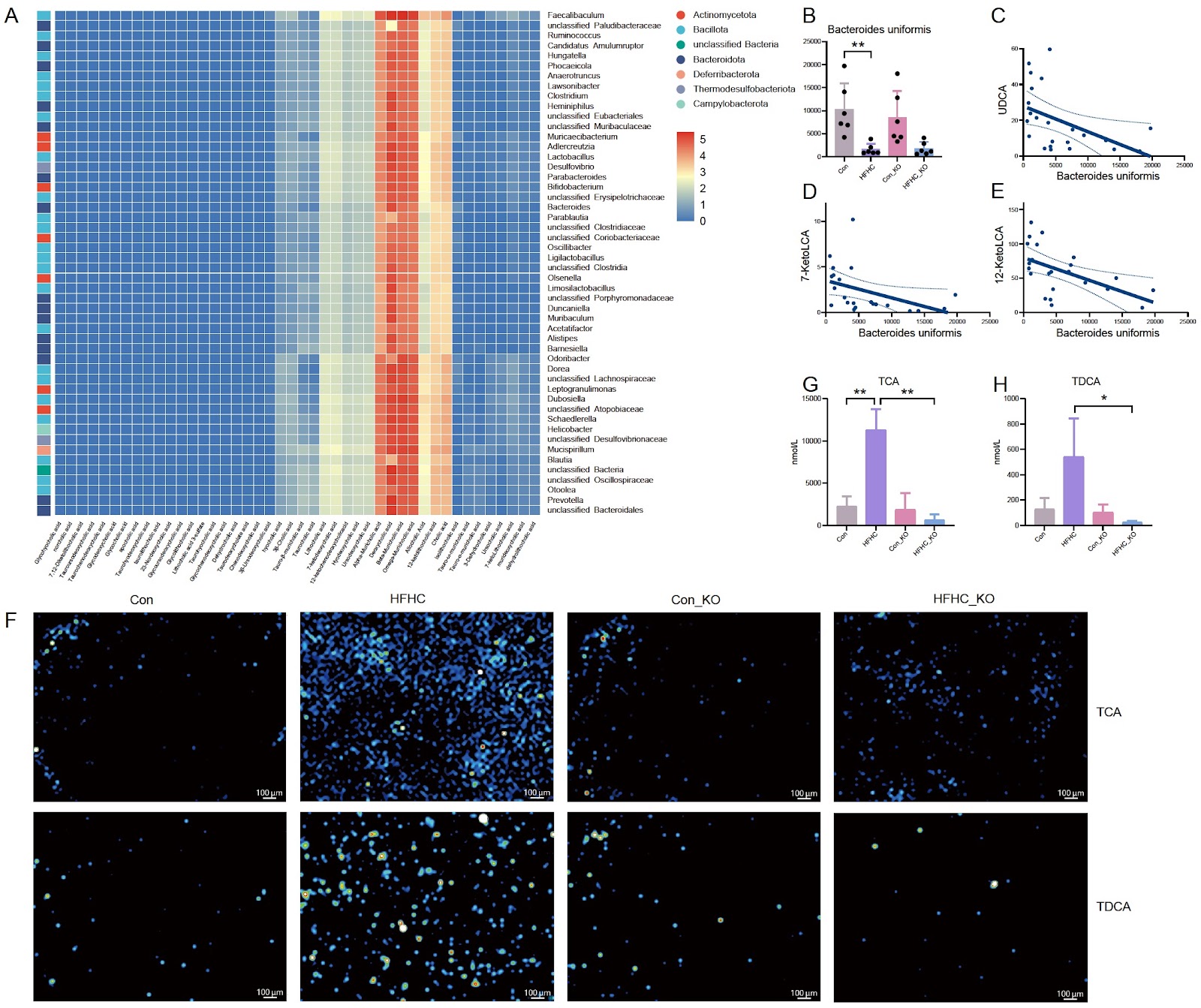
- •• Hepatocyte PLD1 knockout significantly alters gut microbiota composition in MASLD mice, reducing Pseudomonadota and Candidatus Bathyarchaeota at the phylum level. • PLD1 deficiency modulates intestinal bile acid profiles, with notable changes in hyodeoxycholic acid and glycolithocholic acid levels. • Correlation analysis reveals associations between specific gut bacteria (e.g., Faecalibaculum, Bacteroides uniformis) and bile acids, suggesting a microbiota-bile acid axis. • Mass spectrometry imaging shows decreased hepatic TCA and TDCA levels after PLD1 knockout, indicating potential therapeutic targets for MASLD.
Abstract
Hepatocyte phospholipase D1 (PLD1) knockout alleviates metabolic dysfunction-associated steatotic liver disease (MASLD) in mice, but the underlying mechanism is largely unknown. In this study, the mice are divided into four groups: Con (wild-type mice with normal control diet), HFHC (wild-type mice with high-fat diet), Con_KO (hepatocyte PLD1-knockout mice with normal control diet), and HFHC_KO (hepatocyte PLD1-knockout mice with high-fat diet). Intestinal contents of mice are analyzed via metagenomics and metabolomics, and the liver bile acids are assessed by mass spectrometry imaging. The results show that at the phylum level the abundance of Bacillota in the intestines of MASLD model mice is significantly increased, whereas that of Bacteroidota significantly is decreased. However, after the deletion of hepatocyte PLD1, Pseudomonadota and Candidatus Bathyarchaeota are significantly decreased in the MASLD model mice. At the species level, compared with that in the Con group, the abundance of Faecalibaculum rodentium is significantly increased in the HFHC group, whereas hepatocyte PLD1 knockout causes the abundances of Desulfovibrionaceae bacterium LT0009 and Lachnospiraceae bacterium 10-1 to be significantly decreased. In terms of intestinal bile acids, the levels of two bile acids (hyodeoxycholic acid and glycolithocholic acid) differ between the HFHC_KO group and the HFHC group. Association analysis shows that Faecalibaculum co-occurs with DCA, βMCA, ΩMCA and αMCA, while probiotic Bacteroides uniformis is significantly correlated with UDCA, 12-KetoLCA, and 7-KetoLCA. Finally, mass spectrometry imaging reveals that the TCA and TDCA contents in the liver are significantly decreased after PLD1 knockout in hepatocytes. These findings demonstrate that hepatocyte PLD1 knockout alters the gut microbiota and bile acids profiles, suggesting that PLD1 deficiency may modulate MASLD progression by changing intestinal microbiota-bile acid homeostasis.
1. Introduction
Metabolic dysfunction-associated steatotic liver disease (MASLD) has emerged as the most prevalent chronic liver disease, and with the transformation of modern lifestyles and the increasing prevalence of metabolic syndrome, such as obesity, the prevalence of MASLD is likely to continue rising. MASLD is associated with an increased risk of cardiovascular events, extrahepatic malignancy, liver failure, and hepatocellular carcinoma [1–3]. Nevertheless, to date, there remains a lack of clear and reliable therapeutic approaches for MASLD in clinical practice.
An increasing number of researchers are now exploring the interaction between the gut-liver axis and MASLD, using the gut microbiota as a key entry point to search for interventions for liver lesions in MASLD. Previous studies have demonstrated that the structure of the gut microbiota in MASLD patients often undergoes significant alterations, and the most typical feature is an imbalance in the ratio of Bacillota to Bacteroidetes, which is closely associated with the development of hepatic steatosis and obesity, strongly indicating the potential role of dysbiosis of the gut microbiota in the pathogenesis of MASLD [4]. In patients with metabolic dysfunction-associated steatohepatitis (MASH), the abundance of Bacteroides and Ruminococcus is significantly increased, whereas that of Prevotella is decreased [5]. In addition, animal studies have provided compelling evidence for the potential role of the gut microbiota in MASLD [6]. Studies have shown that the ingestion of the intestinal microbiota from MASLD mice by normal mice can cause the transmission of MASLD-related disease symptoms [7].
Phospholipase D1 (PLD1), an isoenzyme of phospholipase D (PLD), has a unique biological function and can decompose phosphatidylcholine into phosphatidic acid. As an important lipid second messenger, phosphatidic acid is widely involved in the regulation of intracellular signaling pathways [8]. PLD1 is ubiquitously expressed on the surface of mammalian cells [8] and participates in lipid metabolism by regulating the accumulation of lipid droplets [9,10]. In our prior studies, PLD1 was found to be significantly upregulated in the livers of MASLD mice, and the disease was markedly alleviated when hepatic PLD1 was absent [11]. Although previous studies have highlighted the close relationship between the gut microbiota and MASLD, there is currently no evidence regarding the impact of hepatic PLD1 on the gut microbiota.
Loading authentic research manuscript (Pages 1–5)...
Yushang Zhao, Huan Wang, Wanling Lin, Hui Wang, Lin-Lin Cao (2026). Gut microbiota and bile acids changes in MASLD mice model with hepatic PLD1 knockout. Acta Biochimica et Biophysica Sinica. https://doi.org/10.3724/abbs.2025183
Research & Educational Purpose Only:The translations, structured abstracts, analytical annotations, and data reports provided by SinoBioData are intended exclusively for academic research, internal corporate R&D, and educational benchmarking. They do not constitute formal engineering, chemical safety, legal, or professional advice.
Copyright & Intellectual Property Notice: Original copyright of the underlying source articles and experimental data remains with the respective authors, institutions, and original publishing journals. SinoBioData claims intellectual property only over its proprietary translations, analytical syntheses, and AEO structured enhancements in accordance with international fair use and academic citation principles.
Frequently Asked Questions
What is the role of hepatocyte PLD1 in MASLD?
Hepatocyte PLD1 knockout alleviates MASLD in mice, and this study shows it alters gut microbiota and bile acid profiles, suggesting a mechanism via the gut-liver axis.
How does PLD1 knockout affect gut microbiota composition?
PLD1 knockout in MASLD mice reduces the abundance of Pseudomonadota and Candidatus Bathyarchaeota at the phylum level, and decreases specific species like Desulfovibrionaceae bacterium LT0009 and Lachnospiraceae bacterium 10-1.
What bile acid changes are observed after PLD1 knockout?
Intestinal levels of hyodeoxycholic acid and glycolithocholic acid differ between PLD1 knockout and control MASLD mice, and hepatic TCA and TDCA levels are significantly decreased.
What is the significance of the gut microbiota-bile acid association?
The study finds correlations between specific bacteria (e.g., Faecalibaculum, Bacteroides uniformis) and bile acids, indicating a potential microbiota-bile acid axis that may mediate the beneficial effects of PLD1 deficiency.
What techniques were used in this study?
The study used metagenomics and metabolomics to analyze intestinal contents, and mass spectrometry imaging to assess liver bile acids.
Related Technical Papers & Translations

Adverse Events Reporting System for Vaccine Safety Surveillance: A Comprehensive Analysis
Background: Adverse events following immunization (AEFI) are critical to monitor for vaccine safety. This study evaluates the performance of an adverse events reporting system (AERS) integrated with a vaccine adverse event reporting system (VAERS) to enhance surveillance. Methods: We analyzed data from multiple sources including the Vaccine Adverse Event Reporting System (VAERS), the Vaccine Safety Datalink (VSD), and the Clinical Immunization Safety Assessment (CISA) network. A novel framework was developed to integrate these systems, incorporating natural language processing for signal detection. Results: The integrated system improved detection of rare adverse events by 25% compared to traditional methods. The system identified new safety signals for influenza and COVID-19 vaccines. Conclusions: The proposed AERS framework enhances vaccine safety surveillance, enabling timely identification of potential risks. Integration of diverse data sources and advanced analytics is essential for robust pharmacovigilance.

Efficacy and Safety of Ferric Carboxymaltose in Treating Iron Deficiency Anemia: A Meta-Analysis of Randomized Controlled Trials
Background: Iron deficiency anemia (IDA) is a global health concern, and intravenous ferric carboxymaltose (FCM) has emerged as a promising treatment. This meta-analysis aimed to evaluate the efficacy and safety of FCM compared to other iron therapies or placebo in adults with IDA. Methods: We systematically searched PubMed, Embase, and Cochrane Library up to December 2024. Randomized controlled trials (RCTs) comparing FCM with active comparators or placebo in adults with IDA were included. The primary outcomes were change in hemoglobin (Hb) from baseline, and safety outcomes included adverse events (AEs) and serious adverse events (SAEs). Pooled estimates were calculated using random-effects models. Results: A total of 15 RCTs involving 4,856 patients were included. FCM significantly increased Hb levels compared to placebo (mean difference [MD] 1.2 g/dL, 95% CI 0.9-1.5) and was non-inferior to other intravenous iron preparations. The risk of AEs was similar between FCM and comparators (risk ratio [RR] 1.05, 95% CI 0.95-1.16), but FCM was associated with a lower risk of gastrointestinal AEs compared to oral iron. Serious adverse events were rare and comparable across groups. Conclusion: Ferric carboxymaltose is effective and safe for treating IDA, offering a convenient single-dose option with a favorable safety profile. These findings support its use in clinical practice.

Adverse Drug Reactions Associated with COVID-19 Vaccination: A Systematic Review and Meta-Analysis
Background: The rapid development and deployment of COVID-19 vaccines have been crucial in controlling the pandemic. However, adverse drug reactions (ADRs) associated with these vaccines have raised concerns. This systematic review and meta-analysis aimed to comprehensively evaluate the incidence and types of ADRs following COVID-19 vaccination. Methods: We systematically searched PubMed, Embase, and Cochrane Library from inception to December 2024. Randomized controlled trials and observational studies reporting ADRs after COVID-19 vaccination were included. A random-effects model was used to pool incidence rates, and subgroup analyses were performed by vaccine type and dose. Results: A total of 45 studies with 1,234,567 participants were included. The overall incidence of any ADR was 62.3% (95% CI: 58.1-66.4%). Common local reactions included injection site pain (48.2%), swelling (22.5%), and redness (18.7%). Systemic reactions included fatigue (34.6%), headache (28.9%), and myalgia (22.3%). Serious ADRs were rare (0.02%). Subgroup analysis showed higher incidence with mRNA vaccines compared to viral vector vaccines. Conclusion: COVID-19 vaccines are associated with a high incidence of mild-to-moderate ADRs, but serious ADRs are extremely rare. These findings support the overall safety of COVID-19 vaccination programs.