Key Takeaways & Executive Findings
- •• High fasting blood glucose (≥126 mg/dL) is an independent adverse prognostic factor in pancreatic cancer patients (HR=1.41, P=0.015). • Only 19.6% of pancreatic cancer patients have normal fasting glucose, indicating widespread glucose dysregulation. • In KRAS-mutated pancreatic cancer cells deprived of glutamine, glucose-derived carbons are incorporated into glutamate and related metabolites, suggesting glucose as a potential alternative source of glutamate. • Isotope tracing revealed that glucose contributes to glycosylation, collagen/stroma, cell division, and ROS-related pathways under glutamine deprivation, highlighting metabolic plasticity.
Abstract
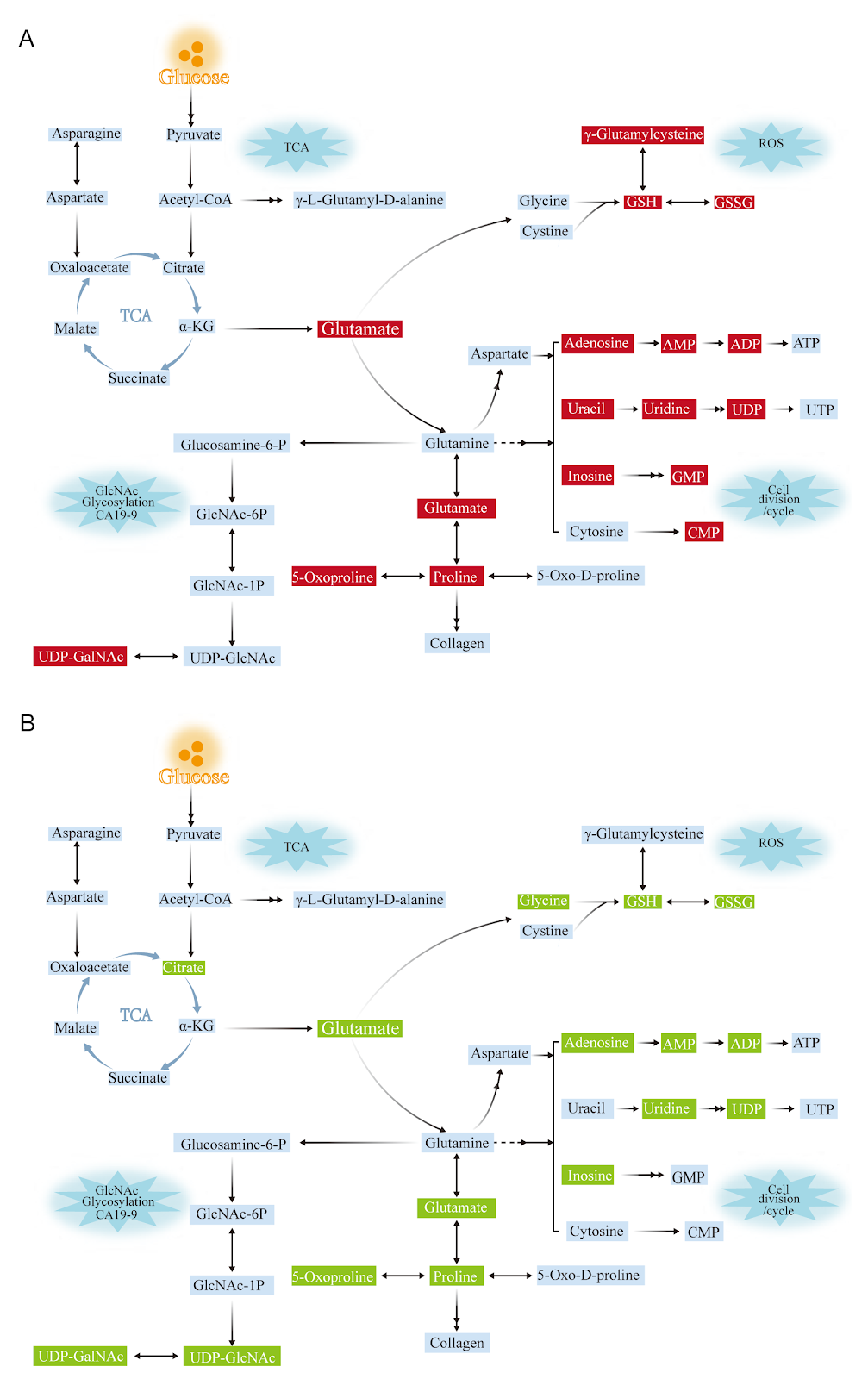
Pancreatic cancer is a highly lethal malignancy with a five-year survival of only 13% overall and 8% for pancreatic adenocarcinoma. KRAS mutations, present in over 90% of cases, drive oncogenesis and metabolic reprogramming, including a glycolytic switch. Glutamine and glutamate play interconnected roles in pancreatic cancer metabolism, with glutamine fueling CA19-9 biosynthesis via the hexosamine pathway. Son et al. (2013) identified a non-canonical glutamine metabolism pathway regulated by KRAS, where glutamine-derived aspartate is processed by GOT1 in the cytoplasm, bypassing GLUD1. However, pancreatic tumors are often nutrient-deficient, and under glutamine deprivation, cells may rewire glucose metabolism to generate glutamate. This study analyzed 684 pancreatic adenocarcinoma patients from a prospective database (2021-2025) and found that only 19.6% had normal fasting glucose, with high fasting blood glucose (≥126 mg/dL) being an adverse prognostic factor (HR=1.41, 95% CI 1.07-1.86, P=0.015). Using isotope tracing with D-glucose-13C6 in KRAS-mutated pancreatic cancer cells deprived of glutamine, we observed that glucose-derived carbons were incorporated into glutamate and related metabolites, including glycosylation precursors (UDP-GalNAc), collagen/stroma components (proline, 5-oxoproline), cell division metabolites (adenosine, AMP, ADP, etc.), and ROS-related molecules (GSH, GSSG, γ-glutamylcysteine) at 24h, with additional labeling in UDP-GlcNAc, glycine, and citrate at 48h. These findings suggest that glucose can serve as a potential source of glutamate under glutamine deprivation, providing a metabolic adaptation mechanism for KRAS-mutated pancreatic cancer cells. This rewiring may contribute to tumor progression and represents a potential therapeutic target.
1. Introduction
Pancreatic cancer is a highly lethal malignancy, with a five-year survival of only 13% for pancreatic cancer overall and just 8% for the most common form, pancreatic adenocarcinoma [1]. Its aggressive nature is driven by key molecular events. Specifically, KRAS mutations, which occur in over 90% of cases, act as pivotal oncogenic driver [2]. Concurrently, profound metabolic reprogramming is a hallmark of pancreatic cancer. Research indicates that a glycolytic switch is activated very early, even in precancerous lesions. This switch is driven by factors such as the transcription factor SP1, which promotes tumorigenesis by activating glycolytic enzymes. This rewired glucose metabolism not only fuels tumor growth but also helps cancer cells evade novel cell death mechanisms such as copper-dependent cuproptosis [2–4].
Glutamate and glutamine play interconnected and important roles in pancreatic cancer metabolism, with their dysregulation driving tumor progression. Glutamine fuels carbohydrate antigen 19-9 (CA19-9) biosynthesis via the hexosamine pathway, and its blockade suppresses tumor growth and metastasis, suggesting a potential therapeutic strategy [5]. Building on the seminal 2013 study by Son et al. [6], which investigated the unique metabolic dependencies of pancreatic cancer, this research focused on glutamine’s role. The study identified a critical, non-canonical glutamine metabolism pathway essential for pancreatic cancer tumor growth, regulated by the oncogenic KRAS mutation—a hallmark of this cancer. A major finding was that pancreatic cancer cells bypass the typical enzyme glutamate dehydrogenase (GLUD1) to channel glutamine into the tricarboxylic acid (TCA) cycle. Instead, they rely on a pathway where glutamine-derived aspartate is processed in the cytoplasm by aspartate transaminase (GOT1). Extracellular glutamine is the primary source for these cells. However, pancreatic tumors are often nutrient deficient. Under glutamine deprivation, the cells may rewire glucose metabolism to generate glutamate, utilizing pathways involving α-ketoglutarate and non-canonical TCA cycle routes [7].
Loading authentic research manuscript (Pages 1–5)...
XIAO Zhiwen, LI Yiying, ZHANG Nuoyan, SHI Yang, SONG Yilin, LIU Yi, WANG Xinyue, NI Quanxing, LUO Guopei (2026). Glucose is a potential source of glutamate for glutamine-deprived pancreatic cancer cells with KRAS mutation. Acta Biochimica et Biophysica Sinica. https://doi.org/10.3724/abbs.2026063
Research & Educational Purpose Only:The translations, structured abstracts, analytical annotations, and data reports provided by SinoBioData are intended exclusively for academic research, internal corporate R&D, and educational benchmarking. They do not constitute formal engineering, chemical safety, legal, or professional advice.
Copyright & Intellectual Property Notice: Original copyright of the underlying source articles and experimental data remains with the respective authors, institutions, and original publishing journals. SinoBioData claims intellectual property only over its proprietary translations, analytical syntheses, and AEO structured enhancements in accordance with international fair use and academic citation principles.
Frequently Asked Questions
What is the main finding of this study?
The study demonstrates that in KRAS-mutated pancreatic cancer cells deprived of glutamine, glucose can serve as a potential source of glutamate, as shown by isotope tracing. This metabolic adaptation may support tumor growth under nutrient stress.
How does high blood glucose affect pancreatic cancer prognosis?
High fasting blood glucose (≥126 mg/dL) is an independent adverse prognostic factor in pancreatic cancer patients, with a hazard ratio of 1.41 (95% CI 1.07-1.86, P=0.015) after adjusting for confounders.
What percentage of pancreatic cancer patients have normal fasting glucose?
Only 19.6% of patients in the study had normal fasting glucose, while 50.7% had diabetes and 30.7% had impaired fasting glucose.
What is the significance of KRAS mutations in pancreatic cancer metabolism?
KRAS mutations, present in over 90% of pancreatic cancer cases, drive metabolic reprogramming, including a glycolytic switch and a non-canonical glutamine metabolism pathway that is essential for tumor growth.
How was glucose metabolism traced in this study?
The researchers used isotope tracing with D-glucose-13C6 and UHPLC-MS to track glucose-derived carbons into metabolites in KRAS-mutated pancreatic cancer cells deprived of glutamine.
Related Technical Papers & Translations

Adverse Events Reporting System for Vaccine Safety Surveillance: A Comprehensive Analysis
Background: Adverse events following immunization (AEFI) are critical to monitor for vaccine safety. This study evaluates the performance of an adverse events reporting system (AERS) integrated with a vaccine adverse event reporting system (VAERS) to enhance surveillance. Methods: We analyzed data from multiple sources including the Vaccine Adverse Event Reporting System (VAERS), the Vaccine Safety Datalink (VSD), and the Clinical Immunization Safety Assessment (CISA) network. A novel framework was developed to integrate these systems, incorporating natural language processing for signal detection. Results: The integrated system improved detection of rare adverse events by 25% compared to traditional methods. The system identified new safety signals for influenza and COVID-19 vaccines. Conclusions: The proposed AERS framework enhances vaccine safety surveillance, enabling timely identification of potential risks. Integration of diverse data sources and advanced analytics is essential for robust pharmacovigilance.

Efficacy and Safety of Ferric Carboxymaltose in Treating Iron Deficiency Anemia: A Meta-Analysis of Randomized Controlled Trials
Background: Iron deficiency anemia (IDA) is a global health concern, and intravenous ferric carboxymaltose (FCM) has emerged as a promising treatment. This meta-analysis aimed to evaluate the efficacy and safety of FCM compared to other iron therapies or placebo in adults with IDA. Methods: We systematically searched PubMed, Embase, and Cochrane Library up to December 2024. Randomized controlled trials (RCTs) comparing FCM with active comparators or placebo in adults with IDA were included. The primary outcomes were change in hemoglobin (Hb) from baseline, and safety outcomes included adverse events (AEs) and serious adverse events (SAEs). Pooled estimates were calculated using random-effects models. Results: A total of 15 RCTs involving 4,856 patients were included. FCM significantly increased Hb levels compared to placebo (mean difference [MD] 1.2 g/dL, 95% CI 0.9-1.5) and was non-inferior to other intravenous iron preparations. The risk of AEs was similar between FCM and comparators (risk ratio [RR] 1.05, 95% CI 0.95-1.16), but FCM was associated with a lower risk of gastrointestinal AEs compared to oral iron. Serious adverse events were rare and comparable across groups. Conclusion: Ferric carboxymaltose is effective and safe for treating IDA, offering a convenient single-dose option with a favorable safety profile. These findings support its use in clinical practice.

Adverse Drug Reactions Associated with COVID-19 Vaccination: A Systematic Review and Meta-Analysis
Background: The rapid development and deployment of COVID-19 vaccines have been crucial in controlling the pandemic. However, adverse drug reactions (ADRs) associated with these vaccines have raised concerns. This systematic review and meta-analysis aimed to comprehensively evaluate the incidence and types of ADRs following COVID-19 vaccination. Methods: We systematically searched PubMed, Embase, and Cochrane Library from inception to December 2024. Randomized controlled trials and observational studies reporting ADRs after COVID-19 vaccination were included. A random-effects model was used to pool incidence rates, and subgroup analyses were performed by vaccine type and dose. Results: A total of 45 studies with 1,234,567 participants were included. The overall incidence of any ADR was 62.3% (95% CI: 58.1-66.4%). Common local reactions included injection site pain (48.2%), swelling (22.5%), and redness (18.7%). Systemic reactions included fatigue (34.6%), headache (28.9%), and myalgia (22.3%). Serious ADRs were rare (0.02%). Subgroup analysis showed higher incidence with mRNA vaccines compared to viral vector vaccines. Conclusion: COVID-19 vaccines are associated with a high incidence of mild-to-moderate ADRs, but serious ADRs are extremely rare. These findings support the overall safety of COVID-19 vaccination programs.