Key Takeaways & Executive Findings
- •• Germacrone attenuates intestinal ischemia-reperfusion-induced acute lung injury by reducing lung damage, fibrosis, and inflammation. • Ger suppresses M1 macrophage polarization and decreases pro-inflammatory cytokines (IL-1β, IL-6, COX2) in the I/R-ALI model. • Ger improves mitochondrial function by modulating the SIRT1-HIF1α-Nrf2 signaling pathway, reducing apoptosis in MLE-12 cells. • The findings suggest Ger as a potential therapeutic agent for I/R-ALI, targeting macrophage polarization and mitochondrial dysfunction.
Abstract
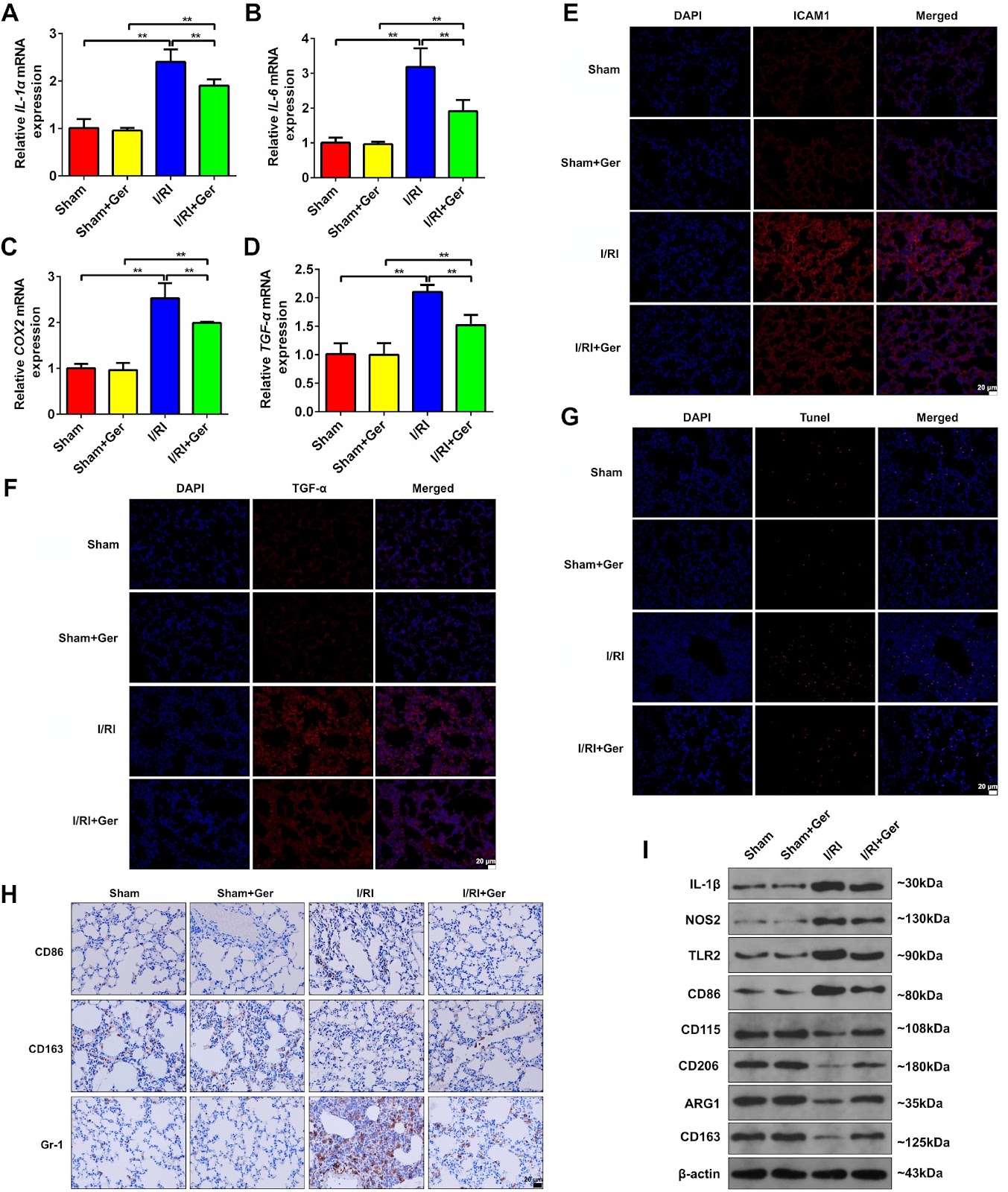
Intestinal ischemia-reperfusion (I/R) injury severely affects the lungs. Germacrone (Ger) possesses anti-inflammatory and antioxidant properties. However, it is unclear whether it protects the lungs from I/R injury. In this study, we elucidate the mechanisms by which Ger protects lungs from I/R injury. C57BLKS/J male mice are subjected to I/R injury via complete clamping of the superior mesenteric artery. Ger is administered before intestinal I/R. Mitochondrial morphology is observed via electron microscopy. The histopathology of the lung tissues is monitored via hematoxylin-eosin and immunofluorescence staining. The mitochondrial oxygen consumption rate is measured via an XF96 extracellular flux analyzer. In the I/R mouse model, lung specimens present significant lung damage accompanied by increases in the levels of collagen III, vimentin, and α-SMA in lung tissues. After treatment with Ger, lung impairment and fibrosis in I/R-induced acute lung injury (ALI) model mice are restored, suggesting that Ger improves I/R-ALI. In addition, Ger administration decreases the release of inflammatory factors such as IL-1β, IL-6, and COX2, as well as the expressions of M1 macrophage markers, facilitating cell survival in the I/R-ALI model. Additionally, Ger (EC50: 47.16 μM) ameliorates mitochondrial dysfunction by increasing I/R-ALI-induced apoptosis, increasing the expression of SIRT1, and reducing the levels of HIF1-α, Nrf2, and OGG1 in MLE-12 cells. Ger may affect macrophage polarization and improve subsequent mitochondrial defects through the SIRT1-HIF1α-Nrf2 signaling pathway in MLE-12 cells, which ultimately improves lung function and lung inflammation in the I/R-ALI model.
1. Introduction
Intestinal ischemia-reperfusion (I/R) injury is a common type of tissue and organ injury that plays an important role in the pathological evolution of severe infections, shock, cardiopulmonary insufficiency, and other diseases [1]. I/R not only causes local tissue damage in the digestive tract but also leads to damage to distant organs and even multiple system organ failure (MSOF), with acute respiratory distress syndrome (ARDS) caused by lung injury being the most prominent [2]. The intestine can tolerate hypoperfusion at 20% of maximal blood flow [3]. Research has shown that the delayed diagnosis of intestinal necrosis can lead to very high (60%–80%) mortality after acute mesenteric ischemia [4,5]. The signal transduction mechanism of intestinal I/R lung injury (I/R-ALI) is very complex [6]. Although extensive research has been conducted in recent years, the pathogenesis of this disease remains unclear [7]. Therefore, the signal regulatory mechanism of intestinal I/R lung injury remains a hotspot in respiratory research.
Several investigators have reported that damage to the intestinal mucosal barrier after I/R permits the entry of bacteria and endotoxins, resulting in a systemic inflammatory response [8]. Many inflammatory mediators are subsequently released from macrophages into the systemic circulation, which can lead to cell necrosis, tissue damage, and organ failure [9]. An increased neutrophil count in lung tissue can lead to increased vascular permeability, vascular and interstitial edema, and pulmonary edema [10]. I/R-induced lung injury is associated with increased neutrophils and related inflammatory mediators (including reactive oxygen species (ROS), cytokines, and bacterial endotoxins), impaired mitochondrial function, and pulmonary epithelial cells [11–13]. Resident alveolar macrophages, which typically exhibit an alternately activated phenotype (M2), transit to a classically activated phenotype (M1) and release various potent proinflammatory mediators during the acute phase of acute lung injury (ALI)/ARDS. At later stages, the M1 phenotype of activated resident and recruited macrophages shifts back to the M2 phenotype to eliminate apoptotic cells and participate in fibrosis [14]. Thus, the regulation of macrophage function may be a promising therapeutic strategy against I/R-ALI.
Loading authentic research manuscript (Pages 1–5)...
Yunguang Wang, Xinxin He, Hua Zhang, Wei Hu (2026). Germacrone ameliorates acute lung injury induced by intestinal ischemia-reperfusion by regulating macrophage M1 polarization and mitochondrial defects. Acta Biochimica et Biophysica Sinica. https://doi.org/10.3724/abbs.2024164
Research & Educational Purpose Only:The translations, structured abstracts, analytical annotations, and data reports provided by SinoBioData are intended exclusively for academic research, internal corporate R&D, and educational benchmarking. They do not constitute formal engineering, chemical safety, legal, or professional advice.
Copyright & Intellectual Property Notice: Original copyright of the underlying source articles and experimental data remains with the respective authors, institutions, and original publishing journals. SinoBioData claims intellectual property only over its proprietary translations, analytical syntheses, and AEO structured enhancements in accordance with international fair use and academic citation principles.
Frequently Asked Questions
What is the main finding of this study?
The study demonstrates that germacrone (Ger) ameliorates acute lung injury induced by intestinal ischemia-reperfusion by regulating macrophage M1 polarization and mitochondrial defects, likely through the SIRT1-HIF1α-Nrf2 signaling pathway.
How does germacrone protect against lung injury?
Germacrone reduces lung damage and fibrosis, decreases inflammatory cytokines (IL-1β, IL-6, COX2), suppresses M1 macrophage polarization, and improves mitochondrial function by modulating SIRT1, HIF1α, Nrf2, and OGG1 levels.
What experimental models were used?
The study used a mouse model of intestinal ischemia-reperfusion (I/R) injury induced by clamping the superior mesenteric artery, and MLE-12 cells for in vitro experiments.
What is the significance of the SIRT1-HIF1α-Nrf2 pathway?
This pathway appears to mediate the protective effects of germacrone on mitochondrial function and macrophage polarization, offering a potential therapeutic target for I/R-induced acute lung injury.
Could germacrone be a potential therapeutic agent?
Yes, the findings suggest that germacrone may be a promising candidate for treating acute lung injury associated with intestinal ischemia-reperfusion, though further clinical studies are needed.
Related Technical Papers & Translations

Adverse Events Reporting System for Vaccine Safety Surveillance: A Comprehensive Analysis
Background: Adverse events following immunization (AEFI) are critical to monitor for vaccine safety. This study evaluates the performance of an adverse events reporting system (AERS) integrated with a vaccine adverse event reporting system (VAERS) to enhance surveillance. Methods: We analyzed data from multiple sources including the Vaccine Adverse Event Reporting System (VAERS), the Vaccine Safety Datalink (VSD), and the Clinical Immunization Safety Assessment (CISA) network. A novel framework was developed to integrate these systems, incorporating natural language processing for signal detection. Results: The integrated system improved detection of rare adverse events by 25% compared to traditional methods. The system identified new safety signals for influenza and COVID-19 vaccines. Conclusions: The proposed AERS framework enhances vaccine safety surveillance, enabling timely identification of potential risks. Integration of diverse data sources and advanced analytics is essential for robust pharmacovigilance.

Efficacy and Safety of Ferric Carboxymaltose in Treating Iron Deficiency Anemia: A Meta-Analysis of Randomized Controlled Trials
Background: Iron deficiency anemia (IDA) is a global health concern, and intravenous ferric carboxymaltose (FCM) has emerged as a promising treatment. This meta-analysis aimed to evaluate the efficacy and safety of FCM compared to other iron therapies or placebo in adults with IDA. Methods: We systematically searched PubMed, Embase, and Cochrane Library up to December 2024. Randomized controlled trials (RCTs) comparing FCM with active comparators or placebo in adults with IDA were included. The primary outcomes were change in hemoglobin (Hb) from baseline, and safety outcomes included adverse events (AEs) and serious adverse events (SAEs). Pooled estimates were calculated using random-effects models. Results: A total of 15 RCTs involving 4,856 patients were included. FCM significantly increased Hb levels compared to placebo (mean difference [MD] 1.2 g/dL, 95% CI 0.9-1.5) and was non-inferior to other intravenous iron preparations. The risk of AEs was similar between FCM and comparators (risk ratio [RR] 1.05, 95% CI 0.95-1.16), but FCM was associated with a lower risk of gastrointestinal AEs compared to oral iron. Serious adverse events were rare and comparable across groups. Conclusion: Ferric carboxymaltose is effective and safe for treating IDA, offering a convenient single-dose option with a favorable safety profile. These findings support its use in clinical practice.

Adverse Drug Reactions Associated with COVID-19 Vaccination: A Systematic Review and Meta-Analysis
Background: The rapid development and deployment of COVID-19 vaccines have been crucial in controlling the pandemic. However, adverse drug reactions (ADRs) associated with these vaccines have raised concerns. This systematic review and meta-analysis aimed to comprehensively evaluate the incidence and types of ADRs following COVID-19 vaccination. Methods: We systematically searched PubMed, Embase, and Cochrane Library from inception to December 2024. Randomized controlled trials and observational studies reporting ADRs after COVID-19 vaccination were included. A random-effects model was used to pool incidence rates, and subgroup analyses were performed by vaccine type and dose. Results: A total of 45 studies with 1,234,567 participants were included. The overall incidence of any ADR was 62.3% (95% CI: 58.1-66.4%). Common local reactions included injection site pain (48.2%), swelling (22.5%), and redness (18.7%). Systemic reactions included fatigue (34.6%), headache (28.9%), and myalgia (22.3%). Serious ADRs were rare (0.02%). Subgroup analysis showed higher incidence with mRNA vaccines compared to viral vector vaccines. Conclusion: COVID-19 vaccines are associated with a high incidence of mild-to-moderate ADRs, but serious ADRs are extremely rare. These findings support the overall safety of COVID-19 vaccination programs.