Key Takeaways & Executive Findings
- •• Gastrodin suppresses reactive astrocyte-mediated neuroinflammation in hypoxic-ischemic brain damage by modulating the S100B/RAGE-Smad3 signaling pathway. • Gastrodin shifts astrocyte polarization from neurotoxic A1 to neuroprotective A2 phenotype, as evidenced by decreased C3 and increased S100A10 and BDNF expression. • The combination of gastrodin with the RAGE inhibitor FPS-ZM1 further reduces A1 astrocyte marker C3, suggesting a potential synergistic therapeutic strategy. • These findings provide a molecular basis for gastrodin as a promising candidate for treating neonatal hypoxic-ischemic brain injury.
Abstract
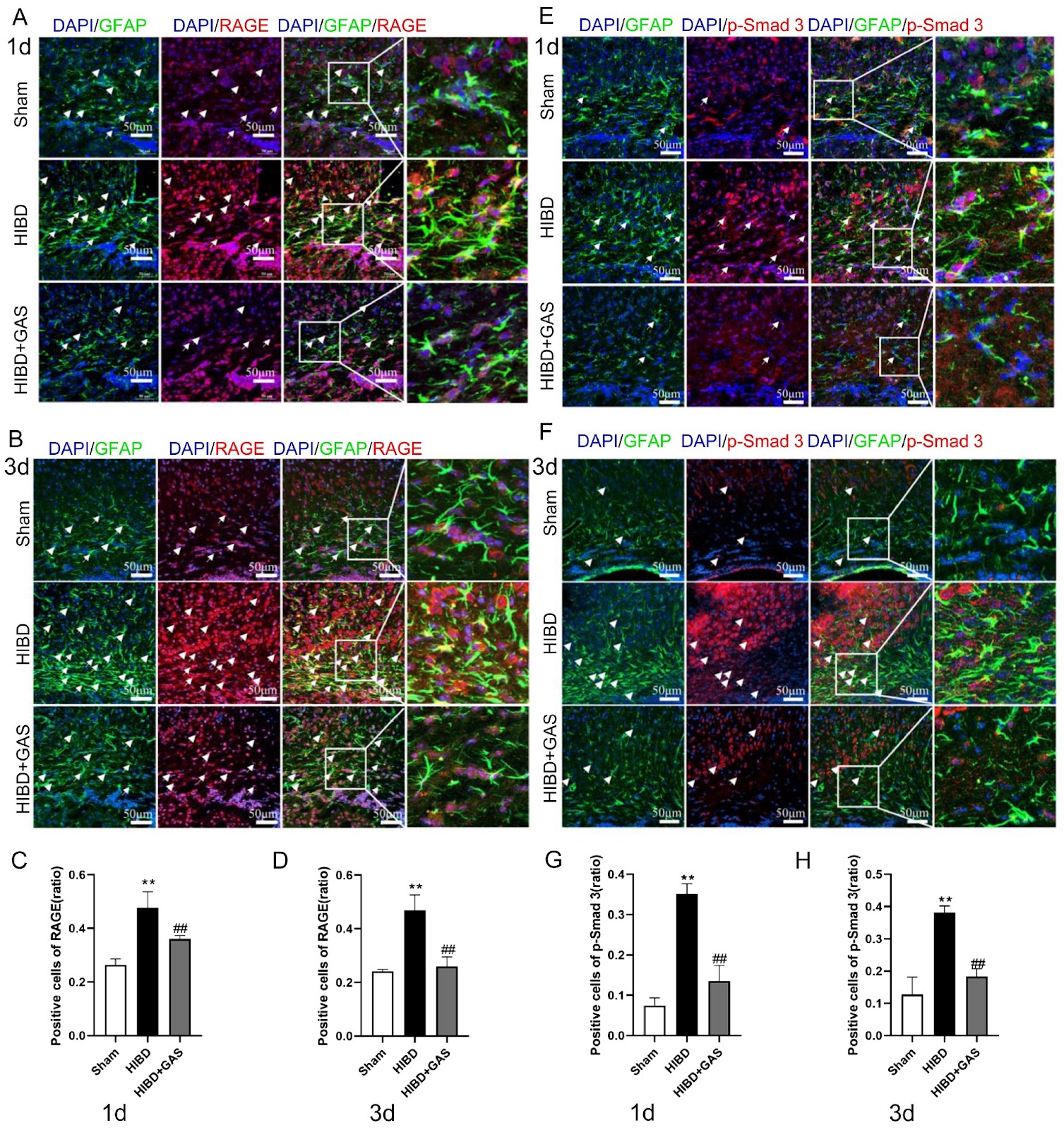
Activated astrocytes and their associated inflammatory responses play critical roles in the pathogenesis of hypoxic-ischemic brain damage (HIBD). Gastrodin (GAS), an anti-inflammatory herbal agent, is known to suppress microglial activation. Here, we investigate whether it exerts a similar effect on activated astrocytes and whether it acts through S100B/RAGE-Smad3 signaling. The expression changes of S100B/RAGE-Smad3 signaling pathway-related proteins, inflammatory factors and A1/A2 astrocyte markers were detected by ELISA, western blot analysis, immunofluorescence and immunohistochemistry. The results show that GAS decreases the expression of sRAGE in the brain tissue and S100B in the serum and brain tissue of HIBD mice. However, it promotes the expression of sRAGE in the serum of HIBD mice. Moreover, GAS inhibits the expressions of RAGE, p-Smad3, TNF-α, and C3 (A1 astrocyte marker), and promotes the expressions of S100A10 (A2 astrocyte marker) and BDNF in HIBD model mice, as well as in oxygen glucose deprivation (OGD)-treated TNC-1 astrocytes. The immunofluorescence and immunohistochemical results of RAGE and p-Smad3, as well as the immunofluorescence results of C3 and S100A10, reveal the same trend. Interestingly, FPS-ZM1 (a specific inhibitor of RAGE) inhibits the expressions of p-Smad3, TNF-α, C3, and S100A10, but promotes that of BDNF compared with those in the OGD group. The combination of GAS and FPS-ZM1 further decreases the expression of C3. These results indicate that GAS can inhibit the activation of Smad3 through S100B/RAGE signaling and regulate the expression of A1/A2-type astrocytes.
1. Introduction
Hypoxic-ischemic brain damage (HIBD) is a leading cause of neonatal death in children. In addition, it has a high probability of causing significant long-term neurodisabilities, even with treatment [1]. HIBD triggers neuroinflammation induced by resident immune cells, including astrocytes and microglia, as well as that involving peripheral immune responses. Neuroinflammation is a major factor responsible for secondary brain tissue injury, which may even lead to neuronal death [2].
Emerging evidence has shown that astrocytes respond to injury, disease, or infection of the central nervous system (CNS) via morphological, molecular, and functional remodeling and turn into reactive astrocytes [3]. Reactive astrocytes play a dual role: they can promote and limit the inflammatory response triggered by HIBD [4]. On the one hand, they secrete tumor necrosis factor-α (TNF-α) and interleukin-6 (IL-6), which can induce neuronal death and other proinflammatory changes in nerve cells [5,6]. On the other hand, they can exhibit neuroprotective and anti-inflammatory effects by releasing brain-derived neurotrophic factor (BDNF) and IL-10 [7,8]. According to Liddelow et al. [9,10], there are at least two categories of astrocytes: A1 astrocytes (induced by neuroinflammation), which are neurotoxic reactive astrocytes marked by complement-3 (C3), and A2 astrocytes (induced by ischemia), which are neuroprotective reactive astrocytes marked by the S100A10 protein.
S100B is a member of a multigenic family of EF-hand calcium-binding proteins. Its primary expression in astrocytes and secretion into the extracellular space within the CNS have been extensively investigated [11,12]. Previous studies have indicated that nanomolar levels of S100B in the healthy brain can increase neuron survival and promote synapse formation [13]. However, when stimulated by brain injury, S100B can rapidly accumulate at micromolar concentrations and exert completely opposite effects. One example of the known deleterious effects of S100B is that it can induce neuronal apoptosis and hippocampus-dependent spatial learning impairment by interacting with the receptor for advanced glycation end products (RAGE) [14,15]. RAGE is a multiligand pattern recognition receptor that has been demonstrated to bind with several ligands, including advanced glycation end products (AGEs), S100B, high-mobility group box (HMGB1), and β amyloid (Aβ), and is associated with chronic inflammatory states in various diseases [16,17]. Additionally, RAGE can undergo alternative splicing to produce different isoforms at the mRNA level, such as secretory/soluble RAGE (sRAGE) and dominant negative RAGE (DNRAGE), with similar ligand-binding affinities to those of RAGE [18]. In addition, sRAGE can be derived by proteolytic cleavage of the extracellular domain of RAGE [19]. In addition, it can act as a decoy to intercept the interaction of ligands with the cell surface RAGE.
Loading authentic research manuscript (Pages 1–5)...
Pengxiang Wang, Hanjun Zuo, Haolong Shi, Zhao Wang, Xueqi Ren, Jinsha Shi, Tao Guo, Xianfeng Kuang, Min Zhao, Jinghui Li, Juanjuan Li (2026). Gastrodin inhibits reactive astrocyte-mediated inflammation in hypoxic-ischemic brain damage through S100B/RAGE-Smad3 signaling. Acta Biochimica et Biophysica Sinica. https://doi.org/10.3724/abbs.2024235
Research & Educational Purpose Only:The translations, structured abstracts, analytical annotations, and data reports provided by SinoBioData are intended exclusively for academic research, internal corporate R&D, and educational benchmarking. They do not constitute formal engineering, chemical safety, legal, or professional advice.
Copyright & Intellectual Property Notice: Original copyright of the underlying source articles and experimental data remains with the respective authors, institutions, and original publishing journals. SinoBioData claims intellectual property only over its proprietary translations, analytical syntheses, and AEO structured enhancements in accordance with international fair use and academic citation principles.
Frequently Asked Questions
What is the role of gastrodin in hypoxic-ischemic brain damage?
Gastrodin inhibits reactive astrocyte-mediated inflammation in hypoxic-ischemic brain damage by modulating the S100B/RAGE-Smad3 signaling pathway, shifting astrocytes from a neurotoxic A1 phenotype to a neuroprotective A2 phenotype.
How does gastrodin affect astrocyte polarization?
Gastrodin reduces the expression of the A1 astrocyte marker C3 and increases the expression of the A2 astrocyte marker S100A10 and BDNF, indicating a shift from neurotoxic to neuroprotective astrocytes.
What is the significance of the S100B/RAGE-Smad3 pathway in this study?
The study demonstrates that gastrodin inhibits Smad3 activation through S100B/RAGE signaling, which is crucial for regulating the inflammatory response and astrocyte phenotype in hypoxic-ischemic brain damage.
Could gastrodin be a potential therapeutic agent for neonatal brain injury?
Yes, the findings suggest that gastrodin has neuroprotective effects and could be a promising candidate for treating neonatal hypoxic-ischemic brain injury, especially when combined with RAGE inhibitors like FPS-ZM1.
What experimental models were used in this study?
The study used a mouse model of hypoxic-ischemic brain damage and oxygen-glucose deprivation (OGD)-treated TNC-1 astrocytes to investigate the effects of gastrodin.
Related Technical Papers & Translations

Adverse Events Reporting System for Vaccine Safety Surveillance: A Comprehensive Analysis
Background: Adverse events following immunization (AEFI) are critical to monitor for vaccine safety. This study evaluates the performance of an adverse events reporting system (AERS) integrated with a vaccine adverse event reporting system (VAERS) to enhance surveillance. Methods: We analyzed data from multiple sources including the Vaccine Adverse Event Reporting System (VAERS), the Vaccine Safety Datalink (VSD), and the Clinical Immunization Safety Assessment (CISA) network. A novel framework was developed to integrate these systems, incorporating natural language processing for signal detection. Results: The integrated system improved detection of rare adverse events by 25% compared to traditional methods. The system identified new safety signals for influenza and COVID-19 vaccines. Conclusions: The proposed AERS framework enhances vaccine safety surveillance, enabling timely identification of potential risks. Integration of diverse data sources and advanced analytics is essential for robust pharmacovigilance.

Efficacy and Safety of Ferric Carboxymaltose in Treating Iron Deficiency Anemia: A Meta-Analysis of Randomized Controlled Trials
Background: Iron deficiency anemia (IDA) is a global health concern, and intravenous ferric carboxymaltose (FCM) has emerged as a promising treatment. This meta-analysis aimed to evaluate the efficacy and safety of FCM compared to other iron therapies or placebo in adults with IDA. Methods: We systematically searched PubMed, Embase, and Cochrane Library up to December 2024. Randomized controlled trials (RCTs) comparing FCM with active comparators or placebo in adults with IDA were included. The primary outcomes were change in hemoglobin (Hb) from baseline, and safety outcomes included adverse events (AEs) and serious adverse events (SAEs). Pooled estimates were calculated using random-effects models. Results: A total of 15 RCTs involving 4,856 patients were included. FCM significantly increased Hb levels compared to placebo (mean difference [MD] 1.2 g/dL, 95% CI 0.9-1.5) and was non-inferior to other intravenous iron preparations. The risk of AEs was similar between FCM and comparators (risk ratio [RR] 1.05, 95% CI 0.95-1.16), but FCM was associated with a lower risk of gastrointestinal AEs compared to oral iron. Serious adverse events were rare and comparable across groups. Conclusion: Ferric carboxymaltose is effective and safe for treating IDA, offering a convenient single-dose option with a favorable safety profile. These findings support its use in clinical practice.

Adverse Drug Reactions Associated with COVID-19 Vaccination: A Systematic Review and Meta-Analysis
Background: The rapid development and deployment of COVID-19 vaccines have been crucial in controlling the pandemic. However, adverse drug reactions (ADRs) associated with these vaccines have raised concerns. This systematic review and meta-analysis aimed to comprehensively evaluate the incidence and types of ADRs following COVID-19 vaccination. Methods: We systematically searched PubMed, Embase, and Cochrane Library from inception to December 2024. Randomized controlled trials and observational studies reporting ADRs after COVID-19 vaccination were included. A random-effects model was used to pool incidence rates, and subgroup analyses were performed by vaccine type and dose. Results: A total of 45 studies with 1,234,567 participants were included. The overall incidence of any ADR was 62.3% (95% CI: 58.1-66.4%). Common local reactions included injection site pain (48.2%), swelling (22.5%), and redness (18.7%). Systemic reactions included fatigue (34.6%), headache (28.9%), and myalgia (22.3%). Serious ADRs were rare (0.02%). Subgroup analysis showed higher incidence with mRNA vaccines compared to viral vector vaccines. Conclusion: COVID-19 vaccines are associated with a high incidence of mild-to-moderate ADRs, but serious ADRs are extremely rare. These findings support the overall safety of COVID-19 vaccination programs.