Key Takeaways & Executive Findings
- •• Gankyrin deficiency impairs liver regeneration after partial hepatectomy by disrupting glycogenolysis and fatty acid uptake. • Gankyrin promotes degradation of FOXO1 via ubiquitination, leading to upregulation of Pygl and Cd36 to fuel hepatocyte proliferation. • Pharmacological inhibition of PYGL activity retards liver regeneration, highlighting a potential therapeutic target. • The Gankyrin/FOXO1-PYGL/CD36 axis integrates metabolic reprogramming with proliferative signaling, offering novel strategies for enhancing liver regeneration in clinical settings.
Abstract
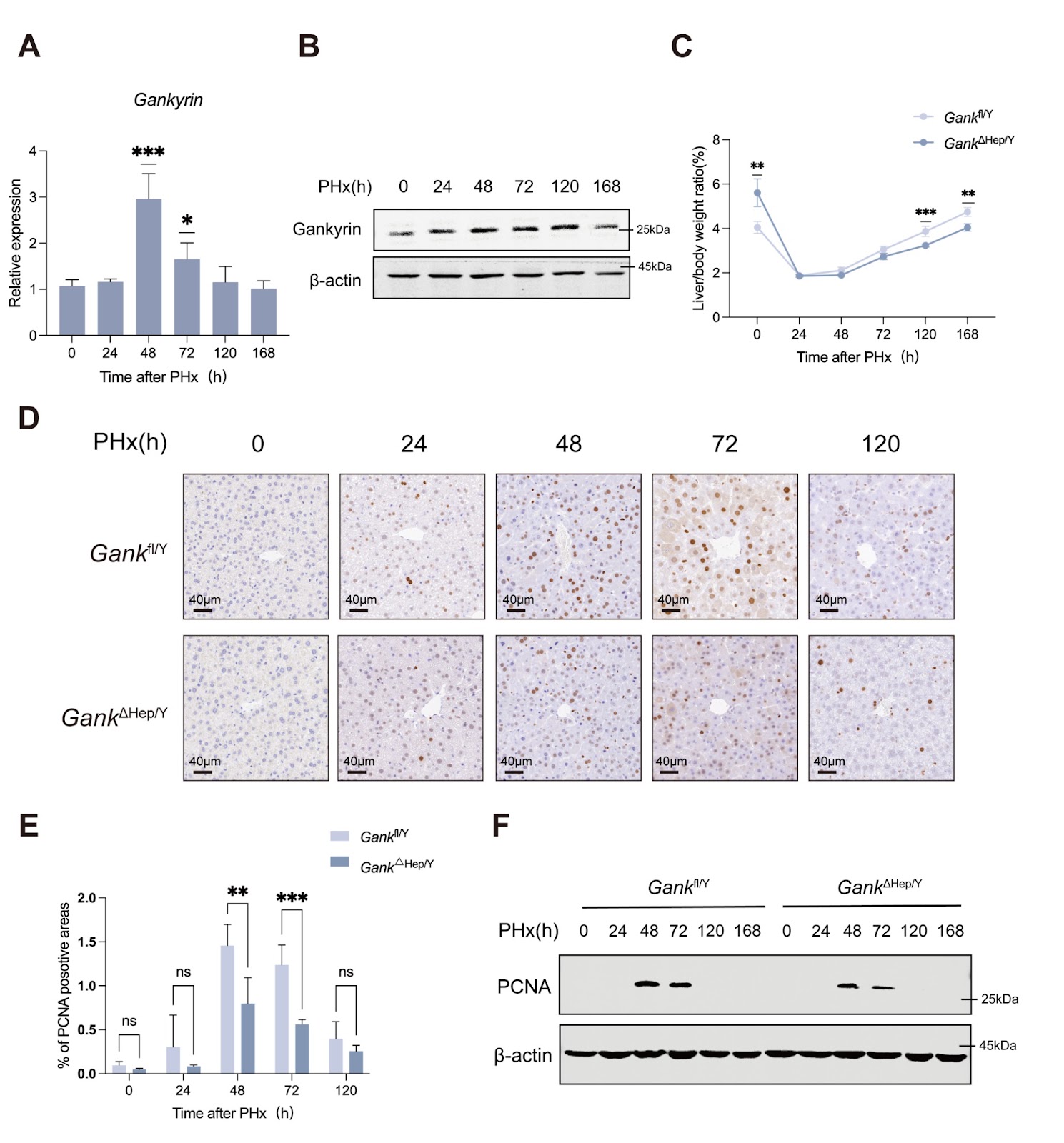
Liver regeneration is a critical adaptive response to hepatic injury, requiring precise metabolic reprogramming to meet the energetic and biosynthetic demands of proliferating hepatocytes. While the oncoprotein Gankyrin is well-established as a promoter of liver fibrosis and hepatocarcinogenesis, its role in metabolic adaptations underlying liver regeneration remains unclear. In this study, we demonstrate that Gankyrin deficiency in the liver (Gank△Hep/Y) induces hepatic hypertrophy and aberrant glycogen accumulation. Gankyrin expression is significantly upregulated after partial hepatectomy (PHx), whereas Gank△Hep/Y -PHx mice exhibit impaired liver regeneration. This impairment is marked by a delayed restoration of the liver-to-body weight ratio, blunted glycogenolysis, and reduced fatty acid uptake. Mechanistically, Gankyrin activates Pygl and Cd36, key regulators of glycogenolysis and lipid uptake, respectively. Pharmacological inhibition of PYGL activity retards liver regeneration. Furthermore, we identify a novel interaction between Gankyrin and FOXO1, wherein Gankyrin promotes FOXO1 ubiquitination and subsequent proteasomal degradation. This Gankyrin-dependent suppression of FOXO1 leads to the transcriptional upregulation of Pygl and Cd36, thereby fueling hepatocyte proliferation. Collectively, our findings reveal Gankyrin as a master regulator of liver regeneration, integrating metabolic reprogramming with proliferative signaling through the FOXO1-PYGL/CD36 axis. These insights not only elucidate the mechanistic underpinnings of liver regeneration but also unveil the therapeutic potential of targeting the Gankyrin/FOXO1 pathway to mitigate hepatic insufficiency and enhance regenerative capacity in clinical settings.
1. Introduction
Liver is a central metabolic hub, endowed with extraordinary regenerative potential that enables it to recover from injury and maintain homeostasis [1,2]. Under physiological conditions, the liver exhibits a remarkable regeneration capacity, restoring its mass and function following damage [3,4]. However, this regeneration capacity is severely compromised in clinical scenarios involving extensive liver resections, acute liver failure, severe chronic liver injury or hepatocellular carcinoma [5‒8]. Despite decades of research, effective strategies to accelerate liver regeneration remain elusive. Thus, understanding the mechanisms of liver regeneration is critical for the design of innovative interventions to restore hepatic function in patients with severe liver injury or disease.
The 70% partial hepatectomy (PHx) model is the most common paradigm for investigating the mechanism underlying liver regeneration [9,10]. In response to regeneration signals, a series of metabolic adaptations occur in the liver and system-wide, fundamentally altering the metabolic landscape [11]. During the early phase of liver regeneration, rapid glycogen depletion leads to transient hypoglycemia, a hallmark of the initial regenerative response [12,13]. However, compensatory mechanisms are activated, including enhanced gluconeogenesis and suppressed glycolysis [14]. Notably, interfering with this hypoglycemic response, such as exogenous glucose supplementation, can negatively affect hepatocyte proliferation [15]. In response to glucose depletion, the regenerating liver shifts its primary energy source from glucose to fatty acid β-oxidation, resulting in transient hepatic steatosis [16,17]. This lipid accumulation is driven by increased fatty acid uptake from adipose tissue [18,19]. The accumulation of lipid droplets significantly influences subsequent liver regeneration. Intriguingly, de novo hepatic lipogenesis is dispensable for resection-induced steatosis [20]. Understanding these metabolic adjustments could provide insights into therapeutic strategies to enhance liver regeneration.
Loading authentic research manuscript (Pages 1–5)...
Yitian Liu, Yiwei Sun, Lv Jin, Ying Xu, Bibo Wang, Ting Yu, Xiaofei Wei, Jing Xu, Yating Wei, Shuai Yang, Min Yu, Hongyang Wang, Yao Chen (2026). Gankyrin-deficiency reprograms intrahepatic glucose and lipid metabolism to delay liver regeneration. Acta Biochimica et Biophysica Sinica. https://doi.org/10.3724/abbs.2025086
Research & Educational Purpose Only:The translations, structured abstracts, analytical annotations, and data reports provided by SinoBioData are intended exclusively for academic research, internal corporate R&D, and educational benchmarking. They do not constitute formal engineering, chemical safety, legal, or professional advice.
Copyright & Intellectual Property Notice: Original copyright of the underlying source articles and experimental data remains with the respective authors, institutions, and original publishing journals. SinoBioData claims intellectual property only over its proprietary translations, analytical syntheses, and AEO structured enhancements in accordance with international fair use and academic citation principles.
Frequently Asked Questions
What is the role of Gankyrin in liver regeneration?
Gankyrin acts as a master regulator of liver regeneration by promoting the degradation of FOXO1, leading to upregulation of Pygl and Cd36, which are key for glycogenolysis and fatty acid uptake, respectively. This metabolic reprogramming fuels hepatocyte proliferation and is essential for efficient liver regeneration.
How does Gankyrin deficiency affect liver regeneration?
Gankyrin deficiency impairs liver regeneration after partial hepatectomy, characterized by delayed restoration of liver-to-body weight ratio, blunted glycogenolysis, and reduced fatty acid uptake, ultimately leading to delayed regenerative response.
What is the molecular mechanism by which Gankyrin regulates metabolism?
Gankyrin interacts with FOXO1 and promotes its ubiquitination and proteasomal degradation. This suppresses FOXO1, which normally represses Pygl and Cd36 transcription, thereby increasing their expression to enhance glycogenolysis and fatty acid uptake.
Can pharmacological inhibition of PYGL affect liver regeneration?
Yes, pharmacological inhibition of PYGL activity retards liver regeneration, indicating that PYGL-mediated glycogenolysis is crucial for the regenerative process and could be a therapeutic target.
What are the therapeutic implications of this study?
Targeting the Gankyrin/FOXO1 pathway may offer novel strategies to enhance liver regeneration in clinical settings, such as after extensive liver resection or in acute liver failure, by modulating metabolic reprogramming.
Related Technical Papers & Translations

Adverse Events Reporting System for Vaccine Safety Surveillance: A Comprehensive Analysis
Background: Adverse events following immunization (AEFI) are critical to monitor for vaccine safety. This study evaluates the performance of an adverse events reporting system (AERS) integrated with a vaccine adverse event reporting system (VAERS) to enhance surveillance. Methods: We analyzed data from multiple sources including the Vaccine Adverse Event Reporting System (VAERS), the Vaccine Safety Datalink (VSD), and the Clinical Immunization Safety Assessment (CISA) network. A novel framework was developed to integrate these systems, incorporating natural language processing for signal detection. Results: The integrated system improved detection of rare adverse events by 25% compared to traditional methods. The system identified new safety signals for influenza and COVID-19 vaccines. Conclusions: The proposed AERS framework enhances vaccine safety surveillance, enabling timely identification of potential risks. Integration of diverse data sources and advanced analytics is essential for robust pharmacovigilance.

Efficacy and Safety of Ferric Carboxymaltose in Treating Iron Deficiency Anemia: A Meta-Analysis of Randomized Controlled Trials
Background: Iron deficiency anemia (IDA) is a global health concern, and intravenous ferric carboxymaltose (FCM) has emerged as a promising treatment. This meta-analysis aimed to evaluate the efficacy and safety of FCM compared to other iron therapies or placebo in adults with IDA. Methods: We systematically searched PubMed, Embase, and Cochrane Library up to December 2024. Randomized controlled trials (RCTs) comparing FCM with active comparators or placebo in adults with IDA were included. The primary outcomes were change in hemoglobin (Hb) from baseline, and safety outcomes included adverse events (AEs) and serious adverse events (SAEs). Pooled estimates were calculated using random-effects models. Results: A total of 15 RCTs involving 4,856 patients were included. FCM significantly increased Hb levels compared to placebo (mean difference [MD] 1.2 g/dL, 95% CI 0.9-1.5) and was non-inferior to other intravenous iron preparations. The risk of AEs was similar between FCM and comparators (risk ratio [RR] 1.05, 95% CI 0.95-1.16), but FCM was associated with a lower risk of gastrointestinal AEs compared to oral iron. Serious adverse events were rare and comparable across groups. Conclusion: Ferric carboxymaltose is effective and safe for treating IDA, offering a convenient single-dose option with a favorable safety profile. These findings support its use in clinical practice.

Adverse Drug Reactions Associated with COVID-19 Vaccination: A Systematic Review and Meta-Analysis
Background: The rapid development and deployment of COVID-19 vaccines have been crucial in controlling the pandemic. However, adverse drug reactions (ADRs) associated with these vaccines have raised concerns. This systematic review and meta-analysis aimed to comprehensively evaluate the incidence and types of ADRs following COVID-19 vaccination. Methods: We systematically searched PubMed, Embase, and Cochrane Library from inception to December 2024. Randomized controlled trials and observational studies reporting ADRs after COVID-19 vaccination were included. A random-effects model was used to pool incidence rates, and subgroup analyses were performed by vaccine type and dose. Results: A total of 45 studies with 1,234,567 participants were included. The overall incidence of any ADR was 62.3% (95% CI: 58.1-66.4%). Common local reactions included injection site pain (48.2%), swelling (22.5%), and redness (18.7%). Systemic reactions included fatigue (34.6%), headache (28.9%), and myalgia (22.3%). Serious ADRs were rare (0.02%). Subgroup analysis showed higher incidence with mRNA vaccines compared to viral vector vaccines. Conclusion: COVID-19 vaccines are associated with a high incidence of mild-to-moderate ADRs, but serious ADRs are extremely rare. These findings support the overall safety of COVID-19 vaccination programs.