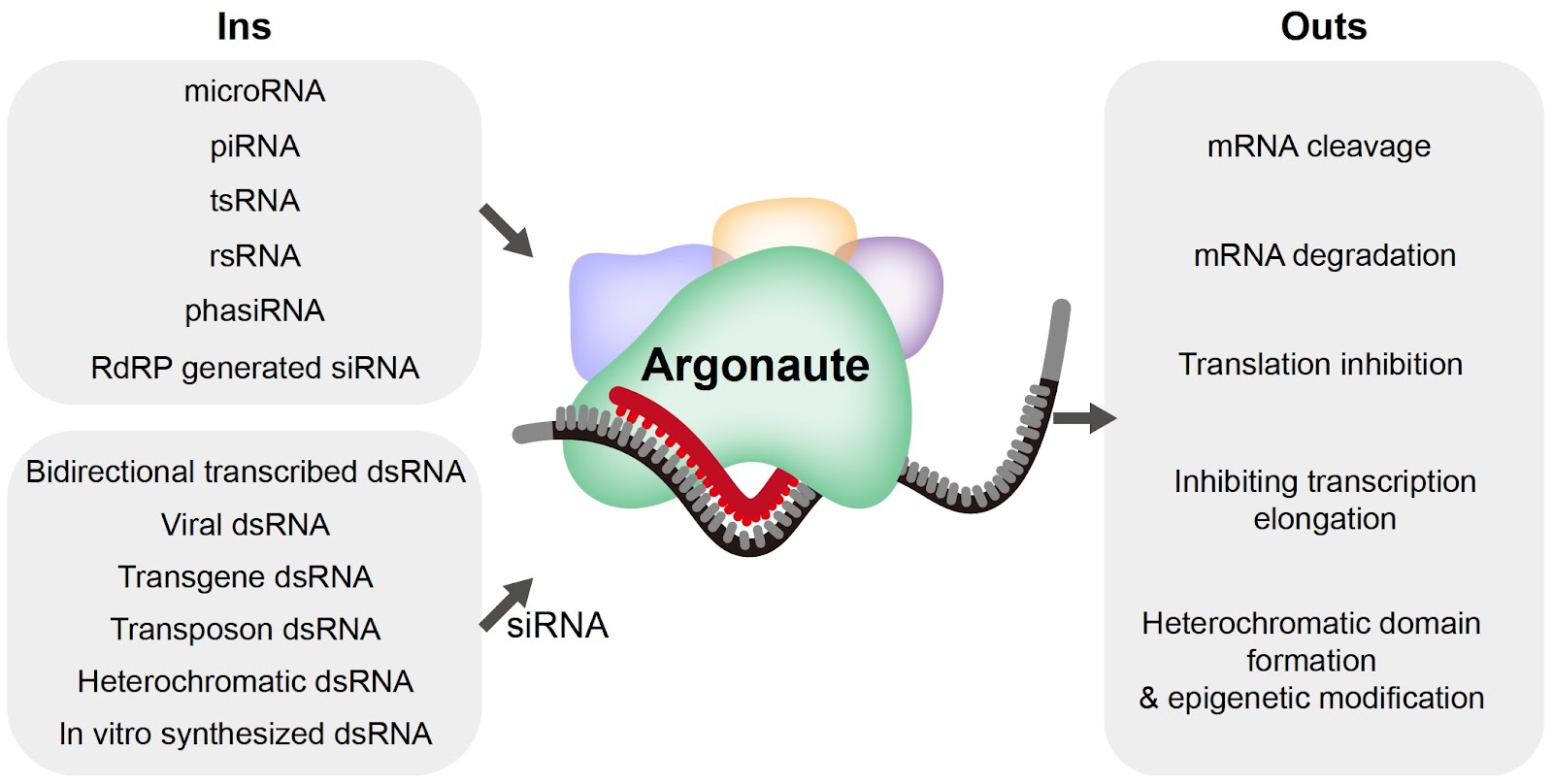
Key Takeaways & Executive Findings
- •• RNAi is a conserved gene regulatory mechanism involving small RNAs and Argonaute proteins, essential for gene silencing, antiviral defense, and genome integrity. • The review highlights the roles of RNAi in transposon silencing, fertility, development, immunity, stress responses, and transgenerational inheritance. • RNAi technology has broad applications in functional genomics, biomedical research, agriculture, and therapeutics. • Recent advances in RNA sequencing have expanded the discovery of novel small regulatory RNAs with important biological functions.
Abstract
Small regulatory RNAs play a variety of crucial roles in eukaryotes, influencing gene regulation, developmental timing, antiviral defense, and genome integrity via a process termed RNA interference (RNAi). This process involves Argonaute/small RNA (AGO/sRNA) complexes that target transcripts via sequence complementarity and modulate gene expression and epigenetic modifications. RNAi is a highly conserved gene regulatory phenomenon that recognizes self- and non-self nucleic acids, thereby defending against invasive sequences. Since its discovery, RNAi has been widely applied in functional genomic studies and a range of practical applications. In this review, we focus on the current understanding of the biological roles of the RNAi pathway in transposon silencing, fertility, developmental regulation, immunity, stress responses, and acquired transgenerational inheritance. Additionally, we provide an overview of the applications of RNAi technology in biomedical research, agriculture, and therapeutics.
1. Introduction
Small regulatory RNAs direct sequence-specific regulation of gene expression via a mechanism termed RNA interference (RNAi), which was first described in nematodes in 1998 [1]. In a range of eukaryotic organisms, small regulatory RNAs and their associated Argonaute proteins play essential roles in RNAi-mediated gene silencing, whereby small regulatory RNAs guide the Argonaute-containing protein complexes to targeted nucleic acids with sequence complementarity [2‒7]. Small RNA/Argonaute complexes modulate gene expression via several mechanisms, including degrading targeted RNAs, inhibiting translation, inducing epigenetic modifications and heterochromatin formation, and inhibiting transcription elongation or triggering alternative splicing [8‒14].
There are three main classes of small regulatory RNAs: microRNAs (miRNAs), small interfering RNAs (siRNAs) and PIWI-interacting RNAs (piRNAs) [15‒18]. Additional classes of small regulatory RNAs, such as antisense ribosomal siRNAs (risiRNAs) [19‒21], tRNA-derived small RNAs (tsRNAs), and phased secondary small interfering RNAs (phasiRNAs), have also been shown to act through the RNAi pathway (Table 1) [22‒25]. Notably, recent developments in novel RNA-sequencing techniques have significantly expanded our knowledge of small regulatory RNAs by overcoming sequencing obstacles, which are caused either by specific modifications or by terminus multiplicities of small RNAs. More importantly, many of these newly detected small RNAs have important functions in different biological processes, such as reprogramming, lineage specification and apoptosis [26‒28].
Loading authentic research manuscript (Pages 1–5)...
Xuezhu Feng, Shouhong Guang (2026). Functions and applications of RNA interference and small regulatory RNAs. Acta Biochimica et Biophysica Sinica. https://doi.org/10.3724/abbs.2024196
Research & Educational Purpose Only:The translations, structured abstracts, analytical annotations, and data reports provided by SinoBioData are intended exclusively for academic research, internal corporate R&D, and educational benchmarking. They do not constitute formal engineering, chemical safety, legal, or professional advice.
Copyright & Intellectual Property Notice: Original copyright of the underlying source articles and experimental data remains with the respective authors, institutions, and original publishing journals. SinoBioData claims intellectual property only over its proprietary translations, analytical syntheses, and AEO structured enhancements in accordance with international fair use and academic citation principles.
Frequently Asked Questions
What is RNA interference (RNAi)?
RNA interference (RNAi) is a conserved gene regulatory mechanism in eukaryotes where small regulatory RNAs guide Argonaute-containing complexes to target nucleic acids via sequence complementarity, leading to gene silencing through mRNA degradation, translation inhibition, or epigenetic modifications.
What are the main classes of small regulatory RNAs?
The three main classes are microRNAs (miRNAs), small interfering RNAs (siRNAs), and PIWI-interacting RNAs (piRNAs). Additional classes include antisense ribosomal siRNAs (risiRNAs), tRNA-derived small RNAs (tsRNAs), and phased secondary siRNAs (phasiRNAs).
What are the biological roles of RNAi?
RNAi plays crucial roles in transposon silencing, fertility, developmental regulation, immunity, stress responses, and acquired transgenerational inheritance, as well as in maintaining genome integrity and defending against invasive nucleic acids.
What are the applications of RNAi technology?
RNAi technology is widely applied in functional genomic studies, biomedical research, agriculture (e.g., pest control and crop improvement), and therapeutics (e.g., developing RNAi-based drugs for diseases).
How are small regulatory RNAs produced?
miRNAs are processed from hairpin precursors by Drosha and Dicer; siRNAs derive from long double-stranded RNA cleaved by Dicer; piRNAs are generated via distinct mechanisms in animal gonads. Other small RNAs like tsRNAs and risiRNAs have specific biogenesis pathways.
Related Technical Papers & Translations

Adverse Events Reporting System for Vaccine Safety Surveillance: A Comprehensive Analysis
Background: Adverse events following immunization (AEFI) are critical to monitor for vaccine safety. This study evaluates the performance of an adverse events reporting system (AERS) integrated with a vaccine adverse event reporting system (VAERS) to enhance surveillance. Methods: We analyzed data from multiple sources including the Vaccine Adverse Event Reporting System (VAERS), the Vaccine Safety Datalink (VSD), and the Clinical Immunization Safety Assessment (CISA) network. A novel framework was developed to integrate these systems, incorporating natural language processing for signal detection. Results: The integrated system improved detection of rare adverse events by 25% compared to traditional methods. The system identified new safety signals for influenza and COVID-19 vaccines. Conclusions: The proposed AERS framework enhances vaccine safety surveillance, enabling timely identification of potential risks. Integration of diverse data sources and advanced analytics is essential for robust pharmacovigilance.

Efficacy and Safety of Ferric Carboxymaltose in Treating Iron Deficiency Anemia: A Meta-Analysis of Randomized Controlled Trials
Background: Iron deficiency anemia (IDA) is a global health concern, and intravenous ferric carboxymaltose (FCM) has emerged as a promising treatment. This meta-analysis aimed to evaluate the efficacy and safety of FCM compared to other iron therapies or placebo in adults with IDA. Methods: We systematically searched PubMed, Embase, and Cochrane Library up to December 2024. Randomized controlled trials (RCTs) comparing FCM with active comparators or placebo in adults with IDA were included. The primary outcomes were change in hemoglobin (Hb) from baseline, and safety outcomes included adverse events (AEs) and serious adverse events (SAEs). Pooled estimates were calculated using random-effects models. Results: A total of 15 RCTs involving 4,856 patients were included. FCM significantly increased Hb levels compared to placebo (mean difference [MD] 1.2 g/dL, 95% CI 0.9-1.5) and was non-inferior to other intravenous iron preparations. The risk of AEs was similar between FCM and comparators (risk ratio [RR] 1.05, 95% CI 0.95-1.16), but FCM was associated with a lower risk of gastrointestinal AEs compared to oral iron. Serious adverse events were rare and comparable across groups. Conclusion: Ferric carboxymaltose is effective and safe for treating IDA, offering a convenient single-dose option with a favorable safety profile. These findings support its use in clinical practice.

Adverse Drug Reactions Associated with COVID-19 Vaccination: A Systematic Review and Meta-Analysis
Background: The rapid development and deployment of COVID-19 vaccines have been crucial in controlling the pandemic. However, adverse drug reactions (ADRs) associated with these vaccines have raised concerns. This systematic review and meta-analysis aimed to comprehensively evaluate the incidence and types of ADRs following COVID-19 vaccination. Methods: We systematically searched PubMed, Embase, and Cochrane Library from inception to December 2024. Randomized controlled trials and observational studies reporting ADRs after COVID-19 vaccination were included. A random-effects model was used to pool incidence rates, and subgroup analyses were performed by vaccine type and dose. Results: A total of 45 studies with 1,234,567 participants were included. The overall incidence of any ADR was 62.3% (95% CI: 58.1-66.4%). Common local reactions included injection site pain (48.2%), swelling (22.5%), and redness (18.7%). Systemic reactions included fatigue (34.6%), headache (28.9%), and myalgia (22.3%). Serious ADRs were rare (0.02%). Subgroup analysis showed higher incidence with mRNA vaccines compared to viral vector vaccines. Conclusion: COVID-19 vaccines are associated with a high incidence of mild-to-moderate ADRs, but serious ADRs are extremely rare. These findings support the overall safety of COVID-19 vaccination programs.