Key Takeaways & Executive Findings
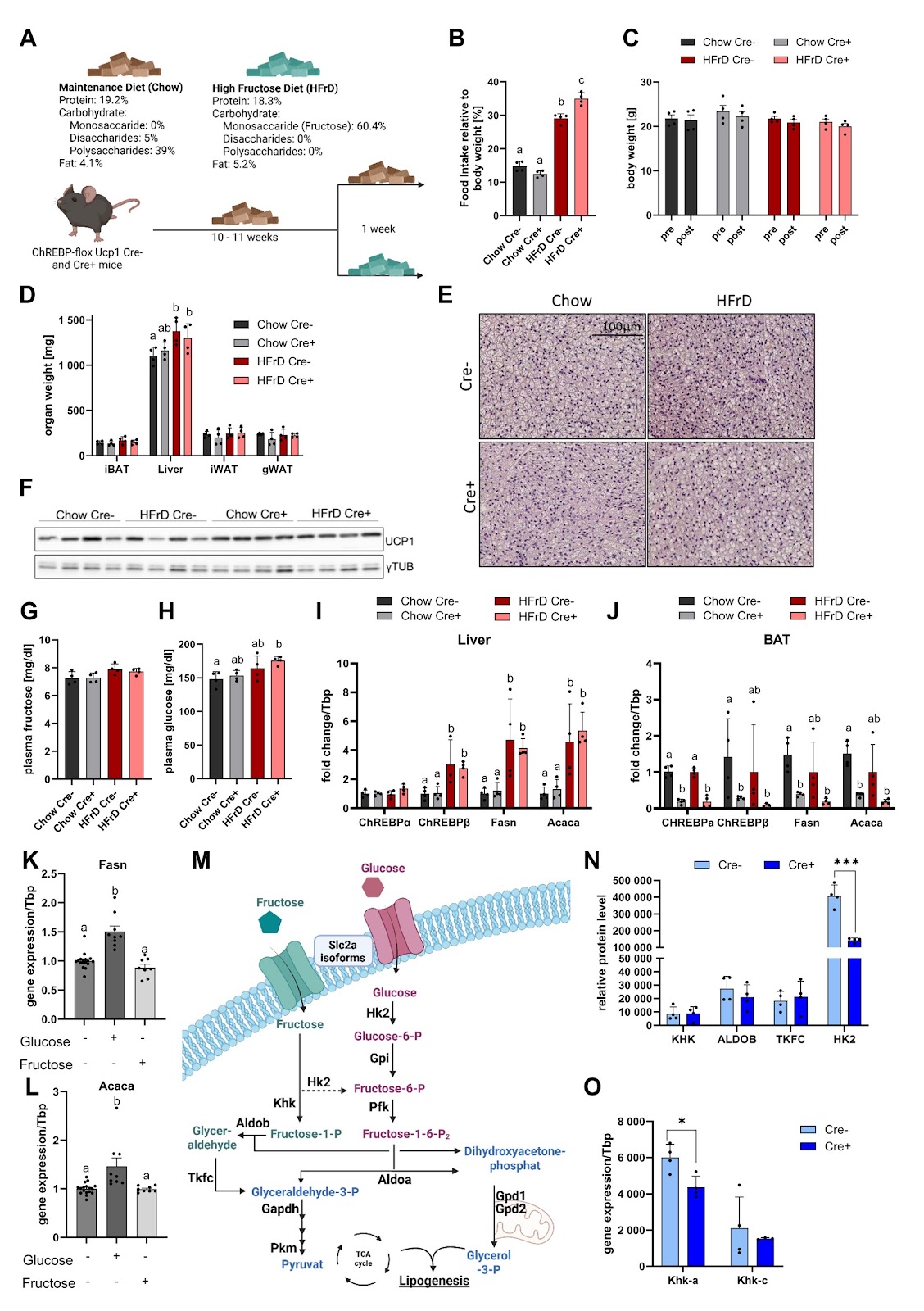
- •• Brown adipocytes can utilize fructose as a substrate, but to a lesser extent than glucose. • ChREBP and GLUT5 are not essential for fructose uptake and metabolism in brown adipose tissue. • High-fructose feeding does not stimulate de novo lipogenesis in BAT, unlike in liver and intestine. • Excessive carbohydrate loading in brown adipocytes leads to accumulation of hexosylceramides, suggesting a shift towards glycosphingolipid synthesis.
Abstract
Brown adipose tissue (BAT) is a heat-generating organ burning significant amounts of calories from fatty acids and glucose. The importance of glucose metabolism in the context of thermogenic function has been underlined by several studies. However, fructose metabolism and consequences of fructose overfeeding are poorly studied in BAT. Here we provide evidence that brown adipocytes use fructose as a substrate, however to a lesser extent than glucose. Furthermore, our data suggest that carbohydrate response element binding protein (ChREBP) and its target glucose transporter 5 (GLUT5) are not essential for fructose uptake and metabolism in BAT. Notably, we report that high fructose feeding has no effect on ChREBP activity and thus de novo fatty acid synthesis in BAT as opposed to liver and intestine. Instead, excessive carbohydrate loading of brown adipocytes induced by both, high-fructose feeding and impairment of ChREBP-dependent glucose metabolism, causes a massive accumulation of hexosylceramide species, as revealed by mass spectrometry-based lipidomics. Based on our data we hypothesize a reprogramming of fructose utilization upon impaired carbohydrate metabolism from canonical glycolysis and pentose phosphate pathway towards glycosphingolipid synthesis.
1. Introduction
Fructose consumption in the form of added sugar in refined foods or sugar-sweetened drinks has strongly increased in many countries worldwide since the 1970s [1–3]. Excessive fructose intake is associated with overweight and cardiometabolic disorders including hypertriglyceridemia, fatty liver disease, type 2 diabetes and cardiovascular diseases [3–7]. The development of fatty liver and hypertriglyceridemia in response to fructose overfeeding is mechanistically well understood, in particular how it is linked to de novo lipogenesis (DNL), the metabolic pathway converting carbohydrates into long-chain fatty acids [8]. In human and rodent hepatocytes, fructose is rapidly metabolized to C3 intermediates of glycolysis via ketohexokinase (KHK), aldolase B (ALDOB) and triokinase (TKFC) in a relatively unregulated fashion [9], thereby providing acetyl-CoA as substrate for DNL. When in excess, fructose can thus promote liver steatosis and cause hypertriglyceridemia [9–12].
In parallel to metabolically supplying the DNL pathway, fructose metabolism in hepatocytes efficiently stimulates the transcription of DNL enzyme genes, predominantly through activation of the transcription factor carbohydrate response element-binding protein (ChREBP) [9,13]. As shown by studies in liver-specific ChREBP-knockout mice, activation of ChREBP is essential for the development of obesity and disturbed glucose homeostasis in mice fed with a high-fructose diet [14]. Several members of the hexose transporter family, SLC2A2 (GLUT2), SLC2A5 (GLUT5) and SLC2A8 (GLUT8), have been implicated in hepatocyte fructose uptake [2,9,15]. Of note, the selective fructose transporter SLC2A5 [16] is activated by ChREBP in both the small intestine and the liver, a regulation that establishes a feed-forward mechanism linking fructose uptake, fructose metabolism and DNL [14,17]. Quantitative postprandial studies have determined that a significant proportion of fructose is metabolized already in enterocytes of the small intestine and converted into glucose via gluconeogenesis [18]. In addition, microbiota in the colon convert fructose into short-chain fatty acids [18–20]. Intestinal metabolism may be the primary route for ingested fructose when moderate amounts of the sugar are consumed, at least in mice [9,18]. If fructose intake is high, a larger portion of the monosaccharide is directed to the liver via the portal vein and is cleared by hepatocytes [11,18]. In consequence of the splanchnic processing, only a minor proportion of ingested fructose reaches the systemic circulation [21] and the concentration of fructose in peripheral blood is low compared to glucose [21–23]. Nevertheless, systemic fructose concentrations rise postprandially [21] and fructose use in peripheral organs can be of relevance. For example, fructose metabolism has been shown to promote the development of cardiomyopathy in mice [24]. The significance of fructose utilization in adipose tissue as another major site of energy metabolism is not well researched. Slc2a5 is expressed in white adipocytes [25] and Slc2a5-KO mice have reduced epididymal white fat mass [26]. In line with this observation, fructose promotes the differentiation of 3T3-L1 preadipocytes [26,27]. Even less is known about the functional significance of fructose metabolism in brown adipose tissue (BAT). BAT is a heat-generating organ that burns significant amounts of calories from fatty acids and glucose, and its importance in energy metabolism is increasingly recognized.
Loading authentic research manuscript (Pages 1–5)...
Janina Behrens, Marceline Manka Fuh, Daniel T. Haas, Michelle Y. Jaeckstein, Markus Heine, Bente Siebels, Anna Worthmann, Natalie Krahmer, Joerg Heeren, Ludger Scheja (2026). Fructose uptake by brown adipose tissue is independent of carbohydrate response element-binding protein and does not cause elevated de novo lipogenesis. Acta Biochimica et Biophysica Sinica. https://doi.org/10.3724/abbs.2025229
Research & Educational Purpose Only:The translations, structured abstracts, analytical annotations, and data reports provided by SinoBioData are intended exclusively for academic research, internal corporate R&D, and educational benchmarking. They do not constitute formal engineering, chemical safety, legal, or professional advice.
Copyright & Intellectual Property Notice: Original copyright of the underlying source articles and experimental data remains with the respective authors, institutions, and original publishing journals. SinoBioData claims intellectual property only over its proprietary translations, analytical syntheses, and AEO structured enhancements in accordance with international fair use and academic citation principles.
Frequently Asked Questions
What is the role of ChREBP in fructose metabolism in brown adipose tissue?
The study shows that ChREBP is not essential for fructose uptake and metabolism in brown adipose tissue, as its activity is not increased by high-fructose feeding, unlike in liver and intestine.
Does high-fructose feeding induce de novo lipogenesis in brown adipose tissue?
No, high-fructose feeding does not elevate de novo lipogenesis in brown adipose tissue, in contrast to its effects in liver and intestine.
What happens to brown adipocytes when carbohydrate metabolism is impaired?
Impairment of ChREBP-dependent glucose metabolism or high-fructose feeding leads to massive accumulation of hexosylceramide species, suggesting a reprogramming towards glycosphingolipid synthesis.
How does fructose uptake in brown adipose tissue compare to glucose?
Brown adipocytes can use fructose as a substrate, but to a lesser extent than glucose.
What is the significance of GLUT5 in fructose transport in brown adipose tissue?
GLUT5, a target of ChREBP, is not essential for fructose uptake in brown adipose tissue, as fructose metabolism proceeds independently of this transporter.
Related Technical Papers & Translations

Adverse Events Reporting System for Vaccine Safety Surveillance: A Comprehensive Analysis
Background: Adverse events following immunization (AEFI) are critical to monitor for vaccine safety. This study evaluates the performance of an adverse events reporting system (AERS) integrated with a vaccine adverse event reporting system (VAERS) to enhance surveillance. Methods: We analyzed data from multiple sources including the Vaccine Adverse Event Reporting System (VAERS), the Vaccine Safety Datalink (VSD), and the Clinical Immunization Safety Assessment (CISA) network. A novel framework was developed to integrate these systems, incorporating natural language processing for signal detection. Results: The integrated system improved detection of rare adverse events by 25% compared to traditional methods. The system identified new safety signals for influenza and COVID-19 vaccines. Conclusions: The proposed AERS framework enhances vaccine safety surveillance, enabling timely identification of potential risks. Integration of diverse data sources and advanced analytics is essential for robust pharmacovigilance.

Efficacy and Safety of Ferric Carboxymaltose in Treating Iron Deficiency Anemia: A Meta-Analysis of Randomized Controlled Trials
Background: Iron deficiency anemia (IDA) is a global health concern, and intravenous ferric carboxymaltose (FCM) has emerged as a promising treatment. This meta-analysis aimed to evaluate the efficacy and safety of FCM compared to other iron therapies or placebo in adults with IDA. Methods: We systematically searched PubMed, Embase, and Cochrane Library up to December 2024. Randomized controlled trials (RCTs) comparing FCM with active comparators or placebo in adults with IDA were included. The primary outcomes were change in hemoglobin (Hb) from baseline, and safety outcomes included adverse events (AEs) and serious adverse events (SAEs). Pooled estimates were calculated using random-effects models. Results: A total of 15 RCTs involving 4,856 patients were included. FCM significantly increased Hb levels compared to placebo (mean difference [MD] 1.2 g/dL, 95% CI 0.9-1.5) and was non-inferior to other intravenous iron preparations. The risk of AEs was similar between FCM and comparators (risk ratio [RR] 1.05, 95% CI 0.95-1.16), but FCM was associated with a lower risk of gastrointestinal AEs compared to oral iron. Serious adverse events were rare and comparable across groups. Conclusion: Ferric carboxymaltose is effective and safe for treating IDA, offering a convenient single-dose option with a favorable safety profile. These findings support its use in clinical practice.

Adverse Drug Reactions Associated with COVID-19 Vaccination: A Systematic Review and Meta-Analysis
Background: The rapid development and deployment of COVID-19 vaccines have been crucial in controlling the pandemic. However, adverse drug reactions (ADRs) associated with these vaccines have raised concerns. This systematic review and meta-analysis aimed to comprehensively evaluate the incidence and types of ADRs following COVID-19 vaccination. Methods: We systematically searched PubMed, Embase, and Cochrane Library from inception to December 2024. Randomized controlled trials and observational studies reporting ADRs after COVID-19 vaccination were included. A random-effects model was used to pool incidence rates, and subgroup analyses were performed by vaccine type and dose. Results: A total of 45 studies with 1,234,567 participants were included. The overall incidence of any ADR was 62.3% (95% CI: 58.1-66.4%). Common local reactions included injection site pain (48.2%), swelling (22.5%), and redness (18.7%). Systemic reactions included fatigue (34.6%), headache (28.9%), and myalgia (22.3%). Serious ADRs were rare (0.02%). Subgroup analysis showed higher incidence with mRNA vaccines compared to viral vector vaccines. Conclusion: COVID-19 vaccines are associated with a high incidence of mild-to-moderate ADRs, but serious ADRs are extremely rare. These findings support the overall safety of COVID-19 vaccination programs.