Key Takeaways & Executive Findings
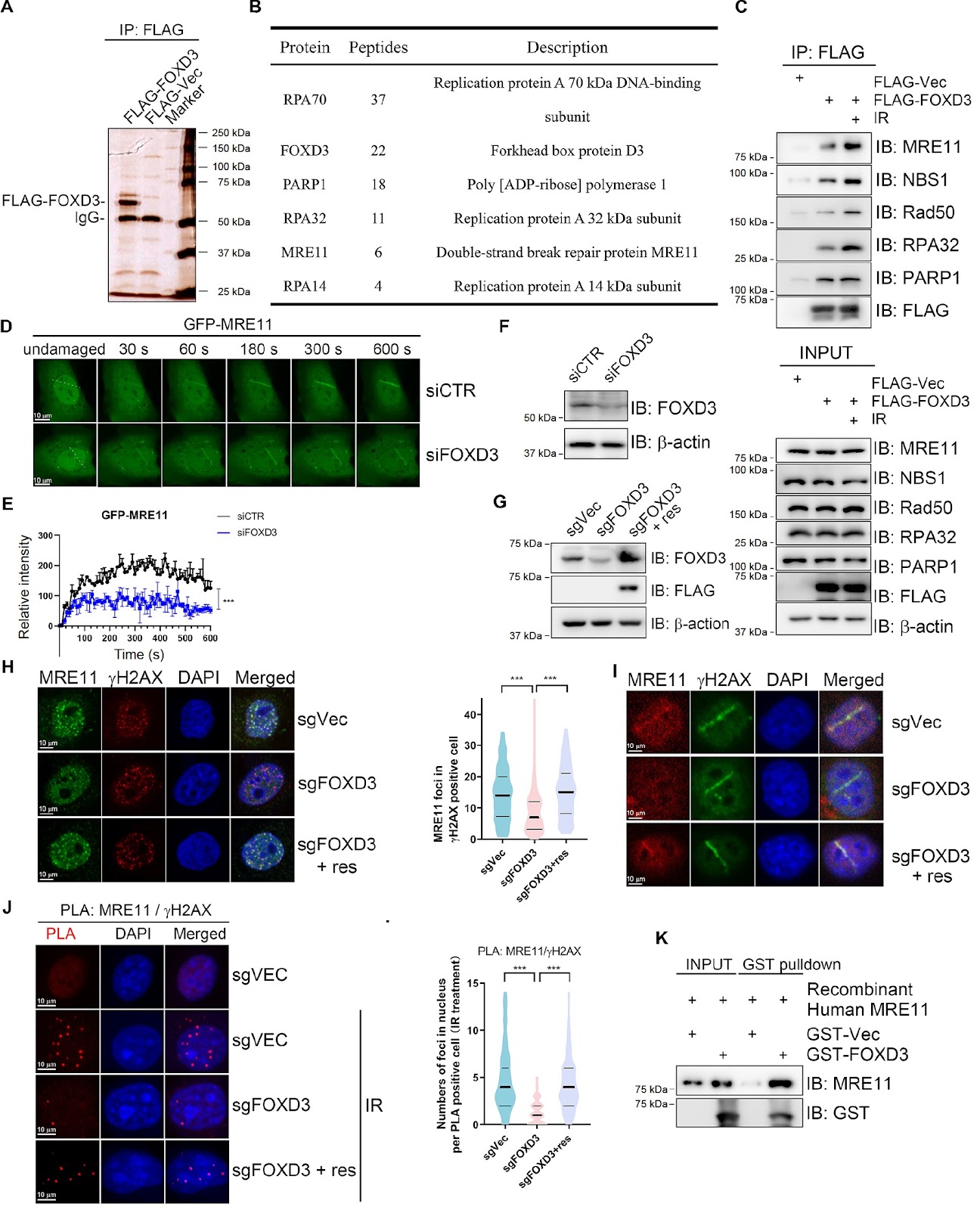
- •• FOXD3 is recruited to DNA double-strand breaks in a PARP1-dependent manner and interacts with PARP1. • FOXD3 directly binds to MRE11 and promotes its recruitment to DSB sites, facilitating end resection. • Inhibition of FOXD3 compromises homologous recombination repair and chromosome stability, sensitizing cancer cells to ionizing radiation. • FOXD3 acts as a novel regulator of HR-mediated DSB repair and genome stability, independent of its transcription factor function.
Abstract
Homologous recombination (HR) is crucial for the high-fidelity repair of DNA double-strand breaks (DSBs), ensuring the maintenance of genome stability. In this study, we show that FOXD3 interacts with poly (ADP-ribose) polymerase 1 (PARP1) and is recruited to DSBs in a PARP1-dependent manner. FOXD3 directly binds to the DSB repair protein MRE11 and promotes its recruitment to DSB sites, ensuring proper end resection. Inhibition of FOXD3 expression compromises HR-mediated DSB repair and chromosome stability and sensitizes cancer cells to ionizing radiation. Collectively, our findings demonstrate that FOXD3 promotes HR-mediated DSB repair and genome stability.
1. Introduction
Genomic DNA is constantly under attack by a variety of environmental and endogenous factors, as one unrepaired DNA double-strand break (DSB) is sufficient to trigger apoptosis, and the accumulation of error-prone repair can lead to genomic instability [1,2]. Genomic instability facilitates the rapid acquisition of genetic diversity, contributing to the development of diverse cancer phenotypes, and is crucial for cancer progression and recurrence [3]. In general, DSBs, the most detrimental among the resulting DNA lesions, can be repaired by two major pathways, namely, non-homologous end joining (NHEJ) and homologous recombination (HR) [4]. HR repair utilizes the sister chromatid as a template; thus, it only occurs in the S/G2 phase of the cell cycle and has high fidelity. NHEJ can be further divided into error-prone canonical NHEJ (c-NHEJ), which re-ligates broken DNA ends after limited end resection and thus can occur throughout the cell cycle, and more mutagenic microhomology-mediated end joining, which utilizes the internal microhomologies of 2–6 base pairs within the DNA as a repairing template, mainly in mitosis [5–7]. These pathways are promising targets for cancer therapy [8,9].
In DSB sensing, the Mre11/Rad50/Nbs1 (MRN) complex is among the earliest factors recruited to DSB ends, promoting the activation of the DNA damage response (DDR) core kinase ataxia telangiectasia mutated (ATM) [10,11] and initiating limited end resection of DSBs in conjunction with CtBP-interacting protein/CtIP and BRCA1 during HR [12–14]. This resection is attributed mainly to MRE11, which possesses both single-stranded DNA (ssDNA) endonuclease activity and double-stranded DNA 3′→5′ exonuclease activity [15–17]. The resulting 3′ ssDNA overhang is coated by replication protein A (RPA) until it is replaced by Rad51, leading to strand invasion into homologous DNA sequences for pairing [18,19]. Although Rad17-mediated or MDC1-mediated MRN complex accumulation and retention at DSBs are well established [20–22], the precise mechanism of MRN complex recruitment at an early stage of DDR is still obscure.
Forkhead box D3 (FOXD3), which belongs to the family of FOXD transcription factors, acts as a transcriptional activator or repressor [23,24]. The FOXD3 protein reportedly has a tumor suppressor function in a variety of tumors, including liver cancer, malignant melanoma, stomach cancer, nasopharyngeal cancer, breast cancer, lung cancer, colorectal cancer, and thyroid cancer [25–32]. It also plays an important role in maintaining genome integrity through the transient inhibition of transcription during S phase entry, enabling faithful DNA replication in pluripotent cells [33]. However, it remains unknown whether FOXD3 also plays a role in the DNA damage response independent of its transcription factor function.
Loading authentic research manuscript (Pages 1–5)...
Shibin Xu, Jingyu Zhang, Congwen Gao, Ziyi Xiong, Yamin Gong, Bao Chai, Hongxiang Chen, Xingzhi Xu (2026). FOXD3 promotes homologous recombination repair and genomic stability by facilitating MRE11-mediated DNA end resection. Acta Biochimica et Biophysica Sinica. https://doi.org/10.3724/abbs.2025063
Research & Educational Purpose Only:The translations, structured abstracts, analytical annotations, and data reports provided by SinoBioData are intended exclusively for academic research, internal corporate R&D, and educational benchmarking. They do not constitute formal engineering, chemical safety, legal, or professional advice.
Copyright & Intellectual Property Notice: Original copyright of the underlying source articles and experimental data remains with the respective authors, institutions, and original publishing journals. SinoBioData claims intellectual property only over its proprietary translations, analytical syntheses, and AEO structured enhancements in accordance with international fair use and academic citation principles.
Frequently Asked Questions
What is the role of FOXD3 in DNA repair?
FOXD3 promotes homologous recombination repair by interacting with PARP1 and MRE11, facilitating DNA end resection and ensuring genome stability.
How does FOXD3 affect cancer cell sensitivity to radiation?
Inhibition of FOXD3 expression sensitizes cancer cells to ionizing radiation, suggesting that FOXD3 could be a target for enhancing radiotherapy efficacy.
What is the mechanism of FOXD3 recruitment to DNA damage sites?
FOXD3 is recruited to DNA double-strand breaks in a PARP1-dependent manner, where it directly binds to MRE11 and promotes its recruitment to the break sites.
Does FOXD3 function as a transcription factor in this context?
This study reveals a transcription-independent role of FOXD3 in the DNA damage response, as it directly participates in homologous recombination repair.
What are the implications of this study for cancer therapy?
Targeting FOXD3 could potentially improve the effectiveness of DNA-damaging treatments like radiation and chemotherapy by impairing homologous recombination repair in cancer cells.
Related Technical Papers & Translations

Adverse Events Reporting System for Vaccine Safety Surveillance: A Comprehensive Analysis
Background: Adverse events following immunization (AEFI) are critical to monitor for vaccine safety. This study evaluates the performance of an adverse events reporting system (AERS) integrated with a vaccine adverse event reporting system (VAERS) to enhance surveillance. Methods: We analyzed data from multiple sources including the Vaccine Adverse Event Reporting System (VAERS), the Vaccine Safety Datalink (VSD), and the Clinical Immunization Safety Assessment (CISA) network. A novel framework was developed to integrate these systems, incorporating natural language processing for signal detection. Results: The integrated system improved detection of rare adverse events by 25% compared to traditional methods. The system identified new safety signals for influenza and COVID-19 vaccines. Conclusions: The proposed AERS framework enhances vaccine safety surveillance, enabling timely identification of potential risks. Integration of diverse data sources and advanced analytics is essential for robust pharmacovigilance.

Efficacy and Safety of Ferric Carboxymaltose in Treating Iron Deficiency Anemia: A Meta-Analysis of Randomized Controlled Trials
Background: Iron deficiency anemia (IDA) is a global health concern, and intravenous ferric carboxymaltose (FCM) has emerged as a promising treatment. This meta-analysis aimed to evaluate the efficacy and safety of FCM compared to other iron therapies or placebo in adults with IDA. Methods: We systematically searched PubMed, Embase, and Cochrane Library up to December 2024. Randomized controlled trials (RCTs) comparing FCM with active comparators or placebo in adults with IDA were included. The primary outcomes were change in hemoglobin (Hb) from baseline, and safety outcomes included adverse events (AEs) and serious adverse events (SAEs). Pooled estimates were calculated using random-effects models. Results: A total of 15 RCTs involving 4,856 patients were included. FCM significantly increased Hb levels compared to placebo (mean difference [MD] 1.2 g/dL, 95% CI 0.9-1.5) and was non-inferior to other intravenous iron preparations. The risk of AEs was similar between FCM and comparators (risk ratio [RR] 1.05, 95% CI 0.95-1.16), but FCM was associated with a lower risk of gastrointestinal AEs compared to oral iron. Serious adverse events were rare and comparable across groups. Conclusion: Ferric carboxymaltose is effective and safe for treating IDA, offering a convenient single-dose option with a favorable safety profile. These findings support its use in clinical practice.

Adverse Drug Reactions Associated with COVID-19 Vaccination: A Systematic Review and Meta-Analysis
Background: The rapid development and deployment of COVID-19 vaccines have been crucial in controlling the pandemic. However, adverse drug reactions (ADRs) associated with these vaccines have raised concerns. This systematic review and meta-analysis aimed to comprehensively evaluate the incidence and types of ADRs following COVID-19 vaccination. Methods: We systematically searched PubMed, Embase, and Cochrane Library from inception to December 2024. Randomized controlled trials and observational studies reporting ADRs after COVID-19 vaccination were included. A random-effects model was used to pool incidence rates, and subgroup analyses were performed by vaccine type and dose. Results: A total of 45 studies with 1,234,567 participants were included. The overall incidence of any ADR was 62.3% (95% CI: 58.1-66.4%). Common local reactions included injection site pain (48.2%), swelling (22.5%), and redness (18.7%). Systemic reactions included fatigue (34.6%), headache (28.9%), and myalgia (22.3%). Serious ADRs were rare (0.02%). Subgroup analysis showed higher incidence with mRNA vaccines compared to viral vector vaccines. Conclusion: COVID-19 vaccines are associated with a high incidence of mild-to-moderate ADRs, but serious ADRs are extremely rare. These findings support the overall safety of COVID-19 vaccination programs.