Key Takeaways & Executive Findings
- •• FGF13 deficiency mitigates doxorubicin-induced cardiotoxicity by improving cardiac function and reducing myocardial injury. • Fgf13 knockout prevents DOX-induced cardiomyocyte apoptosis and mitochondrial damage. • FGF13 interacts with Parkin, and its deficiency upregulates Parkin to confer cardioprotection. • FGF13 represents a promising therapeutic target for preventing DOX-induced cardiotoxicity in cancer patients.
Abstract
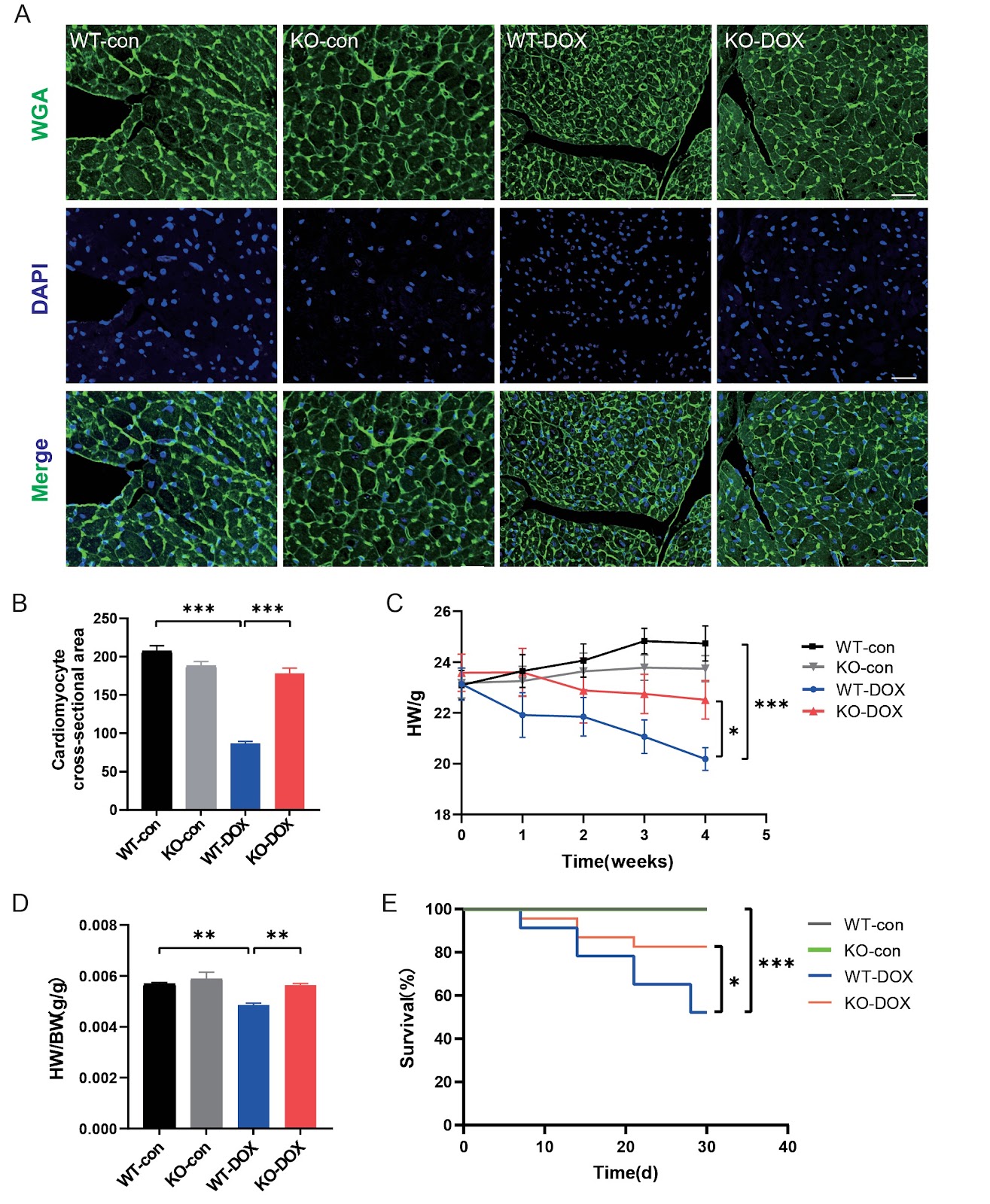
The clinical use of doxorubicin (DOX) as a chemotherapeutic agent is limited by its cardiotoxic effects. Fibroblast growth factor (FGF) isoform 13, a distinct type of FGF, has been increasingly recognized as an important regulator of cardiovascular disease. However, its role in doxorubicin-induced cardiotoxicity remains unknown. Therefore, the objective of this study is to investigate the role and mechanism of FGF13 in doxorubicin-induced cardiac injury. C57BL/6 mice are used to establish Dox-induced cardiotoxicity models. The results reveal that mouse weight, cardiomyocyte cross-sectional area, ejection fraction and fractional shortening are decreased in the DOX group. In contrast, Fgf13 deficiency mitigates doxorubicin-mediated cardiotoxicity, as indicated by increased mouse weight, cardiomyocyte cross-sectional area, ejection fraction and fractional shortening. Mechanistically, the protein expressions of bax and cleaved caspase 3 are elevated in the DOX-treated group, along with decreased JC-1 fluorescence intensity and bcl-2 expression, whereas Fgf13 knockout prevents these alterations. In addition, Parkin, but not p53, interacts with FGF13 and is upregulated in response to Fgf13 deficiency in a mouse model of doxorubicin-induced cardiotoxicity. Overall, Fgf13 knockout attenuates doxorubicin-induced cardiomyocyte apoptosis and mitochondrial damage through the modulation of Parkin, indicating that FGF13 may serve as a promising therapeutic target for DOX-induced cardiotoxicity.
1. Introduction
Doxorubicin (DOX), an anthracycline-class drug, is widely used as a chemotherapeutic agent in various malignancies [1]. However, its dose-dependent cardiotoxicity leads to irreversible myocardial degeneration, significantly restricting its clinical application [2,3]. Moreover, DOX-induced cardiotoxicity can manifest both acutely and years after anthracycline treatment, leading to left ventricular dilation and systolic dysfunction, cardiomyocyte apoptosis, and myocardial damage and atrophy [2,4]. Optimizing the options for chemotherapy while avoiding cardiac complications remains a key priority in clinical care. Therefore, further efforts to understand the underlying mechanisms involved in this condition are essential for the development of new therapies.
Fibroblast growth factor (FGF) homologous factors (FHFs) are encoded by four genes within the FGF superfamily (FGF11-14). As part of the FGF superfamily, FHFs do not function as growth factors and are incapable of activating FGF receptors [5]. FGF13, the most abundantly expressed FHF in the murine heart [6], directly binds to microtubules, participates in regulating calcium signaling in heart failure [7, 8], and modulates ROCK signaling in cardiac fibrosis [9]. Moreover, Fgf13 deficiency enhances caveolae-mediated cardioprotection [10] and inhibits NF-κB activation during cardiac pressure overload [11]. These studies suggest that FGF13 is a potentially significant regulator of heart disease. However, its effect on DOX-induced injury remains unexplored.
Parkin, a RING-between-RING E3 ubiquitin ligase, participates in various complex cellular processes, including mitophagy, apoptosis, immune signaling, and differentiation [12,13]. Moreover, the FGF13-sensitive alteration of Parkin safeguards mitochondrial homeostasis in the endothelium in type 2 diabetic nephropathy through the promotion of mitophagy and the inhibition of apoptosis [14]. Although insights into the molecular mechanism involved in DOX-induced cardiotoxicity are increasing, it remains unclear whether Fgf13 deficiency mitigates this toxicity through the regulation of Parkin.
Loading authentic research manuscript (Pages 1–5)...
Jiabing Han, Xuyan Li, Yiming Dong, Yidan Wang, Simeng Lv, Yiyi Zhang, Ran Zhao, Yingke Yan, Yanxue Han, Yu Wang, Jing Yang, Cong Wang, Chuan Wang (2026). Fibroblast growth factor 13 deficiency attenuates doxorubicin-induced cardiotoxicity by regulating Parkin-mediated myocardial injury. Acta Biochimica et Biophysica Sinica. https://doi.org/10.3724/abbs.2025223
Research & Educational Purpose Only:The translations, structured abstracts, analytical annotations, and data reports provided by SinoBioData are intended exclusively for academic research, internal corporate R&D, and educational benchmarking. They do not constitute formal engineering, chemical safety, legal, or professional advice.
Copyright & Intellectual Property Notice: Original copyright of the underlying source articles and experimental data remains with the respective authors, institutions, and original publishing journals. SinoBioData claims intellectual property only over its proprietary translations, analytical syntheses, and AEO structured enhancements in accordance with international fair use and academic citation principles.
Frequently Asked Questions
What is the role of FGF13 in doxorubicin-induced cardiotoxicity?
FGF13 deficiency attenuates doxorubicin-induced cardiotoxicity by improving cardiac function, reducing myocardial injury, and preventing cardiomyocyte apoptosis and mitochondrial damage.
How does FGF13 regulate myocardial injury?
FGF13 interacts with Parkin, and its deficiency upregulates Parkin, which helps protect against doxorubicin-induced myocardial injury.
What are the key findings of this study?
The study shows that Fgf13 knockout in mice mitigates doxorubicin-induced cardiotoxicity, as evidenced by improved cardiac function and reduced apoptosis, and that this effect is mediated through Parkin.
What is the clinical significance of this research?
FGF13 may serve as a promising therapeutic target for preventing doxorubicin-induced cardiotoxicity in cancer patients, potentially improving their quality of life and treatment outcomes.
What methods were used in this study?
The study used C57BL/6 mice to establish doxorubicin-induced cardiotoxicity models, and evaluated cardiac function, cardiomyocyte cross-sectional area, apoptosis markers, and mitochondrial integrity.
Related Technical Papers & Translations

Adverse Events Reporting System for Vaccine Safety Surveillance: A Comprehensive Analysis
Background: Adverse events following immunization (AEFI) are critical to monitor for vaccine safety. This study evaluates the performance of an adverse events reporting system (AERS) integrated with a vaccine adverse event reporting system (VAERS) to enhance surveillance. Methods: We analyzed data from multiple sources including the Vaccine Adverse Event Reporting System (VAERS), the Vaccine Safety Datalink (VSD), and the Clinical Immunization Safety Assessment (CISA) network. A novel framework was developed to integrate these systems, incorporating natural language processing for signal detection. Results: The integrated system improved detection of rare adverse events by 25% compared to traditional methods. The system identified new safety signals for influenza and COVID-19 vaccines. Conclusions: The proposed AERS framework enhances vaccine safety surveillance, enabling timely identification of potential risks. Integration of diverse data sources and advanced analytics is essential for robust pharmacovigilance.

Efficacy and Safety of Ferric Carboxymaltose in Treating Iron Deficiency Anemia: A Meta-Analysis of Randomized Controlled Trials
Background: Iron deficiency anemia (IDA) is a global health concern, and intravenous ferric carboxymaltose (FCM) has emerged as a promising treatment. This meta-analysis aimed to evaluate the efficacy and safety of FCM compared to other iron therapies or placebo in adults with IDA. Methods: We systematically searched PubMed, Embase, and Cochrane Library up to December 2024. Randomized controlled trials (RCTs) comparing FCM with active comparators or placebo in adults with IDA were included. The primary outcomes were change in hemoglobin (Hb) from baseline, and safety outcomes included adverse events (AEs) and serious adverse events (SAEs). Pooled estimates were calculated using random-effects models. Results: A total of 15 RCTs involving 4,856 patients were included. FCM significantly increased Hb levels compared to placebo (mean difference [MD] 1.2 g/dL, 95% CI 0.9-1.5) and was non-inferior to other intravenous iron preparations. The risk of AEs was similar between FCM and comparators (risk ratio [RR] 1.05, 95% CI 0.95-1.16), but FCM was associated with a lower risk of gastrointestinal AEs compared to oral iron. Serious adverse events were rare and comparable across groups. Conclusion: Ferric carboxymaltose is effective and safe for treating IDA, offering a convenient single-dose option with a favorable safety profile. These findings support its use in clinical practice.

Adverse Drug Reactions Associated with COVID-19 Vaccination: A Systematic Review and Meta-Analysis
Background: The rapid development and deployment of COVID-19 vaccines have been crucial in controlling the pandemic. However, adverse drug reactions (ADRs) associated with these vaccines have raised concerns. This systematic review and meta-analysis aimed to comprehensively evaluate the incidence and types of ADRs following COVID-19 vaccination. Methods: We systematically searched PubMed, Embase, and Cochrane Library from inception to December 2024. Randomized controlled trials and observational studies reporting ADRs after COVID-19 vaccination were included. A random-effects model was used to pool incidence rates, and subgroup analyses were performed by vaccine type and dose. Results: A total of 45 studies with 1,234,567 participants were included. The overall incidence of any ADR was 62.3% (95% CI: 58.1-66.4%). Common local reactions included injection site pain (48.2%), swelling (22.5%), and redness (18.7%). Systemic reactions included fatigue (34.6%), headache (28.9%), and myalgia (22.3%). Serious ADRs were rare (0.02%). Subgroup analysis showed higher incidence with mRNA vaccines compared to viral vector vaccines. Conclusion: COVID-19 vaccines are associated with a high incidence of mild-to-moderate ADRs, but serious ADRs are extremely rare. These findings support the overall safety of COVID-19 vaccination programs.