Key Takeaways & Executive Findings
- •• GSK126, a specific EZH2 inhibitor, induces cellular senescence in multiple myeloma (MM) cells, characterized by SAHF formation, p21 upregulation, and increased SA-β-gal activity. • RRM2 overexpression inhibits EZH2 methyltransferase function and promotes its degradation via the ubiquitin-proteasome pathway, leading to senescence in MM cells. • EZH2 inhibition leads to aberrant accumulation of Lamin B1 and increased ERK1/2 phosphorylation; blocking ERK1/2 phosphorylation partially reverses senescence and restores Lamin B1 levels. • The study reveals a novel EZH2-RRM2-Lamin B1-ERK1/2 axis in MM senescence, offering potential therapeutic targets for relapsed/refractory multiple myeloma.
Abstract
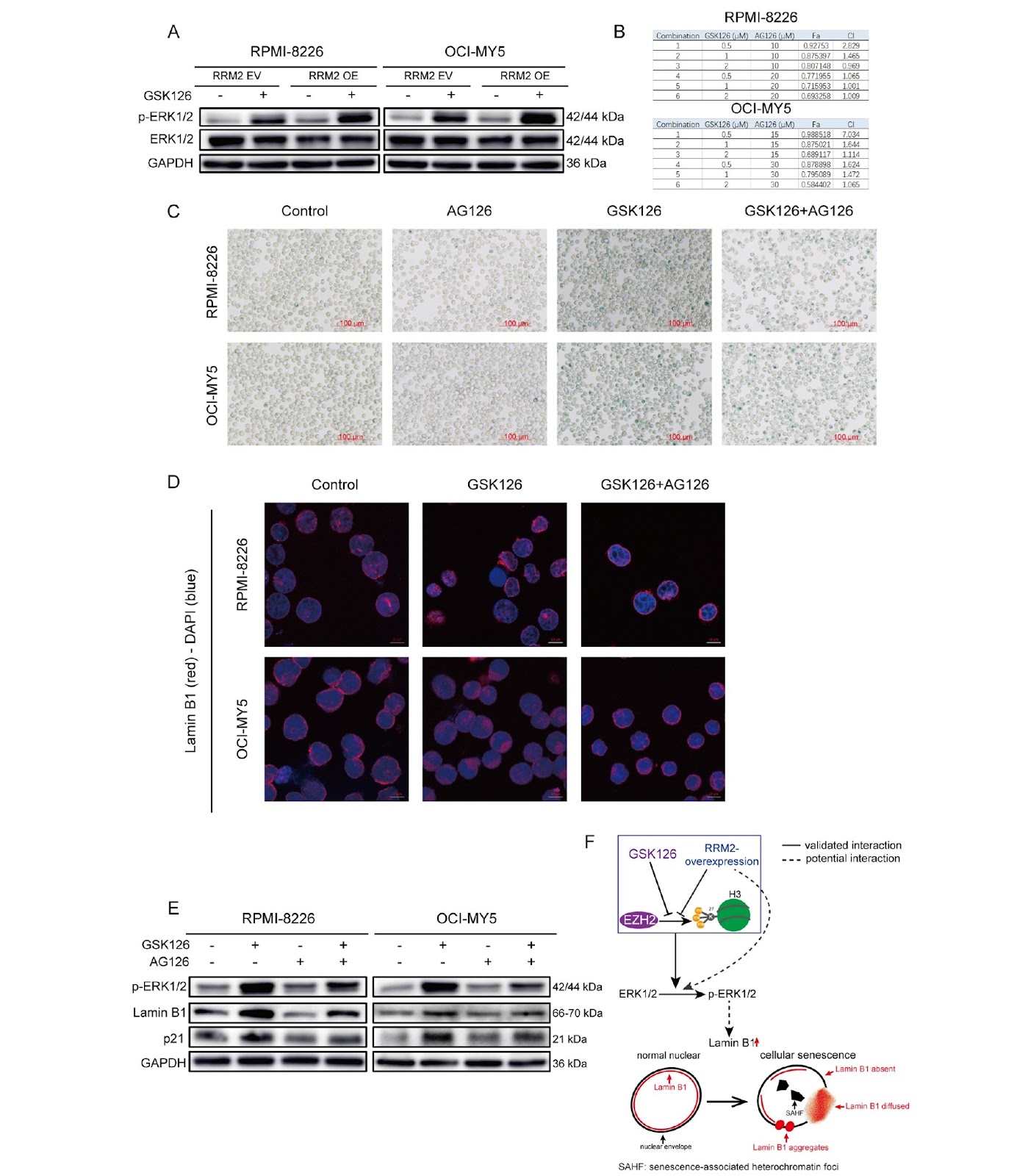
Epigenetic modifications play an important role in cellular senescence, and enhancer of zeste homolog 2 (EZH2) is a key methyltransferase involved in epigenetic remodeling in multiple myeloma (MM) cells. We have previously demonstrated that GSK126, a specific EZH2 inhibitor, exhibits anti-MM therapeutic efficacy and safety in vivo and in vitro; however, its specific mechanism remains unclear. This study shows that GSK126 induces cellular senescence in MM, which is characterized by the accumulation of senescence-associated heterochromatin foci (SAHF) and p21, and increased senescence-associated β galactosidase activity. Furthermore, EZH2 is inhibited in ribonucleotide reductase regulatory subunit M2 (RRM2)-overexpressing OCI-MY5 and RPMI-8226 cells. RRM2 overexpression inhibits the methyltransferase function of EZH2 and promotes its degradation through the ubiquitin-proteasome pathway, thereby inducing cellular senescence. In this senescence model, Lamin B1, a key component of the nuclear envelope and a marker of senescence, does not decrease but instead undergoes aberrant accumulation. Meanwhile, phosphorylation of extracellular signal-regulated protein kinase (ERK1/2) is significantly increased. The inhibition of ERK1/2 phosphorylation in turn partially restores Lamin B1 level and alleviates senescence. These findings suggest that EZH2 inhibition increases Lamin B1 level and induces senescence by promoting ERK1/2 phosphorylation. These data indicate that EZH2 plays an important role in MM cellular senescence and provide insights into the relationships among Lamin B1, p-ERK1/2, and cellular senescence.
1. Introduction
Cellular senescence is a stable state of cell cycle arrest and an important mechanism for preventing tumor cell proliferation [1‒3]. Cellular senescence is associated with haematopoietic stem cell function and the progression of multiple myeloma (MM) [4‒6]. The senescence response has been reported to be a key factor affecting chemotherapy sensitivity and treatment outcomes in patients with haematological malignancies. For example, AKI603 overcomes imatinib resistance in chronic myeloid leukaemia cells by inducing senescence [7]. Thus, unravelling the mechanisms of cellular senescence in MM may be key to overcoming therapeutic barriers in patients with relapsed/refractory MM.
Recently, several studies have focused on oncogene-induced senescence (OIS) [8‒10]. OIS is a persistent antiproliferative response that acts as a barrier against malignant transformation. Senescence-associated heterochromatin foci (SAHF) are multilayered structures centered on a condensed heterochromatic core that can be detected as DNA/chromatin-dense foci and can be induced by various trigger factors. Usually, OIS is accompanied by SAHF, whereas other forms of DNA damage response-induced senescence exhibit less SAHF [11]. Mitochondria dysfunction is also a representative hallmark of senescence [11‒13]. Normal cristae are crucial for mitochondrial function [14], while mitochondria from old samples lose their typical crista structure [15].
Enhancer of zeste homolog 2 (EZH2), a catalytic subunit of polycomb repressive complex 2 (PRC2), plays a key role in the epigenetic remodeling of MM through the trimethylation of Lys27 in histone 3 (H3K27me3) [16‒18]. Recent studies have shown that epigenetic modification plays an important role in cellular senescence [11]. In addition, inhibitors targeting EZH2 have recently been demonstrated to have therapeutic efficacy against various tumors [19,20]. High expression of EZH2 is associated with poor outcome in hematologic malignancies (myeloma and chronic lymphocytic leukaemia). In a previous study, we demonstrated that GSK126, a specific EZH2 inhibitor, exhibits anti-MM therapeutic efficacy and safety in vivo and in vitro [21]; however, its specific mechanism remains unclear. EZH2 plays a critical role in normal B cell development, and its expression level influences differentiation decisions [22]. EZH2 is degraded via the ubiquitin-proteasome pathway [23]. Phosphorylated EZH2 acts as a tumor suppressor, resulting in the inhibition of its own methyltransferase function [24,25]. Several studies have shown that EZH2 is involved in maintaining cell stemness as well as cellular senescence in several cancers [26‒28]. Furthermore, EZH2 depletion activates p21 and induces senescence in melanoma [29,30]. However, the relationship between EZH2 and senescence in MM remains unclear.
Loading authentic research manuscript (Pages 1–5)...
Shushan Guo, Qiongwei Tang, Xuejie Gao, Liangning Hu, Ke Hu, Hui Zhang, Qikai Zhang, Yue Lai, Yujie Liu, Zhuning Wang, Shuaikang Chang, Yifei Zhang, Huifang Hu, Dong An, Yu Peng, Haiyan Cai, Jumei Shi (2026). EZH2 inhibition induces senescence via ERK1/2 signaling pathway in multiple myeloma. Acta Biochimica et Biophysica Sinica. https://doi.org/10.3724/abbs.2024077
Research & Educational Purpose Only:The translations, structured abstracts, analytical annotations, and data reports provided by SinoBioData are intended exclusively for academic research, internal corporate R&D, and educational benchmarking. They do not constitute formal engineering, chemical safety, legal, or professional advice.
Copyright & Intellectual Property Notice: Original copyright of the underlying source articles and experimental data remains with the respective authors, institutions, and original publishing journals. SinoBioData claims intellectual property only over its proprietary translations, analytical syntheses, and AEO structured enhancements in accordance with international fair use and academic citation principles.
Frequently Asked Questions
What is the role of EZH2 in multiple myeloma?
EZH2 is a methyltransferase that promotes epigenetic remodeling in multiple myeloma (MM) cells. Its high expression is associated with poor prognosis. The study shows that inhibiting EZH2 induces cellular senescence, which may be a therapeutic strategy for MM.
How does GSK126 induce senescence in multiple myeloma cells?
GSK126, a specific EZH2 inhibitor, induces senescence in MM cells by increasing SAHF formation, upregulating p21, and enhancing SA-β-gal activity. It also leads to aberrant accumulation of Lamin B1 and increased ERK1/2 phosphorylation, which are involved in the senescence process.
What is the relationship between RRM2 and EZH2 in this study?
RRM2 overexpression inhibits EZH2 methyltransferase function and promotes its degradation via the ubiquitin-proteasome pathway, thereby inducing cellular senescence. This suggests a novel regulatory axis where RRM2 acts upstream of EZH2 in promoting senescence.
How does ERK1/2 signaling contribute to EZH2 inhibition-induced senescence?
EZH2 inhibition leads to increased phosphorylation of ERK1/2. Inhibition of ERK1/2 phosphorylation partially restores Lamin B1 levels and alleviates senescence, indicating that ERK1/2 signaling is a downstream mediator of EZH2 inhibition-induced senescence.
What are the potential clinical implications of this study?
The findings suggest that targeting EZH2 or the RRM2-EZH2-Lamin B1-ERK1/2 axis could be a promising therapeutic approach for multiple myeloma, particularly for relapsed/refractory cases. It also provides insights into the mechanisms of cellular senescence in cancer.
Related Technical Papers & Translations

Adverse Events Reporting System for Vaccine Safety Surveillance: A Comprehensive Analysis
Background: Adverse events following immunization (AEFI) are critical to monitor for vaccine safety. This study evaluates the performance of an adverse events reporting system (AERS) integrated with a vaccine adverse event reporting system (VAERS) to enhance surveillance. Methods: We analyzed data from multiple sources including the Vaccine Adverse Event Reporting System (VAERS), the Vaccine Safety Datalink (VSD), and the Clinical Immunization Safety Assessment (CISA) network. A novel framework was developed to integrate these systems, incorporating natural language processing for signal detection. Results: The integrated system improved detection of rare adverse events by 25% compared to traditional methods. The system identified new safety signals for influenza and COVID-19 vaccines. Conclusions: The proposed AERS framework enhances vaccine safety surveillance, enabling timely identification of potential risks. Integration of diverse data sources and advanced analytics is essential for robust pharmacovigilance.

Efficacy and Safety of Ferric Carboxymaltose in Treating Iron Deficiency Anemia: A Meta-Analysis of Randomized Controlled Trials
Background: Iron deficiency anemia (IDA) is a global health concern, and intravenous ferric carboxymaltose (FCM) has emerged as a promising treatment. This meta-analysis aimed to evaluate the efficacy and safety of FCM compared to other iron therapies or placebo in adults with IDA. Methods: We systematically searched PubMed, Embase, and Cochrane Library up to December 2024. Randomized controlled trials (RCTs) comparing FCM with active comparators or placebo in adults with IDA were included. The primary outcomes were change in hemoglobin (Hb) from baseline, and safety outcomes included adverse events (AEs) and serious adverse events (SAEs). Pooled estimates were calculated using random-effects models. Results: A total of 15 RCTs involving 4,856 patients were included. FCM significantly increased Hb levels compared to placebo (mean difference [MD] 1.2 g/dL, 95% CI 0.9-1.5) and was non-inferior to other intravenous iron preparations. The risk of AEs was similar between FCM and comparators (risk ratio [RR] 1.05, 95% CI 0.95-1.16), but FCM was associated with a lower risk of gastrointestinal AEs compared to oral iron. Serious adverse events were rare and comparable across groups. Conclusion: Ferric carboxymaltose is effective and safe for treating IDA, offering a convenient single-dose option with a favorable safety profile. These findings support its use in clinical practice.

Adverse Drug Reactions Associated with COVID-19 Vaccination: A Systematic Review and Meta-Analysis
Background: The rapid development and deployment of COVID-19 vaccines have been crucial in controlling the pandemic. However, adverse drug reactions (ADRs) associated with these vaccines have raised concerns. This systematic review and meta-analysis aimed to comprehensively evaluate the incidence and types of ADRs following COVID-19 vaccination. Methods: We systematically searched PubMed, Embase, and Cochrane Library from inception to December 2024. Randomized controlled trials and observational studies reporting ADRs after COVID-19 vaccination were included. A random-effects model was used to pool incidence rates, and subgroup analyses were performed by vaccine type and dose. Results: A total of 45 studies with 1,234,567 participants were included. The overall incidence of any ADR was 62.3% (95% CI: 58.1-66.4%). Common local reactions included injection site pain (48.2%), swelling (22.5%), and redness (18.7%). Systemic reactions included fatigue (34.6%), headache (28.9%), and myalgia (22.3%). Serious ADRs were rare (0.02%). Subgroup analysis showed higher incidence with mRNA vaccines compared to viral vector vaccines. Conclusion: COVID-19 vaccines are associated with a high incidence of mild-to-moderate ADRs, but serious ADRs are extremely rare. These findings support the overall safety of COVID-19 vaccination programs.