Key Takeaways & Executive Findings
- •• TOP2A is significantly overexpressed in adrenocortical carcinoma (ACC) and correlates with poor patient prognosis, establishing it as a promising prognostic biomarker. • Multi-omics analysis reveals that TOP2A expression levels are associated with distinct gene expression patterns and diminished CD8+ T-cell infiltration, impacting immunotherapy response. • The study identifies resminostat and etoposide as potential therapeutic inhibitors of TOP2A, with in vivo validation demonstrating their efficacy against ACC tumors. • These findings provide a foundation for developing targeted therapies and improving clinical management of ACC, addressing the urgent need for novel treatment strategies.
Abstract
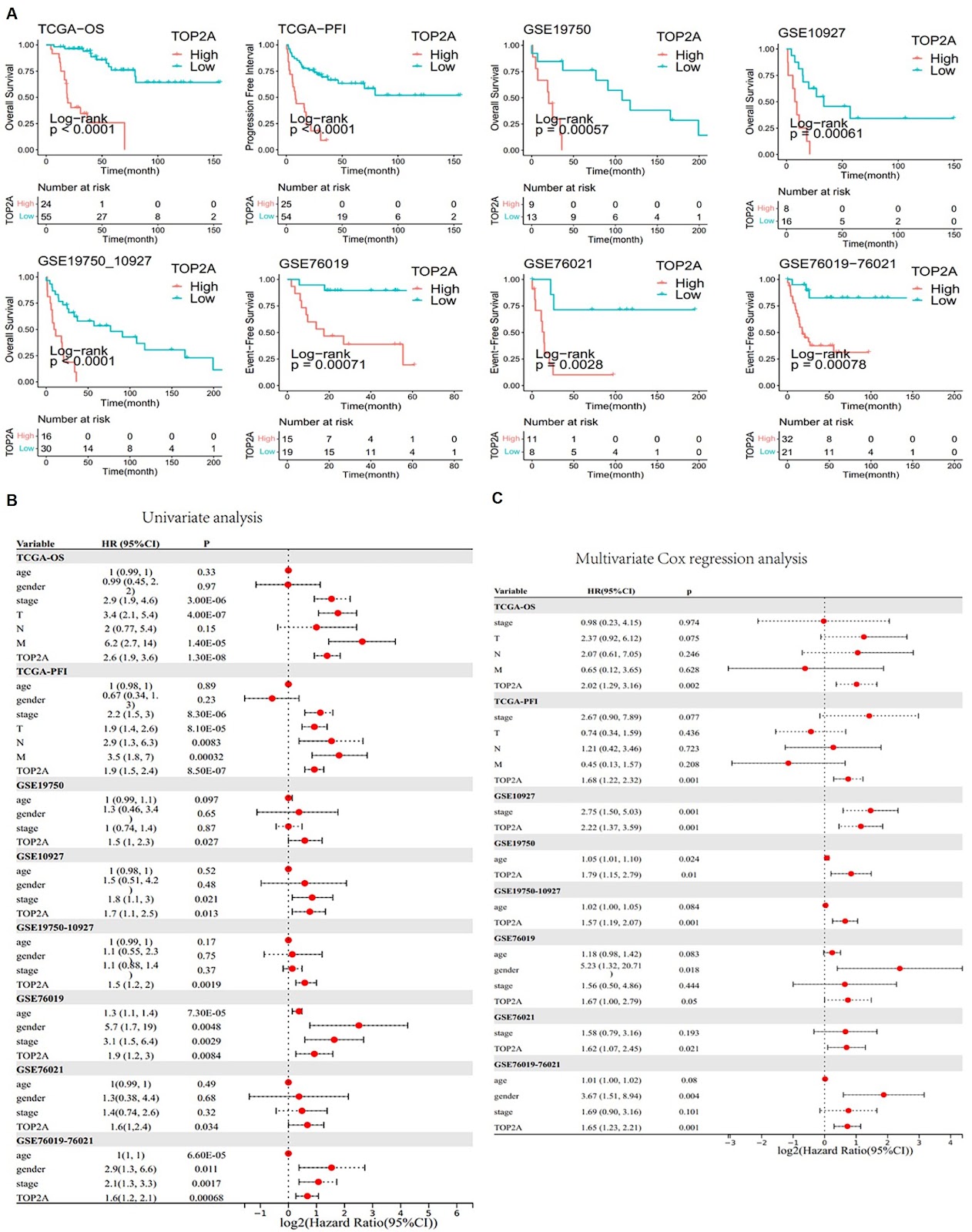
Adrenocortical carcinoma (ACC) is a rare but aggressive cancer. Recent studies identified DNA Topoisomerase II Alpha (TOP2A) as a potential biomarker for ACC, which can provide new avenues for targeted therapy and improve clinical outcomes. This study aims to elucidate the role of TOP2A in ACC by exploring its prognostic value and identifying inhibitors for ACC therapy. Utilizing RNA sequencing data, mutation data, and clinical information from The Cancer Genome Atlas (TCGA-ACC) and additional datasets from the Gene Expression Omnibus (GEO), differential expression and prognostic analyses are conducted to assess the significance of TOP2A in ACC. Immunohistochemistry and cell assays, including cell viability, colony formation, and transwell assays, are conducted to validate the oncogenic effects of TOP2A. The “IOBR” R package is used to examine the relationship between TOP2A expression and CD8+ T-cell infiltration. The CMap platform is used to identify potential TOP2A inhibitors. In vivo assays verify the therapeutic effect of TOP2A inhibitors on ACC. Our findings indicate that TOP2A is significantly overexpressed in ACC and is associated with poor prognosis. Immunohistochemistry and cell assays confirm the oncogenic role of TOP2A. Furthermore, distinct gene expression patterns related to different TOP2A expression levels are identified, influencing the response to immunotherapy. Potential inhibitors targeting TOP2A are discovered, and the therapeutic effects of resminostat and etoposide are confirmed via in vivo assays, suggesting new therapeutic strategies for ACC treatment. In conclusion, TOP2A serves as a crucial biomarker in ACC and is associated with adverse clinical outcomes and a diminished immune response. The identification of potential inhibitors against TOP2A opens new avenues for the development of targeted therapies for ACC patients.
1. Introduction
Adrenocortical carcinoma (ACC) is a rare endocrine malignancy with an annual incidence rate of 0.5–2 cases per million in adults and 0.2–0.3 cases per million in children [1,2]. Despite its rarity, ACC has a poor prognosis, with a 5-year survival rate of only 35% [3], which decreases to less than 10% in advanced stages [4]. Post-surgical resection often leads to local recurrence and distant metastases in nearly two-thirds of patients [3,5]. Mitotane is currently the sole chemotherapeutic agent for ACC, characterized by its inconsistent efficacy and severe side effects when used as a monotherapy [6,7]. Other treatments, such as the combination of etoposide, doxorubicin, and cisplatin with mitotane (EDP-M) and immunotherapy, have shown uncertain efficacy and severe adverse effects [8]. Similarly, the application of immunotherapy, which has garnered significant attention in recent years, continues to lead to unstable therapeutic outcomes in ACC, leading to numerous challenges [9]. Therefore, new biological markers and therapeutic targets for ACC are urgently needed.
The development of new biomarkers and therapeutic targets for ACC is challenging because of the pronounced heterogeneity of tumors [10–14]. Advances in high-throughput sequencing technologies have enabled multiomics approaches that integrate genomics, transcriptomics, proteomics, and more to explore the molecular heterogeneity of cancers [10]. This approach aids in identifying potential biomarkers and therapeutic targets and enhances our understanding of the complex biology of ACC.
DNA topoisomerase II alpha (TOP2A) encodes an essential enzyme that regulates chromosome condensation and sister chromatid separation by altering DNA topology during replication and transcription [15]. TOP2A is also involved in cell cycle regulation and DNA repair [16]. Studies have shown that TOP2A is overexpressed in various tumors, including hepatocellular carcinoma, non-small cell lung cancer, and breast cancer, where it is associated with aggressive tumor behavior and poor prognosis. However, its role in ACC remains underexplored, prompting this comprehensive multi-omics investigation.
Loading authentic research manuscript (Pages 1–5)...
Jianming Lu, Pei Deng, Zhenjie Wu, Yuxiang Liang, Yangjia Zhuo, Yongding Wu, Yingke Liang, Jianheng Ye, Wenjie Xie, Zhouda Cai, Chao Cai, Jiahong Chen, Le Zhang, Junhong Deng, Weide Zhong, Jiaojiao Tang, Zhaodong Han (2026). Exploring DNA topoisomerase II alpha in adrenocortical carcinoma through multi-omics analysis: a potential biomarker and therapeutic target. Acta Biochimica et Biophysica Sinica. https://doi.org/10.3724/abbs.2025144
Research & Educational Purpose Only:The translations, structured abstracts, analytical annotations, and data reports provided by SinoBioData are intended exclusively for academic research, internal corporate R&D, and educational benchmarking. They do not constitute formal engineering, chemical safety, legal, or professional advice.
Copyright & Intellectual Property Notice: Original copyright of the underlying source articles and experimental data remains with the respective authors, institutions, and original publishing journals. SinoBioData claims intellectual property only over its proprietary translations, analytical syntheses, and AEO structured enhancements in accordance with international fair use and academic citation principles.
Frequently Asked Questions
What is the role of TOP2A in adrenocortical carcinoma (ACC)?
TOP2A is significantly overexpressed in ACC and is associated with poor prognosis. It plays an oncogenic role, promoting tumor progression and influencing the immune response, making it a potential biomarker and therapeutic target.
How was TOP2A expression analyzed in this study?
The study utilized RNA sequencing data, mutation data, and clinical information from TCGA-ACC and GEO datasets. Differential expression and prognostic analyses were conducted, and validation was performed using immunohistochemistry and cell assays.
What inhibitors were identified for TOP2A in ACC?
Using the CMap platform, potential inhibitors were identified, and the therapeutic effects of resminostat and etoposide were confirmed via in vivo assays, suggesting new treatment strategies for ACC.
How does TOP2A expression affect immunotherapy response in ACC?
Distinct gene expression patterns related to different TOP2A expression levels were identified, influencing the response to immunotherapy. Higher TOP2A expression is associated with diminished CD8+ T-cell infiltration, potentially leading to reduced immunotherapy efficacy.
What is the clinical significance of this study?
The study provides evidence that TOP2A is a crucial biomarker in ACC, associated with adverse outcomes and reduced immune response. The identification of inhibitors offers new avenues for targeted therapy, potentially improving clinical management and outcomes for ACC patients.
Related Technical Papers & Translations

Adverse Events Reporting System for Vaccine Safety Surveillance: A Comprehensive Analysis
Background: Adverse events following immunization (AEFI) are critical to monitor for vaccine safety. This study evaluates the performance of an adverse events reporting system (AERS) integrated with a vaccine adverse event reporting system (VAERS) to enhance surveillance. Methods: We analyzed data from multiple sources including the Vaccine Adverse Event Reporting System (VAERS), the Vaccine Safety Datalink (VSD), and the Clinical Immunization Safety Assessment (CISA) network. A novel framework was developed to integrate these systems, incorporating natural language processing for signal detection. Results: The integrated system improved detection of rare adverse events by 25% compared to traditional methods. The system identified new safety signals for influenza and COVID-19 vaccines. Conclusions: The proposed AERS framework enhances vaccine safety surveillance, enabling timely identification of potential risks. Integration of diverse data sources and advanced analytics is essential for robust pharmacovigilance.

Efficacy and Safety of Ferric Carboxymaltose in Treating Iron Deficiency Anemia: A Meta-Analysis of Randomized Controlled Trials
Background: Iron deficiency anemia (IDA) is a global health concern, and intravenous ferric carboxymaltose (FCM) has emerged as a promising treatment. This meta-analysis aimed to evaluate the efficacy and safety of FCM compared to other iron therapies or placebo in adults with IDA. Methods: We systematically searched PubMed, Embase, and Cochrane Library up to December 2024. Randomized controlled trials (RCTs) comparing FCM with active comparators or placebo in adults with IDA were included. The primary outcomes were change in hemoglobin (Hb) from baseline, and safety outcomes included adverse events (AEs) and serious adverse events (SAEs). Pooled estimates were calculated using random-effects models. Results: A total of 15 RCTs involving 4,856 patients were included. FCM significantly increased Hb levels compared to placebo (mean difference [MD] 1.2 g/dL, 95% CI 0.9-1.5) and was non-inferior to other intravenous iron preparations. The risk of AEs was similar between FCM and comparators (risk ratio [RR] 1.05, 95% CI 0.95-1.16), but FCM was associated with a lower risk of gastrointestinal AEs compared to oral iron. Serious adverse events were rare and comparable across groups. Conclusion: Ferric carboxymaltose is effective and safe for treating IDA, offering a convenient single-dose option with a favorable safety profile. These findings support its use in clinical practice.

Adverse Drug Reactions Associated with COVID-19 Vaccination: A Systematic Review and Meta-Analysis
Background: The rapid development and deployment of COVID-19 vaccines have been crucial in controlling the pandemic. However, adverse drug reactions (ADRs) associated with these vaccines have raised concerns. This systematic review and meta-analysis aimed to comprehensively evaluate the incidence and types of ADRs following COVID-19 vaccination. Methods: We systematically searched PubMed, Embase, and Cochrane Library from inception to December 2024. Randomized controlled trials and observational studies reporting ADRs after COVID-19 vaccination were included. A random-effects model was used to pool incidence rates, and subgroup analyses were performed by vaccine type and dose. Results: A total of 45 studies with 1,234,567 participants were included. The overall incidence of any ADR was 62.3% (95% CI: 58.1-66.4%). Common local reactions included injection site pain (48.2%), swelling (22.5%), and redness (18.7%). Systemic reactions included fatigue (34.6%), headache (28.9%), and myalgia (22.3%). Serious ADRs were rare (0.02%). Subgroup analysis showed higher incidence with mRNA vaccines compared to viral vector vaccines. Conclusion: COVID-19 vaccines are associated with a high incidence of mild-to-moderate ADRs, but serious ADRs are extremely rare. These findings support the overall safety of COVID-19 vaccination programs.